Why MOQ Negotiation Is Different for Trade Show Jute Bags
Trade show exhibitors usually buy jute tote bags against a fixed event date, a fixed booth plan, and a budget that has already been split across graphics, freight, samples, staff travel, and giveaways. That makes MOQ negotiation more sensitive than a normal retail replenishment order. A buyer may need 800 bags for one exhibition, while the factory prefers 1,000 or 2,000 pieces because fabric purchase, cutting setup, printing screens, and packing labor do not shrink neatly with quantity.
The useful negotiation is not simply asking the factory to lower the MOQ. It is finding which part of the order creates the minimum. For jute totes, the MOQ may come from the raw jute roll, the laminated material batch, the handle stock, the print setup, or the factory's minimum production value. When you identify that driver, you can trade intelligently: use a standard body size, reduce print versions, accept a stock jute shade, or pay a setup charge instead of forcing the supplier into a loss-making order.
- Event orders need calendar certainty more than the absolute lowest unit price.
- MOQ flexibility improves when the bag body is standard and only the artwork changes.
- Small quantity orders should be negotiated with clear acceptance criteria because factories have less room for rework.
- A buyer with complete quote data usually gets a more realistic answer than a buyer asking for a general best price.
Start With the Real Usage Load
Many RFQs describe the bag as a promotional giveaway, but the actual load can vary widely. A jute tote used to hold two brochures and a badge lanyard is not the same as a bag used for catalogs, metal samples, drink bottles, and retail merchandise after the show. MOQ discussion becomes cleaner when the factory understands the intended load because fabric weight, handle width, seam reinforcement, and carton packing all connect to that use.
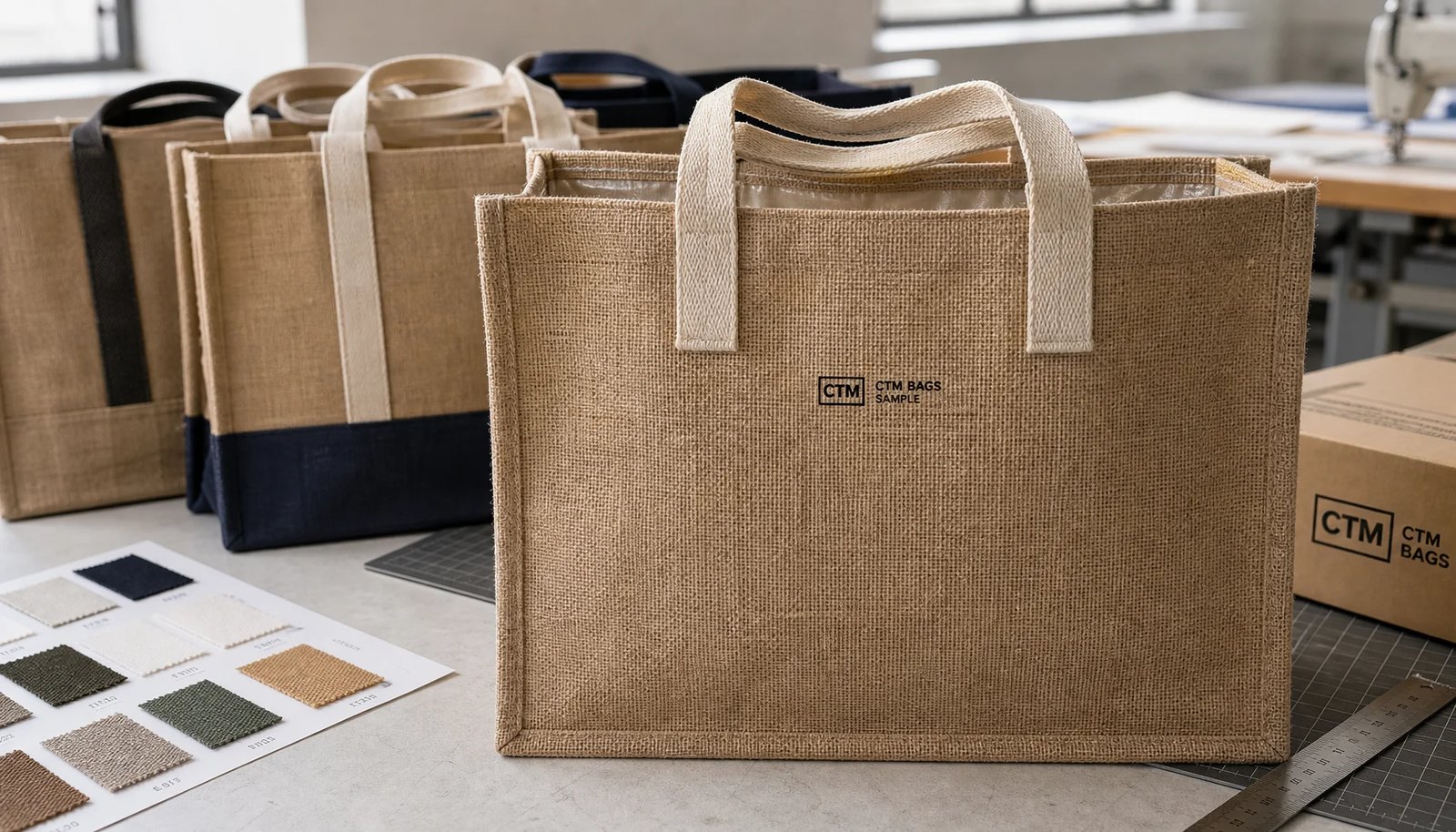
For trade show exhibitors, a practical starting point is a laminated jute tote around 35 x 40 x 15 cm or 38 x 42 x 15 cm. This size handles A4 documents without curling and still fits booth storage better than oversized shopping totes. If the booth team plans to insert heavy product samples, specify the expected load in kilograms and request reinforced stitching. A small increase in handle quality is usually cheaper than replacing failed bags or handling complaints on the show floor.
- Light documents only: 13-14 oz jute may be acceptable if the brand accepts a more flexible bag.
- Catalogs and samples: 14-16 oz jute with lamination and wider cotton handles is safer.
- Retail resale or premium gift use: tighter weave, cleaner lamination, stronger bottom structure, and stricter shade control are worth specifying.
- Large booth giveaways: avoid unnecessary oversized dimensions because freight volume can rise faster than the bag cost savings.
Fabric Weight, GSM, and Lamination Choices
Jute tote quotes often use oz, GSM, or a supplier's internal description such as natural jute, laminated jute, or heavy jute. These labels are not interchangeable. A 14 oz jute may feel very different depending on weave density, backing, finishing, and moisture content. For buying control, state an acceptable range, such as 14-16 oz jute or approximately 420-480 GSM after considering the supplier's measurement method. Then require the bulk material to match the approved sample in hand feel, shade, and stiffness.
Lamination is important for exhibitor bags because it helps the tote stand open, gives a cleaner inside surface, and reduces shedding. PP or PE lamination can also improve print stability, but poor lamination may create odor, bubbling, or cracking at folds. If the bags will be packed for weeks before the exhibition, request a sample that has been folded or packed long enough to expose odor and crease behavior. The cheapest jute quote often hides in loose weave or thin backing, not only in labor cost.
- Specify natural jute shade expectations, especially if bags from different cartons will be displayed together.
- For screen printing, a smoother laminated face usually gives cleaner edges than very open rustic weave.
- For eco-positioning claims, keep wording conservative and confirm what materials are actually used in lamination, handles, and packaging.
- Do not approve only from a supplier photo; jute texture, smell, and stiffness must be judged from a physical sample.
How Factories Think About MOQ
A factory MOQ is a combination of material efficiency, machine setup, labor planning, and commercial value. Cutting tables, sewing lines, and printing screens all need setup time. If a buyer orders 300 pieces with three logo versions, the factory may spend more time changing screens and sorting cartons than sewing bags. That is why a lower total quantity can sometimes be accepted if the specification is simple, while a larger quantity can still be troublesome if it has many versions and special packing rules.
For jute tote bags, the most negotiable path is usually to keep the same bag body and reduce complexity around print and packing. A factory may accept 1,000 total pieces split into two artwork versions if the same jute, size, handle, and carton packing are used. It may reject 600 pieces split across four sizes because cutting waste and production control become messy. The buyer's job is to offer a structure that protects the factory's efficiency while still meeting event needs.
- Raw material MOQ: easier to negotiate if using the factory's regular jute weight and natural shade.
- Print MOQ: easier to negotiate with one-color artwork and common ink colors.
- Order value MOQ: sometimes solved by paying a setup charge or accepting a higher unit price for lower quantity.
- Packing MOQ: becomes harder when each carton needs special labels, inserts, or destination sorting.
Negotiation Levers That Do Not Damage the Bag
Reducing MOQ should not mean quietly weakening the product. The safer levers are standardization, scheduling flexibility, and artwork simplification. Use a standard tote size already in the factory's pattern library. Keep handle material from stock, such as natural cotton webbing in a common width. Limit print colors to solid screen print where possible. These changes reduce setup risk without making the bag look cheap at the booth.
Some buyers try to negotiate MOQ by removing lamination, narrowing handles, or lowering fabric weight too far. That may win the unit price and lose the event experience. A bag that collapses on the booth table, scratches a printed brochure, or has handles that cut into the user's hand does not support the exhibitor's brand. If the budget is tight, it is often better to reduce quantity slightly and improve allocation than to produce a weak bag for everyone.
- Good lever: one shared body size for all departments or regions.
- Good lever: one-color logo instead of multi-color fine artwork.
- Good lever: factory stock handle tape and standard carton packing.
- Risky lever: reducing handle width below comfortable carry level for loaded event bags.
- Risky lever: choosing very open jute weave when logo clarity matters.
- Risky lever: approving a lower GSM without testing load, shape, and print result.
Print Method and Artwork Limits on Jute
Jute is not a smooth paper surface. The weave creates uneven ink coverage, broken edges, and movement around fine details. Screen printing is usually the most practical choice for trade show jute totes when artwork uses one to three solid colors. It is durable enough for event handling and cost-efficient at normal wholesale quantities. Heat transfer may work for detailed designs, gradients, or small type, but it should be tested because the transfer film can look too plastic on rustic jute and may not bond evenly over coarse weave.
Artwork should be prepared for the material rather than copied directly from a brochure layout. Thin reversed text, small registration marks, narrow outlines, and tight color trapping are common failure points. Instead of simply sending the logo and requesting best result, give the factory a print area, Pantone targets, line width limits, and placement from bag edges. For MOQ negotiation, fewer print colors and fewer versions reduce the factory's setup burden and make a lower quantity more realistic.
- Use vector artwork and define actual print size in centimeters.
- Avoid tiny reversed text under roughly 6-8 mm height unless the factory proves it on jute.
- Expect natural variation in ink coverage because jute fibers are uneven.
- For multi-color screen print, require a printed sample to review registration before bulk.
- Define whether the logo is centered on the panel, centered above the gusset, or aligned to a specific seam.
Sample Approval Before Deposit or Bulk Cutting
For event bags, a sample is not a decoration. It is the control document for fabric, handle, stitching, print, size, and packing behavior. A plain material sample can be enough for early budget approval, but a printed pre-production sample is safer when the logo is detailed or the order is visible to senior management, sponsors, or retail partners. The approved sample should be kept by both buyer and factory, with photos and written notes attached to the purchase order.
Sample review should be structured. Measure the finished size, handle drop, gusset, logo position, and print area. Load the bag with the expected event contents for a short practical test. Check whether the bag stands open, whether the handles twist, and whether loose jute fibers transfer onto documents. Smell the inside of the bag after it has been closed in a polybag or carton. These checks catch problems that do not show in a neat front-view photo.
- Approve fabric shade under neutral light, not only under warm office lighting.
- Measure handle drop because short handles make the bag awkward over coats or jackets.
- Rub the print lightly after curing to identify smearing or poor adhesion.
- Fold and unfold the sample to see whether lamination cracks at the corners.
- Record all approved dimensions and tolerances in the PO or sample approval sheet.
Quote Data That Makes MOQ Comparison Fair
A low unit price is not enough for comparing jute tote suppliers. Two quotes may both say 14 oz laminated jute tote, but one includes wider handles, heavier cartons, better print curing, and export packing while the other leaves out setup costs and carton dimensions. For trade show orders, the quote should separate product unit price, print setup, sample fee, packing requirement, carton data, lead time, and payment terms. This lets procurement compare total cost and delivery risk, not only the first number on the sheet.
Carton information is especially important because jute totes are bulky. A few cents saved on fabric can disappear if carton CBM increases and the order moves by air due to deadline pressure. Ask for pieces per carton, carton dimensions, gross weight, net weight, and total CBM for the order quantity. If the exhibition date is close, request both sea and air packing assumptions because dense cartons may be better for sea freight while excessive compression can damage presentation quality.
- Quote line: bag size, jute weight, lamination, handle width, handle drop, stitching, print method, and print colors.
- Commercial line: MOQ, unit price by quantity tier, setup charge, sample fee, and payment terms.
- Logistics line: carton quantity, carton dimensions, gross weight, total CBM, and loading method.
- Schedule line: artwork deadline, sample lead time, bulk lead time, inspection date, and estimated ship date.
- Control line: approved sample reference, inspection criteria, and allowed quantity variance if applicable.
Packing and Event Delivery Risks
Packing is where many trade show bag orders lose their clean presentation. Jute totes are often flat packed, but heavy compression can leave deep creases, especially on laminated material. Loose packing protects shape but increases carton volume. A practical balance is usually 50-100 pieces per export carton depending on size, handle thickness, and freight method. If the bags will be opened at the venue, carton labels must be clear enough for booth staff or contractors to identify the correct artwork version quickly.
Destination planning matters before production starts. One warehouse shipment is simple. Multiple booth locations, regional offices, or venue-direct deliveries require carton sorting and labeling rules. If each carton needs a different destination label, booth number, PO number, or exhibitor name, that must be included in the quote and packing instructions. Small MOQ orders can become expensive when the packing workflow is more complex than the sewing workflow.
- Use master carton labels with SKU, logo version, quantity, carton number, and gross weight.
- For mixed artwork versions, avoid mixed cartons unless the receiving team has a clear reason for it.
- Confirm whether inner polybags are required by the buyer, retailer, or venue rules.
- If direct-to-venue delivery is planned, build in time for customs clearance, appointment booking, and contractor handling.
- Request final packing photos before shipment, including carton marks and one opened carton.
Lead Time and Decision Calendar
MOQ negotiation should be tied to the decision calendar. A factory may accept a smaller quantity if the buyer gives more lead time, because the order can be fitted around larger production runs. The same small order becomes harder when the ship date is close and the factory must interrupt a line, rush material, or print during overtime. For custom printed jute totes, a practical schedule includes artwork confirmation, material sampling, printed sample approval, bulk production, inspection, packing, and freight buffer.
A safe event schedule works backward from the in-hand date, not the trade show opening date. Bags need time to arrive at the warehouse or venue, be counted, moved to the booth, and inserted with any brochures or samples. If approval is late, protect the event by considering a split shipment: a smaller air shipment for the opening day and the balance by sea or standard freight. This is not ideal, but it is better to plan the option early than discover it after production is already late.
- Artwork and spec lock: ideally 7-10 days before sample deadline.
- Sample production and courier: commonly 7-15 days depending on print complexity and location.
- Bulk production after approval: often several weeks, longer during peak seasons or holiday periods.
- Inspection and packing: reserve time for rework if print, stitching, or carton labeling fails.
- Freight buffer: larger for venue-direct delivery because missed appointments can create costly delays.
Specification comparison for buyers
| Spec decision | Recommended option | When it fits | Buyer risk to check |
|---|---|---|---|
| Base jute weight | 14 oz to 16 oz jute, roughly 420-480 GSM depending on weave and lamination | Standard trade show giveaway bags carrying catalogs, samples, brochures, and light retail items | Very loose weave may look rustic but can distort print edges and reduce perceived value |
| Inner structure | Laminated jute with PP or PE backing, plus bound seams | Exhibitors need bags to stand open at booths and resist moisture from floors or shipping | Low-grade lamination can crack at folded corners or create odor inside cartons |
| Handle material | Cotton webbing handles, 2.5-3.8 cm wide, cross-stitched or box-stitched | Comfortable carry during a full exhibition day and better logo presentation than rope handles | Thin handles reduce cost but create complaints when the bag carries catalogs or drink bottles |
| Logo method | Screen print for 1-3 solid colors; heat transfer only for detailed artwork after sample test | Most exhibitor orders with clear brand marks and event messaging | Jute texture causes broken fine lines, so artwork needs minimum stroke and gap rules |
| MOQ negotiation unit | Negotiate by same body size and material first, then split print designs if factory allows | Multiple exhibitors, regions, or booth teams using one bag structure with different logos | Too many small print variants can increase setup waste, sampling time, and carton sorting errors |
| Size selection | Approx. 35 x 40 x 15 cm or 38 x 42 x 15 cm with boxed bottom | Trade show bags carrying A4 documents, small giveaways, and samples without folding brochures | Oversized bags increase freight volume quickly and may not fit under booth storage counters |
| Packing plan | Flat pack 50-100 pieces per export carton with inner polybag only if required | Balanced carton weight and acceptable loading efficiency for air or sea shipment | Over-compressed packing can crease laminated jute and make bags look tired at the booth |
| Lead time buffer | Approve pre-production sample at least 35-50 days before required ship date | Custom printed jute totes for fixed exhibition dates with no room for late correction | Late artwork changes after sample approval can reset printing schedule and cause partial shipment |
Buyer checklist before sampling
- Define the trade show date, required in-hand date, and whether the bags must arrive at one warehouse, several venues, or directly to an exhibition contractor.
- Choose one core bag size before negotiating MOQ; size changes usually affect cutting yield, carton volume, and sample timing.
- Specify jute weight in oz or GSM range, lamination requirement, handle material, handle width, and stitch style instead of asking only for a photo-matched quote.
- Limit logo versions during first negotiation. If several exhibitor teams need different artwork, request a price for shared body MOQ plus per-design print MOQ.
- Send vector artwork with Pantone references, minimum line width expectations, logo position, and maximum print area.
- Request one plain material sample and one printed pre-production sample if the logo has fine lines, reversed type, or more than one color.
- Set acceptance criteria for print position tolerance, color variance, seam strength, odor, stains, loose fiber, and carton labeling before deposit.
- Compare quotes using carton quantity, gross weight, carton dimensions, and total CBM, not only unit price.
- Confirm whether the MOQ is driven by raw jute purchase, cutting setup, lamination batch, printing setup, or factory order value.
- Keep a contingency plan for partial air shipment if the event date is fixed and the full order ships by sea.
Factory quote questions to send
- What is your standard MOQ for this exact jute weight, lamination type, size, and handle material?
- If we keep the same bag body, can the MOQ be split across two or three logo designs, and what is the minimum quantity per design?
- Is the quoted jute 14 oz, 15 oz, 16 oz, or a GSM range after lamination? Please state the fabric weight method used.
- What print method do you recommend for our artwork, and what minimum line width or gap should we follow on jute?
- Can you quote screen setup cost, sample cost, bulk unit price, carton quantity, carton size, gross weight, and total CBM separately?
- What is the realistic sample lead time after artwork confirmation, and what is the bulk lead time after sample approval and deposit?
- Will the bulk order use the same handle width, stitching pattern, lamination, and print ink as the approved sample?
- What inspection standard do you use for print defects, stains, broken stitches, handle pull strength, and carton damage?
- Can you provide photos of current jute tote production, packing method, and carton labels before shipment?
- If the order is below standard MOQ, what changes would make it workable: stock fabric, fewer print colors, shared size, higher unit price, or longer lead time?
Quality-control points to confirm
- Jute fabric weight should match the approved sample within an agreed tolerance, with no obvious thin panels or mixed shade panels in the same bag.
- Finished size tolerance should be defined, commonly plus or minus 1 cm for width and height and plus or minus 0.5-1 cm for gusset depending on construction.
- Logo position should stay within an agreed tolerance, commonly plus or minus 0.5-1 cm from approved placement for trade show grade bags.
- Screen print should not show heavy ink bleeding, missing strokes, serious pinholes, wrong Pantone direction, or smearing after normal handling.
- Handles should be symmetrical, firmly stitched, and tested with a realistic load based on intended use, not only pulled by hand for a few seconds.
- Seams and bottom corners should have no open stitches, loose binding, or sharp unfinished edges that can catch brochures or clothing.
- Lamination should be even, without strong odor, peeling, bubbling, or cracking after normal folding and carton compression.
- Cartons should carry SKU, artwork version, quantity, carton number, gross weight, and destination information matching the packing list.