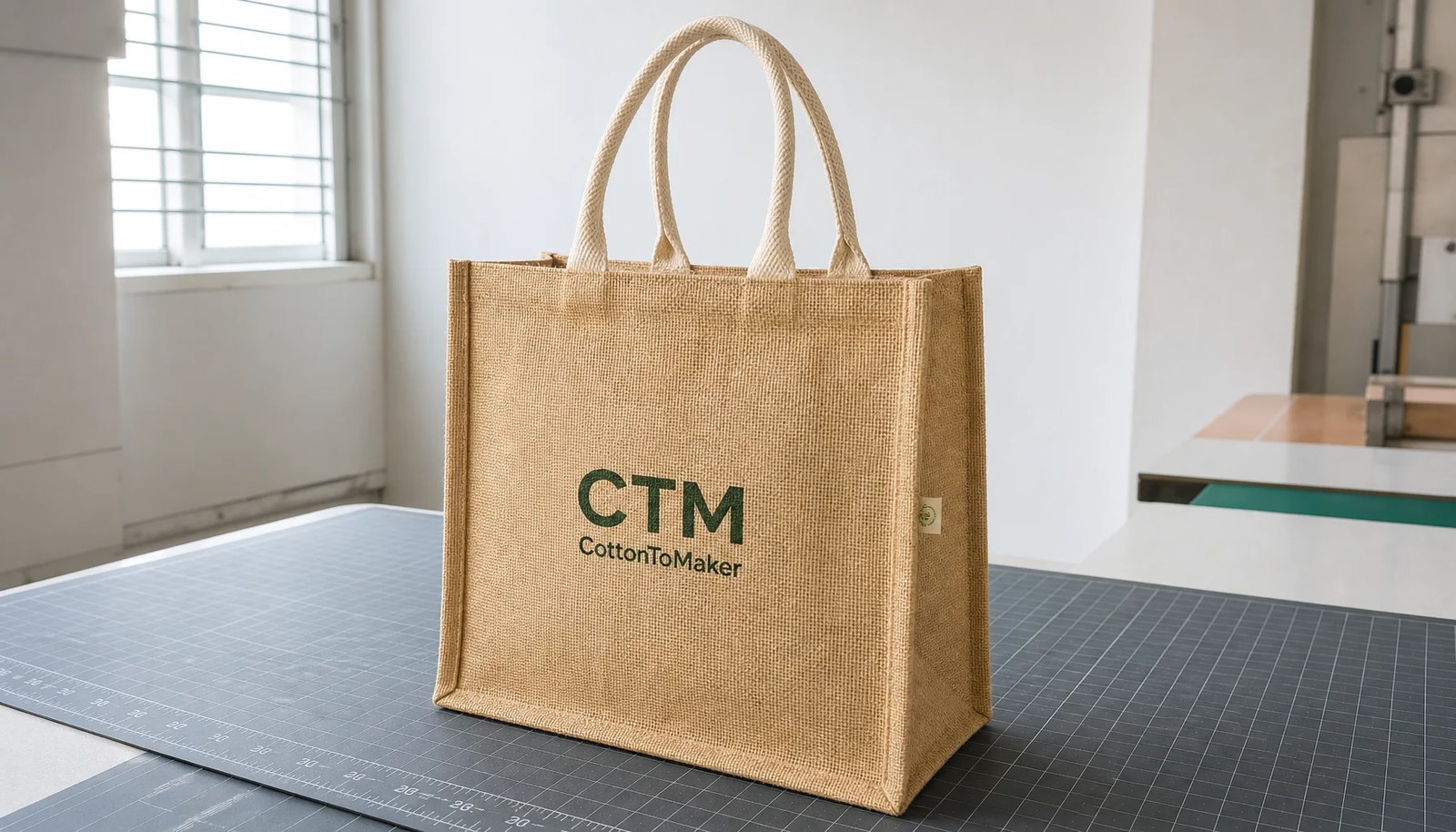
Define The Event Job Before The Tote Spec
A jute tote for a trade show is not just a reusable shopping bag with a logo. It has to be stacked at a booth, handed over quickly, filled with uneven materials, carried through aisles, and still present the exhibitor's brand clearly. That use case should drive the specification before anyone discusses decoration artwork.
Start by deciding what the bag must carry. A high-volume literature handout can use a simpler build than a qualified-buyer kit with boxed samples, notebooks, and inserts. A premium meeting bag may justify heavier fabric, cleaner handles, lining, or a smaller retail-style logo. A general giveaway usually needs a bolder front mark and efficient bulk packing.
The sourcing risk starts when buyers ask several vendors for custom jute totes without fixing the product details. One supplier may quote a light stock blank with a small print. Another may quote a heavier made-to-order bag with reinforced handles and export cartons. The prices look comparable, but they are buying different products.
- Classify the order as giveaway, meeting kit, sample carrier, or premium reusable item.
- Estimate the loaded weight before choosing GSM, handle width, and reinforcement.
- Decide whether booth visibility or post-show reuse is the main branding goal.
- Keep the first event order simple when timing is tight: one main bag, one primary print position, one approved decoration method.
Set Construction Benchmarks Suppliers Can Match
For most exhibitor programs, 280 to 320 GSM natural jute is the practical baseline. It gives more structure than very light promotional cloth without moving into a heavy premium tote. Below that range, the bag may wrinkle more, sag when loaded, or make the print look uneven. Above it, the tote can feel sturdier, but the buyer should expect higher material cost, carton weight, and sometimes freight cost.
Heavier or lined jute can be worth specifying when the bag carries catalogs, drinkware, boxed samples, or other dense booth materials. Lining or lamination can help the body stand up and protect the inside, but it also changes hand feel, appearance, odor, and the way decoration behaves. If sustainability claims matter, ask exactly what the lining is and whether the supplier can document the material.
Handles should not be left as factory default. Cotton web handles are common because they are more comfortable than rough jute for all-day carrying. A 25 to 38 mm width is a useful working range for many trade show totes. Specify handle drop, not only handle length, because drop affects shoulder comfort and how the logo hangs when the bag is carried.
- Use 280 to 320 GSM for most brochure and light-sample programs.
- Move to 320 to 400 GSM when structure, heavier contents, or a premium feel matter.
- Specify handle material, width, color, drop, and reinforcement method.
- Ask for the actual flat print area on the sewn panel, not the cut-panel size before sewing.
Use Measured Logo Placement, Not Mockup Guesswork
A centered front-panel logo remains the safest default because it is readable from the aisle, easy to explain to suppliers, and straightforward to inspect. It works best with simple artwork, strong contrast, and enough size to survive the coarse jute texture. A logo that looks sharp on a PDF can lose authority on woven fabric if the lines are too thin or the mark is scaled down too far.
Lower-third or offset placement can look more refined and less like a mass giveaway. That can suit premium meeting bags or reusable client gifts. The tradeoff is distance visibility. If attendees will be walking past a crowded booth, a small low logo may not do enough brand work. Side-gusset printing is possible for secondary messages, web addresses, or campaign names, but it adds alignment and inspection complexity.
Write the placement in dimensions. A stronger instruction is: front panel, logo centered horizontally, artwork 180 mm wide, top of artwork 90 mm below top hem, tolerance plus or minus 5 mm. That gives the factory a target and gives QC a way to measure the order. It also prevents disagreement over what centered means after sewing and folding.
- Use top hem, side seam, and panel centerline as placement references.
- Keep artwork clear of top hems, side seams, gusset folds, handle anchors, and heavy seam bulk.
- Avoid QR codes, tiny type, hairline strokes, and pale ink unless a decorated sample proves readability.
- Price back-panel and side-gusset marks as separate decoration operations.
Choose Decoration By Artwork, Quantity, And Failure Mode
One-color or two-color screen printing is usually the best benchmark for trade show jute totes with bold logos. It is familiar, scalable, and economical across many event quantities. It also has clear limitations. Jute is uneven, so fine serif text, gradients, tiny registration details, and thin outlines can fill in, break up, or look rough at the edges.
If the artwork is detailed, a patch, woven label, cotton label, heat transfer, or embroidery may solve a real problem. Each option changes the bag. A patch can look more retail and hide some texture issues, but it needs stitching and placement control. A heat transfer may offer a cleaner image, but buyers should ask about adhesion on jute and handling after packing. Embroidery can look premium, but dense stitching may distort lighter bag bodies.
Ask the supplier what minimum line thickness and text height they recommend for the chosen material and method. That answer is more useful than a generic statement that printing is possible. For corporate colors, approve against the production sample, not only a Pantone number, because natural jute color affects how ink is perceived.
- Use screen print for bold marks, simple icons, and clear booth visibility.
- Simplify artwork before paying for a more complex decoration method.
- Ask for a close-up sample photo showing print edges on the same jute quality.
- Confirm whether screens, digitizing files, or tooling are retained for reorders.
Know Realistic MOQ, Price, And Lead-Time Ranges
Commercial benchmarks help buyers spot quotes that are either incomplete or overbuilt. For common custom jute totes, MOQ often starts around 500 to 1,000 pieces when the bag is made to order. Lower quantities may be possible from stock blanks, but the buyer usually accepts standard size, available handle colors, and less control over construction. Larger orders such as 2,500 to 5,000 pieces generally give better unit economics because setup and sampling costs spread across more bags.
Indicative factory-level pricing varies by market, size, fabric weight, decoration, and packing. As a planning range, a simple stock-size jute tote with one-color print may fall roughly around USD 1.20 to 2.20 at moderate quantities. A made-to-order 280 to 320 GSM tote with cotton handles and one-color front print may sit around USD 1.80 to 3.50. Heavier, lined, multi-color, patch, embroidery, or specialty packed versions can move above USD 3.50 to 6.00 or more. These are sourcing benchmarks, not guaranteed quotes.
Lead time should be quoted by stage. A common schedule is 5 to 10 working days for a sewn blank or material sample, 5 to 7 working days for a decorated pre-production sample after artwork approval, and 20 to 35 working days for bulk production after sample approval. Screen print is usually faster than patch, embroidery, or complex multi-position decoration. International freight, customs, warehouse receiving, and show-site delivery add time beyond factory production.
- Ask for pricing at realistic tiers, such as 500, 1,000, 2,500, and 5,000 pieces.
- Separate setup, sample, decoration, packing, inspection, and local delivery charges from the unit price.
- Confirm whether the quote is for stock blanks or made-to-order construction.
- Build schedule buffers for sample revisions, decoration rework, freight handoff, and show contractor receiving.
Build An RFQ That Forces Clean Comparisons
A strong RFQ removes the supplier's need to guess. It should state bag width, height, gusset depth, jute GSM, lining or lamination, handle material, handle width, handle drop, print method, number of colors, artwork size, placement measurements, quantity tiers, sample requirements, packing method, carton marks, incoterm, and delivery point. Missing details usually become hidden differences in the quote.
Separate must-have requirements from optional upgrades. For example, the base request may be 300 GSM natural jute, cotton web handles, one-color centered front print, and bulk carton packing. Optional lines can include lining, individual polybags, inner bundles of 25, reinforced cartons, back print, or side-gusset print. This lets procurement see which choices actually move the price.
Include the event date and required arrival point, but do not make urgency the only instruction. A supplier cannot price accurately from a vague rush request. Ask for the fastest realistic schedule and the normal schedule. If the order is urgent, ask what approval steps would be compressed and what risks that creates.
- Send vector artwork with final print dimensions and color references.
- State the destination as factory gate, forwarder warehouse, distributor, destination warehouse, or show contractor.
- Ask suppliers to confirm exclusions, not only inclusions.
- Require placement tolerance and sample approval terms in the quotation, not only after the PO is issued.
Read The Quote Like A Buyer, Not A Logo Buyer
The lowest jute tote quote may simply include less product. One vendor may quote 250 GSM fabric, short handles, a small print area, loose bulk packing, and light cartons. Another may include 320 GSM jute, cotton web handles, reinforced stitching, a decorated sample, stronger cartons, and delivery to a forwarder. Until those details are normalized, the unit prices do not mean much.
Build a comparison sheet with separate lines for construction, decoration, packing, logistics, and commercial terms. Under construction, compare GSM, size tolerance, lining, handles, and reinforcement. Under decoration, compare print size, color count, method, setup cost, placement tolerance, and sample cost. Under packing, compare fold method, units per carton, carton dimensions, gross weight, inner bundles, moisture protection, and labels.
A useful negotiation question is: what changes if we need to reduce cost? A capable supplier can explain the savings from reducing GSM, simplifying print colors, using a stock size, changing handles, increasing quantity, or simplifying packing. That answer is safer than an unexplained discount, because procurement can see which quality or service level is being traded away.
- Compare cost per usable bag delivered to the required point, not only ex-factory unit price.
- Watch for missing setup fees, sample fees, artwork adjustment, carton marks, inspection, and local trucking.
- Normalize all quotes to the same logo size, decoration method, bag body, pack-out, and incoterm.
- Ask for cost-reduction options as named alternatives instead of silent substitutions.
Approve Samples Against The Way The Bag Will Be Used
A digital proof is useful for layout, but it cannot approve the full order. Jute texture, sewn panel shape, gusset depth, handle position, and folding all affect how the logo looks. When the construction is new, approve a sewn blank sample first. Then approve a decorated pre-production sample made on the final bag body with the intended decoration method.
Handle the sample like an attendee would. Put brochures, a notebook, or sample products inside. Carry it by the handles. Stand it on a table. View it from several meters away. Check whether the bag twists, whether the handles feel comfortable, whether the logo stays visible, and whether the print becomes distorted when the bag is loaded.
Tie the approved sample to the purchase order. Record artwork version, print size, placement measurements, color reference, bag spec, packing expectation, and tolerance. If the supplier changes material lot, decorator, print process, or construction after approval, require written confirmation before bulk production continues.
- Approve a sewn blank sample when size, GSM, handle, or gusset construction is new.
- Approve the decorated sample on the final bag, not on a loose jute swatch.
- Measure placement during sample review and write the tolerance into the PO.
- Reject samples that look acceptable flat but fail when loaded, carried, or viewed at booth distance.
Control Packing, Labels, And Event Logistics
Packing can make or break an otherwise acceptable order. Printed faces can rub, cartons can arrive damp, and unclear labels can cost the event team time before the show opens. Bulk flat packing is often efficient, but define how bags are folded and whether printed faces touch each other. For softer inks, dark colors, or premium presentation, ask whether interleaving or inner bundles are needed.
A practical master carton count may be 50 or 100 bags, depending on size, GSM, fold style, and target carton weight. The goal is not to force the highest count possible. Overfilled cartons can crush folds, scuff prints, and become awkward for warehouse or show staff to move. Ask for estimated carton dimensions and gross weight before production so logistics teams can plan receiving and freight.
Carton labels should be readable without opening the box. Include PO number, style code, quantity, carton sequence, destination, gross weight, and any booth or show reference required by the receiver. If bags are going to a show contractor, confirm that the label format matches inbound rules. A correct product can still create operational trouble if the cartons cannot be identified quickly.
- Define fold method, inner bundle count, master carton quantity, carton marks, and maximum carton weight.
- Ask for packing photos before shipment: folded bag, inner bundle, master carton, and label.
- Confirm whether the pack-out supports warehouse storage, distributor kitting, direct booth use, or show-contractor receiving.
- Add destination labels and artwork version references when one order serves multiple venues or booths.
Inspect Before Shipment Release
Final QC should focus on the failures that matter most at a trade show: misplaced logos, unclear printing, weak handles, uneven sewing, odor, stains, wrong pack count, and incorrect carton labels. A visual glance is not enough. Inspectors should measure print position from the agreed reference points and compare bulk goods with the approved sample.
Pull samples from multiple cartons and production points, not only the top of one box. Open the gusset, check whether the bag sits square, tug handles with reasonable force, review print edges, and look for damp smell or stains. If the tote will carry a known kit weight, test a loaded bag before release. That check is simple and can prevent a very visible event failure.
Natural jute has slubs, fiber variation, and some shade inconsistency. Those characteristics should be allowed within reason. Mold spots, oil stains, heavy dirt, major print scuffing, loose handles, wrong artwork, unreadable text, and incorrect labels are not natural texture. The PO should state which defects require sorting, rework, discount, or replacement.
- Measure logo placement and print size against the approved tolerance.
- Check print clarity, registration, ink coverage, rub marks, and scuffing after packing.
- Inspect handle anchors, stitching, gusset shape, odor, stains, and carton condition.
- Match carton count, pack quantity, PO number, artwork version, and destination labels before release.
Specification comparison for buyers
| Spec decision | Recommended option | When it fits | Buyer risk to check |
|---|---|---|---|
| Baseline fabric | 280 to 320 GSM natural jute | Most trade show handouts carrying brochures, light samples, catalogs, and booth literature | Lower GSM can wrinkle, collapse, or distort the print; confirm actual GSM by sample weight and supplier spec sheet |
| Premium fabric | 320 to 400 GSM jute, lined or laminated if needed | Qualified-buyer kits, boxed samples, heavier inserts, or bags expected to stand upright on a booth table | Higher unit cost and carton weight; check odor, print adhesion, sustainability claims, and whether lamination changes the look |
| Handle spec | 25 to 38 mm cotton web handles with defined drop | Best comfort for visitors carrying the bag through a venue for several hours | Factories may quote shorter or rougher handles by default; specify handle drop, color, width, and reinforcement |
| Logo placement | Centered front panel with measured top and side references | Safest default for aisle visibility, repeat orders, and easy QC measurement | Do not approve only a visual mockup; require final print size, clearances, and placement tolerance on the sewn bag |
| Logo placement | Lower-third or offset front print | Useful when the bag should feel more retail-like and reusable after the show | Less visible from distance; keep the mark large enough for coarse jute and avoid placing it near gusset folds |
| Decoration method | 1-color or 2-color screen print | Best commercial benchmark for bold logos, medium to large orders, and reliable repeat production | Fine type, gradients, and thin strokes can fill in; approve print edge quality on actual jute |
| Decoration method | Patch, label, heat transfer, or embroidery | Works when artwork needs cleaner detail, a retail finish, or a different texture than direct print | Adds cost, lead time, and alignment checks; confirm adhesion, stitching quality, and bulk handling |
| MOQ and price | 500 to 1,000 pcs for common custom runs; lower only when using stock blanks | Good starting point for most exhibitor programs and distributor orders | Very low MOQs may mean stock size, limited colors, higher setup allocation, or less control over packing |
| Lead time | 10 to 15 days for sampling, 20 to 35 days for bulk after approval on common builds | Typical planning range for standard jute totes with screen print, excluding international freight | Rush orders compress review time; confirm lead time by sample, material, sewing, print, packing, and delivery stage |
Buyer checklist before sampling
- Bag dimensions are fixed in centimeters, including width, height, gusset depth, top hem depth, handle drop, and acceptable size tolerance.
- Jute GSM, lining or lamination status, handle material, handle width, handle color, and handle reinforcement are stated before suppliers price the order.
- Logo artwork is supplied as vector art with Pantone or brand color references, final print size in millimeters, and a marked placement sketch.
- Logo position is written with distances from top hem, side seam, or panel centerline, not only described as centered or lower-third.
- The RFQ asks for quantity tiers such as 500, 1,000, 2,500, and 5,000 pieces when those volumes are commercially realistic.
- The quote separates bag unit cost, decoration setup, sample cost, packing upgrades, carton charges, inspection, local delivery, and export documentation where applicable.
- MOQ is confirmed for the exact construction, decoration method, print color count, logo position, and packing requirement being ordered.
- Lead time is broken down by sample, artwork approval, material booking, bulk sewing, decoration, packing, inspection, and local delivery.
- Sample approval includes a sewn blank sample when construction is new and a decorated pre-production sample on the final bag body.
- The supplier confirms placement tolerance, print size tolerance, color reference, registration expectation, and the remedy if bulk production misses those limits.
Factory quote questions to send
- What exact bag size, gusset depth, jute GSM, lining status, handle material, handle width, handle drop, and reinforcement are included in this unit price?
- Is this a stock blank with decoration or a made-to-order bag, and what MOQ applies to this exact version?
- What price tiers can you quote for 500, 1,000, 2,500, and 5,000 pieces, including setup charges shown separately?
- What is the maximum usable print area in millimeters on the sewn front panel, and how far should artwork stay from hems, seams, gussets, and handle anchors?
- Which decoration method are you quoting, how many colors are included, and what artwork details are too fine for this jute weave?
- Are screen setup, transfer tooling, embroidery digitizing, artwork adjustment, and repeat-order setup charges included or separate?
- Can you provide a sewn blank sample and a decorated pre-production sample, and how many working days are needed for each after artwork approval?
- What placement tolerance do you commit to on finished bags, such as plus or minus 5 mm, and will that be written on the approval proof?
- What print defects are rejected in your factory inspection, including blurred edges, pinholes, color drift, scuffing, misregistration, or poor ink coverage?
- What is the normal bulk production lead time after sample approval for this order size and decoration method?
Quality-control points to confirm
- Logo placement is measured from agreed reference points, such as top hem, side seam, and panel centerline, rather than judged by eye only.
- Print size matches the approved artwork within the agreed tolerance, and the print does not creep toward seams, gussets, or handle stitching.
- Small text, thin strokes, and registration between colors remain legible on the woven jute surface at normal booth viewing distance.
- Ink coverage is even enough for the approved style, with no obvious blur, smearing, heavy bleed, missing letters, or scuffed logo areas after packing.
- Print color is checked against the approved sample or color reference under consistent light, with natural jute color variation considered separately from ink drift.
- Handle attachment uses the agreed reinforcement, with no loose bartacks, skipped stitches, weak anchors, uneven handle drop, or sharp thread ends.
- Bag body sits reasonably square, side gussets open cleanly, the base is not twisted, and the printed panel is not distorted by puckering.
- Visible surfaces are free from damp smell, mold spots, oil stains, heavy dirt, excessive loose fiber, and foreign fibers that would affect event presentation.
- Packing count, carton sequence, PO number, style code, artwork version, destination, and carton labels match the purchase order and shipping plan.
- Pre-shipment evidence includes photos of the front print, handle anchors, inside construction if lined, folded pack method, master carton, and carton label.