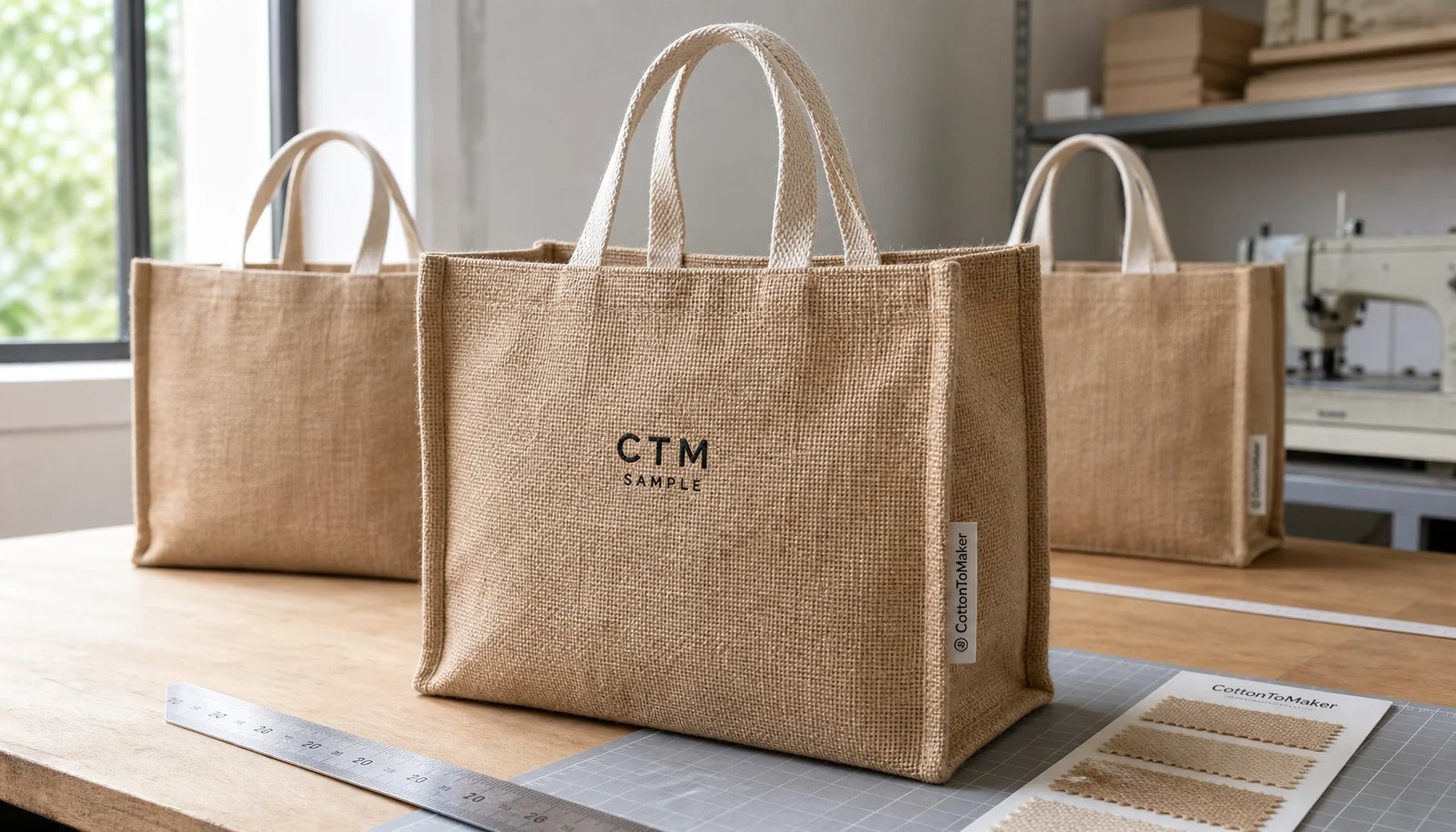
Start With the Event Load, Not the Bag Photo
Jute tote bags for trade show exhibitors fail most often when the buyer approves a polished sample without matching it to the real use case. A visitor bag carrying one brochure is not the same product as a sponsor tote holding a catalogue, notebook, boxed sample, water bottle, and the extra pieces a visitor collects during a full show day. Before you compare supplier quotes, define the actual load and build the bag around that load, not around a rendering.
For many exhibitor programs, the practical load lands between 2 kg and 5 kg. Some industrial, food, beauty, and building-material events run higher because the sample mix is dense, sharp-edged, or awkwardly shaped. The procurement brief should state the expected load clearly. Otherwise the factory may quote a cheaper standard construction and leave the risk hidden in the seams, handles, and bottom corners.
- Light handout tote: 1 to 2 kg load, badges, flyers, and a few small giveaways.
- Standard exhibitor kit: 2 to 4 kg load, catalogues, notebook, gift item, and a bottle.
- Heavy sample tote: 4 to 6 kg load, product samples, tools, food jars, cosmetics, or hardware.
- Useful RFQ wording: the bag must pass a loaded carry test at the agreed event load plus a defined safety margin.
Turn the Brief Into a Supplier-Ready Spec Sheet
The biggest mistake in sourcing jute totes is treating the spec as a brand brief instead of a manufacturing brief. A supplier can only quote accurately when the bag is defined in dimensions, materials, construction, print method, and pack-out. The more measurable the spec, the fewer surprises during sampling and final QC.
A practical spec sheet should include finished width, finished height, gusset depth, handle drop, body fabric weight, whether the body is laminated, handle width, stitch pattern, logo size, print location, and acceptable tolerances. If the bag must fit a brochure pack or an insert card, include those dimensions too. When a supplier proposes an alternate construction, ask for a separate line item instead of letting the substitution disappear inside the price.
- Define finished dimensions and the allowed tolerance for each critical dimension.
- State whether the bag must stand upright when empty or partially loaded.
- Specify the exact print location from the top edge and side seam, not only a centered artwork mockup.
- Note any internal features, such as binding, lining, cardboard insert, or closure.
Choose Fabric and Construction by Failure Risk
Jute is often described in ounces, GSM, or supplier-specific grades, and those figures are not always directly comparable because weave openness, yarn thickness, finishing, and moisture content change the handfeel. For trade show totes, a sensible working range is 13 oz to 15 oz jute, roughly 370 to 425 GSM equivalent, when the bag needs to carry printed materials and still look stable on a booth counter.
A lower-cost tote can work for a very light giveaway, but a loose weave and thin panel tend to collapse, distort under print pressure, and stress the seams. Heavier fabric adds cost and carton weight, but it improves perceived value, shape retention, and durability. Compare actual swatches side by side instead of treating one GSM number as proof of quality.
- Request swatches from the actual fabric lot or the same grade planned for bulk production.
- Compare weave density by holding the swatch against light; large gaps usually mean lower stability.
- Confirm whether the quoted fabric weight includes lamination or only the base cloth.
- Use heavier jute for bags that will be photographed, resold, or used as premium sponsor merchandise.
Lamination Changes Both Durability and Presentation
Many exhibitor totes use inner PP lamination because it helps the bag hold shape, reduces fiber dust, and improves the pack-out of brochures and collateral. It also gives the tote a cleaner presentation at the booth, which matters when the bags are stacked on counters, stored overnight, or distributed through a hotel or event warehouse.
The tradeoff is fold behavior. Poor lamination can crack, whiten, or separate after compression in export cartons. Too much coating makes the tote stiff and noisy, which may not fit a brand that wants a softer natural presentation. A sample should be folded and packed the way the bulk goods will be packed, then opened the next day to inspect creasing, coating stress, and odor.
- Use laminated jute when structure, cleanliness, and print presentation matter more than a soft handfeel.
- Use unlaminated jute for a more natural look, but expect more fiber dust and less shape retention.
- Test lamination by bending the bottom corners and side panels, not only the front face.
- Reject samples with a strong plastic smell, peeling film, or white stress lines after folding.
Handle Strength Is the First Failure Point
The handle is where a trade show tote earns or loses trust. Cotton webbing handles are usually safer than narrow rope or thin jute for a bag that will carry several kilograms for several hours. A 30 to 35 mm cotton webbing handle spreads pressure on the hand or shoulder and gives the factory a cleaner surface for secure stitching.
Handle attachment should be treated as a functional component, not decoration. Box-X or cross-stitch reinforcement is usually the better choice for heavier use. The stitch pattern must be consistent, with enough distance from the fabric edge to avoid tearing through the panel. Buyers should also confirm handle drop because a bag that rides too high on the shoulder, or drags when held by hand, gets judged as poor quality even when the fabric is fine.
- For light handout totes, a simpler reinforced stitch may be enough if the load is low.
- For sponsor kits and heavier samples, specify box-X or cross-stitch reinforcement.
- Check handle width, thickness, color fastness, and comfort under a real load.
- Measure handle drop on the filled sample, not just the flat handle length in the quote.
Make Print Durability Part of the Spec
Screen print is usually the most practical method for solid logos, event marks, and one to three color branding on jute. The coarse surface does not behave like cotton canvas. Ink coverage can vary across the highs and lows of the weave, and very small type can fill in or break at the edges. A good factory will flag minimum line thickness and may suggest artwork adjustments for the fabric.
Heat transfer can work for detailed art, gradients, or small registration, but adhesion must be tested carefully because jute texture and lamination can reduce consistency. Digital print is less common for bulk natural jute totes and should be evaluated by sample, not by catalogue promise. The safest approval path is a print strike-off on production fabric with the actual logo size, color reference, and position marked against the finished bag dimensions.
- Approve logo size and position using a measured sample, not only a PDF layout.
- Use Pantone references where possible, but allow reasonable variation on natural jute.
- Run dry rub and damp rub tests with a white cloth to identify transfer.
- Avoid very small reversed text, thin lines, and tight multi-color registration on coarse jute.
Run a Real Durability Test Plan
The most useful durability testing checklist is simple and tied to the event scenario. A trade show tote does not need laboratory certification unless the buyer has a specific compliance requirement. It does need enough testing to expose weak handles, seam failures, print rub, and lamination cracks before the order reaches the booth. The best test sequence is one that simulates the day: load, carry, set down, stack, fold, and inspect.
For a standard exhibitor tote, use a loaded hang test, a walking carry test, a handle pull test, a print rub test, and a carton drop check. The acceptance criteria should be written in plain language. If the bag fails any one of these checks, it is usually cheaper to fix the spec than to sort defects after the goods ship.
- Static hang test: suspend the tote at 1.5 times the working load for 60 minutes. Pass means no seam opening, no handle separation, no bottom failure, and no permanent deformation that changes the carry position.
- Carry-cycle test: complete 25 lift-carry-setdown cycles at the working load. Pass means the bag still carries normally and shows no stitch break or handle twist that makes it awkward to use.
- Handle pull test: hold 15 kgf for a standard tote or 20 kgf for a heavier kit for 10 seconds. Pass means no tearing, no reinforcement migration, and no visible pull-out.
- Print rub test: apply 20 dry cloth strokes and 10 damp cloth strokes. Pass means no visible transfer, no edge lift, and no cracking across the main logo area.
- Carton drop test: drop one packed carton from 76 cm on one face and one edge. Pass means the carton stays intact, corners do not burst open, and the bag faces are not visibly crushed.
Compare Suppliers on More Than MOQ
Many quote comparisons fail because the products are not actually the same. One supplier may quote a lighter fabric, thinner handles, a smaller logo, a different stitch pattern, or a simpler carton pack. For procurement, the right method is to send one spec sheet and ask each factory to confirm every variable, not just the bag dimensions. If a supplier proposes an alternate construction, list it separately with a clear price delta.
MOQ is part of the same decision, but not the whole decision. A lower quantity can still be manufactured, yet the factory may need a setup fee, longer lead time, or a reduction in customization. When the show date is fixed, it is often better to simplify the spec than to force a low quantity through a highly customized process. Ask for pricing at two or three quantity breaks so you can see where the cost steps actually occur instead of guessing from one quote.
- Ask each supplier to quote the same size, same material, same handle, same print, and same packing method.
- Separate one-time setup charges from recurring unit price so the comparison is transparent.
- Request alternate pricing for simpler options if your deadline is tight or the MOQ is high.
- Do not compare quotes without confirming carton size, gross weight, and delivery destination.
Treat Supplier Location as a Production Risk Factor
Supplier selection is not just about price. It is about who controls the fabric, who sews the bags, who prints them, and who packs them for export. A trading company can still be the right answer if it manages quality tightly, but the quote should make ownership clear. Ask for the factory line, not just a sales sample room, and ask who signs off on first article approval.
Regional risk is less about the country name and more about cluster maturity, route complexity, and schedule discipline. If the jute mill, sewing line, and export port are in different places, add time for internal movement and more chances for spec drift. Ask for the backup mill, holiday calendar, and cut-off dates before you award the order. If the supplier suggests an alternate region or alternate construction to hit MOQ or lead time, require a fresh sample and a side-by-side price sheet.
- Ask who owns fabric sourcing and whether the factory can provide lot traceability for the body cloth.
- Confirm whether printing, sewing, and packing are in-house or subcontracted, and how each step is checked.
- Request the backup mill or backup date in writing if the primary route slips.
- Ask how many handoffs the carton will pass through before export, because each handoff adds packing risk.
Approve the Sample as Pre-Production Evidence
A good sample set is a proof pack, not a single hero bag. Request one unprinted construction sample and one printed pre-production sample from the final fabric lot. Keep a sealed reference sample for final inspection. If the factory uses substitute fabric, alternate handles, or a different coating for the first sample, label it clearly and do not let it become the approval standard.
The sample review should include measurements, photos, and a short test log. Measure the width, height, gusset, handle drop, and print position. Load the bag with the actual event kit and check the inside seams, bottom corners, handle backs, and fold lines after the test. The sample is approved only when the construction, artwork, and pack-out all match the PO.
- Measure and photograph the bag against a ruler, not only against the artwork mockup.
- Review the inside seams, handle anchor points, and bottom corners after loading the tote.
- Keep one signed reference sample or marked production sample for final QC comparison.
- If the factory changes fabric lot, handle material, or print method, require re-approval.
Specification comparison for buyers
| Spec decision | Recommended option | When it fits | Buyer risk to check |
|---|---|---|---|
| Jute fabric weight | 13 oz to 15 oz jute, roughly 370 to 425 GSM equivalent depending on weave and finishing | Standard exhibitor kits carrying brochures, notebooks, catalogues, and a few sample items | Quoted GSM alone does not prove density; ask for a swatch from the actual production lot and compare weave openness against your expected load |
| Fabric construction | Laminated jute with bound seams or piping, plus a reinforced bottom panel or insert board | Bags that must stand on a counter, look neat in photos, and keep inserts clean | A stiff laminate can crack at fold points; require a folded sample check for whitening, odor, and seam peeling after compression |
| Handle material | Cotton webbing, usually 30 to 35 mm wide, with reinforced attachment stitching | Bags carried across an exhibit hall, worn by hand or shoulder, or loaded with heavier kits | Thin rope or narrow handles can cut into the hand and elongate under load; ask for a handle pull test and inspect stitch placement |
| Handle drop | About 45 to 55 cm total handle length, verified as roughly 24 to 28 cm loaded drop | Visitors who need hand carry plus a short shoulder carry during a long show day | A flat handle length can look fine on paper but fail when loaded; always measure the filled sample, not only the loose tote |
| Print method | Screen print for solid logos and one to three colors; heat transfer only after adhesion testing on production fabric | Most exhibitor branding, sponsor marks, and event messaging | Jute texture affects coverage and edge sharpness; require a strike-off on the actual fabric, not on a smoother substitute |
| Inner coating | Light PP lamination when structure, cleanliness, and shape retention matter | Orders where the tote must stand upright and keep brochures clean before handout | Too much coating makes the bag stiff and noisy; confirm fold behavior, stress whitening, and odor after carton compression |
| Top and bottom construction | Reinforced bottom panel, box gusset, or board insert if the tote must stand upright | Photo-ready counters, dense kits, or any program where the bag should not collapse empty | Underbuilt corners and bottoms wear out first; check for corner puckering, bottom sag, and seam drift after loading |
| Packing method | Flat packed in export cartons with paper interleaving when print rub risk exists | Shipments to event warehouses, booth builders, hotels, distributor centers, or retail DCs | Over-tight packing can crease lamination and mark the print; ask for carton photos and count photos before dispatch |
| Inspection standard | AQL 2.5 major / 4.0 minor plus load, rub, and carton-drop checks | Bulk orders where a show-floor failure is more expensive than a few extra inspection steps | Visual inspection alone misses weak stitching, coating cracks, print abrasion, and poor pack-out |
Buyer checklist before sampling
- Weigh the full event kit before you ask for quotes. Include brochures, notebook, sample product, bottle, badge inserts, and any sponsor collateral. Set a design load, not an average load, and add a safety margin. For most trade show programs that means planning around 2 to 4 kg, with heavier kits moving into the 4 to 6 kg range.
- Write the brief in manufacturing terms. Specify finished width, finished height, gusset depth, handle length, handle drop, fabric weight, body construction, reinforcement method, print size, print location, and any internal insert or closure. If the bag must fit inside a registration pack or a hotel delivery tote, include the outer carton and receiving constraints too.
- Ask suppliers to quote the same spec sheet and to list any alternate constructions as separate price lines. A useful comparison is laminated versus unlaminated, cotton webbing versus jute handle, bound seam versus piped seam, and flat bottom versus reinforced bottom. This shows the real cost of each upgrade instead of hiding it in a generic unit price.
- Request two samples before bulk release: one unprinted construction sample and one printed pre-production sample made from the same fabric lot. If the first sample uses substitute cloth, alternate handles, or a different coating, treat it as a reference only, not an approval piece.
- Test the sample at the expected event load plus a margin. Load it, carry it, set it down, pick it up again, and repeat the motion. Inspect the top seam, handle anchor points, bottom corners, and any body distortion. A tote that survives one lift but twists, sags, or sheds stitches after repeated use is not ready for a show floor.
- Run a simple rub test on the artwork. Use a dry white cloth and a slightly damp white cloth against the printed area. Reject samples that show visible transfer, edge lift, smearing, or cracking. If the logo has fine type, test whether it is still readable after the bag has been folded once or twice.
- Fold the tote the way it will be packed for shipment and leave it compressed overnight. Reopen it the next day and check for permanent creases, laminate cracks, print marking, and odor. This matters more for laminated jute and for any order that will sit in cartons through a long freight leg before the event.
- Confirm the delivery route before the quote is finalized. Event warehouse, booth builder, hotel, distributor center, and retail warehouse all have different packing and labeling requirements. Ask who is receiving the cartons, whether appointments are required, and whether the venue needs pallet labels, carton marks, or carrier references.
- Lock artwork details before strike-off approval. Confirm logo size, Pantone references, print placement, smallest text size, and acceptable registration tolerance. If your brand is comfortable with natural jute variation, say so in writing. If it is not, say that too and expect tighter approval criteria.
- Set inspection gates before production starts: incoming fabric check, first-piece sewing check, print approval, final AQL, and carton packing review. The quality plan should say what happens if one gate fails. That is where a small defect becomes a bulk problem, and where a clear correction path saves the order.
Factory quote questions to send
- What is the actual jute weight in oz or GSM from the same lot planned for bulk production, and can you send a swatch or fabric photo with lot reference?
- Is the body laminated or unlaminated, and if laminated, what coating type is used and how does it behave after folding and carton compression?
- What handle material, width, length, and reinforcement stitch are included in the quoted price?
- What working load do you recommend for this construction, and what test method supports that recommendation?
- Will you quote alternate constructions separately, such as unlaminated, laminated, cotton webbing handles, jute handles, board insert, or piped seams?
- Which print method do you recommend for this artwork on your production fabric, and what is the minimum text size and line weight you can hold reliably?
- Will the strike-off use the same fabric, ink, transfer, and lamination planned for bulk production?
- What are the finished size tolerances, print placement tolerances, and acceptable shade variation for natural jute?
- What are the carton dimensions, units per carton, gross weight, interleaving method, pallet options, and carton marks for the destination?
- Which production line, export port, backup mill, or backup date do you use if the primary route slips, and what inspection photos or test records can you share before shipment?
Quality-control points to confirm
- Finished bag size should stay within plus or minus 1 cm on width and height unless the spec calls for tighter control on a critical fit dimension.
- Handle attachment should show even reinforcement stitching with no skipped stitches, loose tails, stitch drift, or misaligned anchor points.
- Handle pull test should pass without seam failure at 15 kgf for a standard exhibitor tote and 20 kgf for a heavier kit, held for 10 seconds, unless your program requires a stricter threshold.
- Loaded hang test should run at 1.5 times the working load for 60 minutes with no seam opening, handle separation, bottom failure, or permanent deformation that changes the carry position.
- Carry-cycle test should include 25 lift-carry-setdown cycles at the working load with no functional failure and no twist or elongation that makes the bag awkward to use.
- Print should match the approved size, position, color target, and edge sharpness on the actual jute surface, with no visible smearing or missing coverage in the main logo area.
- Dry rub testing should show no meaningful ink transfer on a white cloth after 20 strokes, and damp rub testing should show no visible smear after 10 strokes unless the approved print method allows otherwise.
- If lamination is specified, the coating should not crack, whiten, or peel at fold points after overnight compression and reopening.
- Panels should not show heavy stains, mold marks, oil spots, holes, sharp fiber clusters, or shade mixing beyond the approved swatch range.
- Cartons should match the approved count and carton marks, survive one 76 cm drop on a face or edge without bursting, and protect the printed surface from crush marks.