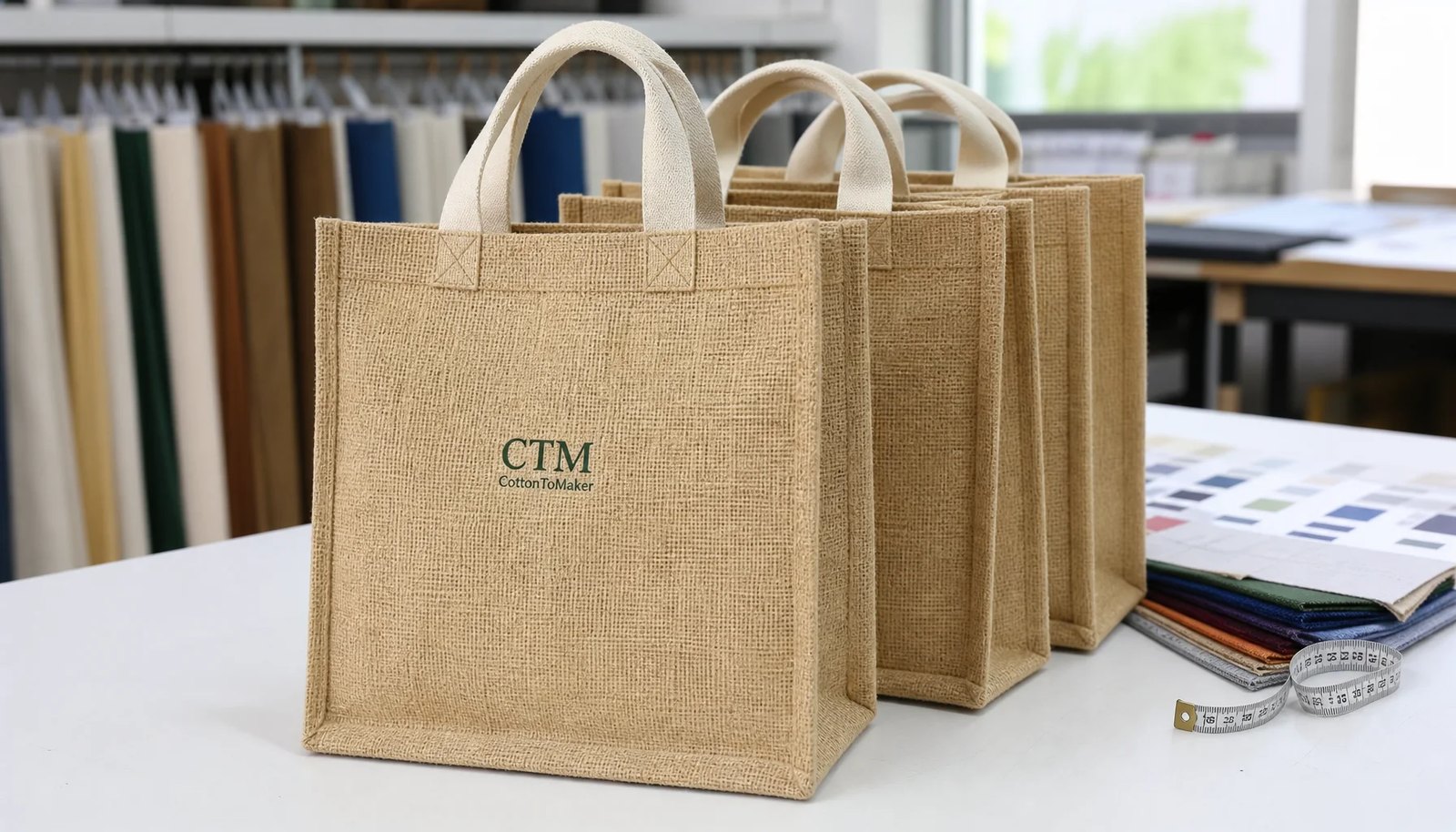
Define the Compliance Problem Before the RFQ
For university bookstores, a jute tote bag is not only a reusable shopping bag. It may carry licensed school artwork, sit on retail shelves, move through distributor warehouses, and be handled by students, parents, alumni, and store staff. The buying risk is therefore broader than unit price. Procurement teams need the supplier to meet product specification, print control, packing accuracy, shipment timing, and documentation requirements at the same time.
The most useful RFQ starts by describing the sales channel and the operational constraint. A bag for retail resale needs cleaner sewing, stronger shelf presentation, barcode readiness, and lower visual defect tolerance than a one-day giveaway. A bag for a campus bookstore chain may also need store-level carton marks and split allocations. If those details are missing, suppliers quote different assumptions and the cheapest offer may be the least compliant.
- State whether the bag is for resale, promotion, staff use, event kit, or distributor catalog inventory.
- List the destination market and any retailer routing, barcode, carton mark, or pallet requirement.
- Separate mandatory compliance requirements from preferences so suppliers do not hide risk in vague language.
- Attach artwork files and licensing notes early if university marks, mascots, or slogans are involved.
Choose a Jute Construction That Matches Bookstore Use
Jute tote bags are usually quoted by finished size, fabric weight, lamination, handle type, and print method. A typical university bookstore tote may use natural jute in the 260-320 GSM range. Lighter jute can reduce material cost and carton weight, but it may feel floppy and show more uneven weave. Heavier jute gives a more substantial retail feel, but increases cost, sewing difficulty, and freight volume.
The buyer should decide whether the bag needs lamination. Unlaminated jute has a natural, matte, craft appearance and often fits sustainability-oriented merchandising. Laminated jute is stiffer, stands better, and can improve print definition, but it changes the feel and may conflict with some environmental messaging. If the bookstore plans to sell the bag near apparel or books, also consider lint transfer, odor, and roughness against printed course materials.
- Common retail size: about 35-40 cm wide, 35-40 cm high, with a 10-15 cm gusset for books and apparel.
- Handle drop: around 20-25 cm for shoulder carry; shorter handles may fit hand-carry promotional bags.
- Body fabric: 260-320 GSM is a practical starting range; premium structured bags may go heavier.
- Reinforcement: handle stitching should be box or cross stitched, not only a single straight seam.
Compare Supplier Routes Without Mixing Assumptions
A direct factory, trading company, stock bag supplier, and local decorator can all be valid options, but they should not be compared as if they are quoting the same product. Direct factories are usually stronger when the buyer needs custom construction and repeat consistency. Traders may help with consolidation, but the buyer needs visibility into the production site and responsibility for defects. Stock suppliers can support urgent events, but blank bag quality may vary by available lot.
Supplier compliance evidence should be practical rather than decorative. A buyer does not need a long presentation full of generic certificates if the actual risk is print registration, handle strength, or carton labeling. Better evidence includes recent jute tote production photos, material swatches, sample records, inspection reports, packing photos, and a clear statement of which processes are in-house. For licensed university goods, the supplier must also understand that artwork approval and trademark control are not optional.
- Request factory profile details only after confirming the supplier can make the exact construction required.
- Ask whether printing is done before or after sewing, because this affects print position and distortion.
- Require production-line sample evidence if the order is large enough to justify custom material purchase.
- For distributor orders, confirm whether the supplier can manage SKU separation and store allocation packing.
Set Fabric, Handle, and Stitching Acceptance Criteria
Jute is a natural fiber, so some shade variation, slubs, and uneven yarns are normal. Compliance problems start when the buyer does not define where natural variation ends and a retail defect begins. A bookstore may accept small weave irregularities, but should reject mold marks, oil stains, heavy odor, large holes, broken yarn clusters, and panels that look mismatched across the same display set.
Handle construction deserves more attention than many RFQs give it. Books are heavier than typical promotional items, and students may load the bag with apparel, drinkware, and course packs. Cotton webbing handles are common because they feel better in the hand than raw jute handles. The attachment point should have reinforced stitching with stable thread tension. If the tote has a lining or lamination, the handle sewing must not tear the body material or create sharp internal edges.
- Fabric shade: approve a swatch range, not only a single photo under unknown lighting.
- Loose fibers: define an acceptable retail appearance after light brushing or normal handling.
- Handle width: 2.5-4 cm is common; wider handles improve comfort for heavier bookstore use.
- Stitching: reject open seams, broken threads, skipped stitches, weak back tacking, and visibly crooked handle placement.
- Load expectation: state intended carrying weight so the supplier can choose handle and stitch reinforcement correctly.
Control Print Method and Artwork Limits
Screen printing is often the practical choice for jute tote bags because it handles solid logos and campus marks well, especially on natural fiber texture. Heat transfer can work for detailed graphics, but buyers must evaluate hand feel, adhesion, and how the transfer behaves on rough weave or laminated surfaces. Embroidery is possible for simple marks or patches, but dense embroidery directly on jute can distort the panel and increase cost.
Artwork designed for paper or apparel may not work on jute without adjustment. Fine serif text, thin mascot outlines, small trademark symbols, and tight halftones can break up on coarse weave. A responsible supplier should warn the buyer before sampling instead of simply printing a poor result. Procurement teams should include minimum line thickness, approved logo size, Pantone references, and print position measurements in the RFQ, then judge the strike-off under realistic lighting.
- Use larger text and bold shapes for natural jute; avoid tiny legal text unless a separate label carries it.
- Measure print placement from top edge and side seam, with a tolerance such as plus or minus 5 mm if achievable.
- Approve ink color on the actual jute shade, because natural tan fabric changes perceived color.
- Test rub resistance after the ink cures, especially for dark ink on unlaminated jute.
- Keep licensed artwork files version-controlled so outdated logos do not enter production.
Understand MOQ Logic and Cost Drivers
MOQ for jute tote bags is driven by material purchase, cutting efficiency, print setup, labor scheduling, and packing requirements. A supplier may accept a lower MOQ for a stock body with one-color print, while a custom size, custom handle, lining, lamination, hangtag, barcode label, or multi-color print can raise the MOQ. Buyers should request MOQ by configuration, not treat it as one fixed number for every design.
Unit cost differences often come from hidden specification gaps. One quote may use 260 GSM unlaminated jute with simple cotton handles and bulk carton packing. Another may use 320 GSM laminated jute, reinforced handles, individual bags, barcode labels, and stricter inspection. Those two prices cannot be compared without normalizing the spec. A clean quote should show fabric basis, print cost, sample cost, packing cost, export carton details, and any tooling or screen charge.
- Material cost changes with GSM, lamination, lining, handle material, and body size.
- Print cost changes with color count, artwork size, registration difficulty, and spoilage allowance.
- Labor cost changes with gusset construction, zipper or pocket additions, labels, and reinforced stitching.
- Packing cost changes with individual polybags, hangtags, barcodes, carton thickness, and store-level sorting.
- Freight cost changes with carton CBM; structured jute bags may ship more volume than flat cotton bags.
Approve Samples Like a Production Buyer
A photo approval is not enough for jute tote bags when the order is for retail or licensed bookstore use. The buyer should approve a material swatch, a blank construction sample, and a printed pre-production sample where budget and timing allow. The pre-production sample should use the same fabric weight, handle material, stitching method, print method, and packing approach intended for bulk goods.
Sample comments should be written as measurable corrections. Instead of saying the bag feels weak, state that handle stitching needs box reinforcement and the handle drop should be increased to a specific measurement. Instead of saying the logo is too low, state the approved distance from the top edge. Clear sample approval records protect both sides when bulk inspection begins, because the inspector can compare production against an agreed physical standard.
- Keep one signed approval sample with the buyer and one with the factory before bulk starts.
- Record finished size, fabric GSM, handle drop, print size, print position, and carton packing in the sample approval sheet.
- Review the bag loaded with typical bookstore items such as two books and a hoodie, not empty on a table only.
- Fold and unfold the sample to see whether lamination creases, ink cracks, or seams distort.
- Do not approve bulk cutting until artwork, licensing, and label content are final.
Build Packing Rules Into the Purchase Order
Packing is a compliance point, not an afterthought. Bookstore totes may move through campus receiving rooms, distributor warehouses, retail backrooms, and sales floors. If carton marks, barcode labels, and SKU counts are wrong, the buyer loses time even if the bag itself is acceptable. Packing instructions should cover units per carton, inner packing, carton dimensions, carton weight limit, SKU separation, barcode placement, and pallet requirements if any.
Jute bags can crease, smell, or absorb moisture if packed badly. Laminated jute should not be crushed so tightly that panels develop permanent fold lines. Unlaminated jute should be protected from damp cartons and dirty warehouse floors. If the buyer wants reduced plastic packaging, the supplier still needs a moisture-control and cleanliness plan. Retail buyers should approve a sample carton photo or packed carton sample for larger programs.
- Use consistent carton quantity by SKU to simplify receiving and cycle counts.
- Add carton marks with PO number, SKU, color, quantity, gross weight, net weight, carton size, and country of origin if required.
- Set a maximum carton weight that warehouse staff can handle safely.
- Use desiccant or moisture precautions where shipping route and season create humidity risk.
- Require carton drop resistance appropriate for export handling if bags are shipped by ocean or courier.
Protect the Lead Time Around Bookstore Seasons
University bookstore demand is seasonal. Orientation, back-to-school, homecoming, graduation, alumni events, and holiday gifting all create hard dates. A supplier quote that says production takes a certain number of days is incomplete unless it states when the clock starts. Production may start after deposit, sample approval, artwork approval, fabric arrival, or label confirmation. These milestones should be written into the order schedule.
The biggest schedule risks are usually buyer-side delays and late spec changes. A revised logo, added barcode, changed carton mark, or switch from unlaminated to laminated jute can restart sampling and material planning. For importers, the shipment plan must also include inspection booking, export documents, vessel cutoff, customs clearance, and final delivery to the bookstore or distributor warehouse. A realistic timeline is more valuable than an optimistic lead time that misses the retail window.
- Freeze artwork before the pre-production sample, especially for licensed university marks.
- Reserve time for sample shipping, buyer review, corrections, and second sample if needed.
- Book inspection before the planned completion date so the factory does not pack and ship unverified goods.
- For ocean freight, include port congestion, customs exam risk, and inland delivery in the campus delivery plan.
- For urgent event goods, consider stock blanks with controlled print rather than full custom construction.
Compare Quotes by Landed Cost and Compliance Exposure
The lowest FOB price can become expensive if the bag ships bulky cartons, fails print inspection, needs repacking, or arrives without correct labels. A better comparison looks at landed cost per sellable unit. Include unit price, sample charges, screen or setup cost, inspection cost, export packing, freight, duty if applicable, customs brokerage, inland delivery, and expected defect allowance. If a supplier’s quote lacks carton CBM and gross weight, the buyer cannot estimate freight reliably.
Compliance exposure should also be part of the commercial comparison. A supplier with stronger sample control, clearer packing data, and better inspection cooperation may reduce claims and late-season shortages. For university bookstores, the damage from missed delivery or wrong logo can be greater than a small unit cost difference. Procurement teams should score quotes on production readiness, documentation quality, and defect remedy terms, not just price.
- Normalize quotes to the same size, GSM, lamination, handle type, print size, color count, and packing method.
- Calculate landed cost using estimated CBM and carton weight, not only unit price.
- Identify which costs are included, such as screens, sample freight, hangtags, barcodes, and export cartons.
- Set overrun and underrun tolerance in writing so store allocations are not short.
- Define remedy terms for major defects: rework, replacement, discount, or credit timing.
Specification comparison for buyers
| Supplier option | What to verify | Commercial advantage | Buyer risk to control |
|---|---|---|---|
| Direct sewing factory | jute roll photos, lamination sample, odor-control process, handle pull evidence, and pre-shipment carton condition photos | Better sample-to-bulk control and faster production feedback | May be weaker on export paperwork or branded packing unless checked early |
| Trading company | Factory name, production photos, trim-source proof, and who owns QC decisions | Can coordinate small mixed orders and extra services | Markup can hide real factory capability and slow defect decisions |
| Specialized bag workshop | handle stitching, side gusset, lamination edge control, inner seam cover, and fiber shedding tolerance | More practical for detailed construction, trims, and repeat programs | Capacity may be limited during peak seasons |
| Low-price general supplier | laminated or unlaminated jute, cotton-jute blend, inner coating, odor control, yarn thickness, and color shade variation | Useful for simple promotional runs with loose specs | Material downgrades, weak packing, and vague inspection scope can erase savings |
| Retail-ready supplier | airing time, moisture absorber, carton liner, bundle wrap, odor separation, and warehouse ventilation before loading | Can handle labels, SKU separation, carton marks, and receiving rules | Higher unit cost must be compared against reduced warehouse work |
| Compliance-focused supplier | Fabric records, labeling review, test plan, and production traceability | Safer for retail programs and repeat brand orders | Documentation claims need evidence, not only sales language |
| Local sample room plus bulk factory | Signed sample, bulk factory handoff, first-piece photos, and deviation owner | Good for complex branding before large production | Sample room quality may not match bulk line unless handoff is controlled |
Buyer checklist before sampling
- Define the bookstore use case: retail resale, orientation giveaway, gift-with-purchase, alumni event, or bundled course material program.
- Specify finished size with width, height, gusset, and handle drop, not only an approximate capacity photo.
- State jute fabric weight target, such as 260-320 GSM, plus whether the body is laminated, unlaminated, or lined.
- Provide artwork size, print colors, Pantone references, and minimum readable text height before requesting a quote.
- Require a pre-production sample using production fabric, production handles, and the intended print method.
- Set acceptable tolerances for size, fabric shade, print position, handle strength, odor, stains, and loose fibers.
- Confirm whether any university trademark, licensing, country-of-origin label, or retail hangtag rule applies.
- Request MOQ by body size, fabric type, print method, and color count so quotes can be compared fairly.
- Lock carton quantity, inner polybag policy, barcode label placement, carton marks, and pallet requirement before bulk packing.
- Include inspection timing, AQL level, defect definitions, and remedy terms in the purchase order.
Factory quote questions to send
- Is the quoted jute fabric laminated or unlaminated, and what GSM range will be used for bulk production?
- Will the bag body, handle sewing, printing, labeling, and packing be completed in-house or by subcontractors?
- What is the MOQ for this exact size, fabric weight, handle type, and print color count?
- What print method is recommended for natural jute texture, and what is the minimum safe line thickness for our artwork?
- Can you provide a material swatch, blank sample, and printed pre-production sample before bulk cutting?
- What finished size tolerance, print position tolerance, and handle pull-strength standard do you use for jute totes?
- How many extra units are recommended for print setup, inspection replacement, or distributor allocation?
- What carton size, carton weight, units per carton, and estimated CBM will apply to the quoted packing plan?
- What lead time starts after sample approval, deposit, artwork confirmation, or material arrival?
- Which compliance documents can be supplied: invoice, packing list, country-of-origin marking details, material declaration, test reports if requested, and inspection report?
Quality-control points to confirm
- Finished dimensions should be measured flat at top width, height, bottom gusset, and handle drop with agreed tolerance, commonly plus or minus 1 cm for sewn jute bags unless a tighter standard is approved.
- Fabric GSM should be verified against the approved swatch; large variance changes bag stiffness, print appearance, carton CBM, and perceived retail value.
- Handle attachment should use reinforced box or cross stitching, with no skipped stitches, open seams, or weak thread tension at the load-bearing points.
- Print position should be checked from the top edge and side seam, not judged by eye only; jute weave movement can make off-center artwork look worse on shelf.
- Ink coverage should be evaluated for cracking, rubbing, bleeding, pinholes, and unreadable small text after the bag is folded and handled.
- Odor, moisture, mold marks, oil stains, rust stains from hardware, and excessive loose fibers should be treated as major retail defects.
- Carton count, SKU labels, barcode labels, and campus allocation labels should be reconciled before shipment, especially for multi-store bookstore groups.
- Packing compression should not crease laminated jute panels beyond recovery; sample cartons should be reviewed before mass packing when bags are structured.