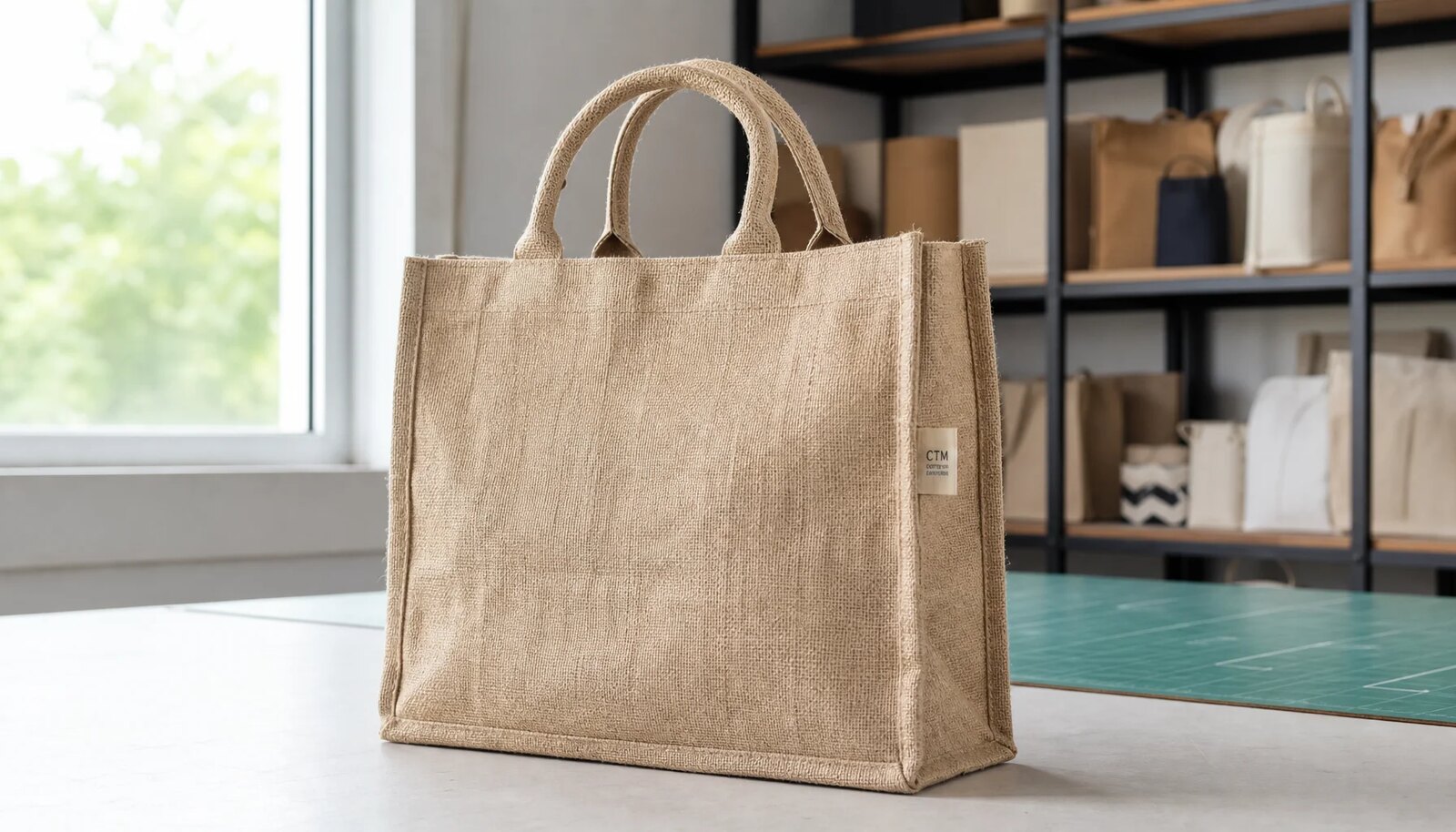
Start With the Event Job, Not the Tote Photo
A useful jute tote bags supplier compliance checklist for event planners starts with the job the bag must do. A product photo can show texture, shape, and logo placement, but it cannot prove that the tote will carry the intended contents, survive guest handling, arrive before the venue receiving deadline, and meet sponsor expectations. A bag used for a folded agenda and lanyard is not the same purchase as a bag carrying a boxed gift, bottle, catalog, charger, and several sponsor samples.
Write the event requirement before sending the RFQ. List the contents, estimated filled weight, distribution method, expected carry time, guest profile, and whether the bag must stand upright on a registration table. For a light conference handout, simple laminated or unlaminated jute may be enough if the seams and handles are reliable. For heavier kits, ask the supplier how the handle tape, stitch pattern, gusset depth, and bottom construction support the target load. For sponsor gifts or merchandise sales, presentation, odor, label accuracy, carton cleanliness, and count control become part of the buying standard.
The operational side matters just as much. A supplier can make a usable tote and still create trouble by packing cartons too heavily, using vague carton marks, mixing destinations, or failing to separate sponsor versions. Build the product spec and the receiving plan together. Inner bundle counts, pieces per carton, carton numbering, venue references, and delivery appointment rules should be fixed before production starts. Once the goods are packed, correcting those details costs time that event teams rarely have.
- State the event type, contents, filled weight, distribution method, and venue receiving date in the first RFQ.
- Separate guest-facing requirements from operational requirements such as carton count, carton labels, and destination splits.
- Tell suppliers whether the tote is a giveaway, premium sponsor gift, merchandise item, retail-ready product, or registration kit.
- Treat strength, odor, count accuracy, and packing format as compliance requirements, not afterthoughts.
Write a Spec That Makes Quotes Comparable
Jute tote quotations only become useful when each supplier is pricing the same bag. A request for natural jute tote, one-color logo, 1,000 pieces leaves too much room for interpretation. One supplier may quote 280 gsm unlaminated jute with narrow handles and no inner seam cover. Another may quote 330 gsm laminated jute with cotton webbing, top binding, reinforced handle stitching, and cleaner carton packing. Both may look close in a thumbnail. They are not the same commercial offer.
A complete specification should include finished width, height, gusset depth, handle drop, handle tape width, body fabric weight, lamination or lining, top edge finish, bottom seam style, decoration method, label position, and packing format. Common event tote bodies are often discussed in approximate ranges such as 280 to 360 gsm, depending on weave, lamination, and use. Still, GSM is only one part of quality. A heavier body with weak handle stitching can fail sooner than a lighter body with a better reinforcement pattern.
Put realistic tolerances into the RFQ. Jute is a natural woven material, so small variation is normal. A practical specification might allow plus or minus 5 mm on smaller measurements and plus or minus 10 mm on larger body dimensions if the supplier confirms that standard. Print position might be controlled within plus or minus 5 mm to 8 mm for many promotional programs. Shade variation should be judged against an approved sample or shade range. The exact tolerance should match the supplier's capability and the buyer's risk, but it must be written before inspection.
- Define finished size, gusset, handle drop, handle width, body GSM range, lamination, lining, binding, and bottom construction.
- Ask whether GSM is measured before or after lamination where that affects comparison.
- Require every quote to state whether the construction matches the RFQ or includes substitutions.
- Use written tolerances for size, handle placement, print position, stitch quality, odor, and shade variation.
- Compare unit prices only after hidden differences in material, handle, print area, and packing are removed.
Match Fabric, Lamination, and Handles to the Load
The right construction depends on the contents. Plain jute gives a natural texture and can work well for lighter handouts, but it may shed more fiber and hold less shape. Laminated jute usually improves structure, reduces some shedding, and helps the bag stand more cleanly, although it can change the hand feel and may require better odor-control time after production. Cotton-lined jute improves presentation and protects contents, but it adds cost, weight, stitching complexity, and inspection points.
Handles deserve close attention because many tote failures begin at the handle root. Ask for handle material, width, weight, color, drop length, attachment method, and stitch pattern. Cotton webbing can feel more polished. Jute or blended handles can match the body more closely. For heavier contents, a wider handle with a reinforced box stitch or cross stitch may be more suitable than narrow tape with a simple straight stitch. Also confirm how close the handle is sewn to the top edge and whether the reinforcement affects the logo position.
Use a load test that reflects the actual event. If the expected contents weigh 3 kg, test at that weight and agree a reasonable margin with the supplier. Lift the packed bag from a table, carry it, set it down, and lift it again. Then inspect the handle root, side seams, bottom seam, gusset corners, and body distortion. Dense catalogs, bottled items, and boxed electronics put different stress on a tote than paper inserts do.
- Match jute build to the use: light literature, registration kit, premium gift, boxed merchandise, or retail resale.
- Confirm whether the bag is plain jute, laminated jute, lined jute, blended fabric, or coated inside.
- Specify handle material, handle width, handle drop, color, stitch pattern, and reinforcement position.
- Test with real contents and inspect handle roots, side seams, bottom seams, and gusset corners after carrying.
- Account for the effect of stronger construction on unit cost, carton weight, and freight volume.
Screen the Supplier With Order-Specific Evidence
Supplier compliance is not a single certificate. For event planners, it means knowing who sells the goods, who makes them, where each production step happens, and who has authority when defects appear. Request the legal selling entity, production address, factory or workshop role, and written disclosure of any subcontracted cutting, printing, sewing, labeling, inspection, or packing. Subcontracting is not automatically a problem. Hidden subcontracting is the problem because accountability becomes vague.
Evidence should connect to the exact order. Generic factory photos, old certificates, and broad sustainability language do not prove that your jute, ink, lamination, label, and packing method are controlled. For a simple event giveaway, a reasonable file may include supplier identity, specification sheet, approved artwork, approved sample photos, purchase order, production photos, inspection report, packing list, carton photos, and shipping documents. For retail, regulated, children's, food-adjacent, or brand-sensitive channels, you may need material declarations, ink or coating information, labeling confirmation, restricted substance statements, or audit summaries tied to the destination market.
Ask suppliers to describe the production flow plainly. Where are jute rolls stored? How are shade lots separated? When are panels printed, dried, cut, and sewn? Who checks the first pieces? Where do packed cartons wait before loading? A supplier that answers these questions consistently is easier to manage against a fixed event date. Sales language is not enough when the deadline is real.
- Collect legal entity, production address, factory role, and subcontracting disclosure before deposit.
- Ask for order-relevant evidence instead of generic compliance claims detached from the goods being bought.
- Confirm who can approve rework, replacement, concessions, or shipment release after inspection.
- Keep material, ink, coating, label, and packing records tied to the purchase order and destination market.
- Use production photos as supporting evidence while still relying on samples, tolerances, and inspection for acceptance.
Turn Artwork Approval Into Production Instructions
Jute is textured, so decoration approval needs more than a clean digital mockup. Screen printing is common for bulk event logos because it works well for simple one- or two-color artwork and is easier to price once screens are set. Heat transfer can handle more detail, but buyers should review edge appearance, adhesion, and hand feel on the actual jute surface. Embroidery can look premium, yet it may pucker lighter fabric and add labor. Woven labels, sewn patches, and side tags are good options when the brand wants a subtle mark rather than a large printed panel.
Artwork instructions should include file format, logo width and height, print side, number of colors, color target, placement reference, and approval owner. Replace centered logo with a measurable instruction, such as logo centered horizontally on front panel, top of logo 90 mm below finished top edge, tolerance plus or minus 5 mm if accepted by the supplier. If the bag has a gusset, decide whether the logo should look centered when the bag is flat or when filled. Those can be different visual outcomes.
Set print-quality expectations for natural jute. Minor texture show-through can be normal. Major bleed, ghosting, smearing, pinholes, cracked edges, wrong color, wrong scale, wrong side, or tilted placement should be treated as defects. A strike-off on the actual material is far more useful than a paper proof. When sponsor artwork is critical, approve a pre-production sample using the actual print method before releasing bulk production.
- Provide production-ready artwork, logo dimensions, color references, side count, and placement measurements.
- Approve a printed strike-off or pre-production sample on the actual jute construction.
- Define whether artwork is centered on the flat panel, filled bag face, seam line, or another reference point.
- Separate acceptable natural texture from unacceptable defects such as major bleed, tilt, smearing, or incorrect color.
- Lock sponsor approval before screen setup, transfer production, label weaving, or embroidery programming.
Price MOQ and Scope Line by Line
MOQ is affected by more than sewing capacity. Jute roll usage, fabric color, lamination, handle tape, print screens, woven labels, packing format, and carton separation can all push the practical minimum quantity. A workshop may agree to sew 300 bags, but a custom dyed handle, special lining, or multi-color print may require a higher minimum because trims and setup work have their own thresholds. Ask for quantity breaks at realistic levels such as 500, 1,000, 3,000, and 5,000 pieces when those volumes fit the program.
Line-item pricing prevents expensive ambiguity. Separate blank bag cost, decoration cost, screen or tooling charges, sample charges, courier cost, label cost, packing upgrades, inspection, export fees, and freight terms. Confirm whether the quote is EXW, FOB, CIF, DDP, or another term. A low ex-works price can look attractive while leaving the buyer to manage inland transport, export handling, international freight, customs, and local delivery. For fixed-date events, total landed cost matters more than the headline unit price.
Build change control into the order. A revised logo, second print side, larger gusset, different handle color, individual polybag, hangtag, carton split, or shipment split can change both cost and timing. When specs change, the supplier should reissue the quote or provide written confirmation. It may feel formal for a tote bag, but event procurement runs on deadlines, approvals, and receiving windows. Assumptions are expensive.
- Request quantity breaks at likely order volumes and ask what changes at each breakpoint.
- Separate blank bag, decoration, setup, sample, label, packing, inspection, freight, duty, and local delivery assumptions.
- Confirm the trade term and delivery point before comparing supplier prices.
- Ask what specification changes trigger a new MOQ, new setup charge, or revised lead time.
- Compare total scope, schedule reliability, and documentation fit alongside unit price.
Use Samples as the Bulk Standard
The approved sample should be the production standard, not a loose reference. A strong sample process may include a material swatch, digital artwork proof, printed strike-off, pre-production sample, first-piece production photos, and retained golden sample. For simple event orders, every stage may not be necessary. Still, a physical pre-production sample is valuable when size, strength, print, packing, or sponsor approval matters. The buyer and supplier should retain the same approved standard or clearly documented duplicates.
Sample comments should be measurable. Replace improve stitching with a specific note: handle drop is 15 mm shorter than spec, top binding is wavy on the left side, logo is 8 mm too low, side gusset is not square, loose thread chain exceeds accepted length, or print edge bleeds on the lower right corner. Specific comments help the supplier correct the process instead of polishing one sample. If client, sponsor, and internal procurement stakeholders all need a say, collect their comments together before sending instructions.
Before bulk release, test the sample like the guest will use it. Load the real contents, lift the bag from a table, carry it, set it down, and lift it again. Check handle comfort, body distortion, gusset fit, logo position when filled, and odor after the bag has been enclosed. This simple exercise catches problems that flat photos miss.
- Approve a physical sample when size, strength, print, or presentation is important.
- Keep a golden sample and a written tolerance sheet as the inspection reference.
- Make revision comments with measurements, defect locations, and required corrections.
- Test the sample with the intended contents and handling pattern before bulk release.
- Require first-piece production photos for handle stitching, logo placement, label position, and packing start.
Define QC Before the PO Is Final
Quality control should be agreed before production starts. The inspection standard for jute tote bags should cover fabric, lamination or lining, dimensions, handles, seams, decoration, odor, cleanliness, labels, carton packing, and functional strength. Buyers should define critical, major, and minor defects in advance. Mold, wrong artwork, unsafe contamination, or severe handle failure may be critical or major depending on the program. A small loose thread may be minor if it does not affect function or presentation.
For measurable points, state the method. Finished dimensions should be measured on a flat bag in a consistent way. Handle drop should be measured from the top edge to the peak of the handle. Print placement should be measured from an agreed edge, seam, or center line. Stitch density can be checked in stitches per inch or centimeter if the supplier uses that control. Fabric weight can be checked against the approved GSM range, with the understanding that natural jute variation and lamination affect measurement.
Higher-risk orders benefit from staged QC. A first-piece check confirms that the sewing and printing line understands the standard. An in-line check catches repeated defects before all units are completed. A final random inspection checks packed goods, carton labels, counts, and shipment readiness. If the event date is fixed, inspection timing belongs on the production calendar. Waiting until goods are fully packed leaves fewer options for sorting, rework, replacement, or slower freight.
- Define critical, major, and minor defects before inspection starts.
- Set measurement methods for size, gusset, handle drop, print position, label placement, and carton count.
- Inspect material, stitching, handles, print, odor, stains, shade, labels, packing, and carton condition.
- Use first-piece and in-line checks for higher-risk orders instead of relying only on final inspection.
- Agree the failed-inspection process: sorting, rework, replacement, reinspection cost, and revised ship date.
Control Odor Moisture Cartons and Receiving
Jute is a natural fiber, so odor and moisture control matter for guest-facing events. A mild natural fiber smell can be acceptable if it matches the approved sample. Strong chemical odor, mustiness, mold, dampness, heavy glue smell, trapped ink odor, or foreign contamination should not be accepted. Ask how the supplier airs jute rolls, dries printed panels, cures transfers or adhesives, stores finished bags, and ventilates goods before carton sealing. Rushed packing after printing, lamination, or gluing can trap odor inside cartons.
Packing should fit the distribution plan. Decide whether bags are packed flat, nested, bundled, individually wrapped, or separated by sponsor, color, size, destination, or SKU. Inner bundles of 25 or 50 pieces can make counting faster for many event teams, but the right count depends on tote size, carton weight, and venue handling. Individual polybags may protect premium or retail-ready items, yet they add waste and labor. For low-waste events, bundle wrap or carton liners may be enough.
Carton planning belongs in the quote stage, not the final shipping week. Confirm pieces per carton, carton dimensions, gross weight, carton marks, total cartons, and shipment volume. Cartons should be light enough for venue handling and strong enough to protect the bags from compression and dirt. For multi-venue programs, labels should show event name, destination, SKU or bag version, quantity, carton number, and receiving reference. Pre-shipment photos of packed cartons and labels are a simple control point that can prevent costly confusion on arrival.
- Reject strong chemical, moldy, musty, damp, or heavy glue odors that are not approved in the sample standard.
- Ask for airing and curing time before final carton sealing, especially for laminated, printed, glued, or transfer-decorated bags.
- Confirm inner bundle count, pieces per carton, carton dimensions, gross weight, and total carton quantity.
- Use destination-specific carton marks for multi-venue, sponsor-specific, or SKU-separated shipments.
- Review carton photos before shipment release to catch label, count, and packing errors early.
Build the Schedule Backward From the Event Date
Lead time is more than production days. A realistic schedule includes RFQ clarification, quote comparison, artwork preparation, sample production, sample courier time, client or sponsor approval, material booking, cutting, printing, sewing, in-line checks, final inspection, packing, export documentation, freight, customs clearance, local delivery, and venue receiving. When a supplier says production is 20 days after approval, clarify what approval means: final artwork, deposit, material confirmation, pre-production sample approval, or all of these.
Many delays happen between steps. Artwork waits for sponsor approval. A sample arrives but sits unreviewed. Carton marks are missing when packing begins. A public holiday interrupts material booking. A shipment reaches the destination but documents or receiving references are incomplete. Build the calendar backward from the venue delivery deadline and assign an owner to every approval gate. Each gate needs a date, required output, and escalation path.
When the date is fixed and time is short, reduce complexity. Use one base size, one handle color, one decoration method, and one packing plan where possible. If the design is still changing, a stock blank with local decoration may be more realistic than a fully custom import, provided the blanks are inspected before printing. Air freight can rescue a late order, but it can quickly outweigh savings from a low unit price. Early approval and a stable specification remain the best schedule controls.
- Work backward from venue receiving date, not from the supplier's production estimate.
- Track artwork approval, sample approval, material booking, production start, inspection, shipment, customs, and final delivery.
- Assign one owner for each approval gate so the schedule does not stall silently.
- Add buffer for holidays, peak gifting seasons, port congestion, customs checks, or multi-destination delivery.
- Simplify construction, artwork, and packing when the deadline is fixed and the order starts late.
Specification comparison for buyers
| Supplier option | What to verify | Commercial advantage | Buyer risk to control |
|---|---|---|---|
| Direct sewing factory | jute roll photos, lamination sample, odor-control process, handle pull evidence, and pre-shipment carton condition photos | Better sample-to-bulk control and faster production feedback | May be weaker on export paperwork or branded packing unless checked early |
| Trading company | Factory name, production photos, trim-source proof, and who owns QC decisions | Can coordinate small mixed orders and extra services | Markup can hide real factory capability and slow defect decisions |
| Specialized bag workshop | handle stitching, side gusset, lamination edge control, inner seam cover, and fiber shedding tolerance | More practical for detailed construction, trims, and repeat programs | Capacity may be limited during peak seasons |
| Low-price general supplier | laminated or unlaminated jute, cotton-jute blend, inner coating, odor control, yarn thickness, and color shade variation | Useful for simple promotional runs with loose specs | Material downgrades, weak packing, and vague inspection scope can erase savings |
| Retail-ready supplier | airing time, moisture absorber, carton liner, bundle wrap, odor separation, and warehouse ventilation before loading | Can handle labels, SKU separation, carton marks, and receiving rules | Higher unit cost must be compared against reduced warehouse work |
| Compliance-focused supplier | Fabric records, labeling review, test plan, and production traceability | Safer for retail programs and repeat brand orders | Documentation claims need evidence, not only sales language |
| Local sample room plus bulk factory | Signed sample, bulk factory handoff, first-piece photos, and deviation owner | Good for complex branding before large production | Sample room quality may not match bulk line unless handoff is controlled |
Buyer checklist before sampling
- Define the event use case: brochure handout, registration kit, sponsor gift, merchandise sale, retail resale, or multi-venue distribution.
- List expected contents and estimated filled weight in kilograms before choosing jute GSM, gusset depth, handle tape, and reinforcement method.
- Set finished bag width, height, gusset depth, handle drop, handle width, top finish, bottom construction, and whether the bag must stand upright when filled.
- Choose the fabric build: plain woven jute, laminated jute, jute-cotton blend, jute with cotton lining, jute with inner coating, or jute with bound seams.
- State the target fabric weight range and bulk tolerance, such as 300 gsm plus or minus 5 percent when the supplier confirms this is practical for the chosen jute.
- Specify logo method, print size, color count, print position, side count, Pantone or approved color target, and whether sponsor approval is required before bulk printing.
- Request supplier legal name, selling entity, production address, subcontracting disclosure, and material, ink, coating, label, or audit evidence relevant to the order.
- Ask for tiered pricing at realistic volumes with blank bag cost, decoration cost, screen or tooling charges, sample fees, packing, inspection, and freight terms separated.
- Agree sample stages: artwork proof, material swatch when needed, printed strike-off, pre-production sample, first-piece production photos, and retained golden sample.
- Define measurable tolerances for finished size, gusset, handle drop, handle placement, print position, stitch density, shade variation, odor, carton count, and carton marks.
Factory quote questions to send
- What exact jute construction, GSM range, weave appearance, lamination or lining, handle material, handle width, binding, and bottom style are included in the quoted price?
- Is the price for blank bags or decorated bags, and how many print colors, print sides, print positions, and square centimeters of print area are included?
- What is the MOQ by bag size, fabric color, handle color, lamination, lining, woven label, screen print color, transfer print, embroidery, or packing format?
- What are the sample charges, and are screen setup, tooling, strike-off, woven label setup, artwork cleanup, approval sample courier, or remake fees separate?
- What lead time do you give at 500, 1,000, 3,000, and 5,000 pieces after final artwork, deposit, material approval, and pre-production sample approval?
- Which inspections, test reports, material declarations, labeling checks, audit summaries, or destination-specific documents can you provide for this exact order?
- What finished size tolerance, handle drop tolerance, stitch density target, print position tolerance, and natural shade variation standard do you accept in bulk?
- What load test do you recommend for the intended contents, and how will the handle root, side seams, and bottom seam be checked before shipment?
- What packing method is included, including inner bundle count, individual polybag or no polybag, pieces per carton, carton dimensions, gross weight, and carton marks?
- Will cutting, printing, sewing, labeling, inspection, or packing be subcontracted, and if so, which step, where, and who approves defects or rework?
Quality-control points to confirm
- Fabric weight matches the approved range, with no severe thin spots, broken yarn clusters, staining, oil marks, uneven lamination, bubbling, or delamination at edges.
- Finished width, height, gusset depth, opening shape, handle drop, and handle placement stay within the written tolerance agreed before production.
- Handle material, handle width, handle length, handle color, and reinforcement stitching match the approved golden sample and purchase order.
- Handle root, side seams, bottom seam, and corner construction withstand the agreed loaded carry test without slipping, tearing, seam opening, or visible stress failure.
- Print color is close to the approved reference, with no major bleed, ghosting, pinholes, smearing, cracked edges, incorrect side, or incorrect placement.
- Print position is measured from agreed reference points such as top edge, side seam, center line, or bottom edge, not judged only by eye.
- Top binding, side seams, bottom seams, inner seam covers, and corners are straight, secure, and free of skipped stitches, loose thread chains, and raw edges beyond tolerance.
- Jute shade variation remains within the approved natural range and does not create obvious mixed-lot front and back panels on the same bag unless accepted in writing.
- Odor is within the approved standard, with no strong chemical smell, mustiness, mold, dampness, heavy ink odor, glue residue, or foreign contamination.
- Bag stands, folds, nests, or packs as expected for the approved construction and does not distort under the intended event contents.