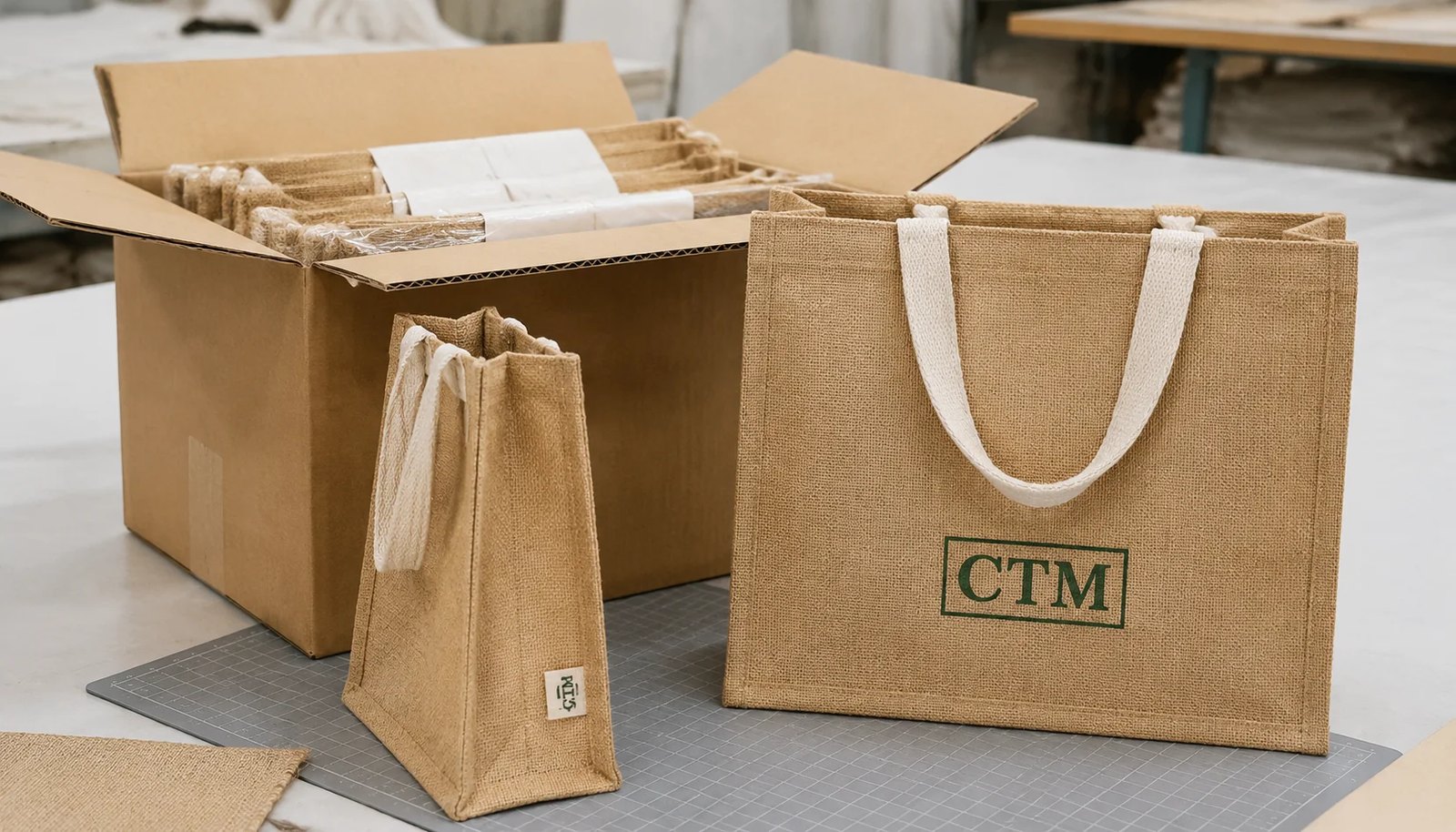
Why carton planning matters more for jute than for flat cotton totes
Jute tote bags are not difficult to manufacture, but they are easy to mis-pack. Natural grocer programs usually order bags with a wide gusset, laminated body, and firm cotton handles so the bag can carry produce, jars, and pantry items. Those features create bulk. If procurement treats the carton plan as a warehouse detail to be solved after production, the program can suffer higher freight cost, crushed panels, poor shelf presentation, and slower store distribution.
The buying problem is simple: the same jute tote unit price can produce very different landed costs depending on how many bags fit per carton and how that carton survives export transit. A supplier can quote a low FOB price by using thinner jute, loose bulk packing, oversized cartons, or cartons too heavy for your distribution center. The buyer sees the problem only when the forwarder receives cube data or when store staff open distorted bags.
- Jute is thicker and less compressible than cotton canvas, so carton cube becomes a real cost driver.
- Laminated jute holds shape better but traps air and increases carton volume.
- Wide gussets improve grocery use but reduce pieces per carton.
- Natural fiber odor and moisture need more attention during packing than synthetic nonwoven bags.
Start with the bag size and grocery load before choosing carton count
A carton plan cannot be accurate until the finished tote dimensions are locked. For natural grocers, a common reusable jute tote may be around 13-15 inches wide, 14-16 inches high, with a 6-8 inch gusset. Larger market totes may look better in promotional photos but can reduce carton efficiency quickly. A half-inch change in gusset depth can multiply across every folded bag in the carton.
The load target also changes construction. If the bag is only a low-cost gift with purchase, lighter jute and simpler handles may be acceptable. If it is a paid checkout bag expected to carry bottles, produce, and dry goods, the buyer should plan stronger handle stitching, bound seams, and a carton count that does not crush reinforced corners. Avoid copying a competitor's bag dimensions without testing how your carton quantity, store shelf space, and pallet height will work.
- For checkout resale: prioritize upright shape, consistent print, and clean carton opening for store staff.
- For event giveaway: lower GSM may be acceptable, but carton labeling and fast allocation matter more.
- For private label retail: presentation condition after unpacking is part of product quality.
- For distributor replenishment: standardized carton quantities reduce counting and inventory disputes.
Fabric weight and lamination change both bag quality and freight math
Jute fabric for grocery totes is often specified by ounce weight or GSM, but suppliers may describe it differently depending on mill source. A practical range for natural grocer programs is about 14 oz to 16 oz jute, roughly 380-450 GSM in many constructions. Below that range, the bag may still function, but panels can wrinkle, print edges break up, and the tote may not sit well at checkout. Above that range, the bag feels premium but carton weight and freight cube increase.
Lamination is a separate decision. A laminated inner surface helps the bag keep shape and gives better resistance to light moisture from produce or refrigerated items. It can also reduce fiber shedding inside the bag. The tradeoff is stiffness, odor risk, and larger packed volume. When quoting, separate the base fabric weight from lamination thickness or coating type. Two suppliers may both say 'laminated jute tote' while delivering different hand feel, odor, and carton compression behavior.
- Use 12 oz or lower only for short-term promotions where price and weight dominate.
- Use 14-16 oz for mainstream natural grocer checkout and loyalty programs.
- Use heavier jute only when the bag is sold as a premium reusable item and the freight budget supports it.
- Require the pre-production sample to be packed for 24-48 hours before odor review if the bag is laminated.
Print method should be chosen before final packing trials
Most natural grocer artwork uses one to three solid colors, making screen print the usual choice for jute tote bags. The rough woven surface does not support tiny type, thin strokes, or smooth gradients as cleanly as canvas. A logo that looks sharp on a digital proof can look broken on coarse jute, especially if the print crosses thick yarn slubs. Buyers should approve a real print strike-off on the actual jute fabric, not on cotton or paper.
Print can influence packing because ink curing time and surface friction affect whether bags can be stacked without transfer marks. Dark green, black, and deep brown inks are common for natural grocery branding, but heavy ink deposits may need longer drying. If bags are packed too soon, the front panel can mark the back of the next bag. For detailed multi-color artwork, heat transfer may be considered, but it needs testing for adhesion, edge lifting, and visual compatibility with the natural jute texture.
- Keep small text at a practical height; many jute prints perform better when letters are bold and open.
- Avoid large solid ink blocks unless the supplier can show even coverage on the selected weave.
- Approve Pantone targets with tolerance because natural jute base color shifts final ink appearance.
- Do not allow bulk packing until ink cure and rub performance match the approved sample.
The carton quantity is a sourcing decision, not just a packing detail
For medium jute grocery totes, 50 pieces per master carton is a common starting point. For oversized laminated totes, 25 pieces may be safer. The right number depends on finished dimensions, folded thickness, handle bulk, and carton weight. The procurement team should set a maximum carton weight with the warehouse before finalizing the purchase order. Many retail and distributor operations prefer cartons that stay around or below 18-20 kg for manual handling.
Overpacking creates hidden cost. Heavy cartons split at the corners, deform the bags at the bottom, and slow unloading. Underpacking also costs money because the container ships air. The factory should perform a packed carton trial using the actual pre-production bag, not a paper estimate. The trial should record carton inside dimensions, outside dimensions, gross weight, net weight, and photographs showing the packing direction. This data should be part of the final quotation.
- Use 25 pcs per carton when the tote has a large gusset, heavy lamination, rigid base insert, or premium retail presentation.
- Use 50 pcs per carton for standard grocery totes if weight and panel compression remain acceptable.
- Use inner packs of 10 pcs when stores or distributors need easy counting.
- Avoid random carton counts because they create receiving errors and purchase order reconciliation problems.
Inner packing affects damage rate, store labor, and sustainability claims
Natural grocer buyers often prefer reduced plastic, but the packing still has to protect the product. Loose bulk packing may look sustainable on paper, yet it can cause abrasion, bent corners, and dirty panels if cartons shift during ocean or truck movement. A practical compromise is flat packing with paper bands, recyclable inner bags, or 10-piece bundle sleeves depending on the brand's packaging policy and the shipping route.
The inner pack should match downstream handling. If the distributor allocates 30 bags per store, bundles of 10 make sense. If cartons go directly to a checkout display area, the master carton should open cleanly and allow staff to remove bags without unfolding a tangled stack. For retail resale bags with hangtags or barcodes, protect the tag from bending and ink rub. A low-cost inner packing choice can create avoidable store labor across hundreds of locations.
- Paper bands are low plastic and easy for store staff, but they provide less moisture protection.
- Recyclable poly inner bags protect from dust and humidity, but may conflict with plastic reduction goals.
- Individual polybags are usually unnecessary for grocery totes unless sold as premium retail items.
- Bundles should face the same direction so staff can count and display without re-sorting.
MOQ logic: carton planning becomes harder with many artwork versions
A natural grocer program may include regional logos, seasonal messages, vendor sponsor logos, or store-opening versions. Each variation affects MOQ, print setup, carton labels, and inspection sampling. A factory may accept 500 pieces per artwork, but the unit price and packing accuracy become less attractive if every small run needs separate screens, separate inner packs, and separate carton marks. The buyer should decide which variations are commercially necessary before quote comparison.
A sensible RFQ groups the order by size and construction first, then lists artwork versions under that shared base spec. This allows the supplier to calculate fabric purchasing and cutting more efficiently. If the program needs many versions, standardize carton count across all versions when possible. Mixed packing can be arranged, but it should be described clearly: carton by single SKU, carton by store allocation, or mixed master carton with inner pack labels. Unclear mixing instructions are a common source of shipment disputes.
- Expect stronger pricing when one bag size, one fabric, and one handle color are used across all artwork.
- Below MOQ, setup fees and cutting loss often matter more than raw material cost.
- Separate SKU carton marks prevent warehouse confusion when artwork differences are small.
- If mixed cartons are required, define the exact unit mix and label format before production.
Quote data that procurement needs for landed-cost comparison
A jute tote quotation without carton data is incomplete. Procurement teams comparing suppliers should request unit price, sample cost, mold or screen cost if any, fabric specification, print method, MOQ, lead time, and packing details in the same quote sheet. The freight team needs master carton dimensions, gross weight, net weight, pieces per carton, and CBM per 1,000 pieces. Without that information, the lowest unit price is only a partial number.
When comparing suppliers, calculate estimated landed cost per usable bag. This includes FOB or EXW price, inland freight if relevant, export carton cost if charged separately, ocean or air freight based on CBM or chargeable weight, duty and broker fees where applicable, and expected damage or repacking allowance. Jute totes are dense but bulky enough that both weight and cube matter. A slightly higher unit price with tighter carton cube and stronger export packing can be cheaper after receiving.
- Request CBM per carton and CBM per 1,000 pieces for fast quote comparison.
- Record gross weight, not only net weight, because freight and handling use gross figures.
- Clarify whether quote includes inner packing, carton labels, barcode stickers, and palletization if needed.
- Compare the cost impact of 25 pcs versus 50 pcs per carton before locking the PO.
Sample approval should include a packed carton review
Many buyers approve the bag sample but never approve the packed condition. That leaves the factory to choose the final fold, bundle direction, and carton fill during mass packing. For jute tote bags, the packed sample review should include at least one finished bag stored in the intended fold and inner pack. For larger orders, a pilot carton or packing photos should be approved before final production packing starts.
The sample approval form should cover fabric hand feel, finished dimensions, handle strength, print color, print placement, odor, fold line, and recovery after unpacking. If the bag has a laminated body, open the packed sample after it has been sealed for a day. If the smell is unacceptable in the sample stage, it will be worse when thousands of pieces are packed into a container. Also check whether fold marks run through the logo, because a creased logo panel looks poor at checkout even if the bag is technically usable.
- Approve a production fabric swatch before cutting if jute shade matters to the brand.
- Approve a print strike-off on the actual jute surface before mass printing.
- Approve the pre-production sample with final handles, binding, lamination, label, and carton fold.
- Keep one signed approval sample at the factory and one with the buyer for final inspection comparison.
Lead time risks: fabric, curing, inspection, and vessel cutoff
Typical lead time depends on order size, fabric availability, artwork complexity, and approval speed. For a standard custom jute tote program, buyers often plan several stages: artwork confirmation, fabric sourcing, sample making, sample approval, bulk cutting, printing, stitching, curing or airing, final inspection, packing, and export handover. The clock should not start vaguely from the first email. It should start from confirmed artwork, approved sample, deposit or payment arrangement, and available production slot.
Carton planning can affect schedule. If the supplier discovers during packing that cartons are too small, too weak, or too heavy, shipment can slip while new cartons are made. If barcode labels or store allocation marks arrive late, finished goods may sit unpacked. A procurement calendar for natural grocer launches should include buffer for packed sample review and final inspection, especially before seasonal campaigns, Earth Month promotions, store openings, and loyalty program resets.
- Reserve time for real jute print strike-off because artwork may need line-weight adjustment.
- Add airing time for laminated bags before final sealing into cartons.
- Schedule inspection when at least 80 percent is produced and packed, unless your QC plan states otherwise.
- Do not book freight based on estimated carton size if the order is large enough for carton cube to affect cost materially.
Specification comparison for buyers
| Spec decision | Recommended option | When it fits | Buyer risk to check |
|---|---|---|---|
| Jute fabric weight | 14 oz to 16 oz jute or approximately 380-450 GSM depending on yarn and weave | Regular grocery retail programs needing a natural look with enough body to stand on shelf or at checkout | Low GSM may reduce carton weight but causes limp panels, wavy printing, and higher rejection in store displays |
| Bag construction | Laminated jute body with cotton webbing handles and bound seams | Programs needing better shape retention, moisture resistance during transit, and stronger seams for heavier grocery use | Lamination can create odor if poorly cured; require sample airing and odor approval before bulk cutting |
| Carton packing count | 50 pcs per master carton for medium grocery totes; 25 pcs for oversized or heavy laminated bags | Balances warehouse handling weight, cube efficiency, and reduced bag crushing | Cartons above 18-20 kg can face handling damage, retailer DC objections, or higher injury risk |
| Inner packing | Flat packed with 10 pcs per paper band or recyclable inner bag | Good for store allocation, counting, and reduced repacking at distributor warehouses | Loose bulk packing saves cents but increases abrasion, folded corners, and counting disputes |
| Print method | Screen print for 1-3 solid colors; heat transfer only for detailed tonal artwork after lamination test | Natural grocer logos, campaign slogans, and simple seasonal graphics | Jute texture breaks fine lines; require actual jute strike-off, not only digital proof |
| Carton material | 5-ply export carton, around 200 lb burst or equivalent, with moisture-resistant tape | Ocean shipment, mixed container loading, and distribution to multiple store locations | Weak cartons collapse because jute bags are dense and edges press against carton walls |
| MOQ structure | 500-1,000 pcs per size/color/artwork, with carton plan finalized before price lock | Natural grocers testing a local store group or regional branded reusable bag program | Small MOQs with many artwork versions increase setup cost, carton labels, and picking errors |
| Landed-cost quote basis | Quote by bag unit plus carton dimensions, gross weight, net weight, CBM, HS code, and packing count | Importers comparing FOB, EXW, or delivered warehouse quotations | A cheap unit price can lose margin if carton cube is inefficient or gross weight is missing |
Buyer checklist before sampling
- Define the bag use case: checkout resale, loyalty giveaway, vendor-funded promotion, private label retail, or store opening kit.
- Lock the finished bag size, gusset depth, handle length, and load expectation before discussing carton quantity.
- Specify jute GSM or ounce weight, lamination preference, handle material, seam binding, and whether the bag must stand upright.
- Provide artwork at final size with Pantone references and confirm whether the design uses solid colors, gradients, or small text.
- Require a physical sample packed in the proposed inner packing so the team can review creasing, odor, print coverage, and carton fit.
- Set carton weight limits acceptable to your warehouse or retail DC, typically keeping master cartons near or below 18-20 kg.
- Request carton dimensions, packing count, gross weight, net weight, and CBM in the quotation, not after purchase order release.
- Confirm inner pack allocation, carton marks, barcode label position, and whether cartons ship by store, SKU, or bulk warehouse.
- Build approval time for fabric, print strike-off, pre-production sample, and carton drop or stacking review into the launch calendar.
- Compare quotes using landed cost per usable bag, including estimated damage, repacking labor, and warehouse handling, not only FOB unit price.
Factory quote questions to send
- What jute weight, yarn count, and construction are included in your quoted price, and is the sample made from the same bulk fabric?
- Is the bag laminated or unlaminated, and what odor control or airing time is planned before final packing?
- What finished bag dimensions and tolerance are you quoting, including gusset depth, handle length, and seam allowance?
- Which print method is included, how many colors, what maximum print area, and what ink system works best on this jute surface?
- What MOQ applies per size, fabric color, handle color, and artwork version, and what surcharge applies below MOQ?
- How many pieces per inner pack and master carton are assumed in the quote?
- What are the master carton dimensions, gross weight, net weight, and CBM per 1,000 pieces?
- What carton strength, flute type, and sealing method will be used for export shipment?
- Can you provide a packed pre-production sample or packing photo before mass shipment?
- What lead time starts after which approvals: artwork, deposit, fabric availability, print strike-off, or final packed sample?
Quality-control points to confirm
- Fabric weight tolerance should be agreed before bulk production; common acceptance is within approximately plus or minus 5 percent if the hand feel and strength match the approved sample.
- Finished bag dimensions should be measured flat, including width, height, gusset, and handle drop; typical tolerance is plus or minus 5 mm for small dimensions and plus or minus 10 mm for larger panels.
- Print placement should be centered within agreed tolerance, usually plus or minus 5 mm to 8 mm depending on bag size and jute surface variation.
- Print adhesion should pass a basic rub test after drying; dark ink on natural jute should not transfer heavily onto tissue or adjacent bags.
- Handles should be bar-tacked or box-stitched consistently, with no skipped stitches, loose thread nests, or weak top edge attachment.
- Seams and binding should be checked for raw jute shedding, open stitching, and inconsistent corner finishing.
- Odor must be reviewed after bags sit sealed in the proposed inner packing for at least 24 hours, especially for laminated jute.
- Cartons should be weighed and measured during final inspection; any change in carton quantity can change freight cost and warehouse handling.
- Packed cartons should show no severe bulging, crushed corners, or excessive void space after normal stacking.
- Carton labels should match SKU, artwork version, quantity, purchase order, and destination requirements before container loading.