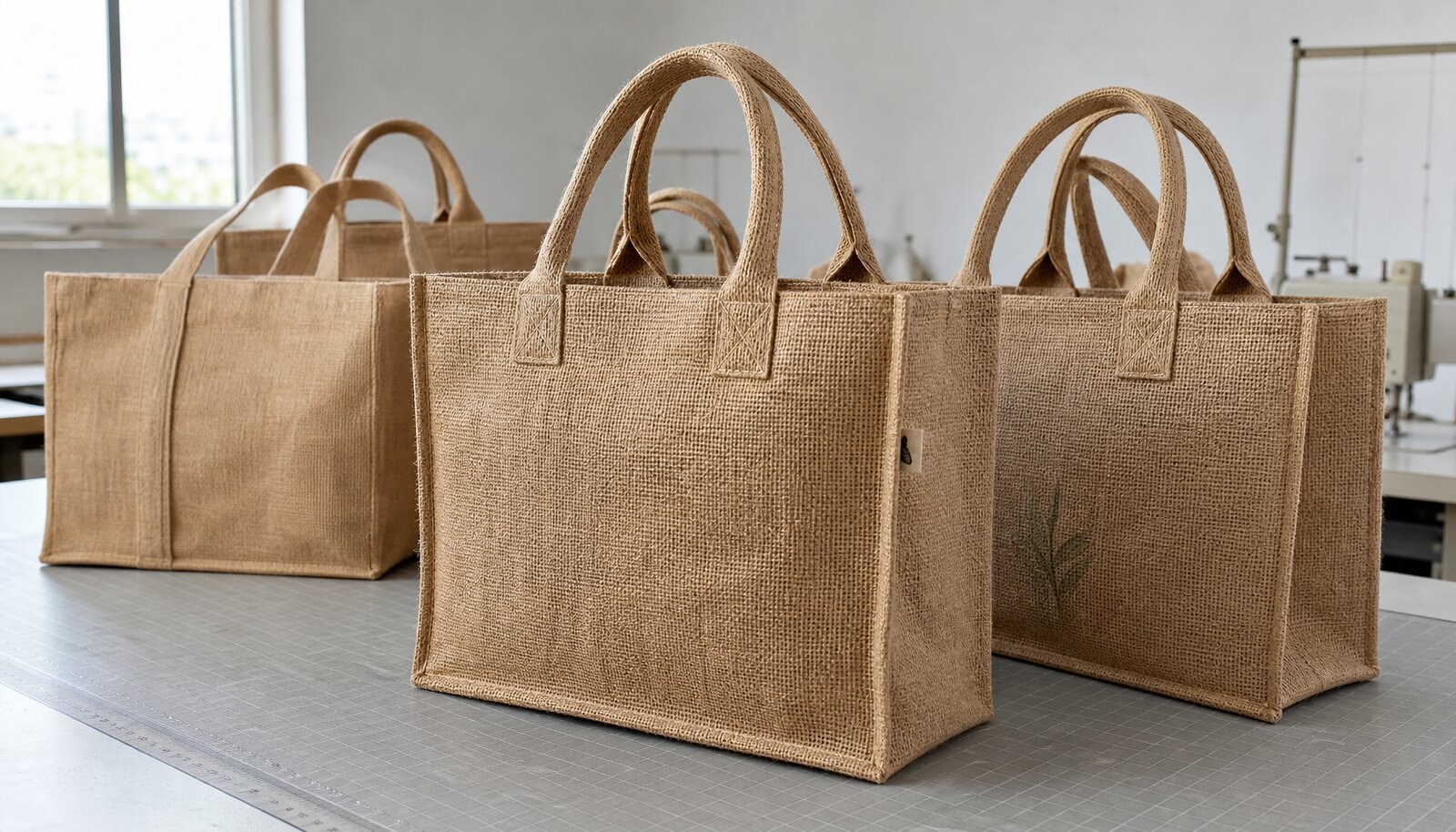
Why gift shop jute tote RFQs go wrong
Most jute tote RFQs fail before pricing starts. The buyer sends a logo, a rough size, and maybe one reference image, then suppliers fill in the blanks with their own assumptions. That is how you end up comparing quotes that are not actually the same product. One factory prices a 350 GSM unlaminated tote with cotton web handles and a single-color print; another quotes a heavier laminated body with self-fabric handles, a different carton pack, and a different folding method. The unit price may look close, but the landed cost, retail feel, and replenishment risk are not comparable.
Gift shops have a different use case from grocery, trade show, or pure promotional buying. The bag has to look natural on a hook or shelf, keep its shape after handling, and still feel like a product the shopper wants to pay for rather than just a free giveaway. If you are buying for a museum store, resort shop, zoo gift shop, heritage site, airport retail kiosk, or tourist market, the tote often becomes a takeaway item that has to help sell itself. That means the RFQ has to define display value, print quality, folding behavior, and shelf-ready packing as clearly as it defines size.
Procurement teams also need to watch the hidden source of quote drift: terms. A quote that looks lower may exclude sample freight, surcharge for color matching, carton changes, barcode labels, or packing labor. Another supplier may quote a higher unit price but include stronger stitching, a better carton spec, and a cleaner sample approval process. If the brief is not written tightly, the cheapest line item can become the most expensive purchase once freight, inspection, and rework are counted.
- Do not compare quotes unless fabric, print, handles, packing, and carton count are written the same way.
- Treat the tote as both a merchandise item and a shipping item; it has to work in-store and in transit.
- Ask suppliers to quote the same structure: material, construction, printing, packing, and one-time charges.
Start with the right jute construction and GSM
For gift shops, the most common body spec is a 10x10 or 11x11 jute weave in the 320–450 GSM range. That range usually gives enough body for shelf appeal without pushing the tote into a rigid or overly rustic look. If the bag is too light, it wrinkles badly, collapses on a hook, and can feel inexpensive. If it is too heavy, you often pay more for material and freight without improving customer perception enough to justify the cost. A good buyer spec should name either the target GSM or the weave count and allow only a narrow tolerance.
Lamination changes the whole user experience. A light internal lamination can help with moisture resistance, reduce fiber shedding, and keep prints from bleeding through the weave. But it also changes stiffness, fold behavior, and the way the bag sits in display. For souvenir shops in humid, coastal, or high-traffic locations, lamination can be useful. For premium artisan retail or natural-style destination stores, an unlaminated surface may sell better. If you need lining, the RFQ should state whether it is full lining, partial top lining, or only a reinforced base panel. Do not leave that choice to supplier discretion.
A practical buyer should also specify what the jute is trying to achieve in retail terms. If the tote is meant to sit beside candles, guidebooks, apparel, or boxed gifts, the body needs enough structure to stand up visually. If it is meant to be folded, stuffed into another bag, or sold as a low-cost souvenir, a lighter and simpler build may be better. The right spec is not the thickest fabric you can buy; it is the fabric that fits the retail job and the freight budget.
- Use one of these body specs as a starting point: 320–450 GSM natural jute for standard retail totes.
- Choose lamination only if the bag needs moisture resistance, print backing, or extra structure.
- State tolerance for GSM, weave count, and thickness so the factory cannot swap in a different fabric lot.
Size, handle, and structure should match the gift-shop use case
A practical gift-shop tote usually sits in the medium retail range: enough room for souvenirs, books, candles, apparel, or boxed gifts, but not so large that it feels like a market bag. A common working size is around 30–35 cm wide, 25–40 cm high, with a gusset of 10–15 cm. Handle drop matters as much as bag size. If the handle is too short, the tote is awkward on the shoulder and hard to carry when the shopper already has other purchases. If the handle is too long, the bag loses its compact retail look and can hang lower than the buyer intended. Include the full handle length and handle drop in the RFQ, not just the material type.
Construction details affect rejection rates more than many buyers expect. Reinforced top edges, bartacked handle ends, and even gusset folding improve retail durability and reduce customer complaints. If the bag needs to stand upright for display, ask for a reinforced base insert, a heavier body weight, or a folded bottom construction that creates a more stable footprint. If you want a softer, foldable souvenir tote, keep the build simpler and avoid unnecessary internal support. These decisions change both price and freight volume.
It also helps to define the tote’s “load story” in practical terms. For example, tell the factory whether the bag will carry folded textiles, small boxed gifts, books, or mixed souvenirs. You do not need to invent lab-style claims, but you do need to tell the supplier what the bag must survive in real use. That gives the factory a clearer basis for handle reinforcement, seam spacing, and top-edge finishing.
- Specify bag width, height, gusset, handle drop, and handle width.
- State whether the tote must stand upright, fold flat, or carry a fixed load target in normal retail use.
- Use bartack or box-X reinforcement at handle stress points for repeated store handling.
Print method drives appearance, MOQ, and reject risk
The safest print methods for jute tote bags are usually screen print for one or two solid colors, or transfer/digital print for shorter runs with more complex artwork. Jute is not a forgiving surface for tiny text, gradients, or soft photographic detail. If your artwork includes thin lines, legal text, or a very small destination mark, ask the factory to confirm the minimum readable line width before you approve the design. Otherwise, the bag can pass a basic inspection and still look weak on the shelf.
For gift shops, print placement matters as much as print method. A logo can be centered on the front, placed low with a larger blank upper panel, or printed on both sides if the bag is meant to function as a souvenir item with visible branding from either direction. Each option changes ink usage, setup cost, and visual impact. If you need multiple colorways, ask whether the supplier can reuse the same screen setup or whether each colorway creates a new setup charge. That is one of the most common hidden cost drivers in jute tote sourcing.
Procurement buyers should also ask how the supplier controls registration and color consistency. A quote that says “screen print” is not enough. The supplier should state how many colors are included, how print position is measured, what tolerance they allow for shift, and whether they will share a strike-off or print proof before mass production. That is especially important if the tote is sold in a gift shop where the print is part of the brand story, not just decoration.
- Use screen print for simple brand marks, destination graphics, and one- or two-color art.
- Use transfer or digital print only when the design complexity justifies the added cost.
- Ask for print size in millimeters and the exact position from the top edge and side seam.
Use MOQ logic to avoid false low quotes
MOQ in jute tote sourcing is rarely just a production number. It is usually tied to fabric cutting efficiency, print setup, and packaging labor. A factory may accept 300 pieces for a stock-style bag, but if your art, size, and packing are all custom, the real economic MOQ may be 500 to 1,000 pieces per design or color. If you push below that, the price often rises through setup recovery or the supplier may quietly substitute stock materials. That is why buyers should request MOQ stated in three parts: per design, per color, and per carton configuration.
If you are sourcing through a trading company, the MOQ may be lower on paper because the trader aggregates orders. That can help test a market, but it often comes with less control over fabric lots, print matching, and carton consistency. For direct factory sourcing, the MOQ is usually more transparent and the unit price is better once the spec is stable. The decision is not just about volume; it is about how much control you need over repeat production and continuity for replenishment orders.
For procurement teams, the useful question is not “What is your MOQ?” but “What MOQ is tied to this exact spec, with this print method, this packing, and this carton count?” That extra sentence forces the supplier to price the real product instead of a loose version of it. If you are planning seasonal replenishment for gift shops, a higher but stable MOQ can be better than a low first-order promise that cannot be repeated on the same terms later.
- Separate MOQ by design, color, and packing so the supplier cannot hide setup costs.
- Expect lower price efficiency once the order drops below the factory's cutting and print sweet spot.
- For repeat gift-shop programs, prioritize reproducibility over the lowest first-order MOQ.
Use the comparison table to choose the right spec, not just the cheapest one
This is where the RFQ becomes more useful than a simple price sheet. The comparison table below is meant to help gift-shop buyers decide which spec choices are worth paying for and which are only adding cost. A jute tote is a small-ticket item, but the spec still has to match how the bag will be sold, carried, displayed, and replenished. A bag that feels right in-store and packs efficiently in cartons will usually outperform a slightly cheaper bag that looks rough or arrives distorted.
The key is to read the table as a trade-off map. Fabric weight influences shelf structure and freight. Lamination influences feel and moisture resistance. Handle construction influences durability and customer experience. Print method influences artwork flexibility and reject risk. MOQ route influences whether the order is better suited to a direct factory or a trading-company path. None of these choices should be made in isolation.
A procurement team should use the table in the RFQ discussion and ask suppliers to confirm where they are willing to hold spec, where they need a tolerance range, and where an upgrade changes the price materially. That makes quote comparison clearer and reduces the chance that one supplier silently improves or downgrades the build to win the order. In short: compare on the same spec, then choose the route that fits your order size and retail goal.
- Write decisions in measurable language, not only descriptive wording.
- Ask for sample photos plus one physical approval sample for important orders.
- Keep quotation, sample approval, and inspection notes tied to the same spec version.
Sourcing route comparison for gift-shop jute tote buyers
Gift-shop buyers often assume the cheapest route is the best route, but that is rarely true once MOQ, print control, and communication speed are included. Direct factory sourcing gives you the cleanest technical line of sight: you can ask for stitch details, construction photos, and a pre-production sample that matches your approved brief. This route is usually best when the tote will be replenished, printed with destination artwork, or sold as a core retail SKU that must stay consistent across seasons.
Trading-company sourcing can work well when you are testing the market, buying mixed SKUs, or combining tote bags with other gift items in the same shipment. The convenience is real: one contact, one consolidated order, and sometimes a lower apparent MOQ. The tradeoff is less direct control over the actual factory floor, which can matter when you care about print accuracy, packing standardization, or a specific fabric lot. If the tote is a one-time seasonal item, that may be acceptable. If it is a repeat program, the lack of transparency can become expensive.
For gift shop procurement, the decision usually comes down to three questions. First, do you need the same tote to be repeatable in six months without visible changes? If yes, direct factory usually offers better continuity. Second, do you need a mixed basket of products in the same shipment? If yes, a trading route may save coordination time. Third, is your internal team equipped to manage sample approvals, QC notes, and carton specs directly with the factory? If not, a good trading partner can help, but only if the quote clearly shows what is included and where responsibility sits. Use the route that fits your operating model, not the route that merely produces the lowest first-page number.
- Direct factory is usually better for repeatable specs and stronger technical control.
- Trading route can fit mixed orders, small tests, or multi-item consolidation.
- Ask which route will own print matching, carton approval, and complaint handling after shipment.
How to read the factory quote without missing hidden costs
A proper jute tote quote should separate the bag price from one-time costs. Screen setup, plate fees, sample charges, special hangtags, barcode labels, and carton changes can distort the comparison if they are bundled into a single unit price. Ask for the full production structure before you judge the quote. If two suppliers are both quoting the same unit price but one includes heavier fabric, better handle reinforcement, and carton marks while the other includes only the naked bag, you are not comparing like for like.
Also check what the quote actually covers at the packing stage. Some factories quote ex-bag only; others include polybags, master cartons, carton marks, inner packing, and even moisture control. For retail buyers, packing is not a minor detail. It affects warehouse receiving, carton damage, merchandising, and sometimes the way the bag is displayed in-store. The quote should identify the exact packing unit, carton dimensions, and gross weight range. If your forwarder charges by volumetric weight, carton size becomes part of the cost of goods.
A useful RFQ also asks the supplier to name exclusions. That means asking what is not included in the quote: artwork revisions, extra sampling rounds, express courier for samples, color matching beyond standard tolerance, or special labels for the retailer. If the supplier does not list exclusions, the buyer should request them before issuing a purchase order. This one step prevents many “but that was extra” conversations later in the order cycle.
- Request separate lines for material, print, handles, packing, and one-time setup charges.
- Check whether the quoted price includes polybags, inserts, barcode labels, and carton marks.
- Compare carton size and gross weight because freight can erase a small unit-price advantage.
Sample approval should test more than the logo
For jute tote bags, sample approval should confirm the whole construction package, not just the artwork. A good pre-production sample should match the approved fabric weight, handle type, stitch pattern, print placement, folding method, and packing approach. The buyer should also verify the hand feel, edge fray level, odor, corner shaping, and whether the tote can hold the intended retail load without opening at the seams. If the sample looks right but the bag twists under load or collapses on a shelf, it is not approved.
Use a simple approval flow: strike-off or print proof first, then a full pre-production sample, then final production after written approval. If the supplier changes any element after approval, the buyer should treat it as a revision, not a normal variation. That includes a different weave, a different handle tape width, a new carton size, or a changed print color. In a retail program, those are not cosmetic changes; they can alter shelf appeal, customer handling, and return rates.
The approval note should be specific enough that another buyer could identify the same standard later. For example, do not just write “sample approved.” Write what was approved: fabric construction, handle width, stitch style, print position, carton quantity, and packing method. If there is an acceptable tolerance range, include it in the approval note. That protects both the buyer and the supplier when production later needs to be checked against the same reference point.
- Approve fabric, print, handle, stitching, size, and packing on the same sample whenever possible.
- Test the sample with the actual retail items you expect the tote to carry.
- Treat any post-approval material swap as a formal change, not a casual substitution.
Packing, cartons, and freight affect the real margin
Jute totes are bulky relative to their value, so packing efficiency matters. Bulk packing in polybags and master cartons is usually the most cost-effective route for wholesale shipments, but the carton count must be planned around warehouse handling and retail replenishment. If the bags are folded inconsistently, handles may crease or the front panel may arrive distorted. Ask the supplier to show carton packing photos or a packing diagram before production begins so you can see how the tote will be compressed, stacked, and sealed.
Carton spec should be written into the RFQ as clearly as the bag spec. A standard carton might hold a fixed count of folded totes with a target gross weight that suits your forwarder or distribution center. If your receiving warehouse has carton size limits, state them. If you need hanging labels or barcode stickers visible on the outer carton, include that too. Freight and warehouse labor often cost more than a print upgrade, so ignoring packing can undermine a good unit price. For gift shops, a bag that arrives with crushed handles or damp carton odor may still be usable, but it is not sellable at full retail presentation quality.
Buyers should also think through warehouse flow. If cartons are too heavy, staff handling slows down. If cartons are too large, they are harder to shelve and may push freight into a higher cost band. If each carton contains multiple SKUs or artwork variants, receiving becomes slower and errors become more likely. The goal is not just to protect the bag; it is to make the shipment easy to receive, store, and move into retail inventory without rework.
- Define carton quantity, carton dimensions, and gross weight target before quoting.
- Specify whether each tote is polybagged, banded, folded with tissue, or loose packed.
- Use carton marks that match your PO, SKU system, and receiving requirements.
Specification comparison for buyers
| Spec decision | Recommended option | When it fits | Buyer risk to check |
|---|---|---|---|
| Body fabric | 10x10 to 11x11 jute weave, about 320–450 GSM | Standard gift shop totes that need a natural look, moderate stiffness, and a clean shelf presentation | Too-light fabric collapses on hooks and in cartons; too-heavy fabric can look coarse, reduce foldability, and raise freight without improving sell-through |
| Lamination | No lamination or light PP/PE lamination only if moisture resistance or print backing is needed | Dry retail environments, coastal gift shops, or projects where the printed panel must stay flatter and more stable | Over-lamination can make the bag stiff, reduce the tactile natural feel, and cause cracking at folds or seams |
| Handle construction | Self-fabric or cotton webbing handles with bartacks or box-X reinforcement at stress points | Medium-size retail totes carrying souvenirs, books, candles, or packaged gifts | Short stitch runs, weak bartacks, or narrow handle tape can fail under repeated in-store use and customer returns |
| Print method | Screen print for 1–2 solid colors; transfer or digital only for small art runs or more complex artwork | Simple logos, destination graphics, museum-store marks, or tourist retail graphics | Fine gradients, tiny text, and dense detail can print muddy on jute and increase reject rates |
| MOQ route | 500–1,000 pcs per design/color for direct factory orders, unless stock materials are used | Most gift shops and distributors buying a first run with custom artwork and custom packing | Low-MOQ offers may hide setup fees, rely on stock sizes, or shift cost into sample, plate, or packing charges |
| Size strategy | One core size around 30–35 cm W x 25–40 cm H with a 10–15 cm gusset | Retail buyers needing a display-friendly tote that works for many souvenir and gift items | A bag that is too small limits product use; a bag that is too large adds material cost, freight volume, and shelf awkwardness |
| Packing method | Bulk packed in polybags plus master cartons with carton marks and a fixed folding method | Wholesale shipments where carton efficiency, barcode control, and receiving speed matter | Loose stacking can crush handles and distort shape; overpackaging can add freight cost and warehouse labor quickly |
| Supplier route | Direct factory for repeatable specs; trading company only when you need mixed items, consolidation, or very small runs | Brands and importers comparing long-term cost, control, and replenishment continuity | Trading layers can blur responsibility for print color, packing detail, and claims handling |
| Sample approval level | Pre-production sample with fabric, print, handle, and packaging approval | Any order with custom logo, destination artwork, retail labeling, or SKU-specific packing | Approving only a photo or fabric swatch leaves too many variables open for production changes |
Buyer checklist before sampling
- Final size with tolerance, including gusset and handle drop, so the tote fits the intended retail use, shelf layout, and customer carry comfort.
- Fabric weight target in GSM or weave count, plus whether the body is natural jute, laminated jute, or a jute-cotton blend.
- Print method, artwork format, logo size, color count, and Pantone target if color matching matters for brand or destination retail.
- Handle spec, stitching reinforcement, and whether the tote needs a top edge fold, binding, lining, or base insert.
- Packing requirement: polybag yes/no, carton size limit, carton mark text, barcode label, and master carton quantity.
- Target MOQ, sample approval steps, and the exact lead time you need from approved sample to ex-factory shipment.
Factory quote questions to send
- Please quote the tote with body GSM, size, gusset, handle type, print method, and packing stated separately so I can compare against other suppliers.
- What is your MOQ per design and per print color, and what changes in pricing if I reduce quantity or add a second artwork version?
- Can you separate one-time costs such as screen setup, plate cost, sampling, and carton tooling from the unit price?
- What pre-production sample will you send for approval, and will that sample match the final fabric, print, handle stitching, and packing method?
- What are your standard carton sizes, carton quantity, and master carton weight, and can you optimize for retail distribution freight limits?
- What tolerance do you allow for size, GSM, print placement, color shift, and handle length?
- How many production days do you need after sample approval, and what risks could extend the schedule?
- Can you share photos of similar jute tote production, close-up stitching, and carton packing before I issue the PO?
Quality-control points to confirm
- Fabric thickness and weave consistency match the approved sample; no thin patches, major slubs, weak corners, or loose weave that changes the tote shape.
- Handle bartacks are centered, even, and strong; no skipped stitches, broken thread, twist in the handle tape, or uneven handle length.
- Print placement is within agreed tolerance and the logo is readable; no bleeding, smearing, registration drift, or unexpected color migration.
- Cut edges, internal seams, and gusset corners are clean; no excessive fraying that affects retail appearance or customer handling.
- Carton packing protects the bag shape; no crushed handles, moisture damage, odor, mixed-size cartons, or distorted folding unless approved in writing.
- Final count, carton marks, and barcode labels match the packing list and the buyer's PO, with no SKU mix or label mismatch.