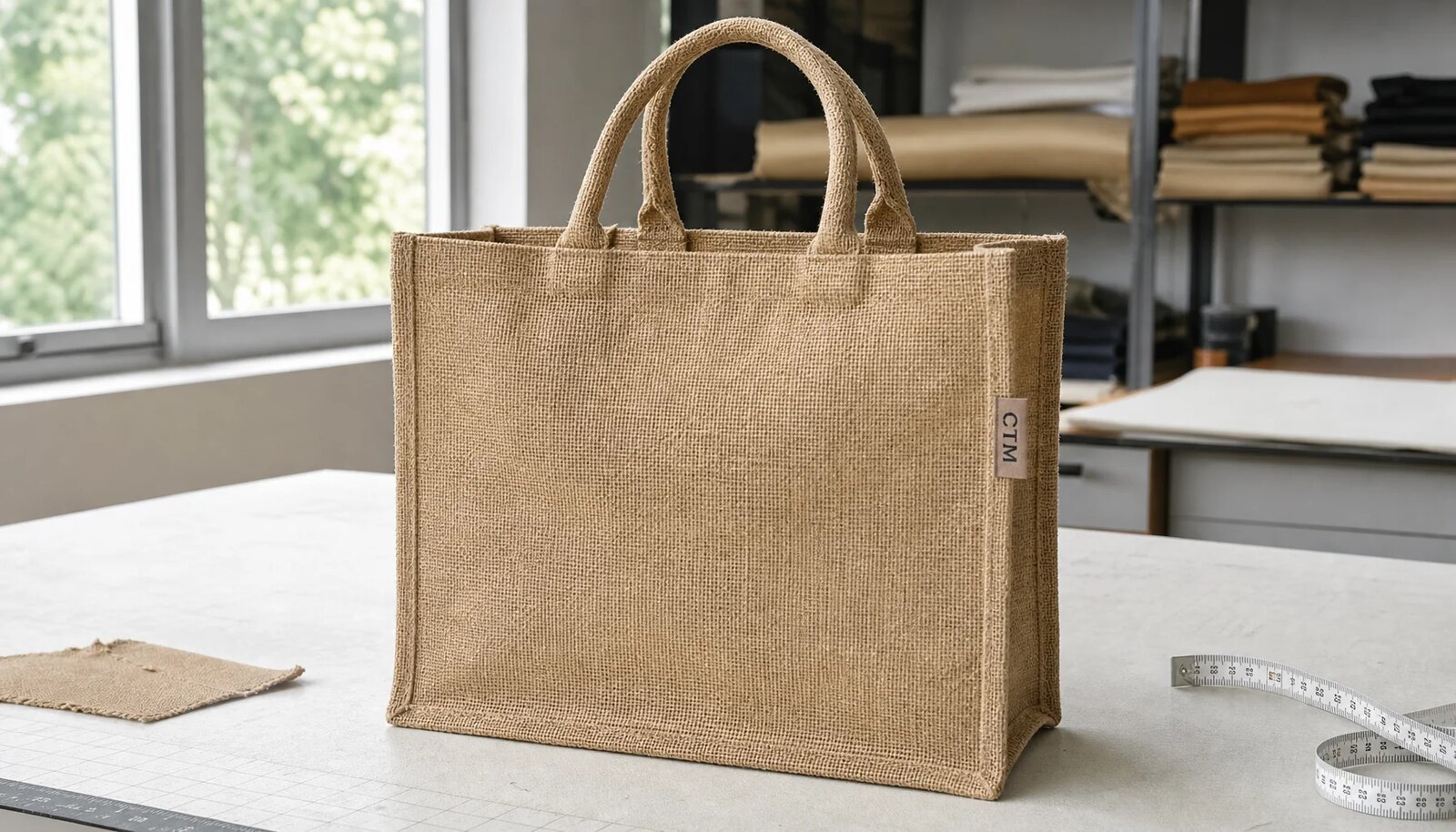
Start With the Event Job, Not a Catalog Name
A good RFQ for jute tote bags begins with the job the bag has to do. The phrase jute tote bag is too broad for procurement. It can mean a light flat handout, a gusseted registration tote, a laminated sponsor bag, or a retail-style piece with labels and individual packing. Those bags may look close in a thumbnail. On site, they behave differently. They carry different loads, take print differently, use different cartons, and create different receiving work.
Before asking suppliers for price, write the buying problem in plain operational terms. What will attendees place in the bag? Will the tote hold a notebook and badge packet, or a water bottle, apparel item, catalog, and boxed sample? Will it be handed out at a registration desk, pre-packed in a warehouse, shipped direct to multiple venues, or sold as branded merchandise? This context helps suppliers recommend realistic fabric weight, gusset depth, handle construction, and packing.
Event planners also need to decide what failure would look like. A low-cost giveaway can tolerate a softer body and simpler finish if contents are light. A sponsor gift bag needs a cleaner presentation, stronger handles, and print that photographs well. A retail-facing tote may need barcode control, hangtags, tighter appearance standards, and individual protection. Put those priorities in the RFQ so the supplier does not guess.
The strongest jute tote bags for event planners RFQ template guide is not a long wish list. It is a short, measurable brief that tells the factory how the bag will be used, how it will be inspected, and when it must arrive. Unit price still matters, but it should sit beside durability, sample approval, packing method, and lead time. Otherwise the lowest quote may simply be a quote for a different bag.
- Define the use case: attendee kit, sponsor gift, booth giveaway, merchandise tote, venue handout, or direct-mail insert.
- List typical contents and expected filled weight before choosing GSM or handle type.
- State the main priority: lowest cost, stronger carry, cleaner branding, eco-forward look, retail presentation, or speed.
- Name the receiving route: direct to venue, warehouse kitting, distributor, retailer, or multi-location shipment.
Turn the Request Into a Spec Sheet Suppliers Can Quote
Loose sourcing language creates quote noise. Words such as medium size, regular jute, long handles, nice print, and standard carton leave too much room for interpretation. One supplier may quote a flat 280 gsm tote with self-fabric handles. Another may price a gusseted 350 gsm bag with cotton webbing and a reinforced base. The numbers will look comparable in a spreadsheet, but the products are not the same.
Build the RFQ around finished measurements and named materials. Include finished width, height, gusset depth, handle drop, handle width, target jute GSM, construction finish, print method, print size, print placement, quantity, packing, delivery term, destination, and required in-hand date. Finished dimensions matter because cutting dimensions change after folding, hemming, and sewing. Print placement should be measured from fixed points such as top edge, side seam, or gusset fold.
Separate the base specification from optional upgrades. A base quote might cover natural jute, 320-350 gsm, 38 x 42 x 10 cm finished size, cotton webbing handles, one-color screen print, open top, and bulk pack. Optional lines can show laminated interior, cotton lining, zipper, snap, woven label, hangtag, individual polybag, tissue insert, reinforced carton, or upgraded print method. This keeps commercial decisions visible instead of hiding them inside one blended price.
The supplier response format is just as important as the buyer specification. Ask every supplier to return unit price, setup charges, sample cost, MOQ, price breaks, production lead time, sample lead time, packing details, carton dimensions, gross weight, incoterm, payment terms, quote validity, and exclusions. Missing fields are useful signals. If a supplier cannot say whether screen charges, courier samples, inland freight, or carton upgrades are included, the quote is not ready for a serious procurement comparison.
- Use finished measurements for bag size, gusset, handle drop, print area, and carton dimensions.
- Separate must-have requirements from optional upgrades so the cost impact is visible.
- Ask suppliers to list inclusions, exclusions, setup charges, sample fees, and quote validity.
- Keep incoterm, destination, quantity, artwork version count, and packing method consistent across suppliers.
Specify Jute Fabric, GSM, Finish, and Natural Variation
Jute is a natural bast fiber, so it will not look like smooth cotton canvas or synthetic nonwoven fabric. Some slubs, texture, fiber variation, and shade movement are normal. Procurement should allow for that character while still controlling the specification. The key is to define the fabric clearly enough that natural variation does not become an excuse for weak construction, dirty fabric, poor cutting, or mismatched production lots.
Fabric weight affects structure, print appearance, perceived value, and cost. Light giveaways may be quoted around 280-300 gsm when contents are modest and the program is price-sensitive. Many event totes sit more comfortably around 320-350 gsm, especially for registration kits, sponsor bags, conference merchandise, and repeat-use handouts. For heavier contents, larger gussets, bottles, catalogs, or retail-style use, ask whether 380 gsm, a reinforced base, or stronger handle reinforcement is recommended.
Do not buy by GSM alone. The same nominal weight can feel different depending on weave density, yarn quality, finishing, lamination, cutting, and storage. Ask whether the quoted GSM is measured before or after lamination. Ask whether fabric is in stock or needs to be ordered. Ask how the factory checks roll-to-roll shade and whether the bulk fabric will match the approved sample. If the supplier uses a fabric-weight tolerance, put that tolerance in the RFQ record.
Construction finish deserves its own line item. Unlaminated jute gives a raw, natural look and may be cost efficient, but the inside can shed fibers and the body may be softer. Laminated jute can create a cleaner interior and stiffer shape, though it may add film cost, lead time, and odor risk if packed before airing. Cotton or nonwoven lining improves the interior presentation but adds seam work, material checks, and inspection points. Buyers should choose the finish because it fits the event, not because the supplier defaulted to it.
- Use 280-300 gsm mainly for light giveaways with modest load expectations.
- Use 320-350 gsm as a practical starting point for many event and sponsor totes.
- Ask about 380 gsm, reinforced base panels, or stronger handle stitching for heavier kits.
- State the exact finish: unlaminated, laminated, cotton-lined, nonwoven-lined, laminated plus lined, or another construction.
Control Size, Gusset, Handles, and Carry Comfort
Capacity is more than width by height. A 38 x 42 cm flat tote and a 38 x 42 x 10 cm gusseted tote can look similar on a quote sheet, but they behave differently during kitting. The gusset affects whether bottles sit upright, whether catalogs bend, whether the bag stands on a table, and how easily an event team can pack contents at speed. If the bag needs to stand upright at registration or hold a folder without curling, say that directly.
Use finished dimensions in the RFQ. Sewing, hemming, folding, and pressing can change the final size, and jute can vary more than synthetic materials. A practical starting tolerance for many sewn jute totes is around +/-1 cm on body dimensions, with gusset and print placement controlled as tightly as the construction allows. For visible branding, print position often needs tighter attention, commonly around +/-0.5 cm to +/-1 cm depending on the artwork size, print method, and production setup.
Handles are a frequent complaint point because attendees feel them before they inspect the stitching. Cotton webbing is often more comfortable than self-fabric jute handles for bags carried around a venue for hours. Jute webbing can match the body but may feel rough if finishing is poor. Rope can look premium, although it may increase packing volume and change how the bag hangs. Specify handle material, width, finished drop, stitch pattern, and reinforcement method.
For heavier event kits, ask suppliers to test the pre-production sample with the expected filled weight. A simple loaded carry check can reveal weak corners, poor handle attachment, bag twisting, and uncomfortable grip. It also helps procurement avoid over-specifying fabric while under-specifying the part that actually bears the load. A sturdy body with weak handle stitching is still a failed tote.
- State finished bag dimensions, not only cut-panel dimensions.
- Define target filled weight and ask how handle reinforcement supports that load.
- Specify handle material, width, finished drop, stitch pattern, and attachment-point reinforcement.
- Ask whether the filled bag can stand upright or hang evenly if presentation matters.
Match Print Method to Artwork, Texture, and Sponsor Visibility
Jute texture changes what is possible with branding. The surface is coarse, the weave is visible, and small details can break up. A logo that looks crisp on screen may lose thin strokes, small reversed text, gradients, or fine sponsor marks when printed on natural jute. The RFQ should make the supplier prove print suitability before bulk production rather than discovering the limits after cartons are packed.
Screen printing is often the most practical method for event logos with one to three solid colors. It can provide good opacity when ink load, mesh choice, placement, and curing are handled well. Ask how many print colors are included, whether screen charges are separate, and how Pantone references will be interpreted on natural jute. Exact color matching may be difficult on a textured, naturally shaded base, so require an approved strike-off instead of relying only on digital proof.
Heat transfer can help with complex artwork, gradients, or smaller programs, but it must be tested on the actual jute being used. Some transfers look glossy or stiff because they sit on top of the weave. Others may have adhesion risk if the fabric is dusty, open, or uneven. Embroidery can work for simple marks but may distort coarse fabric and become expensive on larger designs. Woven labels, cotton patch labels, or stitched tabs are often better for buyers who want subtle premium branding with less ink coverage.
Artwork control should be exact and slightly boring. Send vector artwork, Pantone references, final print dimensions, and placement measured from the top edge, side seam, or gusset fold. Ask the supplier to identify risky details: thin strokes, small text, reversed marks, halftones, gradients, fine outlines, and sponsor logos. For multi-sponsor bags, check the smallest mark first. That is usually where print limitations show up.
- Use screen print for bold one- to three-color logos and simple sponsor marks.
- Use heat transfer only after appearance and adhesion are tested on actual jute.
- Consider woven labels, cotton patches, or stitched tabs for premium low-ink branding.
- Approve a physical print strike-off when logo clarity or sponsor visibility is important.
Build MOQ and Price Break Logic Before Negotiation
MOQ is rarely one simple number. It changes with fabric availability, bag size, gusset, lining, handle material, print method, color count, label requirements, packing format, and artwork version count. A supplier may accept a low MOQ for a standard blank natural jute tote made from stocked fabric. The same supplier may require a higher MOQ for custom dyed fabric, laminated interior, special handles, zipper closure, woven labels, and multiple sponsor versions.
Ask for MOQ by version, not only by total quantity. If the program needs 5,000 bags across five artwork versions, procurement needs to know whether the minimum is 5,000 total or 1,000 per artwork. If the same construction will be used for several regional events, ask whether production can be combined and shipped in split lots. If the product may repeat next year, ask whether reorder MOQ changes after screens, labels, or cutting patterns are already made.
Price breaks should reflect realistic buying decisions. Common request points might be 1,000, 2,500, 5,000, and 10,000 pieces, but the right levels depend on the event plan. Ask suppliers to separate unit price from setup charges, print screens, transfer tooling, label setup, sample cost, courier cost, and packing upgrades. That prevents a low unit price from hiding commercial items that will appear later.
When MOQ is too high, reduce variables first. Standard natural jute, one size, one handle construction, fewer print colors, fewer artwork versions, and bulk packing usually give suppliers more room. Requesting lower MOQ while adding custom lining, special labels, individual polybags, zipper closures, and multiple versions often pushes the quote in the opposite direction. A clean RFQ makes those tradeoffs visible before negotiation becomes circular.
- Quote MOQ by size, fabric, lining, handle, print version, label, and packing format.
- Ask for first-order MOQ and reorder MOQ separately.
- Request price breaks at realistic quantities such as 1,000, 2,500, 5,000, and 10,000 pieces.
- Reduce variables before pushing MOQ: standard fabric, one construction, fewer colors, or bulk pack.
Use Samples, Tolerances, and a Golden Sample to Stop Drift
A digital proof can confirm layout. It cannot confirm fabric feel, odor, stiffness, fiber shedding, seam strength, handle comfort, gusset behavior, or actual print opacity. For customized event totes, a couriered pre-production sample is worth the time, especially with a new supplier, new construction, new print method, tight event date, or high-visibility sponsor program. Photo-only approval leaves too much room for misunderstanding.
Review the sample against the written specification, not against memory. Measure width, height, gusset, handle drop, handle width, and print placement. Compare fabric texture and shade to the approved reference. Load the bag with realistic contents and carry it briefly. Check whether handles feel rough, whether seams pull, whether the base sags, and whether the bag twists when opened or filled. Look at the print under daylight and indoor light because event spaces rarely match factory lighting.
Set tolerances before the sample is approved. For body dimensions, a range around +/-1 cm may be realistic for many sewn jute totes, but confirm it with the supplier. Print placement may need tighter control, especially on simple front-facing logos. Handle length should not wander enough to make bags hang unevenly. Also define acceptable natural weave irregularity so inspectors know the difference between normal jute character and unacceptable holes, stains, oil marks, dampness, or severe shade mismatch.
Once approved, keep a signed golden sample. Pair it with the final artwork file, Pantone references, measurement sheet, tolerance sheet, defect notes, packing instructions, and written change log. If marketing adjusts the logo or operations changes packing, update the approval record. The golden sample is not ceremony. It is the practical reference for sewing, printing, final inspection, and dispute resolution.
- Request a couriered pre-production sample for new suppliers, new artwork, new construction, or fixed event dates.
- Measure the sample against the written RFQ and tolerance sheet.
- Test with realistic contents before approving handle comfort and seam strength.
- Keep a signed golden sample with final artwork, tolerances, and approved packing details.
Define Quality Control in Product-Specific Terms
Quality control should be written into the RFQ before production begins. Natural jute will show texture, slubs, and some shade variation, so the goal is not to demand a synthetic-perfect surface. The goal is to prevent real failures: broken handles, open seams, wrong artwork, severe print misplacement, dirty fabric, damp odor, excessive loose threads, weak corners, crushed cartons, incorrect counts, or mixed versions.
Start with measurements. Inspect finished width, height, gusset depth, handle drop, handle width, and print placement against the approved sample and tolerance sheet. Check fabric weight by roll record or cut-piece sampling so bulk production does not drift from the approved GSM range. Review panel alignment, top hem width, gusset symmetry, stitching tension, skipped stitches, thread tails, raw edges, and whether the bag twists when opened. Handle attachment points deserve special attention because that is where load failures often appear.
Print inspection should include opacity, registration, curing, edge definition, Pantone match range, placement, spelling, and small-text readability. A light dry rub check after curing can reveal obvious smearing, flaking, powdering, or abrasion risk. If the bag includes lining, lamination, pockets, zipper, snap, labels, hangtags, barcodes, or inserts, those components need their own verification against the quote and approved sample.
For larger orders, ask for inline and final inspection evidence. The report can be simple if it is specific: sample reference, inspection quantity, measured results, fabric checks, print checks, handle checks, defect count, carton count, and photos. If the buyer uses AQL, define product-specific critical, major, and minor defects. Critical defects might include wrong artwork or broken handles. Major defects might include open seams, severe stains, or badly shifted logos. Minor defects might include small loose threads within agreed limits.
- Set tolerances for dimensions, print position, handle length, shade range, and natural weave variation.
- Inspect cleanliness, seam alignment, handle reinforcement, print curing, and carton count.
- Ask for inline photos when production moves through cutting, sewing, printing, and packing.
- Define critical, major, and minor defects before final inspection.
Plan Packing, Cartons, and Delivery Around Receiving Work
Packing is not an afterthought for event orders. It affects landed cost, carton volume, unloading time, counting accuracy, product cleanliness, and the condition of bags when they reach the venue. A tote can pass factory inspection and still arrive wrinkled, dusty, damp, crushed, or hard to distribute if the packing plan is weak. Put packing details in the RFQ, not in a last-minute email after production starts.
Bulk packing is usually efficient when a warehouse, fulfillment partner, or event team will kit the bags with printed materials later. It reduces inner packing cost and can speed unpacking. Bundles can help counting if bundle quantities are consistent and clearly marked. Individual polybags are useful for retail presentation, direct mail, long storage, or dust-sensitive contents, but they add material, labor, carton volume, and sometimes odor risk if bags are sealed before airing. Use inner packing only when it solves a real handling problem.
Carton strength matters because jute bags are flexible and can lose shape under compression. Ask for export cartons suitable for the freight mode and handling plan. For heavier or higher-value shipments, many buyers request 5-ply export cartons rather than accepting vague standard carton wording. Keep gross weight manageable, especially for venue receiving where cartons may be moved quickly by a small team. Overweight cartons slow the event crew and increase damage risk.
Carton marks should be practical. Include item name, PO number, quantity, carton number, destination, event code, artwork version, and any location split. If bags are going to multiple venues, require version separation and carton-level labeling before shipment. Mistakes at this stage are expensive because the product may be correct but impossible to route cleanly under a fixed event schedule.
- Choose bulk pack for warehouse kitting and fast event-team unpacking.
- Choose individual polybags for retail presentation, direct mail, long storage, or dust protection.
- Specify pieces per carton, bundle count, carton dimensions, gross weight, carton ply, and shipping marks.
- Keep cartons light enough for practical venue receiving and local delivery handling.
Compare Suppliers by Landed Cost, Lead Time, and Control
A low unit price is not automatically the best buy for customized jute tote bags. Event orders carry deadline risk, artwork risk, packing risk, and receiving risk. Procurement should compare suppliers by total landed cost and control, not just ex-works unit price. A direct factory may offer stronger visibility when the buyer has a complete specification. A trading company may help coordinate mixed product sourcing, but the buyer should understand what is subcontracted and who manages QC. A local converter may help with urgent small runs, although material choices and unit costs may differ from offshore production.
Normalize each quote before ranking. Use the same bag size, GSM, handle type, lining, print method, quantity, artwork version count, packing method, incoterm, destination, and sample path. Then add the costs that often sit outside unit price: screen charges, transfer tooling, labels, hangtags, artwork adjustment, pre-production samples, courier fees, carton upgrades, inland freight, inspection, duty, taxes, customs broker fees, palletizing, and domestic delivery. A quote that includes stronger cartons and inspection cannot be compared directly with one that excludes them.
Lead time needs the same discipline. Work backward from the event date and include RFQ response, artwork cleanup, sample making, courier transit, buyer review, sample revision, material booking, cutting, sewing, printing, inspection, packing, export documents, freight booking, transit, customs clearance, domestic delivery, and kitting. Ask suppliers to break timing into sample lead time, production lead time, and shipping readiness. Also ask which step is most likely to cause delay.
The best supplier for an event program is usually the one that combines a clear quote, realistic schedule, acceptable sample, responsive communication, and documented inspection. Sometimes that supplier is not the cheapest on the first line of the spreadsheet. If the event date is fixed, simplifying the product can be a better procurement move than stretching production too tightly. Standard natural jute, fewer print colors, fewer artwork versions, or bulk packing may protect the schedule without weakening the attendee experience.
- Normalize quotes by specification, quantity, artwork versions, packing, incoterm, destination, and sample path.
- Add setup fees, sample fees, courier charges, freight, duty, taxes, inspection, carton upgrades, and domestic delivery.
- Ask who controls production, inspection, corrective action, and shipment release.
- Rank supplier fit by price, lead time, sample quality, communication clarity, and documentation.
Specification comparison for buyers
| RFQ decision | Procurement-ready specification | Best fit | Buyer risk to verify |
|---|---|---|---|
| Fabric weight | Ask suppliers to quote actual jute fabric weight, commonly 280-300 gsm for light giveaways, 320-350 gsm for standard event totes, and 380 gsm or reinforced construction for heavier kits. | Registration packs, sponsor giveaways, conference merchandise, retail-style handouts. | Too-light fabric can sag at the gusset, distort at seams, show inconsistent weave, or make ink coverage look patchy. |
| Bag size and gusset | State finished width, height, and gusset depth, plus measurement tolerance such as +/-1 cm for body size and +/-0.5 cm for gusset where realistic. | Programs holding brochures, bottles, apparel, catalogs, samples, or boxed inserts. | A flat tote may quote cheaper than a gusseted tote but fail during kitting, display, or attendee use. |
| Construction finish | Specify unlaminated, laminated interior, cotton-lined, nonwoven-lined, or laminated plus lined construction. Ask whether lamination thickness and lining GSM are included. | Eco-forward promos, premium sponsor kits, product sampling, retail-facing bags. | Lamination can add stiffness, odor risk, film cost, and lead time; lining adds sewing points and inspection work. |
| Handle type | Quote handle material, finished drop length, width, stitch pattern, and reinforcement. Common choices include cotton webbing, jute webbing, rope, or self-fabric handles. | Events where bags are carried for several hours or loaded with heavier contents. | Short handles, rough self-fabric handles, sparse stitching, and weak attachment points cause complaints even when the bag body looks acceptable. |
| Print method | Screen print for 1-3 solid colors; heat transfer only after adhesion testing on actual jute; woven or cotton label for subtle premium branding. | Simple event logos, sponsor marks, durable repeat programs, lower-ink brand placements. | Small type, thin strokes, gradients, weak curing, and poor ink opacity can fail on coarse jute texture. |
| Artwork control | Provide vector artwork, Pantone references, maximum print area, exact placement from top edge and side seam, and approved strike-off. | Any branded order with sponsor visibility, social photo exposure, or repeat use. | Words like centered, large logo, or standard placement create inconsistent supplier interpretations. |
| MOQ strategy | Quote MOQ by version: size, fabric, lining, handle, print color count, artwork version, label, and packing format. | Pilot orders, multi-sponsor versions, regional rollouts, reorder programs. | Combining too many variants can raise MOQ, hide setup costs, or make supplier quotes impossible to compare. |
| Sample path | Require a couriered pre-production sample, signed golden sample, approved tolerance sheet, and written change log before bulk production. | New suppliers, new print methods, tight event dates, high-visibility brand orders. | Photo-only approval misses handfeel, odor, stiffness, handle comfort, size variance, print opacity, and fiber shedding. |
| Packing format | Specify bulk pack, bundle count, individual polybag, tissue insert, carton ply, pieces per carton, carton dimensions, gross weight, and shipping marks. | Direct-to-venue shipments, warehouse kitting, retail-ready programs, multi-location distribution. | Extra inner packing, weak cartons, damp storage, or overweight cartons can change landed cost and receiving labor. |
Buyer checklist before sampling
- State finished bag width, height, gusset depth, handle drop, handle width, and target jute fabric weight in gsm.
- Define the expected filled weight and list typical contents such as notebook, water bottle, brochure set, apparel, catalog, or boxed sample.
- Specify whether the bag must stand upright when packed, fold flat for kitting, or hang evenly when carried.
- Name the construction: unlaminated jute, laminated jute, partial lining, full lining, interior pocket, zipper, snap, or open top.
- Confirm handle material, handle drop, stitch pattern, stitch density expectation, and reinforcement at attachment points.
- Attach vector artwork, Pantone references, print size, and print placement measured from the top edge, side seam, or gusset fold.
- Ask the supplier to confirm minimum readable line weight and text height on the actual jute weave before production.
- Request MOQ and price breaks by version, including size, lining, handle, print color count, label, and packing.
- Request a couriered pre-production sample and do not release bulk production until the sample and tolerance sheet are approved.
- Set tolerances for body size, gusset, handle length, print position, color variation, and acceptable natural weave irregularity.
Factory quote questions to send
- What actual jute fabric weight in gsm are you quoting, and is it verified by fabric roll record, supplier certificate, or factory measurement?
- For this bag size and target filled weight, do you recommend 280-300 gsm, 320-350 gsm, 380 gsm, or reinforcement? Please explain the tradeoff.
- Is the quoted price based on unlaminated natural jute, laminated jute, partially lined construction, or fully lined construction?
- What are the finished bag dimensions, gusset depth, handle drop, handle width, and expected production tolerances?
- What handle material and stitch reinforcement are included? Can you provide box stitch, cross stitch, or bar-tack reinforcement if required?
- How many print colors are included, and what are the setup charges for screens, transfers, labels, Pantone matching, or artwork adjustment?
- Can you test our artwork on the actual jute fabric and confirm minimum readable text height, line weight, and logo edge clarity?
- What is the MOQ by version, and does it change if we modify size, handle type, lining, print colors, label, or packing?
- Can you provide a couriered pre-production sample, and what measurements and tests will you verify before bulk production starts?
- What AQL or inspection method do you use for final inspection, and what defects are considered critical, major, and minor?
Quality-control points to confirm
- Measure finished bag width, height, gusset depth, handle drop, handle width, and print placement against the approved sample and agreed tolerance sheet.
- Check fabric weight by roll or cut-piece sampling so the production lot does not shift from the approved gsm range.
- Inspect weave consistency, natural shade range, slubs, holes, stains, oil marks, dampness, loose fibers, and obvious contamination.
- Check cutting accuracy, panel alignment, top hem width, gusset symmetry, and whether the bag twists when opened or filled.
- Inspect handle attachment points for stitch density, reinforcement pattern, skipped stitches, loose threads, broken yarns, and pull resistance under expected filled weight.
- Review seams for open stitches, uneven tension, puckering, raw edges, loose thread tails, and weak corners at the gusset and handle area.
- Inspect print opacity, registration, curing, edge definition, Pantone match range, position, spelling, and small-text readability under daylight and indoor light.
- Perform a light dry rub check after curing to detect obvious smearing, flaking, powdering, or abrasion risk before cartons are closed.
- Verify lining, lamination, labels, hangtags, inserts, closures, pockets, and reinforcement materials against the quote and approved sample.
- Review odor, moisture, and ventilation, especially for laminated, stored, dyed, or tightly packed jute.