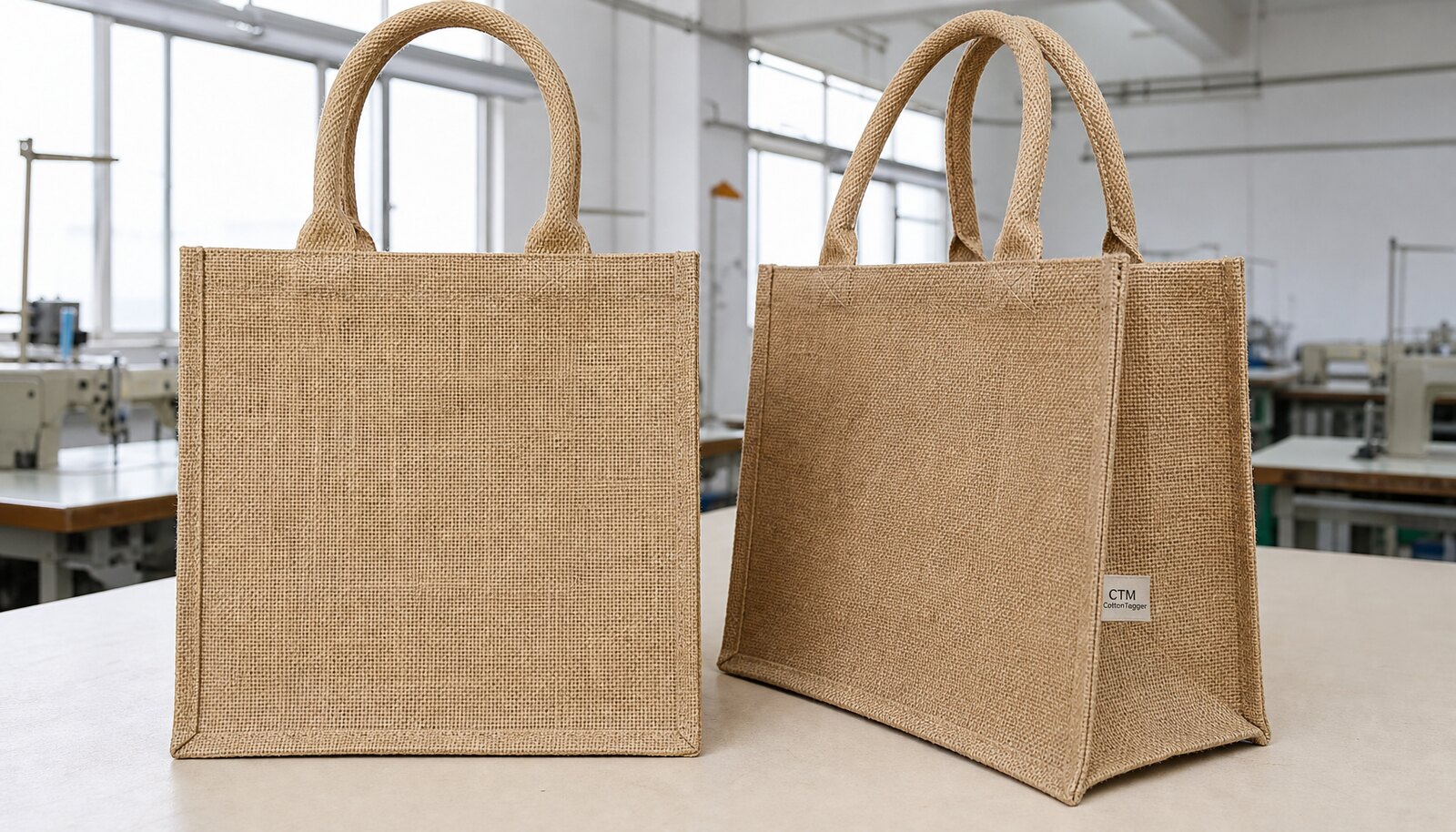
1. Start With the Gift Requirement
A useful jute tote bags RFQ template guide for corporate gifting begins with the job the bag must perform. A request such as “quote natural jute tote with logo” leaves too many blanks. One bidder may quote a light unlined event bag, while another includes lamination, individual packing, reinforced handles, export cartons, and inspection support. The prices look different because the products are different.
Open the RFQ with the program context: conference giveaway, employee welcome kit, client appreciation gift, holiday pack, retail-style event handout, or reusable shopping tote. Then list the actual contents. A tote carrying brochures and a notebook does not need the same base, gusset, lining, or handle reinforcement as one carrying bottles, boxed food, or dense tech accessories.
Appearance also matters. Natural jute has slubs, fiber texture, and shade variation. That can support a rustic brand position, but it may disappoint an executive-gift buyer if the bag arrives wrinkled, sheds heavily, or makes the logo look rough. State whether the target is rustic, economical, natural-but-clean, premium, structured, or retail-ready.
Fulfilment should be part of the opening brief. A tote shipped empty in bulk can be packed differently from one filled at origin or staged for a gifting table. If the tote must stand upright, protect a rigid box, or arrive with minimal creasing, the supplier needs to know before quoting.
- Name the program type, event date, required arrival date, and recipient level.
- List all contents with dimensions and estimated filled weight.
- State whether the tote ships empty, pre-packed, or repacked by a fulfilment partner.
- Define the visual target and whether natural jute variation is acceptable.
- Confirm whether the tote must stand upright, fold flat, or arrive presentation-ready.
2. Specify Construction in Factory Terms
Jute totes can look similar in product photos while using very different constructions. The RFQ should identify the outer jute fabric, lamination or backing, lining, gusset style, base structure, handle material, top finish, and reinforcement. Plain unlined jute offers a natural look, but may shed more fibers and show more weave variation. Laminated jute usually provides more body and shape retention. Lining gives the interior a cleaner finish and can protect gift contents from the coarse jute surface.
Avoid relying on words such as “eco,” “premium,” or “heavy duty” without component detail. Ask whether the bag is plain, laminated, dyed, cotton-blended, lined, backed, or coated. Ask whether the base is folded, boxed, built with a separate bottom panel, or reinforced with an insert. Ask whether the top edge is folded and stitched, bound, or finished another way.
For corporate gifting, base construction is often underestimated. A bag with the same front width and height can behave very differently once rigid items are inserted. If the tote must stand on a table or hold a gift box neatly, a shallow gusset or soft bottom may make the presentation look unstable.
Sustainability requirements should be specific. Jute is a natural fiber, but the finished bag may include polypropylene lamination, polyester thread, cotton webbing, PU patches, coated hangtags, plastic polybags, or synthetic labels. If your policy restricts plastic, PVC, individual polybags, coatings, or certain trims, put that into the RFQ and ask the supplier to list all main materials.
- Specify outer fabric, backing, lining, handle material, thread, labels, patches, hangtags, and packing materials.
- Choose plain jute for rustic light-duty programs where fiber texture is acceptable.
- Choose laminated or lined jute when structure, cleaner presentation, or content protection matters.
- Use a boxed or reinforced base for rigid gift boxes, bottles, or display-ready kits.
- Require suppliers to disclose non-jute components and restricted materials.
3. Control GSM, Size, and Fit
Fabric weight affects price, stiffness, durability, print behavior, carton volume, and perceived value. Ask for the actual fabric weight in GSM or oz/yd². Also ask whether that number refers to the jute face fabric only or includes lamination, backing, or lining. Without that clarification, two quotes using the same product image may not be comparable.
There is no single correct GSM for every jute tote. Lightweight open-weave jute may suit low-load event handouts. A mid-weight or heavier-feel construction is usually more appropriate for reusable gift totes, boxed contents, or premium presentation. Lamination can make a tote feel stiffer even when the face fabric is not dramatically heavier. Request a fabric swatch and approve the shade, weave, stiffness, and backing before bulk production.
Write finished dimensions as width x height x gusset, using one measurement unit. State how each point is measured. For example, width may be measured across the front panel with the bag laid flat, while handle drop is measured from the top edge to the inside top curve of the handle. Tolerances such as half a centimeter or one centimeter should not be copied blindly; the supplier should confirm what is achievable for the selected size, lamination, gusset, and sewing method.
Fit should be verified with real contents. A 10 cm gusset may work for brochures but not for a rigid box that is 12 cm deep. If goods are inserted by hand, allow working room. If the bag must stand upright, confirm boxed-base geometry and whether a reinforced bottom is required.
- State GSM or oz/yd² and identify whether backing or lining is included.
- Require a swatch for shade, weave, stiffness, and lamination approval.
- Use finished dimensions instead of catalog terms such as small, medium, or large.
- Define measurement points for width, height, gusset, base, handle width, and handle drop.
- Ask the supplier to confirm realistic tolerances for the exact construction.
- Test the approved sample with the real gift contents.
4. Engineer Handles and Load Checks
Handle failure is one of the most visible defects in a corporate gift tote. It usually starts with an RFQ that says “strong handles” but does not define material, width, attachment depth, stitch pattern, or load expectation. Handles may be jute, cotton webbing, blended webbing, rope, or another material. Each option changes appearance, cost, comfort, and strength.
Define handle width, total length, finished drop, color, and attachment depth. A shoulder-carry tote often uses a longer drop than a hand-carry gift bag, but the supplier should confirm what fits the bag size and intended use. For heavier kits, ask for wider webbing and a reinforced attachment such as a stitch box with cross-stitching, bartack, double-row stitching, or another agreed method.
The load target should come from the actual kit. Weigh the contents and add a handling margin. Ask the supplier to recommend a construction and perform a practical load check using an agreed weight and hold time. The pass/fail criteria should cover handle pull-out, seam tearing, broken stitches, fabric cracking, and excessive distortion. If your company requires formal lab testing, name the exact test standard separately.
Do not approve handle strength from photos alone. Put the heaviest expected kit into the pre-production sample, carry it normally, and inspect the inside and outside of each attachment point. Dense books, bottles, and sharp-cornered boxes stress a tote differently from apparel or snack packs.
- Specify handle material, width, total length, drop, attachment depth, and color.
- Require a drawing or close-up photo of the reinforcement method.
- Set load expectations based on filled kit weight plus handling margin.
- Define pass/fail criteria for seams, stitches, handle pull-out, and panel distortion.
- Inspect both inside and outside handle attachments on the physical sample.
5. Match Branding to Coarse Jute
Branding on jute is different from branding on smooth cotton canvas. The surface is coarse, uneven, and absorbent. Natural fiber shade can shift ink appearance. A logo that looks sharp in a PDF proof may become fuzzy, broken, or low-contrast when printed across the weave.
Screen printing is common for bold one-color or two-color artwork. It works best with solid shapes, open spacing, and enough line thickness to bridge the fabric texture. Very small text, thin rules, reverse type, gradients, and photographic imagery are riskier. Ask the supplier to confirm minimum line thickness and minimum readable text height for the actual fabric and print method.
For detailed marks or premium programs, a woven label, stitched cotton patch, printed cotton panel, side label, leather-look patch, or hangtag may perform better than direct printing. These options may add tooling, minimums, and sewing labor, so they should be quoted as separate line items rather than hidden in the unit price.
Color control should be physical. Pantone references help, but ink on natural jute will not match coated paper perfectly. Approve a strike-off or pre-production sample under consistent lighting. Define placement tolerance from the centerline, top edge, side seam, or other fixed reference so small deviations are judged against a written standard.
- Use screen print for bold, simple, limited-color artwork.
- Use labels or patches for fine detail, gradients, small text, or premium positioning.
- Provide vector artwork, final logo size, color references, and placement drawing.
- Ask for minimum line thickness and minimum readable text height.
- Approve branding from a physical strike-off or pre-production sample.
- Define unacceptable defects such as bleeding, smudging, weak coverage, misregistration, cracking, and unreadable text.
6. Make MOQ, Versions, and Supplier Type Clear
MOQ is driven by more than total order quantity. Fabric procurement, cutting setup, print screens, label production, handle sourcing, sewing-line setup, packing materials, and export cartons can each create a minimum. A plain natural jute tote with one-color print may be practical at a lower quantity than a dyed, lined, multi-logo, individually packed program.
Define every version. A version can mean a different logo, print color, bag size, handle color, label, language, insert card, barcode, packing format, or delivery destination. A 3,000-piece order split across five departments and three regional artworks may behave like many small runs. Ask for MOQ by version and by total program quantity.
Supplier route should match the project. A direct factory can be efficient for repeat custom production and stronger control over construction. An exporter or trading company may help when the buyer needs sourcing coordination, mixed products, documentation, or communication support. A local decorator can be faster for domestic logo application on stock bags. A gift-pack vendor is useful when the tote is one component in a larger kit.
Qualification should be practical, not ceremonial. Ask for business scope, production capability, product photos, material options, export experience, quality process, and whether the supplier owns production or coordinates subcontractors. For regulated corporate programs, ask for applicable compliance documents, restricted-substance expectations, country-of-origin labeling support, and any buyer-required audit or code-of-conduct process before award.
- Ask for price breaks at realistic quantities such as 500, 1,000, 3,000, and 5,000 pieces.
- Separate compliant quotes from cost-saving alternates.
- Request MOQ by artwork, fabric color, handle color, label, insert, barcode, and packing format.
- Compare factory, exporter, local decorator, and gift-pack vendor roles based on risk and service needed.
- Ask who controls cutting, printing, sewing, packing, inspection, and export documentation.
7. Use Sampling as a Quality Gate
A custom jute tote order should not move to bulk production from a digital mockup alone. Mockups are useful for layout, but they cannot verify shade, odor, stiffness, handle comfort, seam strength, print coverage, folding marks, or packing effect. Sampling turns the RFQ into a real product.
Use a sample sequence that matches the risk. A swatch confirms shade, weave, lamination, and stiffness. A blank sample confirms dimensions, gusset, handle drop, and sewing. A print strike-off confirms whether the logo works on the actual surface. A pre-production sample should combine final fabric, actual handle, approved branding, labels, hangtags, insert cards, and intended packing where practical.
Inspect samples like a small production lot. Measure key dimensions. Fill the tote with the actual contents. Check balance, base shape, handle comfort, print clarity, odor, inside finish, loose fibers, stains, broken stitches, and rough edges. Record comments in writing and mark changes on photos or drawings so the factory understands the approval status.
After approval, seal a gold sample. Label it with artwork version, fabric description, approved dimensions, approval date, and buyer sign-off. Reference it in the purchase order and QC checklist. If the factory keeps a matching sample, both sides have a shared visual standard for shade, print, stitching, and packing.
- Request swatches, blank sample, print strike-off, pre-production sample, and packed sample as needed.
- Approve actual fabric, actual handle, actual branding, and actual packing before production.
- Measure and record approved dimensions and tolerances.
- Test the sample with real contents and normal carrying behavior.
- Seal and label a gold sample for inspection reference.
- Treat changes after approval as a new approval cycle.
8. Define Packing, Moisture Control, and Carton Data
Packing changes both cost and recipient experience. Bulk-packed totes are economical, but they may arrive compressed or creased if cartons are overloaded. Tissue, paper bands, kraft sleeves, hangtags, barcodes, or individual polybags add labor and materials, but they may be necessary for executive gifts, retail-style presentation, or warehouse control.
Jute is a natural fiber, so moisture and storage conditions matter. Bags should not arrive damp, musty, stained, or contaminated. If goods move by sea, pass through humid warehouses, or sit in storage before an event, ask what moisture-control steps are included. Depending on route and season, buyers may request clean dry storage, carton liners, desiccant, moisture checks, and protection from wet floors or uncovered loading.
Warehouse readiness prevents hidden labor. Receiving teams need carton counts, carton dimensions, gross weight, net weight, SKU labels, barcodes, country-of-origin labels if required, and shipping marks. If your warehouse has a maximum carton weight or barcode rule, state it in the RFQ. Ask for carton cube before award so freight and storage estimates are realistic.
For kitted programs, packing instructions must be exact. State whether insert cards go inside the tote, whether hangtags attach to a specific handle, whether the logo faces outward when folded, and whether regional versions must be segregated by carton. Small packing errors can create expensive destination rework.
- Specify bulk pack, paper band, tissue wrap, polybag, kraft sleeve, or retail-ready pack.
- Define units per carton, carton dimensions, gross weight, net weight, carton marks, and maximum carton weight.
- State barcode, SKU, country-of-origin label, hangtag, insert card, and version-segregation rules.
- Ask how the supplier prevents moisture, mildew, odor, dust, oil stains, and contamination.
- Confirm plastic restrictions and preferred paper-based alternatives.
- Require final packing photos and carton data before shipment booking.
9. Compare Landed Cost, Not Just Unit Price
The lowest unit price is not always the lowest program cost. Jute tote quotes can differ in fabric weight, lamination, lining, handle reinforcement, logo method, label quality, carton volume, packing labor, inspection readiness, and defect risk. A cheap bag that needs repacking, fails a handle check, or misses the event date is not a saving.
Normalize every quote. Require the same finished dimensions, fabric construction, GSM, handle specification, branding method, logo size, packing format, units per carton, incoterm, currency, named delivery point, lead time, and exclusions. If one quote is EXW and another is FOB or DDP, adjust the comparison before ranking suppliers. If one includes individual packing and another includes bulk packing only, add the missing cost.
Freight can materially affect jute tote programs because the bags are bulky, especially when laminated, structured, or individually packed. Carton cube, gross weight, and pack count influence chargeable volume and warehouse space. Ask for carton dimensions early, not after production.
Use a simple quote-normalization grid for internal review. Include unit price, tooling, screens, labels, patch dies, sample cost, sample freight, packing cost, carton data, inspection cost, freight estimate, duty or tax assumption if applicable, payment terms, lead-time milestones, and exclusions. This gives procurement a defensible basis for award instead of a unit-price comparison that hides risk.
- Compare unit price, setup, samples, packing, carton volume, freight, inspection, and rework exposure.
- Normalize all quotes to the same incoterm, currency, delivery point, and specification.
- Require carton dimensions, gross weight, net weight, and pack count before award.
- Keep supplier alternates separate from the compliant base quote.
- Ask suppliers to state quote validity and the assumptions that could change price.
10. Put QC and Lead Time in the Purchase Order
Lead time is not one number. A supplier may quote 25 days, but that may mean 25 days after deposit, artwork approval, material availability, and sample sign-off. The real critical path includes RFQ clarification, artwork preparation, sample making, sample transit, buyer review, revisions, material booking, cutting, printing, sewing, packing, inspection, export handling, freight, customs, and inland delivery.
Reverse-plan from the required arrival date. Corporate gifting is often tied to an event, launch, or employee onboarding schedule. Add time for brand approval, procurement approval, finance release, sample review, inspection, and possible rework. Ask each supplier for milestone dates, not only a final shipment promise.
QC standards should be written before production. Define dimensions, supplier-confirmed tolerances, print placement, print defects, stitching requirements, handle load check, odor and moisture rules, packing verification, and defect classifications. Critical defects may include wrong logo, unsafe contamination, mildew, severe odor, mixed versions, or handle failure. Major defects may include dimensions outside tolerance, visibly off-center branding, broken stitches, missing labels, wrong packing, or heavy stains. Minor defects may include small loose threads or slight natural shade variation within the approved range.
If you use third-party inspection, state the sampling plan or AQL approach, inspection date, shipment-hold rules, rework policy, and who pays for reinspection after failure. Required pre-shipment documentation can include production photos, measurement report, packed-carton photos, carton list, shipping marks, barcode proof, material statement, and final inspection report. The sealed gold sample should be the reference for visual judgment.
- Separate sample time, approval time, production, inspection, export handling, freight, customs, and inland delivery.
- Set final artwork and sample approval deadlines with named approvers.
- Classify defects as critical, major, and minor before production starts.
- State AQL or sampling method, inspection timing, shipment-hold rules, and reinspection responsibility.
- Require pre-shipment photos, measurement report, packing photos, carton list, and inspection report.
- Define rework, replacement, credit, and late-delivery escalation procedures in writing.
Specification comparison for buyers
| RFQ decision area | What to normalize in every quote | Cost drivers to make visible | Supplier evidence required |
|---|---|---|---|
| Supplier route | Direct factory, exporter, local decorator, or gift-pack vendor; same incoterm, currency, delivery point, and included services | Factory setup, export handling, domestic decoration, kitting labor, communication layers, inspection support, and margin structure | Business license or company profile, factory photos or audit if available, product scope, export experience, references or past production photos without confidential brand claims |
| Construction and materials | Outer jute type, GSM or oz/yd², lamination/backing, lining, gusset, base, closure, pocket, handles, labels, and packing materials | Heavier fabric, lamination, lining, dyed jute, reinforced base, custom handles, patches, and nonstandard trims | Material breakdown, fabric swatch, component photos, GSM statement, lamination/lining details, and confirmation of restricted materials |
| Finished size and fit | Width, height, gusset, base style, handle drop, measurement method, agreed tolerance, and fit check with actual contents | Larger panels, deeper gussets, boxed bases, extra cutting waste, base inserts, and higher carton cube | Dimension drawing, sample measurements, supplier-confirmed tolerance for the selected construction, and packed-content fit photo |
| Branding method | Screen print, transfer, woven label, cotton patch, leather-look patch, hangtag, side label, print size, colors, placement, and tolerance | Screen setup, color count, patch tooling, label MOQ, artwork cleanup, strike-offs, and rejected fine-detail artwork | Vector artwork review, minimum line/text capability, physical strike-off, Pantone or color target note, and placement drawing |
| MOQ and versions | MOQ by bag size, fabric color, logo version, print color count, handle color, label, hangtag, barcode, insert card, and packing format | Multiple artworks, regional language versions, low-volume labels, custom dyed components, and separate packing runs | Price breaks by exact spec, version table, setup charges, label/patch minimums, and clear exclusions |
| Samples and approvals | Swatch, blank sample, print strike-off, pre-production sample, packed sample, approval deadline, revision rules, and gold sample control | Sample making, sample freight, revised samples, custom trims, urgent sampling, and pre-production line setup | Sample invoice if charged, sample timeline, measured sample report, photos, and sealed reference sample retained by factory |
| Packing and logistics | Bulk or individual packing, tissue, paper band, polybag, hangtag, barcode, units per carton, carton dimensions, gross weight, carton marks, and max carton weight | Presentation packing, manual kitting, carton strength, moisture protection, carton cube, chargeable freight volume, and warehouse relabeling | Packing diagram, carton data, final packing photos, barcode proof, shipping mark draft, and moisture-control statement |
| Commercial terms | Incoterm, named place, payment terms, tooling, sampling, inspection cost, freight quote basis, duty/tax responsibility, validity, and lead time milestones | EXW-to-DDP gaps, inland transport, export docs, bank fees, inspection, reinspection, freight volatility, customs brokerage, and storage | Formal quotation sheet with inclusions/exclusions, lead-time schedule, carton data, HS code if known, and payment milestone terms |
| Quality control | AQL or sampling approach, defect classes, measurement tolerances, load check, print acceptance, odor/moisture rules, packing checks, and rework process | Third-party inspection, factory rework, reinspection, shipment delay, replacement goods, sorting labor, and missed-event risk | QC checklist, defect classification, inspection booking window, pre-shipment photos, measurement report, packed-carton photos, and corrective-action plan |
Buyer checklist before sampling
- Define the program type: conference giveaway, employee welcome kit, client gift, retail-style branded pack, holiday program, or reusable shopping tote.
- List the exact contents with dimensions, total filled weight, rigid boxes, bottles, sharp corners, catalogs, tech accessories, food items, and fragile inserts.
- State finished width, height, gusset depth, base style, handle drop, handle width, and the exact measurement method.
- Specify construction: plain natural jute, laminated jute, lined jute, cotton-jute blend, dyed jute, reinforced base, closure, pocket, or other features.
- Ask for actual fabric weight in GSM or oz/yd² and clarify whether the number includes lamination, backing, or lining.
- Set size tolerances only after the supplier confirms what is realistic for the chosen construction, panel size, lamination, and sewing method.
- Define handle material, width, handle drop, attachment depth, stitch-box dimensions, cross-stitch or bartack requirement, and target load check.
- Provide vector artwork and define branding method, print size, print position, color count, Pantone target if needed, and placement tolerance.
- Request MOQ by version, including logo, fabric color, handle color, label, insert card, barcode, packing format, and destination split.
- Normalize quotes by incoterm, currency, tooling, sampling, packing, carton volume, freight basis, inspection cost, and exclusions.
Factory quote questions to send
- What exact jute construction are you quoting: plain, laminated, lined, dyed, blended, backed, coated, or reinforced? Please list all main materials.
- What is the quoted fabric weight in GSM or oz/yd², and does it refer to the jute face fabric only or include lamination, backing, or lining?
- Can you provide fabric swatches showing shade, weave openness, stiffness, lamination, and lining before the pre-production sample?
- What finished-size tolerance do you recommend for this construction, and how will width, height, gusset, base width, handle width, and handle drop be measured?
- What handle material, width, total length, drop, attachment depth, stitch pattern, stitch-box size, and reinforcement method are included in the unit price?
- What practical load check can your line perform for our filled weight, and what pass/fail criteria do you recommend for handles, seams, and fabric distortion?
- Which branding method do you recommend for our artwork on jute, and what minimum line thickness, minimum text height, and color limitations should we follow?
- Can you provide a physical print strike-off or patch sample on the actual jute or actual label material before bulk production?
- What is the MOQ by bag version, fabric color, print color count, handle type, label, hangtag, insert card, barcode, packing format, and destination?
- Which costs are included and excluded: tooling, screens, labels, samples, sample freight, packing materials, export cartons, inspection support, documentation, and freight?
Quality-control points to confirm
- Finished dimensions match the approved specification within supplier-confirmed tolerances, including body width, height, gusset depth, base shape, handle drop, and handle width.
- Jute fabric weight, backing, shade, stiffness, weave openness, lamination, lining, and hand feel remain consistent with the approved swatch or sealed gold sample.
- Panel-to-panel shade variation on the same bag is not visually obvious under normal light, and carton-to-carton variation stays within the approved range for natural jute.
- Handle stitching uses the approved reinforcement method and does not twist, fray, loosen, crack the jute panel, or pull away during the agreed load check.
- Side seams, bottom seams, gusset corners, top hems, lining seams, and base reinforcement are secure and free from skipped stitches, broken threads, needle cuts, and open seams.
- Print size, color, and placement match the approved sample and placement drawing within the agreed tolerance for the selected logo size and bag construction.
- Print quality is acceptable for jute: no excessive bleeding, smudging, ghosting, pinholes beyond the approved sample, weak coverage, cracking, offset marks, or unreadable text.
- Labels, patches, hangtags, barcodes, and insert cards match the approved version and remain readable at normal viewing distance.
- The tote opens, folds, stands, or lies flat as specified; boxed bases and gussets form correctly when the intended gift contents are inserted.
- No sharp odor, damp feel, mildew marks, oil spots, dirt, rust marks, insect contamination, excessive loose fibers, needle damage, broken stitches, or unsafe foreign matter are present.