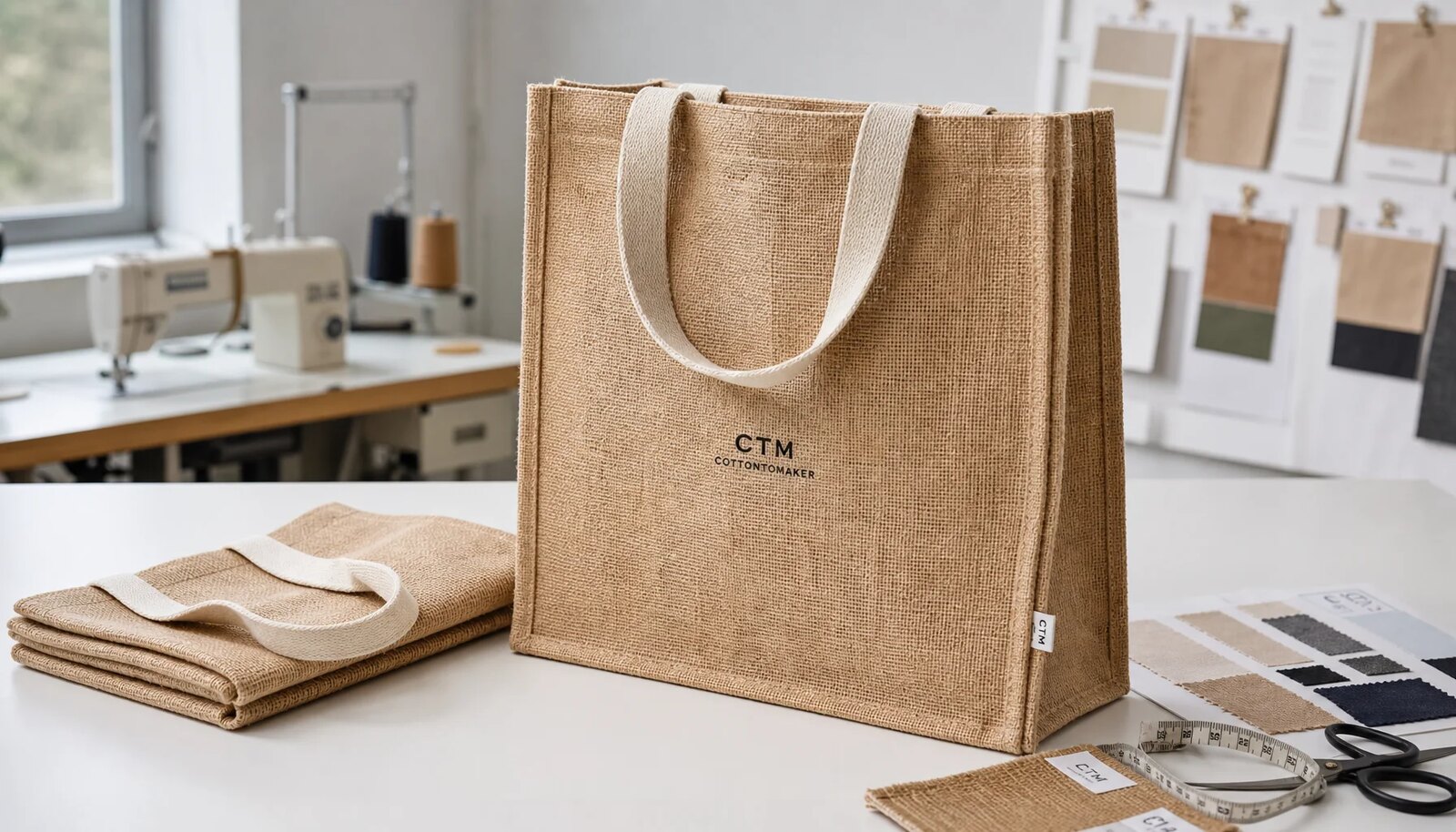
Define the Craft Fair Buying Problem First
A jute tote bag for craft fairs is usually asked to do more than carry goods. It may sit on a booth shelf as branded packaging, hold mixed-weight handmade products, act as a paid resale item, or support a sponsor logo for an event organizer. The RFQ should identify that job before discussing price, because the cheapest jute tote often fails in the exact areas that matter at a fair: standing shape, handle comfort, print readability, and carton efficiency.
Procurement teams should avoid sending only a photo and a quantity. A useful RFQ tells the supplier what the bag will carry, how it will be displayed, how far consumers may walk with it, and whether it is a giveaway or a retail item. A tote that carries one scarf can be lighter and softer. A tote for candles, pottery, jars, and books needs stronger construction, cleaner lamination, and better handle anchoring.
- For booth giveaways, prioritize cost control, acceptable print clarity, and stable carton packing.
- For retail resale, prioritize fabric consistency, upright shape, neat stitching, and a cleaner interior finish.
- For event sponsor bags, prioritize logo accuracy, repeatable print placement, and timely pre-event delivery.
- For handmade food or cosmetics packaging, consider inner dust control and odor limits more carefully.
Write the Core RFQ Specification
The first page of the RFQ should be a specification sheet, not a long conversation thread. Factories quote faster and more accurately when the buyer defines size, material, lamination, handle, print, packing, and target schedule in one place. If one supplier quotes 12 oz unlaminated jute with short handles and another quotes 15 oz laminated jute with cotton webbing handles, the lower quote is not a saving; it is a different product.
Use finished dimensions rather than vague capacity words. For craft fairs, common tote sizes often fall around 30 x 35 x 10 cm, 35 x 40 x 12 cm, or similar, but the right choice depends on the products being sold. A soap maker, bookstore booth, ceramic artist, and farmers market gift vendor will not need the same gusset depth. The RFQ should state width, height, gusset, handle drop, and print area in centimeters or inches.
- Material: natural jute, dyed jute, laminated jute, or jute-cotton blend.
- Weight: target 13 oz, 14 oz, or 15 oz jute, with approximate GSM stated for comparison.
- Size: finished width x height x gusset, with tolerance requested.
- Handle: material, width, drop length, color, and reinforcement method.
- Logo: print method, artwork file type, Pantone color, print size, and position.
- Packing: pieces per carton, flat or shaped packing, polybag requirement, and shipping marks.
Choose Jute Weight and Lamination
For craft fair tote bags, jute weight is one of the biggest cost and performance drivers. A light jute can look acceptable in a quotation photo but lose structure when displayed on a crowded booth table. A heavier jute improves perceived value and load performance, but it also increases material cost, carton weight, and sometimes print unevenness if the weave is coarse. A practical RFQ normally asks for 13 oz to 15 oz jute, then lets suppliers state the exact GSM they can control.
Lamination is another decision that affects both price and function. Interior PP lamination gives the bag more body, reduces fiber shedding, and helps the tote stand better. It can also make the bag slightly noisier and less soft. Unlaminated jute gives a more natural handfeel but may shed fibers and absorb moisture more easily. Buyers selling cosmetics, wrapped food gifts, or light-colored textiles should not ignore this point.
- Use 13 oz jute when the priority is budget and the bag carries light goods.
- Use 14 oz jute when the buyer needs a balanced craft fair tote for mixed handmade products.
- Use 15 oz jute when the tote is a retail item or must carry heavier goods with better structure.
- Specify inner lamination when dust control, shape, and display presentation matter.
- Request an actual material swatch because jute yarn thickness and weave density vary by mill.
Set Handle and Load Requirements
Handles are where many craft fair tote problems appear. A buyer may approve a beautiful front panel but later receive complaints because the handles are too short for shoulder carry, too rough for comfort, or not reinforced for heavier items. The RFQ should define handle drop and material clearly. Cotton webbing handles are often more comfortable than raw jute handles, while jute handles may match the rustic appearance better.
The load requirement should match real usage, not an abstract maximum. If the bag will hold candles, mugs, small books, or jars, the handle joint matters more than the base fabric alone. A good supplier should explain the stitch pattern, seam allowance, and reinforcement method. Cross stitching, bar tacks, or reinforced top hems cost more than a simple straight stitch, but they reduce field failures.
- Short hand-carry handles may use a 12-16 cm drop, depending on bag height.
- Shoulder-friendly handles often need about 22-28 cm drop, depending on market preference.
- Cotton webbing around 2.5-3.8 cm wide improves comfort for heavier craft goods.
- Reinforced handle stitching should be visible and consistent on both sides.
- Loaded sample testing should use the actual expected product weight, not only factory demonstration weights.
Match Print Method to Jute Texture
Jute is not a smooth cotton canvas. Its open weave, slubs, and natural color variation affect logo edges and fine text. Screen printing is usually the practical choice for simple one to three color branding. It gives solid coverage and good cost control, but the artwork must be adjusted for the fabric. Thin lines, small legal text, gradients, and very tight registration between colors are risky on rough jute.
Heat transfer can support more complex artwork, but it may look less natural on a rustic bag and should be tested for adhesion and cracking. Woven labels or sewn cotton labels are useful when the brand wants a cleaner logo without fighting the jute surface. For craft fairs, logo readability from booth distance is often more important than reproducing every design detail.
- Screen print works best for bold logos, event names, sponsor marks, and simple line art.
- Heat transfer should be approved by physical sample, especially for flexing and edge adhesion.
- Woven or cotton labels suit premium resale bags and smaller brand marks.
- Avoid tiny text below what the supplier can hold cleanly on the approved jute weave.
- State print tolerance, such as plus or minus 0.5 cm from the approved position for normal tote production.
Understand MOQ and Cost Drivers
MOQ for jute tote bags is not only a factory policy. It comes from fabric sourcing, cutting efficiency, print setup, labor arrangement, carton packing, and export handling. A factory may accept 300 pieces, but the unit cost can look unattractive once screen setup, sample development, inland transport, and carton handling are included. Buyers should request price breaks at several quantities instead of asking only for the lowest MOQ.
For a craft fair program, a realistic RFQ can request pricing at 500, 1,000, 2,000, and 3,000 pieces per design. This shows where the cost curve improves and whether the supplier is pushing a large MOQ without explaining the savings. If multiple logo versions are needed for different vendors or sponsors, separate screens and production handling may apply even when the bag body is the same.
- Fabric weight increase raises body material cost and shipping weight.
- Dyed jute usually costs more than natural jute and may need longer material preparation.
- More print colors increase setup time, screen cost, and registration risk.
- Multiple designs can reduce production efficiency even if total order quantity is high.
- Individual polybags add labor, material cost, plastic usage, and carton volume.
- Small split shipments may increase handling cost and reduce freight efficiency.
Request Quote Data You Can Compare
A useful supplier quote should be more than a unit price. Procurement teams need enough data to compare landed cost and production risk. If a quote does not state fabric weight, lamination, handle specification, print method, carton quantity, carton size, gross weight, sample cost, and lead time assumptions, it is not ready for approval. It may be a starting estimate, but it should not be used for vendor selection.
The RFQ should require suppliers to separate cost items where possible. This is especially important for craft fair buyers who may adjust quantity, print design, or packing after reviewing freight cost. Separating the bag body, printing, setup, packing, and sample fees helps the buyer see which specification changes actually reduce cost and which only reduce quality.
- Ask for EXW, FOB, or other trade term clearly, not only a factory unit price.
- Require carton dimensions and gross weight so freight forwarders can estimate cost.
- Request lead time counted from deposit, artwork confirmation, and sample approval.
- Ask whether screens, labels, or special packing charges are included or separate.
- Require validity period for the quote because jute and freight costs can move.
Approve Samples Before Bulk Production
For jute tote bags, the sample is not just a visual sign-off. It proves whether the jute weight, lamination, handle feel, logo method, and bag shape work together. A photo can hide rough handle edges, print bleeding, odor, uneven standing shape, and weak top seams. The pre-production sample should use the same construction and print process planned for bulk production.
A buyer should keep one approved sample in the procurement office and require the factory to keep one signed duplicate. For larger orders or tight event schedules, approve a printed strike-off first, then a complete pre-production sample. If the artwork is simple and timing is tight, this can be compressed, but skipping physical approval increases the chance of brand and usability disputes.
- Measure finished width, height, gusset, handle drop, and print position against the RFQ.
- Load the sample with the expected craft fair products and carry it for several minutes.
- Rub the print lightly after drying to check normal handling resistance.
- Fold and unfold the bag to see whether lamination cracks or creates permanent creases.
- Smell the sample after it has been sealed overnight to identify odor risk before shipment.
- Photograph and sign the approved sample with date, version, and specification reference.
Control Packing and Freight Impact
Packing decisions affect landed cost and arrival condition. Flat packing is usually efficient for jute totes, but too much compression can create creases, especially with laminated jute. Shaped packing protects display form better but increases carton volume. For craft fair buyers shipping to multiple venues, the carton quantity should match distribution needs, not only factory convenience.
The RFQ should ask for carton dimensions and gross weight early. Jute is bulkier and heavier than many lightweight cotton bags, and freight cost can change the final decision between 13 oz and 15 oz material. If bags will be sent directly to event sites, shipping marks, carton strength, and moisture control become more important than they may seem at quotation stage.
- Use 25-50 pieces per export carton depending on bag size, lamination, and weight.
- Avoid carton weights that are difficult for event staff or warehouse teams to handle safely.
- Use inner polybag or carton liner when moisture, dust, or long storage is a concern.
- Define shipping marks by SKU, design, quantity, carton number, and destination if split shipments are planned.
- Request photos of packed cartons before shipment for quantity and packing confirmation.
Build the Schedule Around Event Risk
Craft fair orders usually have a fixed use date. A late bag is not a minor inconvenience; it can miss the sales window entirely. The schedule should be built backward from the required arrival date, including sample development, artwork approval, production, inspection, export booking, transit, customs clearance, and local delivery. The RFQ should ask suppliers to state lead time assumptions rather than give a vague production estimate.
Buyers often lose time between artwork revision and sample approval. Jute print results may require artwork simplification or color adjustment after the first strike-off. If the event date is fixed, leave room for one correction cycle. A supplier who promises a fast lead time without confirming material availability, print setup, and carton plan may create more risk than a supplier who gives a slightly longer but controlled schedule.
- Allow time for material swatches if the buyer has not sourced this jute quality before.
- Plan one printed strike-off cycle for new logos, small text, or multi-color artwork.
- Count production lead time from approved sample, not from first inquiry.
- Reserve inspection time before final balance payment or shipment release.
- Build extra buffer for peak export periods, holidays, and vessel booking uncertainty.
Specification comparison for buyers
| Spec decision | Recommended option | When it fits | Buyer risk to check |
|---|---|---|---|
| Jute body weight | 13 oz to 15 oz jute, roughly 370-425 GSM depending on yarn and weave | Craft fair resale bags, booth giveaways, branded shopping totes, and gift packaging that must stand upright | Low GSM can collapse on display, show uneven weave, and fail handle pull testing when loaded with ceramics or candles |
| Lamination | Interior PP lamination for structure and dust reduction; unlaminated only when a softer natural handfeel is required | Retail buyers needing cleaner interiors, sharper bag shape, and easier packing for cartons | Thick lamination can crack at fold lines; unlaminated jute can shed fibers onto packaged goods |
| Bag construction | Box bottom with 8-12 cm gusset and reinforced top hem | Vendors selling jars, soaps, textiles, books, stationery, and multiple small craft items | Flat totes may quote cheaper but reduce usable volume and create poor booth presentation |
| Handle material | Cotton webbing or padded jute handles stitched into the top hem with cross reinforcement | Buyers prioritizing comfort, repeat use, and safer carrying at crowded fairs | Rope handles look rustic but may pull out if grommets or stitching are underspecified |
| Logo method | Screen print for 1-3 color artwork; heat transfer only for complex color; woven label for premium understated branding | Brand owners needing stable color and repeatable production across multiple fair seasons | Jute texture breaks fine lines; tiny text, gradients, and photographic artwork should not be approved without a strike-off |
| MOQ logic | Start from 500-1,000 pcs per size/color/print, with better unit cost at 2,000-3,000 pcs | Importers balancing booth launch risk with freight efficiency and factory setup cost | Very small trial orders may carry high print setup, carton handling, and inland freight cost per bag |
| Packing method | Flat packed 25-50 pcs per export carton with inner polybag only if moisture or dust control is needed | Distributors shipping to multiple craft fair venues or retail stores | Over-compression can crease lamination; no moisture control can lead to odor or mildew claims |
| Sample approval | Pre-production sample with actual jute, actual handle, actual print ink, actual carton folding method | Procurement teams that need to lock cost, appearance, and carton cube before bulk approval | Photo-only approval hides print bleeding, handle stiffness, odor, lamination noise, and real bag standing performance |
Buyer checklist before sampling
- Define the craft fair use case: resale, booth giveaway, gift packaging, VIP buyer tote, or exhibitor kit bag.
- Specify finished size in width x height x gusset, not only approximate capacity.
- State jute weight target in oz or GSM and whether lamination is required inside.
- Attach artwork with Pantone references, print size, print position, and minimum line thickness.
- Confirm handle material, handle drop, webbing width, stitch type, and reinforcement requirement.
- Request itemized quote lines for bag cost, print setup, sample cost, mold or screen cost, packing, and inland freight if applicable.
- Require pre-production sample approval before cutting bulk fabric or printing bulk panels.
- Define QC acceptance for size tolerance, print position tolerance, handle pull strength, odor, stains, and carton damage.
- Specify carton quantity, carton dimensions, gross weight target, and whether bags must ship flat or pre-shaped.
- Ask for production lead time counted from deposit, artwork approval, and sample approval separately.
Factory quote questions to send
- What exact jute weight are you quoting, and is it measured before or after lamination?
- Is the quoted fabric natural jute, dyed jute, laminated jute, or jute blended with cotton or polyester?
- What finished size tolerance can your production hold for width, height, and gusset?
- Which print method are you quoting for this artwork, and what is the maximum print area on textured jute?
- Can you provide a printed strike-off using the actual jute batch before bulk production?
- What handle material, width, length, and reinforcement stitch are included in the quote?
- What is the MOQ per size, per color, and per printed design, and what cost changes at 500, 1,000, 2,000, and 3,000 pcs?
- How many pieces per carton, what carton size, and what estimated gross weight are you using for freight planning?
- What defects are excluded from normal jute variation, and what defects will be replaced or credited?
- What production schedule do you recommend if the bags must arrive before a fixed craft fair date?
Quality-control points to confirm
- Finished bag size within agreed tolerance, commonly plus or minus 0.5 cm for main dimensions and plus or minus 0.8 cm for gusset on soft jute bags.
- Jute weight and lamination match the approved sample, with no unexpected thin panels or brittle laminate cracking at folds.
- Print color, print position, and print edge clarity match the approved strike-off under normal viewing distance.
- Handle drop, webbing width, stitch density, and reinforcement pattern match the approved sample.
- Loaded handle pull test meets the agreed use case, especially for craft goods such as candles, mugs, books, and jars.
- Bag stands reasonably upright when lightly filled if the RFQ requires retail display presentation.
- No heavy odor, mildew, oil stain, rust mark, large slub hole, loose seam, or exposed sharp grommet edge.
- Cartons use adequate export strength and avoid over-compression that creates permanent creases.