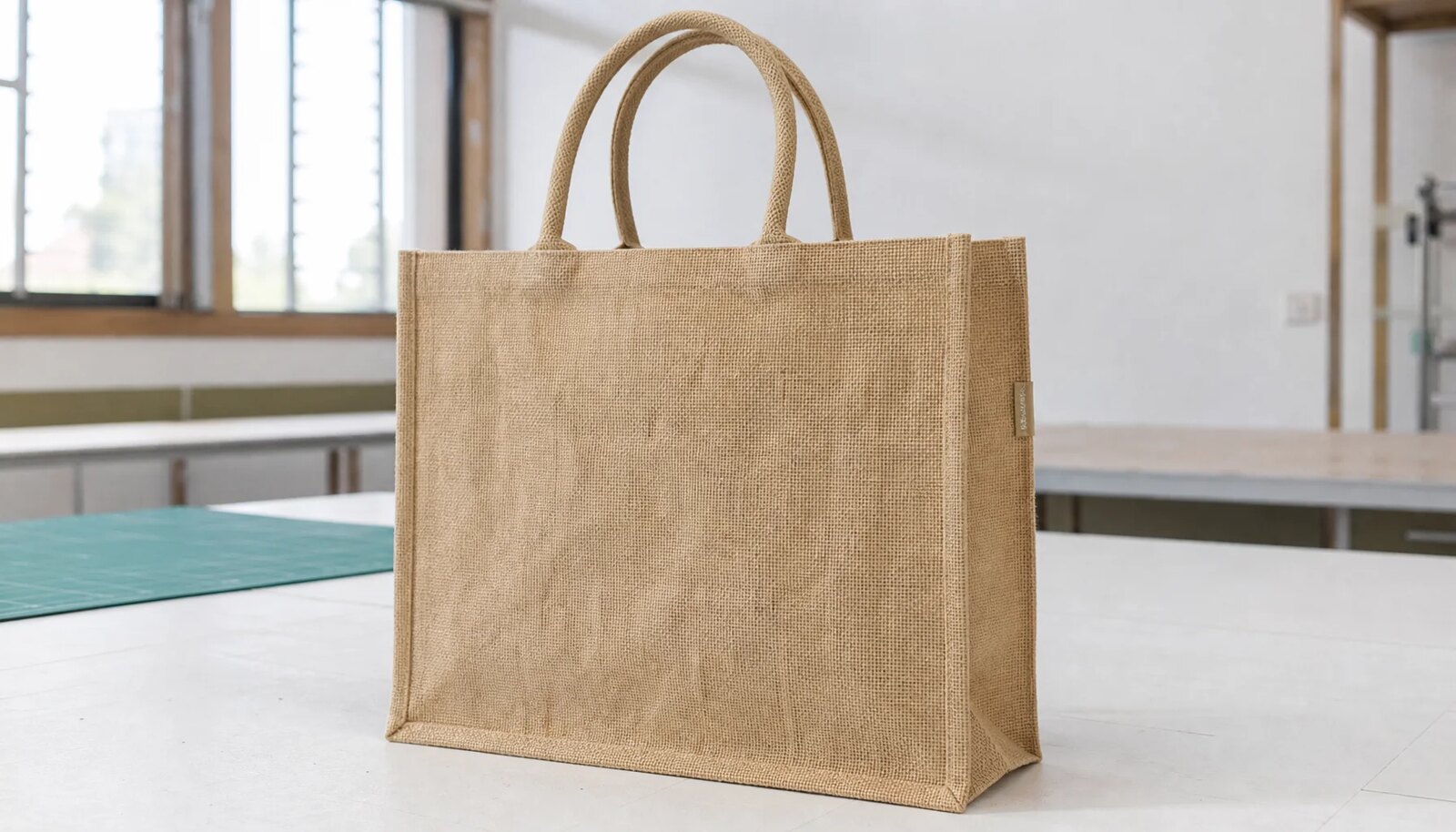
Start With The Event Use Case, Not The Bag Photo
A jute tote bag for an event has to do a fairly unglamorous job well. It needs to arrive before the venue deadline, count correctly, show the sponsor artwork clearly, carry the planned contents, and survive fast handout at registration. A good-looking sample is helpful, but it is not enough. The order can still fail if the handle drop is awkward, the gusset is too narrow for folders, the print cracks after packing, or cartons are sorted by the wrong artwork version.
Before requesting prices, write one sentence that describes what the bag must do. A conference delegate tote for a notebook, program, badge, and pen is different from a VIP gift tote with boxed samples. A sponsor pack with bottles needs different stress control than a lightweight exhibition giveaway. That one sentence should guide shell GSM, handle reinforcement, base support, printing, packing, and inspection severity.
Natural jute also needs a realistic standard. Slubs, small tonal shifts, and uneven texture are part of the material when they match the approved sample. Open holes, mildew marks, damp odor, heavy stains, weak seams, crooked handles, and unreadable logos are not natural character; they are defects. Strong procurement language separates acceptable variation from rejectable problems before the factory starts cutting.
- State the use case: delegate kit, sponsor pack, VIP gift, retail resale, exhibitor handout, or lightweight giveaway.
- List actual contents and approximate working load, including heavy, hard-edged, or sharp-cornered items.
- Decide whether the priority is low cost, premium presentation, reuse value, sustainability messaging, or fast on-site distribution.
- Define acceptable natural jute variation separately from holes, mildew, damp odor, stains, and weak seams.
- Write the QC standard around how the bag will be stacked, lifted, stored, transported, and handed out at the venue.
Build A Quote Sheet Suppliers Cannot Interpret Loosely
Wide price gaps often mean suppliers are not quoting the same bag. Two offers may both describe a 35 x 40 cm natural jute tote. One may include a 280 GSM shell, no lining, simple handles, thin cartons, and bulk packing. Another may include a 340 GSM shell, cotton lining, a reinforced base, cotton webbing handles, print strike-off, and labeled export cartons. The cheaper quote may simply be a thinner construction with less control.
A useful RFQ names the measurable parts: finished width, height, gusset depth, handle drop, handle width, shell GSM, fabric color, finishing, lining, lamination, base board, thread color, seam type, label position, print size, print position, packing count, carton mark, and tolerance. For many standard event totes, 280-320 GSM woven jute shell is a practical starting range. Premium kits or heavier contents often move toward 320-400 GSM, or add lining, lamination, or a base insert.
Tolerances make inspection possible. For sewn jute bags, buyers usually allow more variation than they would for molded or machined goods. As a working RFQ example, finished width and height may be +/- 5 mm to +/- 10 mm depending on bag size, gusset depth +/- 5 mm to +/- 8 mm, handle drop +/- 10 mm, and print placement +/- 5 mm to +/- 10 mm. If your folders, samples, or brand layout require tighter control, put that in the RFQ before sampling.
- Use finished outside measurements and define whether bags are measured flat or opened at the gusset.
- State shell GSM separately from lining, lamination, coating, or any stiffening effect.
- Include tolerances for body dimensions, gusset, handle drop, print placement, label placement, bundle count, and carton count.
- Specify whether the bag is flat, gusseted, laminated, lined, reinforced, or designed to stand upright.
- Treat later reductions in GSM, handle reinforcement, lining, carton quality, or inspection scope as specification changes, not harmless price adjustments.
Match Fabric, Lining, Lamination, And Base Support To The Load
Fabric weight matters, but it is only one part of performance. A laminated jute bag can feel stiff even if the shell is lighter than expected. A heavy shell can still fail if the handle anchors are shallow or poorly stitched. Event planners should connect material choices to the exact contents attendees will carry and the amount of time the bag needs to look presentable.
For light conference materials, a 280-320 GSM jute shell with clean sewing may be suitable. For catalogs, bottles, boxed samples, drinkware, retail resale, or premium sponsor kits, consider 320-400 GSM shell fabric, stronger handles, lining, lamination, or a reinforced base. Lining can improve interior cleanliness and perceived value. Lamination can add structure and reduce fiber shedding. Both add quality risks that need inspection: lining seams can pucker or open, and lamination can bubble, peel, smell, whiten at folds, or affect print adhesion.
Base support is easy to forget until the event team starts packing. A base board can help bags stand upright on registration tables and keep hard-edged contents from distorting the bottom. The insert should fit cleanly, not cut into seams, not create sharp edges, and not shift during normal handling. If the team will pre-pack contents before the event, test the sample with the actual contents before approving bulk production.
- Use 280-320 GSM shell fabric as a standard event starting point for light-to-medium contents.
- Use 320-400 GSM, lining, lamination, or base reinforcement for premium kits or heavier items.
- Check lamination for bubbling, odor, edge peeling, fold whitening, stiffness consistency, and print compatibility.
- Inspect lining for seam security, cleanliness, trapped fibers, puckering, and alignment.
- Test the sample with the actual event inserts before approving the production construction.
Specify Handles Like A Failure Point, Because They Are One
Handles carry most of the risk because the attendee feels the load through a small stitched area. The fabric may be acceptable, the print may look sharp, and the bag may still fail when the handle anchor tears out. Poor stitch density, uneven thread tension, shallow anchor depth, or a missing reinforcement pattern can turn an otherwise acceptable tote into a complaint at registration.
Define handle material, width, drop, placement, reinforcement, and tolerance. Cotton webbing is common because it feels comfortable and gives a stronger appearance. Jute webbing creates a cohesive natural look. Rope or padded handles can support a premium design, but they need careful anchoring and a clear inspection standard. Handle drop should match the carrying method. A short hand-carry handle is not the same as a shoulder-carry handle, and inconsistent handle lengths make stacked bags look careless.
Load testing should be written in practical language. Load the bag with the expected event contents or an agreed equivalent weight. Lift by both handles, hold for a defined time, repeat several lifts, then inspect seams, anchors, and the fabric around each stress point. If attendees may grab one handle while moving through a queue, include a one-handle lift check. The test weight, hold time, lifting method, repeated-lift count, and pass/fail criteria should all appear in the QC file.
- Define handle material, width, drop, color, anchor placement, and reinforcement pattern.
- Use a handle drop tolerance such as +/- 10 mm unless the presentation requirement needs tighter control.
- Inspect box-X, cross-stitch, or bar-tack reinforcement for correct placement, secure thread tension, and no skipped stitches.
- Perform a load test with actual event contents or an agreed test weight, hold time, lifting method, and repeated-lift count.
- Reject broken handles, loose anchors, open anchor seams, severe distortion, or tearing around stress points as major or critical defects.
Approve Artwork On Real Jute, Not Only On Screen
Print approval is its own procurement risk. Artwork that looks crisp in a PDF can lose clarity on coarse natural jute. Texture, slubs, uneven absorption, and natural color variation all affect edge sharpness, ink density, and small text readability. For sponsor logos and event branding, a digital proof is useful for layout, but it should not be the only approval step.
Screen printing is usually the practical choice for bold one- or two-color logos, simple sponsor marks, and repeat event programs. It is economical and easier to inspect when the line work is not too fine. Heat transfer or digital transfer can work for gradients, multi-color artwork, or small batches. Those methods bring different risks: edge lift, cracking, plastic appearance, fold marks, and poor adhesion on rough fibers. The right method depends on the artwork, quantity, fabric, and visual standard.
Require a strike-off on the actual jute material. For higher-risk orders, approve a full pre-production sample with the print in final position. Check color against Pantone or brand references while recognizing that natural jute may require an agreed color tolerance. Measure print placement from seams or edges, not by eye alone. If bags will be folded tightly or packed under pressure, check the print again after folding and compression.
- Send vector files, outlined fonts where needed, Pantone or brand references, print dimensions, and placement from seams or edges.
- Define print placement tolerance, commonly +/- 5 mm to +/- 10 mm depending on artwork and bag size.
- Approve print on actual jute, not only a paper proof, screen image, or digital mockup.
- Set rules for small text readability, edge blur, registration drift, color variation, missing ink coverage, and smudging.
- Perform dry rub, fold, scratch, and adhesion checks before releasing bulk printing.
Know Who Controls Each Production Step
For fixed-date event orders, the production route affects accountability as much as price. A direct factory that controls cutting, sewing, printing, packing, and inspection under one production plan can make schedule control easier. When a defect appears, there is one production owner responsible for correction. That matters when an order includes several logos, carton sequences, or a third-party final inspection.
A trading company can still be a sensible choice for smaller quantities, mixed promotional kits, or buyers who need several items coordinated together. The risk is not the trading model itself. The risk is lack of visibility. If the supplier cannot explain where sewing happens, who prints the logo, who checks cartons, and who pays for rework, the buyer has limited control when defects appear.
Add a simple responsibility map to quote comparison. Identify who buys fabric, cuts panels, sews, prints, packs, stores finished goods, books shipment, and signs the QC report. Ask which steps are outsourced. Also ask whether the buyer will be notified if the production route changes after deposit. A low quote should not hide uncontrolled subcontracting, weaker cartons, missing inspection, or a less capable print workshop.
- Ask whether fabric sourcing, cutting, sewing, printing, finishing, packing, and inspection are in-house or subcontracted.
- Require written responsibility for sample approval, in-line checks, final inspection, rework, and re-inspection.
- Normalize quotes against the same GSM, handle build, print method, sample scope, packing, carton quality, and QC scope.
- Ask for itemized sample, screen, plate, artwork, label, carton, document, inland freight, and inspection-related charges.
- Do not award on unit price alone if the supplier cannot explain production route, schedule control, and defect responsibility.
Turn Samples Into Binding Production References
Sampling is the buyer’s strongest control point. A structure sample can confirm size, handle comfort, gusset behavior, and basic sewing. A print strike-off can confirm decoration quality. A full pre-production sample should bring everything together: final fabric, handle, stitching, print, lining, labels, base insert, packing fold, and carton label format. For a fixed-date event, that sample becomes the bridge between the RFQ and bulk production.
Approval should be measurable. Instead of writing only approved, record finished dimensions, gusset depth, handle drop, shell GSM, lining, lamination, base board, print size, print position, label position, stitch details, and packing method. Sign and date the approval. Photograph the sample. Keep one reference sample with the buyer and require the factory to keep one sealed reference sample until the order is received and accepted.
Changes after approval need control. A factory may want to switch jute shade, lamination source, thread, handle webbing, ink, carton count, or packing fold to solve a production issue. Some changes may be reasonable. They should not happen silently. If the approved sample is binding, then changes to material, construction, printing, labeling, or packing require written buyer approval before production continues.
- Use structure samples early and full pre-production samples before mass production.
- Approve only when fabric, handle, stitching, print, labels, lining, base insert, and packing match the intended bulk order.
- Record sample measurements and visual standards in the approval report.
- Keep signed reference samples with both buyer and factory.
- Require re-approval for changes to GSM, fabric color, finishing, print method, handle construction, labels, carton count, or packing.
Inspect In Stages Instead Of Waiting For Final Inspection
Final inspection is important, but it is late in the process. Staged quality control catches defects while they are still cheaper and faster to correct. Fabric receiving should check GSM, shade, weave appearance, odor, stains, moisture signs, and contamination before cutting begins. Cutting inspection should confirm panel dimensions, grain direction, shade matching, and gusset accuracy.
Early sewing inspection matters because one wrong setup can repeat across thousands of bags. Check the top hem, side seams, base formation, stitch density, thread tension, and handle placement on first pieces. If handles are drifting, seams are puckering, or the bag twists when hanging, the line should be corrected before bulk sewing continues.
Printing inspection should begin with the first production pieces. Compare them to the approved strike-off and pre-production sample for color, placement, registration, curing, edge quality, and readability. Transfer prints need special attention at edges and folds because defects may appear after handling or packing compression. Packing inspection should also start before the truck is waiting. Check bundle count, carton quantity, carton marks, artwork separation, moisture protection, printed-panel protection, carton strength, and carton sequence.
- Check fabric before cutting for GSM, shade, holes, stains, odor, mildew, moisture signs, and contamination.
- Check first cut panels for dimensions, grain direction, gusset shape, and shade matching.
- Check first sewn pieces for seam security, handle anchor position, stitch density, thread tension, and shape stability.
- Check first print pieces against the approved strike-off before releasing full print production.
- Audit packing for bundle count, carton count, carton labels, artwork separation, dryness, and protection from abrasion.
Use AQL Only After Defects Are Clearly Defined
AQL gives the inspection team a sampling framework. It does not decide what a serious defect is. For jute tote bags used at events, the buyer and supplier should agree on defect severity before production starts and include it in the purchase order, QC checklist, or inspection booking. Otherwise the discussion happens too late, when the goods are packed and the event date is close.
Critical defects should include anything unsafe, unusable, or event-breaking: wrong event logo, wrong sponsor artwork, mold, strong damp odor, broken handle, unsafe sharp edge from a base insert, or severe contamination. Major defects should include open seams, missing reinforcement, serious stains, unacceptable size variance, poor print adhesion, unreadable logo, incorrect packing count, wrong carton label, or severe panel twisting. Minor defects may include small loose threads, slight natural slubs, or minor shade variation within the approved sample range.
Good inspection reports include evidence, not just pass/fail language. Request dimension photos, handle drop photos, print placement measurements, rub test results, load test photos, carton label photos, carton count records, and representative defect photos. If the shipment fails, the next step should already be defined: sort, rework, replace, re-inspect, partially ship, or hold. Event buyers should also know the latest date when rework is still possible without risking the venue deadline.
- Choose an AQL or sampling plan and state it before production; do not negotiate acceptance after defects are found.
- Classify wrong logo, mold, damp odor, broken handles, unsafe sharp edges, and severe contamination as critical or high-severity defects.
- Classify open seams, missing reinforcement, poor print adhesion, wrong carton labels, and incorrect counts as major defects.
- Treat small natural jute texture variation as minor only if it matches the approved sample and does not affect appearance or function.
- Require defect photos, measurement evidence, load test records, and carton audit photos in the final inspection report.
Plan Packing For The Warehouse, Venue, And Registration Desk
Packing is not an afterthought for event bags. Jute totes may be received by a warehouse, stored for weeks, moved to a venue, split by sponsor or session, and handed out quickly. If cartons are weak, damp, unmarked, or inconsistent in count, the event team loses time when there is little room for recovery.
The packing specification should define bags per inner bundle, bundles per carton, master carton quantity, carton dimensions, gross weight, carton marks, carton sequence, SKU or barcode labels, and whether individual polybags are required. Bulk packing is cost-effective for large orders, but it still needs clean inner protection and stable carton counts. Individual polybags, paper bands, or bundle wraps may be useful for VIP gifts, resale, pre-packed kits, or events with limited sorting labor.
Moisture control deserves explicit language because jute can absorb odor and humidity. For sea freight, humid routes, or long storage, ask for clean inner liners, dry cartons, desiccants where appropriate, and warehouse handling that avoids damp floors. Carton strength matters too. Collapsed cartons can crease bags, abrade printed panels, and slow receiving. The packing plan should protect the bag from factory floor to registration table.
- Specify bags per bundle, bundles per carton, master carton count, carton dimensions, and gross weight.
- Use carton marks showing item name, artwork version, color, quantity, purchase order, destination, and carton sequence.
- Decide whether each bag needs a polybag, paper band, bundle wrap, tissue sheet, or printed-panel protection.
- Add moisture protection for sea freight, humid routes, or storage before the event.
- Match carton labels to the receiving workflow if bags will be split by venue, sponsor, session, VIP tier, or registration desk.
Specification comparison for buyers
| Spec decision | Recommended option | When it fits | Buyer risk to check |
|---|---|---|---|
| Finished size and tolerance | State width x height x gusset as finished outside measurements. A common working tolerance is +/- 5 mm for smaller bags and +/- 10 mm for larger event totes. | Conference delegate bags, sponsor handouts, VIP kits, and venue registration packs where inserts must fit without forcing. | Do not accept only a nominal size. Confirm whether dimensions are measured flat, opened at the gusset, before packing, or after carton compression. |
| Shell fabric GSM | Use 280-320 GSM woven jute shell for many standard event totes. Require GSM to refer to shell fabric only, not lining, lamination, or total bag stiffness. | Brochures, notebooks, badges, light samples, registration material, and general promotional giveaways. | Suppliers may quote a lighter shell and create stiffness with lamination or lining. Ask for the shell GSM tolerance, commonly +/- 5% to +/- 8% when agreed. |
| Premium or heavy-load build | Specify 320-400 GSM shell, cotton lining or lamination, reinforced base, and stronger handle anchoring. | Catalog packs, bottles, boxed gifts, drinkware, tech accessories, retail resale, and bags expected to stand upright on registration tables. | Heavier and stiffer bags increase carton volume, freight weight, fold marks, odor-control needs, and print adhesion risk. |
| Handle construction | Define cotton webbing, jute webbing, rope, or padded handles with box-X, cross-stitch, or bar-tack reinforcement. Set handle drop tolerance, often +/- 10 mm. | Bags carried through a venue, used for delegate kits, or expected to be reused after the event. | A strong-looking handle can still fail if stitch density, anchor depth, or thread tension is poor. Require a load test using planned contents or an agreed test weight. |
| Screen printing | Use 1-2 color screen print with strike-off on actual jute. Define print placement tolerance such as +/- 5 mm to +/- 10 mm. | Bold event logos, sponsor marks, simple typography, repeat orders, and controlled budgets. | Coarse jute can blur edges and reduce readability. Confirm minimum line thickness, ink coverage, curing time, rub resistance, and color standard. |
| Heat transfer or digital transfer | Use transfer print with adhesion, fold, edge-lift, and rub checks before production approval. | Gradients, multi-color sponsor logos, small batches, or artwork too detailed for screen print. | Transfers may look plastic, crack on folds, lift at edges, or fail on rough fiber. Test on the exact fabric and the final packing fold. |
| Sample control | Use a structure sample plus print strike-off during development, then approve a full pre-production sample before bulk production. | Fixed-date events where wrong artwork, weak handles, or packing errors cannot be corrected on-site. | A sample is not binding unless it uses final fabric, handle, stitching, print, label, lining, base insert, and packing method and is retained by both parties. |
| Inspection method | Run final random inspection using agreed AQL and clear defect definitions. Separate critical, major, and minor defects. | Orders where third-party inspection, buyer QC, or factory final inspection must make clear accept/reject decisions. | AQL alone is not enough. Define wrong logo, unsafe defect, mold, open seam, poor print, incorrect carton count, and acceptable natural jute variation. |
| Bulk packing | Bundle-pack by artwork, color, and carton sequence with clean inner liner and moisture protection where needed. | Large events with warehouse receiving teams and local sorting capacity. | Low packing cost can create counting errors, abrasion, print creasing, or damp cartons. Confirm bundle count, carton marks, desiccant or liner needs, and printed-panel protection. |
Buyer checklist before sampling
- Write the event use case in one line: delegate bag, sponsor pack, VIP gift, retail resale, exhibitor kit, conference registration handout, or lightweight giveaway.
- List expected contents and target working load, including catalogs, bottles, notebooks, boxed samples, laptops, or sharp-edged inserts; use this to set handle and seam tests.
- Lock finished width, height, gusset depth, handle drop, handle width, seam allowance, and measurement method before requesting final quotes.
- State shell fabric GSM separately from lining, lamination, coating, or base board; include an agreed GSM tolerance such as +/- 5% to +/- 8% if your QC team can verify it.
- Specify jute type and finishing: natural, dyed, washed, laminated, lined, coated, calendered, or uncoated, and note odor, color, shedding, and stiffness expectations.
- Define construction details: thread type or color, stitch type, stitch density target, top hem width, side seam method, base corner formation, and handle reinforcement pattern.
- Send final vector artwork with Pantone or brand references, print dimensions, placement from edges or seams, number of sides, and acceptable placement tolerance.
- Confirm the quoted decoration method: screen print, heat transfer, digital transfer, embroidery patch, woven label, or sewn label; list setup, screen, plate, and sampling charges separately.
- Approve a signed pre-production sample that represents final fabric, handle, stitching, print, lining, labels, base insert, packing fold, and carton label format.
- Keep one buyer reference sample and require the factory to keep one sealed production reference sample until the order is received and accepted.
Factory quote questions to send
- What exact shell fabric GSM, weave appearance, color, and finishing are included in the quote, and is GSM measured before or after lamination or coating?
- What GSM tolerance will you accept in production, and can you provide a fabric weight check method or material inspection record?
- Is the jute natural, dyed, laminated, lined, coated, washed, or treated, and how will that affect odor, stiffness, print adhesion, fiber shedding, and folding marks?
- What are the finished width, height, gusset, handle drop, handle width, and measurement tolerances included in the quote?
- What thread, stitch type, stitch density target, seam allowance, top hem width, and handle reinforcement pattern are included in the construction?
- What load test can you perform, using what test weight, hold time, lifting method, repeated-lift count, and pass/fail criteria?
- Is printing done in-house or outsourced, and who controls artwork proofing, ink mixing, screen preparation, curing, strike-off approval, and final print inspection?
- For screen printing, what minimum line thickness and smallest readable text size do you recommend on this jute weave?
- For transfer printing, what adhesion, rub, fold, and edge-lift checks will be done before mass production?
- What setup fees, screen charges, plate charges, sample fees, artwork adjustment fees, carton fees, barcode label fees, document fees, and inland freight charges are separate from the unit price?
Quality-control points to confirm
- Shell fabric GSM matches the approved specification within the agreed tolerance, and the jute shell is checked separately from lining, lamination, coating, or base insert.
- Jute weave is reasonably even for natural fiber, with no open holes, severe slubs, thin panels, mildew marks, oil spots, damp odor, loose contamination, or excessive color mismatch from the approved sample.
- Finished width, height, gusset depth, handle drop, handle spacing, print placement, label position, bundle count, and carton count match the purchase order and approved pre-production sample.
- Bag shape is square enough for event use, with aligned panels, clean base corners, straight top opening, stable gusset, and no obvious twisting when standing or hanging.
- Cut panels are not visibly off-grain, warped, stretched, or mismatched in shade between front, back, gusset, and handles beyond the approved natural variation.
- Stitching is straight, consistent, and secure, with no skipped stitches, broken threads, unraveling hems, open seams, exposed seam gaps, or loose thread tails that affect appearance or strength.
- Handle placement is symmetrical, handle length is consistent across the lot, and box-X, bar-tack, or reinforced stitching is secure at every anchor point.
- Stress points pass the agreed practical load test based on planned contents or test weight, including lifting by both handles, lifting by one handle where required, and short repeated handling.
- Print or transfer placement matches the approved sample, with controlled color, readable small elements, clean edges, no smudging, no severe registration shift, and no missing ink coverage.
- Ink, transfer, label, or patch passes basic dry rub, fold, scratch, and adhesion checks and does not flake, crack, peel, bleed, or transfer color during normal handling.