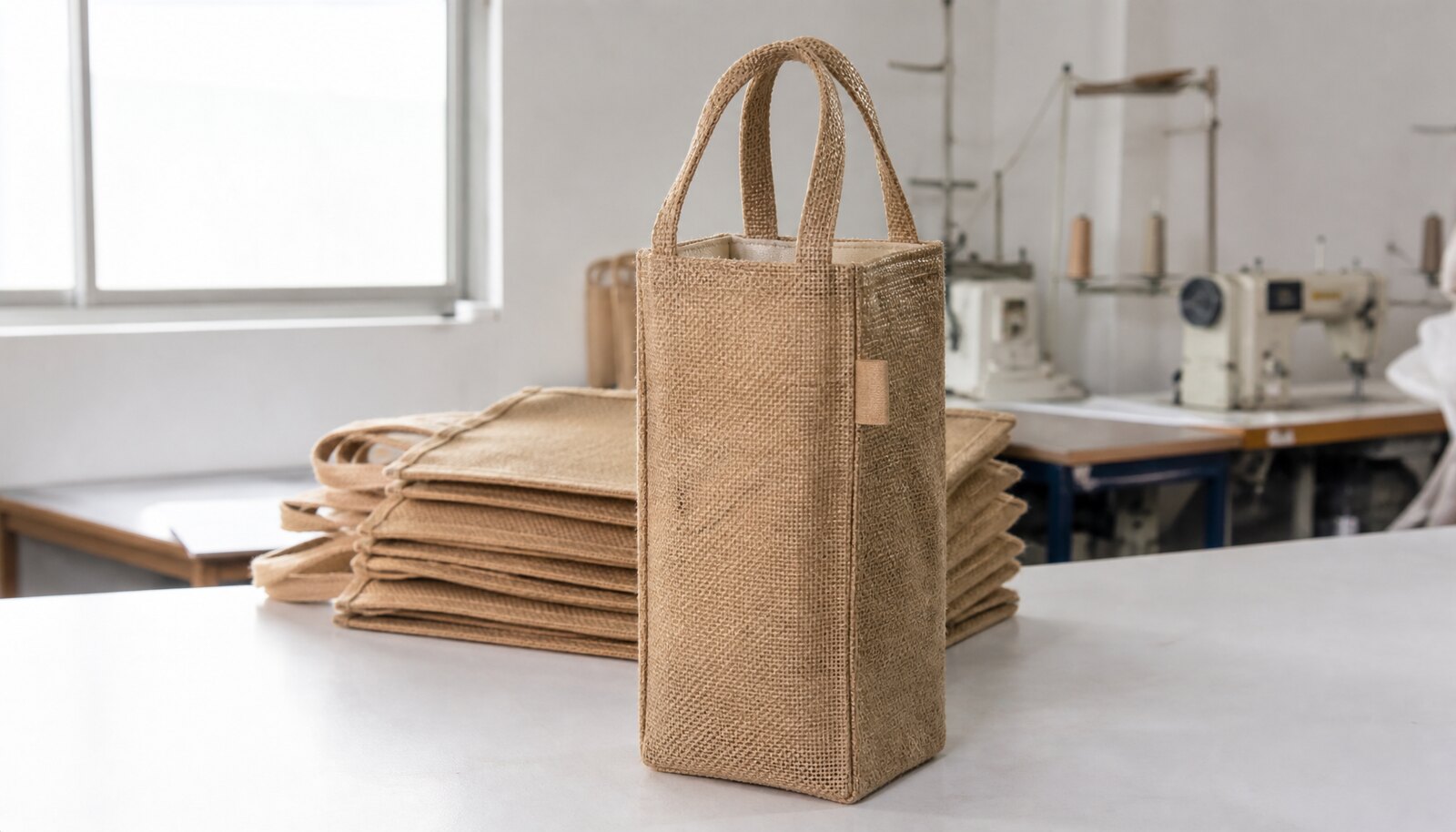
Why boutique wineries need a tighter jute tote inspection standard
Jute tote bags for boutique wineries sit in a difficult middle ground: they need to look rustic enough for the brand story, but they also need to survive retail handling, bottle weight, and seasonal reorder pressure. A bag that looks fine on a sample table can fail in the tasting room if the handle length is wrong, the base seams are weak, or the print cracks after one fold. For this product, quality inspection is not just about appearance. It is about whether the bag holds value at shelf level and does not create avoidable complaints once it reaches wine buyers.
The most common sourcing mistake is treating jute as a simple commodity. It is not. Fiber density, weave consistency, odor, lining choice, and handle reinforcement all change the bag's performance and the quote. Boutique winery buyers usually need a balance of presentation and cost, so the inspection checklist should start with the intended use: gift carry, branded retail merchandise, tasting room packaging, or multi-bottle transport. Once that use case is fixed, the rest of the buying decisions become much easier to compare.
- Retail-facing bags need cleaner stitching and better print registration than internal promotion bags.
- Bottle carriers need handle reinforcement and base strength before they need decorative finishing.
- Seasonal winery launches should use tighter sample approval timing because raw jute color can vary by lot.
Start with the right spec: jute weight, structure, and finish
For most boutique winery programs, a jute cloth around 320-400 GSM is a practical starting point. Below that range, the bag may feel loose, wrinkle easily, and show the bottle shape too much, which can hurt shelf appeal. Above that range, the bag becomes more structured and premium, but cost and folding bulk rise quickly. If the bag will carry one bottle with a gift insert, a moderate-weight jute with a stable base and clean top hem is usually enough. If the bag is meant to carry two bottles or heavier glass, the construction should move toward heavier jute, stronger bottom reinforcement, and a more reliable handle attachment method.
Finish choices should be judged by the actual sales environment, not by sample-room appearance alone. An unlined jute tote gives a natural, low-cost look and is often fine for tasting-room merchandise. Laminated or cotton-lined bags improve shape retention and can reduce fiber shedding, but they also add cost and can complicate sewing quality. Natural jute color can vary from light tan to darker brown between lots, so buyers should define whether that variation is acceptable. If the brand needs a uniform retail wall display, ask the supplier to note the expected shade range before bulk production.
- Ask for fabric weight in GSM, not only a description such as heavy or premium.
- Confirm if the bag is stitched from cut panels or a folded tube construction.
- Define whether inside seams are exposed, bound, or lined, because that changes appearance and fray risk.
Supplier route comparison: which sourcing path fits a winery program
The best supplier route depends on how controlled your winery packaging program needs to be. A direct factory often gives the best balance of price, spec control, and repeatability if they have an in-house sample room and can manage printing, sewing, and export packing under one roof. Trading companies can help when your artwork changes often or when you need multiple product categories in one shipment, but you should expect less clarity on where issues will be fixed. Wholesale stockists may look convenient for very small runs, yet they often limit customization and make it harder to match exact retail presentation needs.
For boutique wineries, the real cost of a bad route is not only the unit price. It is the cost of mismatched cartons, weak print quality, late approvals, and the extra labor needed to sort or rework product at arrival. Use the comparison below to decide which sourcing path fits your timeline and risk tolerance.
- Direct factory: best for repeated orders and construction control.
- Trading company: useful for bundled purchasing, but verify the actual production site and packing responsibility.
- Stock wholesale: fast for urgent needs, but weak on custom branding and spec consistency.
Supplier route comparison table
The table below compares common sourcing routes for jute wine totes. Use it to decide how much control you need over construction, printing, and packing before sending an RFQ.
If your order is for retail sale or distributor resale, the route with the lowest quote is not always the lowest landed cost. Higher QC visibility and cleaner packing often save more than a small unit-price reduction.
- Write decisions in measurable language, not only descriptive wording.
- Ask for sample photos plus one physical approval sample for important orders.
- Keep quotation, sample approval, and inspection notes tied to the same spec version.
Sample approval: what must pass before bulk order release
A sample is not just a visual reference. It is the only realistic way to catch bottle fit problems, handle balance issues, and print distortion before the order enters bulk sewing. For jute tote bags, the sample should be tested with the actual bottle type the winery will use, including any insert, divider, or protective sleeve. A 750 ml bottle may fit differently than a tall sparkling bottle, and the bag may become unstable if the base is too narrow or the handle drop is too short.
The sample approval sequence should be simple: artwork proof, construction sample, then pre-production sample or top-of-production reference. The most reliable approval is one that uses the final fabric, final handle webbing or jute handle, final print method, and final packing style. A paper mockup or print-only sample is useful for layout, but it cannot tell you whether the bag will twist at the seam or show glue marks after finishing.
- Load-test the sample with the heaviest bottle format in the range.
- Open and fold the bag several times to spot print cracking and edge fray.
- Check whether the logo sits level when the bag is filled, not only when empty.
QC thresholds that matter in bulk inspection
For bulk inspection, focus on defects that affect retail acceptance and functional use. Loose threads, uneven top hems, crooked handles, and off-center print placement are not minor issues when the bag is sitting on a tasting-room counter. Natural jute will always show some fiber variation, but that should not be used to excuse weak stitching, visible glue, or ink smearing. Your inspection standard should separate acceptable material variation from actual workmanship defects.
A practical target is an AQL-based visual and functional check, with special attention to handle attachment points and print registration. Because the bag may hold glass, seam failure is a bigger issue than on a normal gift tote. Buyers should define acceptable tolerances for length, width, and handle symmetry, and should also require random pull testing on sample units from each carton range. If the bags are lined or laminated, inspect for delamination, bubbles, or exposed adhesive at seam intersections.
- Seam lines should be straight enough that the bag looks symmetrical from shelf distance.
- Handles should not twist inward or out of plane after light loading.
- Print ink should not bleed when rubbed lightly or when the bag is folded along the artwork area.
Printing decisions: how to avoid logo problems on jute
Jute is not a smooth canvas, so the print method must match the artwork. Simple one- or two-color winery logos usually work best with screen print because the result is bold and cost-effective at scale. Fine gradients, tiny text, or photographic effects are risky on jute and often look softer than expected. Heat transfer can work for short runs or complex art, but buyers should be cautious about durability and the risk of a plastic-looking finish that conflicts with the brand style. Embossed or woven labels may be better if the winery wants a more premium retail cue and lower print wear.
Whatever method you choose, define the acceptance standard before sampling. Specify logo size in millimeters, placement from the top edge, and the maximum allowed shift from center. If the bag uses rough natural fibers, the print may need a stronger underbase or a slightly simplified graphic. The point is not to make the logo larger than necessary. The point is to make it readable from shelf distance and still clean after handling and folding.
- Screen print suits simple logos and higher volume.
- Heat transfer is a fallback for complex artwork or small quantities.
- Woven or sewn labels can reduce ink-related QC risk if the design allows it.
MOQ logic, quote breakdown, and landed-cost comparison
MOQ on custom jute tote bags is usually driven by fabric procurement, print setup, and sewing line efficiency. A supplier may quote a low unit price but require separate setup charges for each color, design, or SKU. For most boutique winery programs, 1,000-3,000 pieces per style/color is a realistic custom range, while smaller runs often carry a meaningful surcharge. If you need mixed bottle sizes, do not assume the same bag body will fit every SKU. A shared print design can be used across sizes, but the dimensions and insert structure may need to change.
To compare quotes properly, split the price into fabric, labor, print, packaging, and freight handling. Ask whether the quote includes a moisture barrier, individual polybag, insert card, carton marking, and any logo label. If you only compare the base unit price, you can miss a meaningful landed-cost difference. For importers and distributors, the cheapest quote often becomes the most expensive after repacking, sorting, or urgent air freight caused by late sample approval.
- Price usually rises with more print colors, lined structure, and custom packing.
- Different SKUs in one order may need separate MOQ commitments.
- Ask for a landed-cost estimate using your actual carton and shipping assumptions.
Packing, moisture control, and warehouse arrival checks
Jute is sensitive to moisture, odor absorption, and rough carton handling. Packing should protect the bag without causing hard fold marks that damage the retail appearance. Flat packing is normal, but the fold direction should be consistent so the bag opens neatly on arrival. If the bags are going to a winery shop or distributor warehouse, carton labels need to match the SKU name, size, color, and quantity exactly. Mixed packing is a common source of counting errors and replenishment delays.
If the shipment is crossing humid routes or sitting in a port warehouse, ask about moisture protection. A simple inner polybag or carton lining may be enough in many cases, but the right option depends on the bag finish. Lined bags can trap moisture if packed too tightly, while unlined bags may pick up smell or surface contamination more easily. On receipt, buyers should inspect carton condition, count accuracy, and whether the first and last bags in the carton still open cleanly without edge crushing.
- Require consistent fold direction and carton count by SKU.
- Use carton labels that match PO language, not just factory shorthand.
- Inspect for odor, moisture marks, and crushed corners on arrival.
Lead time planning: where delays actually happen
A realistic lead time for standard custom jute tote bags is often 30-45 days after sample approval, but that number only works if the buyer keeps approvals moving. Delays usually come from artwork revisions, unclear print placement, late comments on handle length, or changes to carton labels after production has started. Jute itself is not usually the problem. The schedule risk comes from late decision-making and from suppliers who treat sample and bulk as two different versions of the product.
Plan the schedule backward from your winery launch date or promotional event. Leave enough time for sample review, corrections, production, packing, and transit. If the bags will be handed out during a tasting event, build a buffer for weather, customs, and warehouse receipt. For seasonal retail programs, ask the factory when raw material procurement must be locked. Missing that cutoff can push your order into the next production cycle and affect both price and delivery date.
- Sample approval delays are usually more dangerous than sewing delays.
- Build a buffer for print corrections and carton label changes.
- Treat seasonal launch dates as fixed and work backward from them.
Specification comparison for buyers
| Spec decision | Recommended option | When it fits | Buyer risk to check |
|---|---|---|---|
| Fabric weight | Jute cloth around 320-400 GSM for standard wine totes; heavier if carrying glass bottles | Best for boutique wineries needing a structured look and better handle support | Too light looks limp and can distort after print; too heavy raises cost and makes folding harder |
| Lining choice | Unlined for rustic gift use; laminated or cotton-lined for premium retail presentation | Use lining when you want cleaner bottle contact, better shape, or higher perceived value | Poor lamination can crack; thin lining can shift and create wrinkling at seams |
| Handle construction | Double-stitched folded handles with bar-tack reinforcement at stress points | Fits reusable retail bags and bottle carriers that will be loaded repeatedly | Short bar-tacks or weak thread count can fail at the first seam load test |
| Print method | Screen print for simple logos; heat transfer only for short runs and complex art | Choose based on logo color count, run size, and budget | Jute surface can blur fine detail; poor screen setup can crack or misregister artwork |
| Supplier route | Direct factory with sample room and export packing control | Best for stable reorders and custom spec control | Risk of quote gaps if the factory outsources printing, lining, or carton packing |
| MOQ logic | 1,000-3,000 pcs per style/color for most custom jute totes | Good for private label winery gifts and seasonal promotions | Very low MOQ may hide higher unit cost, limited color options, or weak size consistency |
| QC inspection level | AQL-based visual and functional inspection with special focus on seams and print alignment | Appropriate for retail, tasting room, and distributor programs | If you inspect only appearance, you may miss handle pull failure and odor or contamination issues |
| Packing format | Flat packed with moisture protection and carton marks matched to SKU labels | Useful for export and warehouse-friendly inbound handling | Loose packing can warp bags, crush print, or absorb moisture during transit |
| Lead time structure | 30-45 days after sample approval for standard custom jute bags | Works for planned promotions and seasonal winery launches | Sample approval delays and raw material variability can push delivery past campaign dates |
Buyer checklist before sampling
- Confirm the exact bag size against the bottle format: single bottle, two-bottle, or gift set carrier, with allowance for cork height, neck clearance, and insert thickness.
- State the target fabric weight in GSM, not just 'thick' or 'strong,' and define whether you accept natural jute variation in shade and texture.
- Specify handle length, handle fold width, stitching style, and whether a reinforcement patch or bar-tack is required at each handle end.
- Approve print artwork with actual size, Pantone reference if needed, and a rule for acceptable misregistration or edge fray.
- Require a pre-production sample or photo sample that matches the final construction, not just a print proof on loose fabric.
- Define whether the bag is for shelf retail, tasting room gifting, or shipping protection, since each use case changes lining, structure, and carton test expectations.
- Set packing requirements: fold direction, polybag use, desiccant if needed, carton labeling, and pallet or non-pallet preference.
- Request the factory's QC data for seam strength, print adhesion, odor, and carton drop readiness before bulk approval.
Factory quote questions to send
- What exact jute fabric weight, weave count, and finishing are included in the quoted price?
- Does the quote include handles, lining, print setup, packaging, and inner carton labeling, or are any of those charged separately?
- What is the sample approval sequence: design proof, pre-production sample, or full production sample?
- How many print colors are included, and what is the surcharge for additional colors, larger coverage, or front-and-back printing?
- What is the expected production lead time after sample approval, and what factors typically extend it?
- What carton size, packing quantity, and outer carton strength are planned for export use?
- What QC standard do you use for needle skip, loose threads, handle pull, print alignment, and smell/contamination?
- If the order is split across multiple SKUs or artwork versions, how does MOQ and price change per variant?
Quality-control points to confirm
- Fabric weight matches the agreed range and the bag does not feel paper-thin, soft, or overly brittle.
- Bag dimensions are within tolerance, especially opening width, base width, and handle drop.
- Handles are symmetric, securely anchored, and show no fraying, skipped stitches, or weak back-tacks.
- Stitch density is consistent at stress points and seam allowance is even across the batch.
- Print placement is centered and within tolerance; ink is fully cured and does not crack when folded lightly.
- Natural jute odor is acceptable for retail use; no mold smell, oil contamination, or chemical residue is present.
- Lining, if included, lies flat without bubbles, puckering, or exposed adhesive.
- Cartons are correctly labeled, count is accurate, and packs are protected from moisture and crush damage.