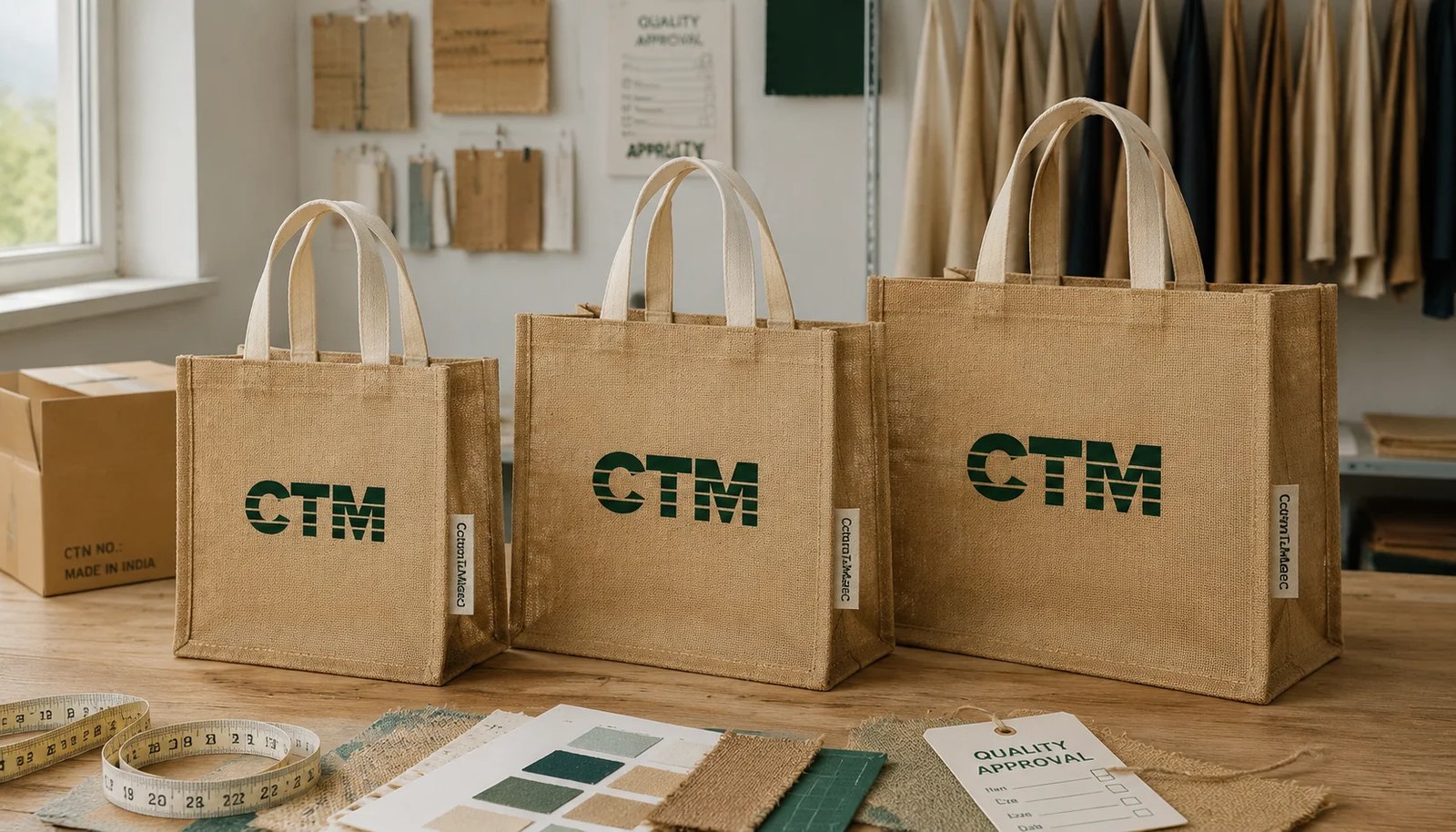
The buying problem: compliance failure usually starts with an incomplete bag spec
Natural grocers and similar retail channels often review reusable bags as a mix of product, packaging, and brand-risk item. Jute tote bags look simple, but supplier compliance problems usually begin before production starts. The buyer sends a visual reference, gets three low-detail quotes, and compares only unit price. The missing information then shows up as inconsistent fabric, weak handles, odor issues, noncompliant packaging, or documents that do not match the actual materials used.
For jute totes, compliance is not only about passing a lab test. It is about whether the supplier can build a repeatable bag with controlled materials, predictable print results, and shipping packs your distribution channel can receive without relabeling or repacking. A good RFQ for a natural grocer program should force clarity on fabric weight, lamination, print process, handle construction, carton rules, and what evidence the supplier can actually provide.
- Main failure points: vague GSM, undefined lamination, no print tolerance, weak handle spec, missing carton limits
- Main quote trap: one supplier quotes laminated jute with cotton handles, another quotes unlaminated self-jute handles, and both are compared as if equal
- Main compliance trap: generic declarations that do not identify the actual bag materials or packaging components
Choose the right jute construction before you compare price
A jute tote for grocery use usually performs best in laminated jute rather than plain unlined jute. Laminated jute holds shape better, sheds dust more easily, and gives more stable print behavior, especially for larger logos. Common market ranges for the outer jute fabric are roughly 240 to 320 GSM, but many quotes use loose descriptions such as '13x13 weave' without linking that to finished bag feel or load performance. If the bag needs a crisp shelf look and reliable standing shape, buyers often prefer a laminated body with a cotton webbing handle.
Unlaminated jute can still work for rustic promotional bags, but it is less forgiving in grocery retail. More fiber shedding, more variation in print edge definition, and more sensitivity to humidity are normal. If your retail channel expects a cleaner consumer presentation, lamination and better inner finishing are usually worth the incremental cost. State the target feel in the RFQ: soft foldable bag, medium body with some structure, or firm standing bag.
- Useful spec language: natural laminated jute, target 280-320 GSM outer fabric, inside PP lamination if required by design
- For light promotional use: 240-260 GSM may be enough if handle reinforcement is strong
- For grocery load and boxier shape: 280-320 GSM with gusset and webbing handles is safer
- If sustainability messaging prohibits certain plastic components, define whether internal lamination is acceptable before sampling
Handle design matters more than a lower unit price
Most bag failures in use happen at the handle attachment, not in the jute panel. For grocery totes, self-material jute handles may look cost-efficient, but they are usually less comfortable for carrying weight and can distort the bag mouth. Cotton webbing handles, typically around 2.5 cm to 3.8 cm wide, distribute load better and are easier to sew securely. Reinforcement should be part of the construction, not a hidden option. Box-X stitching or a well-defined multi-row reinforcement method is the safer baseline.
Handle drop also affects buyer complaints. A short handle around 15 to 20 cm drop suits hand carry and checkout use. A longer drop around 25 to 30 cm works for shoulder carry but changes leverage on the seam area. If the bag will carry heavier grocery items, longer shoulder handles need stronger attachment and often a slightly stiffer body to avoid mouth distortion.
- State handle width, total handle length, visible drop, color, and material
- Specify reinforcement pattern: box-X or approved equivalent
- Require handle placement symmetry tolerance so finished bags do not look uneven on shelf
- If your team runs load testing, define your method and pass/fail criteria in advance
Use the print method that suits jute, not the artwork file alone
Jute is a textured, absorbent surface. Buyers who expect the same print sharpness as canvas often reject good production for the wrong reason. For one-color or two-color logos, screen printing is usually the practical method if the artwork is not too fine. Large solids may need ink control and artwork adjustment because pinholes and edge irregularity are more visible on coarse weave. If the artwork has fine lines, small text, or tighter registration requirements, consider whether a different bag material is better or whether a patch label can deliver the branding more reliably.
Heat transfer can be used in some constructions, but adhesion, feel, and long-term wear should be reviewed carefully on jute. For retail grocery bags, a woven side label or sewn cotton label with logo can support traceability and cleaner branding without forcing detailed front print onto an uneven surface. The best quote is not the one that promises perfect print; it is the one that sets realistic print tolerance for jute and shows production samples.
- One-color logos are usually the safest for cost and repeatability
- Print position should be measured from top seam and side seam, not only centered by eye
- Request a production-method sample, not a digital mockup
- If the logo is detailed, consider a sewn brand label plus simple front print
MOQ logic: the cheapest unit price often creates dead stock or hidden setup cost
MOQ for jute tote bags is not only a factory rule; it reflects material purchasing, cutting efficiency, print screen setup, and carton planning. A supplier may offer an attractive unit price at 5,000 pieces but with one artwork, one handle color, and one pack configuration. If your retail program requires three regional logos or mixed store labels, the actual commercial MOQ is different. Good buyers compare the effective MOQ by construction family, not the headline MOQ by SKU.
For many programs, the best balance is a common bag body with split print versions. That allows the factory to buy one fabric batch and one handle material, while spreading print setup over the order. The unit price usually rises with each artwork split, but this can still be better than holding overstock of one version. Make the supplier show the exact surcharge logic for artwork splits, not only a blended average price.
- Ask for pricing at one artwork and at two or three artwork splits using the same bag construction
- Clarify whether MOQ is per size, per color, per print, or per order
- Request screen/setup charges separately so quote comparison is transparent
- For replenishment business, ask if repeat artwork can reuse screens or if new setup charges apply
What supplier compliance evidence is actually useful for retail procurement
Procurement teams often receive a stack of certificates that do not answer the real question: can this supplier consistently make this bag and document what went into it? For a jute tote program, the useful evidence set is practical. You want a material declaration that covers jute body, lamination if any, handle webbing, sewing thread where relevant, print ink category, label materials, and packaging components. You also want supplier information that shows where each process happens and whether any key step is subcontracted.
Retail buyers should also review consistency evidence, not just compliance papers. Pre-production photos, line QC sheets, carton marking examples, and historical sample quality tell more than a generic audit badge in isolation. If the supplier is trading through multiple workshops, lead-time and consistency risk go up unless there is clear process control and lot traceability.
- Useful evidence: process map, material declaration, packaging statement, sample history, inspection template, carton marking samples
- Useful operational proof: workshop photos, machine types, cutting area, stitching lines, print station, packing area
- Higher-risk signs: inconsistent company names on documents, outdated forms, no link between declared materials and actual sample
- If subcontracting exists, define who controls incoming, in-line, and final inspection
Sample approval should test the production risks, not only the look of the bag
Many buyers approve a photo sample too early, then discover bulk issues that were already visible in process. A useful approval flow for jute totes has stages. First, approve material swatches for color, weave, and lamination feel. Second, approve a pre-production sample using actual bulk fabric and actual handle construction. Third, if the artwork matters, approve a print strike-off or a true printed sample from the intended process. The objective is to freeze the risky variables before bulk starts, especially when natural jute variation is expected.
Your sample comments should convert visual reactions into measurable standards. Instead of writing 'print looks rough', write 'acceptable minor edge irregularity on jute texture, but no missing ink area larger than X mm in logo field'. Instead of 'handle feels weak', state the reinforcement pattern and seam appearance expected. A sealed sample should represent commercial acceptance, not ideal studio perfection.
- Approve swatch, PP sample, print sample, and sealed shipment sample when retail branding is sensitive
- Record the approved color tone under normal light conditions, not edited photos
- State what natural jute variation is acceptable in weave and shading
- Reject samples with strong odor even if visual appearance is acceptable
Packing rules can decide whether the order lands cleanly or creates warehouse rework
Packing is often treated as an afterthought, but for natural grocers and retail distributors it is part of compliance. Jute can absorb odor and moisture more than many synthetic bags, so carton condition matters. If individual polybags are restricted for sustainability reasons, the supplier still needs a clean bundling and carton protection method. Flat packing is normal, but over-compression can crease laminated jute and mark the print surface. Carton weight should match the receiving operation, not simply maximize container fill.
A solid packing spec includes pieces per bundle, bundles per carton, export carton dimensions, gross weight cap, shipping marks, barcode labels, and humidity protection. If your DC prohibits mixed cartons by artwork or store code, define that before quoting. A cheaper quote with loose, high-count cartons can cost more once relabeling, break-bulk handling, or claim risk is added.
- Typical buyer controls: no moldy cartons, no damp smell, no crushing of side gussets, no mixed SKUs unless approved
- Set a gross weight cap appropriate to your warehouse handling rules
- Require carton dimensions to be listed on the quotation, not only pieces per carton
- If no polybags are allowed, define alternative dust protection and carton liner approach if needed
Lead time risk comes from material coordination and approval lag, not only factory capacity
Buyers often hear a simple lead time such as 35 days after deposit, but jute bag schedules depend on more than sewing output. Fabric sourcing, lamination, custom-dyed handles, print screen preparation, and sample approval can each create delay. If your bag uses natural jute plus colored webbing and custom woven labels, the critical path is no longer only in the bag workshop. The safest quote is broken into stages so procurement can see where schedule risk sits.
For replenishment business, the key question is whether the supplier can reserve similar fabric and handle inputs for repeat orders. Jute appearance can shift between batches, and that matters when retail stores place old and new stock side by side. Lead time should therefore be linked to approval status and material booking, not just a blanket production promise.
- Request timeline by stage: sample, material booking, printing prep, sewing, inspection, packing, booking shipment
- Clarify whether lead time starts from deposit, artwork approval, or pre-production sample approval
- Ask what materials are stock-supported and what is made to order
- For seasonal promotions, build buffer for sample correction and carrier booking
How to compare supplier quotes on landed value, not just ex-factory price
A lower ex-factory quote can hide more expensive outcomes: heavier cartons that trigger warehouse issues, poor print that causes retail rejection, weak handles that drive claims, or vague documents that slow import approval. Quote comparison should normalize the offer into the same bag specification and then add the likely hidden costs. At minimum, compare material construction, print method, handle reinforcement, sample charges, packing assumptions, document package, and lead-time confidence.
Procurement teams should also separate one-time cost from recurring cost. Screen charges, sample fees, compliance review, and barcode setup may be one-time or order-specific. Unit price should then be read alongside carton utilization, order split flexibility, and claim risk. The best supplier is often not the cheapest one on a spreadsheet, but the one with the smallest probability of noncompliant variation across repeat shipments.
- Normalize quote basis: same size, same GSM range, same handle, same print colors, same packing
- Separate one-time fees from unit price for fair comparison
- Add expected cost of rework, relabeling, or delayed launch when evaluating risky offers
- Track quote exclusions such as testing, palletization, inspection, or special labels
Specification comparison for buyers
| Supplier option | What to verify | Commercial advantage | Buyer risk to control |
|---|---|---|---|
| Direct sewing factory | jute roll photos, lamination sample, odor-control process, handle pull evidence, and pre-shipment carton condition photos | Better sample-to-bulk control and faster production feedback | May be weaker on export paperwork or branded packing unless checked early |
| Trading company | Factory name, production photos, trim-source proof, and who owns QC decisions | Can coordinate small mixed orders and extra services | Markup can hide real factory capability and slow defect decisions |
| Specialized bag workshop | handle stitching, side gusset, lamination edge control, inner seam cover, and fiber shedding tolerance | More practical for detailed construction, trims, and repeat programs | Capacity may be limited during peak seasons |
| Low-price general supplier | laminated or unlaminated jute, cotton-jute blend, inner coating, odor control, yarn thickness, and color shade variation | Useful for simple promotional runs with loose specs | Material downgrades, weak packing, and vague inspection scope can erase savings |
| Retail-ready supplier | airing time, moisture absorber, carton liner, bundle wrap, odor separation, and warehouse ventilation before loading | Can handle labels, SKU separation, carton marks, and receiving rules | Higher unit cost must be compared against reduced warehouse work |
| Compliance-focused supplier | Fabric records, labeling review, test plan, and production traceability | Safer for retail programs and repeat brand orders | Documentation claims need evidence, not only sales language |
| Local sample room plus bulk factory | Signed sample, bulk factory handoff, first-piece photos, and deviation owner | Good for complex branding before large production | Sample room quality may not match bulk line unless handoff is controlled |
Buyer checklist before sampling
- Define whether the bag is for daily grocery carrying, promotional resale, or checkout replacement; this changes GSM, handle design, and print expectations.
- Specify finished size with gusset, handle length, and measurement tolerance in millimeters or inches, not only a general bag name.
- State jute construction clearly: plain jute or laminated jute, target fabric weight range, and whether inside lamination is required for shape retention and moisture resistance.
- Include handle material, width, color, attachment method, and reinforcement pattern such as box-X stitching.
- Attach artwork with print size, print position from top seam, number of colors, and acceptable print variation on textured jute.
- Set sample approval stages: material swatch, pre-production sample, print strike-off, and sealed shipment sample if artwork is critical.
- Define compliance document package required with quote, including material declarations and packaging compliance statements relevant to your market.
- List packing rules: bundle quantity, carton dimensions, gross weight cap, barcode label needs, and whether individual polybags are prohibited.
- Set acceptance criteria for odor, mildew, loose fibers, broken lamination, print smudging, handle pull-out, and carton moisture damage.
- Request quote validity, production lead time by sample approval date, and any surcharge triggers for split quantities or urgent shipment.
Factory quote questions to send
- What exact jute construction are you quoting: yarn type, weave, lamination status, approximate GSM, and fabric origin?
- Is the quoted bag made in your own factory or with subcontracted printing or stitching? If subcontracted, which process and how is QC controlled?
- What is the MOQ by size, color, and artwork, and how much does the unit price change if the order is split across two or three print versions?
- What handle material and width are included in the quote, and what reinforcement stitch pattern is standard?
- Which print method are you quoting for this artwork on jute, and what print tolerance should the buyer expect for registration and ink spread?
- Can you provide a pre-production sample in production fabric and actual print process, and is that cost refundable against bulk order?
- What export carton count, carton size, and gross weight are assumed in the quote? Please state if quote changes when carton weight is capped below retailer limits.
- What compliance documents can be supplied with the order, and are they linked to the actual materials used for this bag rather than generic templates?
- What in-line and final inspection points do you run for handle attachment, bag size, print position, and odor or mildew control?
- Which Incoterm is quoted, what port is assumed, and what cost elements are excluded such as testing, barcode labels, or palletization?
Quality-control points to confirm
- Finished size must match approved specification within stated tolerance for width, height, and gusset after conditioning in normal room humidity.
- Fabric appearance should be commercially clean with no major stains, mildew marks, oil spots, or excessive yarn slubs beyond approved natural variation.
- Lamination, if specified, must be continuous with no major bubbles, peeling areas, or sharp creases causing delamination near folds.
- Handle placement must be symmetrical, securely stitched, and reinforced as approved; no skipped stitches, loose thread tails, or exposed raw edge where prohibited.
- Handle pull strength should suit grocery use; the approved sample should define the standard, and random load testing should be documented.
- Print color, position, and coverage must match approved strike-off within agreed tolerance, recognizing slight ink spread on textured jute.
- No strong chemical odor, mold smell, or damp carton smell should be present at final inspection or container loading.
- Carton count, assortment, shipping marks, and barcode labels must match the packing list and retailer routing rules exactly.
- Needle control, metal contamination precautions, and carton cleanliness should be verified if the bags will be packed near food-adjacent retail programs.
- Moisture protection measures such as dry cartons, desiccant use where needed, and container loading condition should be recorded before shipment.