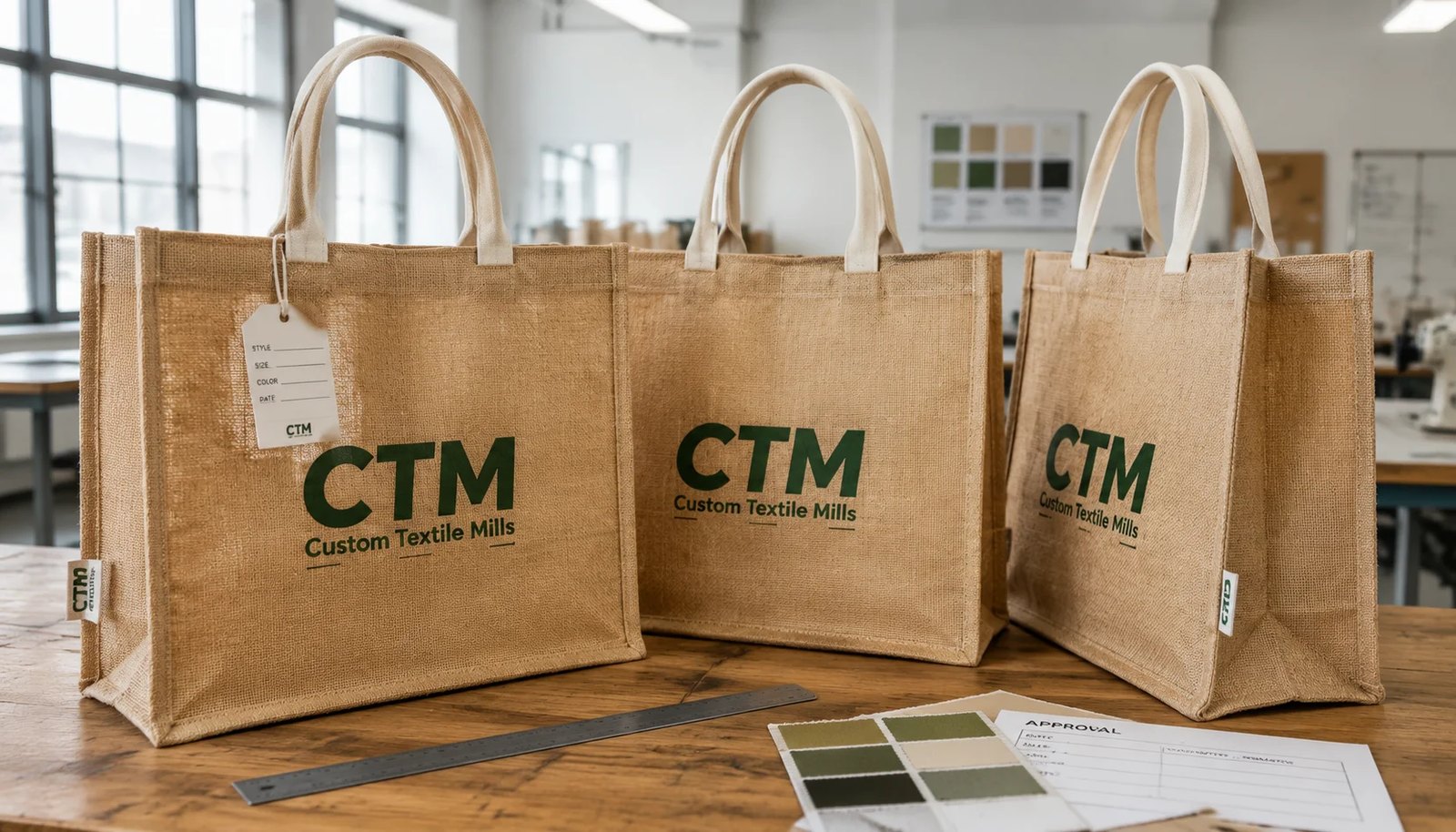
Why print proofing matters more on jute than on canvas
Natural grocers often choose jute tote bags because they present a more rustic, eco-forward shelf image than standard canvas, but that same texture creates print proofing risk. Jute is not a flat, uniform print surface. The weave is more open, yarn thickness varies, and the base color can shift from batch to batch. A logo that looks crisp in vector artwork can lose edge definition once ink sits on the raised fibers, especially on unlaminated panels or low-tension screen setups.
The common buying mistake is treating jute like a standard cotton bag program and approving a digital layout too early. For a grocery tote, the front panel is usually large, the branding area is visible at store exit, and the bag may be reordered over multiple seasons. If print proofing is loose at the first order, later repeats become hard to standardize. The right goal is not perfect paper-level graphics. It is repeatable print quality within the realistic limits of jute construction.
- Coarse weave softens small text and thin lines
- Natural base tone changes perceived ink color
- Seams and gussets can visually pull the logo off-center after sewing
- Lamination affects both ink holdout and final color appearance
Start with the right bag construction before discussing artwork
Print quality starts with construction choice. For grocery use, many buyers select laminated jute with cotton webbing handles because the bag holds shape better, stands more cleanly at retail, and gives the print a more stable face. An unlaminated jute tote can work for simpler branding, but the surface is usually rougher and more absorbent, which makes small details less reliable. If the supplier is vague on fabric weight, request body panel specification and whether the gusset and base use the same material.
Most practical grocery totes sit in the range commonly described by suppliers as around 13 oz to 14 oz equivalent jute cloth, though some factories still quote by bag style instead of GSM. If you need a sharper logo panel, one solution is a laminated body with a cotton canvas or nonwoven front patch panel, but that changes the product identity and cost structure. If the bag must stay fully jute, then the artwork should adapt to the material rather than the other way around.
- Preferred grocery construction: laminated jute body, cotton webbing handles, sewn piping, full gusset
- If using dyed jute, expect more color variation than on cotton canvas
- State whether inside lamination is PE or BOPP if print behavior matters
- Request separate material notes for body, pocket, lining, and handles
Choose the print method based on artwork limits, not sales samples
For most natural grocer logos, silkscreen remains the most practical option on jute. It handles simple spot colors, gives predictable setup costs, and works across standard MOQ ranges. The limit is detail. Fine serif text, dense ingredient-style copy, and subtle tonal gradients usually do not reproduce cleanly on a coarse jute face. If a supplier sends a very clean stock sample, check whether it was made on a tighter weave, a laminated panel, or even a display-only sample with slower print speed than bulk production.
If the buyer wants photo-like graphics or very tight registration, the factory may suggest laminated film printing or a transfer-based process. Those can improve visual sharpness, but they change hand feel, cost, and sometimes durability when the bag folds. For a grocery tote that will be stacked, compressed, and repeatedly opened, the most durable route is often a well-designed spot-color print with artwork simplified for the substrate.
- Silkscreen fits 1 to 3 solid colors and large logo areas
- Halftones and small reverse text should be trialed physically before approval
- Printing on cut panels before sewing usually gives better positioning than after sewing
- Complex print methods can increase setup cost and extend sample lead time
How to adapt artwork so bulk output matches the approved proof
The strongest print proofs usually come from artwork that has already been edited for jute. This means increasing minimum line thickness, opening small gaps in reverse text, avoiding ultra-fine outlines, and keeping the key visual away from seam tension zones. A buyer who sends a standard retail brand book logo without substrate adaptation often gets several rounds of sample revision, not because the factory cannot print, but because the original art is too delicate for the bag face.
Placement matters as much as graphic design. On a gusseted tote, the visual center on a flat panel can shift once the bag is opened. Keep the main logo at least 25 mm from side seams and clear of the bottom fold radius. If there is piping or a front pocket, request a sewing template overlaid on the print area. This helps prevent the common problem where approved art looks balanced on a pre-sew panel proof but crowded in the finished bag.
- Use vector files and convert fonts to outlines
- State minimum line weight and smallest acceptable text height
- Avoid placing logos across fold lines or stitch reinforcement zones
- For dark inks on natural jute, test whether one pass gives enough opacity or if a second pass is needed
What a proper pre-production proof should include
For this category, a useful proof package has two parts: an annotated artwork proof and a physical pre-production sample. The annotated proof should show finished bag dimensions, printable area, seam allowances, logo distance from edges, handle position, and color references. The physical sample should use production-grade jute, lamination, webbing, and print method. A hand-made sample on substitute fabric is only useful for shape review, not final print approval.
Procurement teams often save time by approving a digital proof while the factory starts screen making, but that shortcut creates claims later when the print blooms, shifts, or changes shade on actual jute. A real pre-production sample is where you evaluate line closure, edge fuzziness, color holdout, laminate wrinkle effect, and whether the print still looks balanced after the bag is stuffed. This step is especially important if the order includes multiple store groups or repeat seasonal production.
- Require front, back, side, and inside sample photos if physical courier timing is tight
- Ask the factory to mark print dimensions and centerline directly on approval paperwork
- Review the sample both flat and filled to normal store-use shape
- Keep one approved sealed sample for incoming comparison if using a distributor warehouse
Cost drivers hidden inside print quotes
Two suppliers can quote the same-looking jute tote and differ sharply in cost because the print spec is not equally defined. Screen count, print area size, underbase requirements, laminated versus unlaminated printing behavior, and whether printing happens before or after sewing all affect labor and waste. If one quote is lower, it may be based on a lighter body, smaller print area, looser registration tolerance, or a simpler handle attachment. A low quote is only useful if the approved proof can actually be repeated in bulk.
MOQ logic also matters. Factories may advertise a low MOQ per style, but for printed jute bags the operational MOQ is often tied to one size, one artwork setup, and one colorway. If a grocer program needs split regional branding, holiday variants, or multiple language versions, setup cost can rise even when total units are high. Clarify whether the quote includes screen charges, sample cost credit, carton artwork, barcode labeling, and inspection support.
- Main cost drivers: fabric weight, lamination, handle webbing, print colors, print area, sewing complexity, carton pack
- Artwork revisions can add time even when they do not add visible cost
- Mixed artwork versions often break the lowest MOQ tier
- Bulk pricing is more comparable when all suppliers quote the same packing and QC basis
Sample approval criteria that prevent the usual production disputes
Sample approval should not end at 'logo looks good.' For grocery totes, define acceptance against a short list of measurable points. These usually include finished size, handle length and attachment symmetry, print location from top edge and side edge, line clarity, filled-in text risk, color similarity to reference, surface cleanliness, and whether the bag stands square when loaded. If your organization has separate brand and sourcing teams, align the approval sheet so both visual and functional points are signed off before bulk release.
A frequent source of disputes is approving one golden sample without noting what variation is acceptable in production. Jute is a natural material, so some shade movement and weave variation are normal. Bulk control works better when the buyer states which issues are cosmetic tolerance items and which are reject items. For example, slight yarn slub may be acceptable, but a logo drifting toward the side seam or a reverse text area closing up may not be.
- Record actual measured dimensions from the approved sample
- Photograph the sample under neutral light for internal reference only, not color judgment alone
- Define reject triggers such as unreadable text, major print smudge, seam opening, and lamination peel
- Note whether slight jute fiber show-through is acceptable on solid ink areas
Packing and shipping details that affect print condition on arrival
Packing is not only a logistics issue. It affects print presentation at receiving. Laminated jute bags stacked too tightly can develop pressure marks, and fresh prints packed before full cure can transfer or block under heat. For natural grocer retail programs, especially those distributing through a third-party warehouse, flat packing with controlled bundle counts is usually easier to receive and count than compressed bale-style packing. Add a moisture barrier liner to the export carton if shipment will cross humid lanes.
Buyers should also set a maximum carton gross weight. Overweight cartons save a little on box count but create handling damage and warehouse resistance. For distributor channels, carton labeling should include item code, colorway, quantity, country of origin, and optionally PO or store group references. If the program has multiple artwork versions, carton identification needs to be unambiguous so the wrong store set is not cross-shipped.
- State pieces per carton and bundle quantity clearly in the PO
- Use carton liner or poly barrier for moisture-prone shipment routes
- Avoid over-compression that creases laminated panels or cracks heavy ink areas
- Request outer carton drop and stack suitability only if your supply chain requires it
Lead time planning around proof revision and seasonal grocery windows
For custom jute tote bags, the print proofing stage often drives the schedule more than sewing itself. A realistic workflow includes artwork review, proof revision, screen preparation, pre-production sample, buyer approval, material booking, bulk print and sewing, final inspection, and ex-factory release. Even when a supplier quotes a short production lead time, that usually starts after final approval. If your grocery launch window is tied to store events, Earth Month, or holiday gifting, the artwork decision date matters more than the factory's sewing capacity headline.
Jute programs also face seasonal risk tied to material sourcing, color consistency, and export congestion. The practical way to protect schedule is to freeze artwork earlier, reduce late packaging changes, and avoid combining first-time print development with unusually tight shipment dates. If there are multiple approvers inside your company, set one owner for final sign-off to prevent days of delay between each revision round.
- Typical schedule variables: artwork cleanup, sample courier time, print revision rounds, material booking, export booking
- Peak season can stretch sample and bulk timing even if nominal capacity is available
- Store launch programs should build margin for proof rejection or one resample cycle
- Late carton label changes can delay shipment release even after bags are finished
A practical RFQ structure buyers can use to get cleaner quotes
If the buying problem is poor quote comparability, rewrite the RFQ so print proofing requirements sit inside the commercial package rather than in a later email chain. Many quote gaps happen because the factory prices a basic body spec and assumes flexible print quality. Your RFQ should force alignment on material, print method, artwork placement, sample basis, QC, and packing. When those are standardized, you can compare suppliers on real capability instead of optimistic assumptions.
A useful RFQ for this product should include a dimensioned drawing, artwork file, print area drawing, material description, handle specification, sample requirement, packing plan, and target ship window. Also request separate prices for common option changes such as heavier fabric, wider webbing, an inside pocket, different logo size, and individual polybag packing if needed. This makes future negotiation easier because the cost of each change is visible.
- Quote line items should separate sample cost, setup charges, unit price, and packing additions
- Request ex-factory basis if freight is sourced separately, or FOB basis if comparing export-ready offers
- Get optional pricing for one-color versus two-color print if artwork may be simplified
- Keep one revision-controlled RFQ file so all suppliers quote from the same version
Specification comparison for buyers
| Spec decision | Recommended option | When it fits | Buyer risk to check |
|---|---|---|---|
| Base fabric weight | 13 oz to 14 oz equivalent jute cloth with lamination for grocery tote body | Daily retail grocery use where shape retention matters and print panel needs support | Some quotes state only bag weight, not fabric weight; confirm body, gusset, and pocket material separately |
| Lamination type | BOPP or PE inner lamination matched to print method | Needed when buyer wants cleaner print, better shape, and easier wipe-clean interior | Lamination can alter color appearance and ink adhesion; require sample on production lamination, not bare fabric |
| Print method | Silkscreen for simple 1-3 spot colors; heat transfer or gravure-laminated panel only for photo-like artwork | Best for natural grocer logos, slogans, and large solid graphics | Fine lines and small reverse text often fill in on coarse jute; define minimum line thickness and text size |
| Artwork placement | Keep key logo area centered on front panel, at least 25 mm away from side seams and bottom fold | Reduces distortion on gusseted shopping totes with heavy loading | Suppliers may approve artwork on flat proof but bulk sewing can shift visual center; request panel template with seam allowance |
| Handle material | Cotton webbing 25 mm to 30 mm width, stitched into body with reinforcement box stitch | Suitable for natural grocer private label and better hand feel than jute rope | Handle shade can vary lot to lot; match standard and require pull test or construction photo before bulk |
| Proof approval method | Physical pre-production sample with actual print and construction, plus annotated artwork proof | Required when print color and registration are important across multiple store deliveries | Digital PDF alone will not reveal ink spread, jute show-through, or panel skew after stitching |
| Carton pack | Flat packed in export carton with moisture barrier liner, separated by bundle count | Best for distributor receiving and easier count verification | Over-compression can crack print or crease laminated jute; set max pieces per carton and carton gross weight |
| MOQ logic | MOQ by size and print color count, not only by total order quantity | Useful for buyers running regional store variants or seasonal promotions | Suppliers may quote low MOQ but charge heavily for each artwork change, screen set, or mixed colorway |
Buyer checklist before sampling
- State exact finished bag size, gusset width, handle drop, and whether dimensions are taken after sewing tolerance
- Specify jute construction: natural jute, dyed jute, laminated or unlaminated, and target fabric weight or equivalent GSM if available
- Define print method by artwork area and color count instead of leaving printer to choose based on convenience
- Attach vector artwork and note minimum line thickness, smallest text size, and knockout areas that must stay open
- Mark no-print zones around seams, piping, bottom fold, handle stitch area, pockets, and side gussets
- Approve print color against Pantone reference with tolerance language for natural fiber surface variation
- Request a pre-production sample using production fabric, production lamination, and production handle material
- List sample approval points separately for artwork position, ink coverage, stitching, odor, lamination wrinkles, and handle attachment
- Set carton packing limits including pieces per carton, bundle count, carton size range, and maximum gross weight for warehouse handling
- Define AQL or internal acceptance standard for print defects, seam opening, panel skew, and color variation before booking production
Factory quote questions to send
- What is the exact body material specification, including jute weave, lamination type, and approximate fabric weight for each panel?
- Which print method are you quoting, and what artwork limits apply for line weight, text size, and halftones on this jute surface?
- Is the quote based on printing before sewing or after sewing, and how does that affect placement accuracy on gusseted bags?
- How many screens, plates, or setup charges are included for the quoted logo colors and any side gusset printing?
- What is your MOQ by size, colorway, and artwork version, and what surcharge applies to split deliveries or mixed store assortments?
- Will the pre-production sample use production-grade jute, lamination, webbing, ink, and final packing method?
- What tolerance do you work to for bag size, print placement, color variation, and handle length in bulk production?
- What in-line and final QC points do you record for print adhesion, registration, seam strength, odor, and carton count accuracy?
- How are the bags packed to prevent moisture, print scuffing, and compression marks during sea shipment?
- What is the realistic lead time for sample, artwork proof revision, bulk production, and ex-factory shipment during peak season?
Quality-control points to confirm
- Finished size tolerance should be agreed in writing; many buyers use about plus or minus 10 mm to 15 mm on body dimensions and tighter tolerance on handle length
- Print placement should be measured from finished seam or panel edge, not estimated visually from a flat sample
- Minimum readable text and reverse-out areas should be approved on physical sample because coarse jute can close small gaps
- Color should be reviewed on the actual jute and lamination combination since natural fiber tone changes perceived ink shade
- Seam strength and handle reinforcement need visual inspection plus basic load test standard appropriate for grocery use
- Lamination should be free from major wrinkles, bubbles, delamination, and excessive odor before packing
- Cartons must match approved pack count and stay within agreed gross weight to avoid warehouse receiving issues and crushed bags
- Random bulk samples should be opened from different cartons to verify print consistency across production lots, not only top-layer pieces