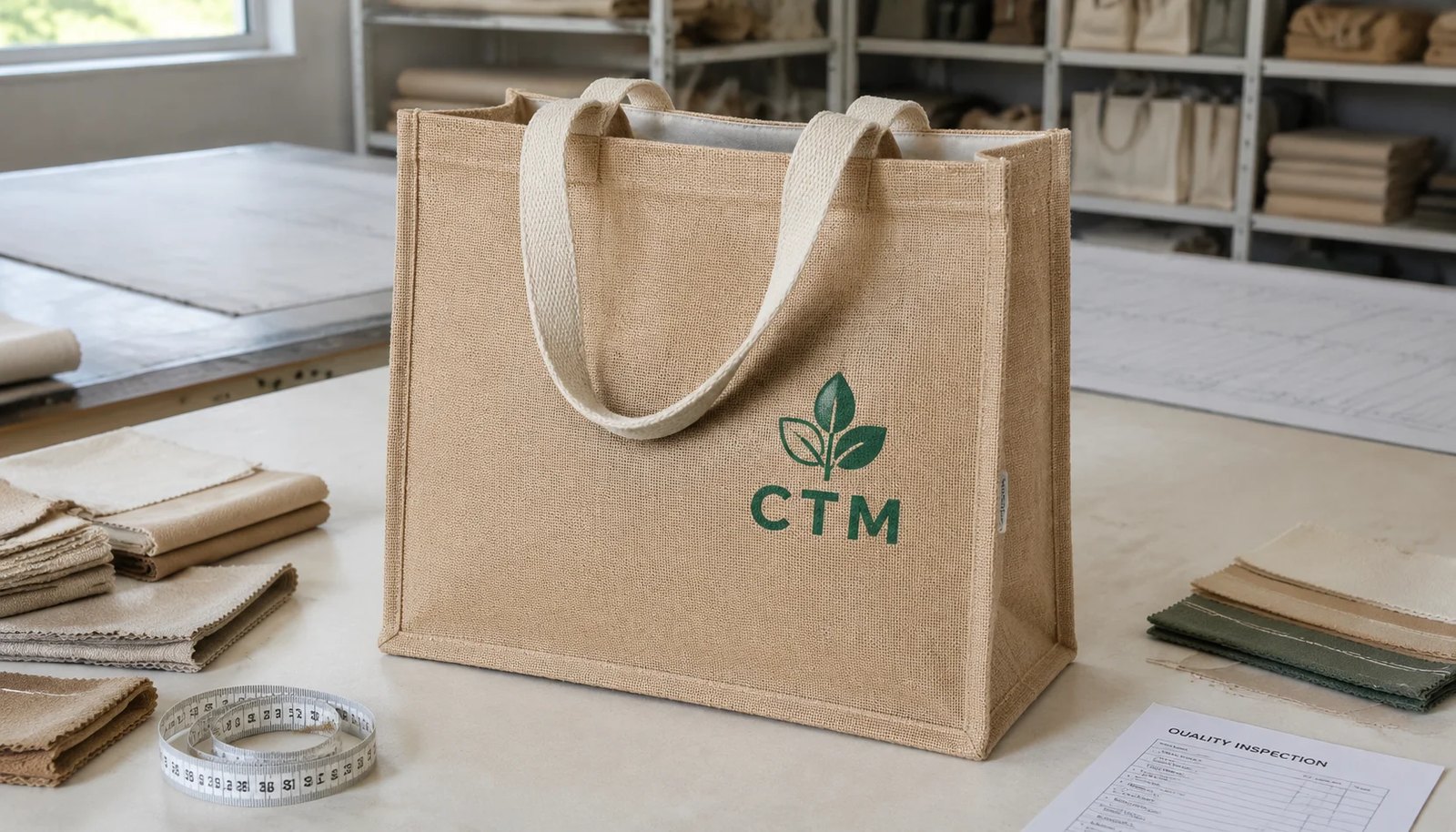
Why material selection matters more than logo design for natural grocer programs
For a natural grocer, the bag is part of the store promise. Buyers usually start from color, print, and sustainability claims, but the real commercial problem appears later: bags that smell after lamination, collapse on shelf, shed too many jute fibers, or fail under bottle weight. Material choice decides whether the product performs like a reusable grocery bag or behaves like a short-life promotion item.
Jute tote bags can fit the natural retail channel well because they communicate texture and a lower-gloss, farm-to-shelf look. But jute is not one standardized material. The weave can be loose or tight, the surface can be hairy or cleaner, and the same bag dimensions can perform very differently depending on GSM, lamination, handle spec, and sewing method. A procurement team that writes a vague RFQ usually gets wide quote variation because each factory is filling in the missing technical details differently.
- Main buying problem: getting a bag that still feels natural but works in daily grocery use
- Main failure points: odor, shedding, seam stress, weak handles, crooked print, and poor carton efficiency
- Main RFQ gap: buyers often specify size and logo only, leaving factories to downgrade hidden components
Choose the bag use case before you choose jute weight
A common sourcing mistake is starting with fabric GSM instead of use case. For natural grocers, there are usually three practical bag roles. First is a checkout reusable bag that must carry produce, boxes, and occasional glass. Second is a branded merchandise tote sold at the register or seasonal display. Third is a campaign bag for membership drives, local farm events, or gift baskets. These roles need different balances of stiffness, comfort, and cost.
If the bag is expected to handle regular grocery loads, the body should hold shape and the handles should stay comfortable under weight. That usually points to a medium-to-heavy jute body with cotton webbing handles. If the bag is mostly a branded retail item, lighter jute may work, but it must still look full and not limp on shelf. Buyers should describe intended load and retail setting in the RFQ, because a supplier pricing for a promotion-grade bag will not quote the same construction as one pricing for repeated grocery use.
- For checkout use, include expected load range such as 6-10 kg typical carry
- For merchandise display, include whether the bag must stand on shelf or in floor bins
- For event distribution, include whether unit price or durability is the priority
- If bottles are part of the use case, note whether a base insert or reinforced bottom is desired
Jute fabric weight and weave: what buyers should actually specify
Jute is often quoted loosely as burlap, Hessian, or natural jute, but those names do not give enough production control. For natural grocers, a workable starting range is roughly 280-330 GSM for the main body if the bag will carry regular groceries. Lighter constructions may be acceptable for promotional use, but too light a weave creates shape loss, panel distortion, and more visible gaps around print. In practice, the weave tightness matters as much as nominal weight.
A tighter, cleaner weave gives better print appearance and lower visible fiber movement. A very open weave may look rustic in a swatch, yet once converted into a tote it can appear uneven and allow the bag to stretch out of shape. Buyers should request both GSM and weave reference photos close enough to show yarn spacing. If the supplier cannot provide actual fabric details and only offers a general 'jute tote' quote, comparison between factories becomes unreliable.
- State target body fabric weight range, not just 'heavy jute'
- Request macro photos of fabric weave under natural light
- Clarify whether the quoted weight includes any backing or lamination
- Ask whether all panels use the same fabric or whether gussets and base use a different weight
- For cleaner retail presentation, request trimmed loose fibers and cleaner finishing on cut edges
Unlaminated or laminated: the natural look versus daily-use tradeoff
This is usually the most important material decision for natural grocer buyers. Unlaminated jute supports a more natural message and avoids the contradiction some retailers see when a natural-fiber bag includes a plastic film. It also gives a softer, more authentic hand feel. The downside is practical: unlaminated jute sheds more fiber, absorbs moisture and spills, and is harder to wipe clean. If shoppers use the bag for produce, chilled items, or reusable circulation over time, returns and customer complaints may increase.
Inside lamination is often the balanced choice for grocery use because it preserves the outer jute appearance while improving shape retention and reducing moisture transfer. The tradeoff is odor and film quality risk. Low-grade lamination can create a chemical smell that is very noticeable when bags are packed in master cartons for shipping. That is why the right sample review is not only visual. Procurement should require a closed-bag odor check after the sample has been packed for at least 24 hours, then opened in room-temperature conditions.
- Choose unlaminated when brand messaging strongly favors all-natural hand feel and lower material complexity
- Choose inside lamination when wipeability and shape retention matter more than pure-material storytelling
- State odor acceptance clearly, especially for food-adjacent retail environments
- If using lamination, request film quality details and sample photos of fold lines and inner surface finish
Handle structure is where grocery bags usually succeed or fail
Many jute tote quotes look similar until you compare the handles. For natural grocer use, cotton webbing handles are usually the safest choice because they are more comfortable than twisted jute handles and support repeated carrying better. Width matters. A 25-30 mm cotton webbing handle generally feels more stable for grocery loads than narrower tape, especially when bottles or jars are inside. Handle drop also matters if the bag is intended for shoulder carry rather than only hand carry.
The hidden issue is not only material but attachment. Handles sewn with a visible cross stitch reinforcement into the body area and supported by proper back tacking will outperform simpler top-seam attachment. Buyers should request photos of the inside seam area and loaded sample images, not only a front beauty shot. If the factory is quoting a lower price, there is a good chance the handle is lighter, narrower, or attached with a shorter stitch pattern that will not show up in a basic spec sheet.
- Preferred grocery handle: cotton webbing, 25-30 mm width
- Typical shoulder drop should be specified if over-the-shoulder use is expected
- Request handle attachment photos from inside and outside the bag
- Include stitch reinforcement requirement in RFQ, not only 'strong handles'
- If trying jute rope or twisted handles for aesthetic reasons, ask for comfort and shedding review during sample stage
Print method on jute: what looks good in art approval may fail in production
Jute is textured, uneven, and naturally less print-friendly than smooth cotton canvas. For most natural grocer programs, simple 1-2 color screen printing is the most practical choice. It keeps branding readable without forcing the factory into print methods that fight the fabric surface. Small text, fine lines, and large solid flood areas are common problem zones because the jute weave interrupts ink coverage and can make sharp edges look broken.
A key production detail is whether printing happens on cut panels before sewing or on finished bags after assembly. Cut-panel printing usually gives better placement and flatter ink coverage. Finished-bag printing may be acceptable for simple art, but seam areas and gussets can distort the logo position. Buyers should approve artwork with realistic expectations for textured jute, not with the same standard used for cotton canvas or coated nonwoven bags.
- Best practical option for most orders: 1-2 color screen print
- Avoid very fine typography unless factory has proven jute print samples
- Request print-size tolerance and placement tolerance in writing
- Approve pantone reference with the understanding that jute background color affects ink appearance
- If side gussets are visible on shelf, decide whether printing must stay clear of fold breaks
MOQ logic and quote structure: why two similar jute bags can price very differently
MOQ on jute tote bags is not only about total units. Fabric sourcing, lamination setup, print screens, handle color, and bag size all affect the factory's real minimum. Many buyers assume a quoted MOQ applies to any variation, but a supplier may mean one MOQ for one size, one print layout, and one handle spec. The moment regional store logos, multiple colorways, or alternate dimensions enter the program, unit cost moves because raw material use and setup fragmentation increase.
The most efficient strategy for natural grocer chains is usually to standardize the body construction and vary only front-panel print where possible. Keeping one size, one handle material, and one lamination choice across several SKUs gives factories better material utilization and improves quote consistency. Buyers comparing quotes should ask suppliers to separate body cost drivers from artwork and packing cost drivers. Otherwise a lower headline unit price can hide more expensive print setup, weaker handles, or less efficient packing.
- Ask for MOQ by size, not just by order
- Ask for MOQ by artwork version if multiple stores or sub-brands are involved
- Use one standard bag body to reduce both sampling time and production variance
- Request separate line items for sample cost, print setup, and export carton packing if possible
- Compare quotes on the same Incoterm and same packing assumption
Sample approval should test load, odor, and shelf appearance, not just dimensions
A pre-production sample is where most preventable failures should be caught. Yet many approvals focus almost entirely on logo position and bag size. For natural grocers, the sample should be reviewed in conditions close to actual retail use. Load the bag with a realistic mix such as boxed cereal, glass jars, produce, and a bottle. Observe whether the base deforms, whether seams pull open, and whether the handles twist or cut into the hand.
The second practical test is a packed-condition review. Ask the factory to fold and pack the sample the same way bulk goods will be packed. After at least 24 hours in closed packaging, open and inspect for odor, lamination wrinkling, print transfer, and permanent creases. A bag that looks good fresh from the sample room can arrive poorly if compression and transit were not considered. This step is especially important for importers shipping by sea over longer transit windows.
- Use a realistic load test rather than a casual hand-feel review
- Review filled-bag photos from front, side, and bottom
- Open a packed sample after 24 hours to evaluate odor and crease recovery
- Check whether print cracks, transfers, or rubs on adjacent panels
- Approve a sealed reference sample if the order is large or multi-batch
Packing and carton planning affect landed cost more than many buyers expect
Jute tote bags are bulkier than many soft cotton bags because of their body stiffness and gusset structure. Carton efficiency therefore matters directly to freight cost and warehouse handling. If the supplier over-compresses bags to reduce carton count, you may get better cube on paper but worse bag appearance at destination. If the cartons are too large or too heavy, receiving teams face handling issues and lower pallet stability. Natural grocer programs with store distribution should think about downstream handling before approving master carton specs.
Procurement should request units per carton, carton dimensions, and gross weight at quotation stage rather than after order placement. This makes landed-cost comparison cleaner across suppliers. One factory may quote a lower bag price but use inefficient packing that raises freight cost per unit. Another may propose a more compact fold with acceptable recovery. The right decision depends on your freight mode, distribution center requirements, and whether bags will be sold folded or opened for retail display.
- Request carton size, units per carton, net weight, and gross weight in every quote
- Set a gross weight ceiling that suits your warehouse handling standards
- Clarify whether inner poly bundles are required or should be minimized
- If bags are for immediate retail display, ask how quickly creases relax after unpacking
- For mixed-SKU programs, specify carton marking format for easier DC sorting
Lead time risk usually comes from approvals and material alignment, not sewing alone
Buyers often view jute totes as simple cut-and-sew items, but schedule risk usually starts earlier. Material approval is a common delay because the first swatch may not match the buyer's expectation for color tone, hairiness, or smell. Print approval can also take longer on jute because artwork that works on a computer proof may need simplification after physical strike-off. If lamination is involved, additional time may be needed for material readiness and sample confirmation.
To get a reliable production schedule, separate the timeline into sample development, artwork finalization, material booking, bulk production, and packing-ready date. A supplier who only states one total lead time is not giving procurement enough control. The safer workflow is to freeze material and print method early, then avoid midstream changes to handle width, gusset size, or bag shape. Those changes can force a new sample cycle and reset the material plan.
- Request a milestone schedule, not one overall lead time figure
- Freeze artwork after physical print review on actual jute
- Avoid changing handle width or lamination after pre-production sample approval
- Book freight based on booking-ready date, not only estimated production completion
- For seasonal retail, build buffer for sample correction and print strike-off approval
Specification comparison for buyers
| Spec decision | Recommended option | When it fits | Buyer risk to check |
|---|---|---|---|
| Base jute fabric weight | 13 oz to 14 oz equivalent jute, typically around 280-330 GSM depending on weave | Best for everyday grocery carry where bag must hold jars, produce, and boxed goods without feeling too soft | Some suppliers quote lower GSM with loose weave that looks bulky but loses shape; request actual fabric weight and close-up weave photo |
| Lamination choice | Thin PP lamination inside only | Fits grocers needing light moisture resistance and easier interior wipe-down without changing exterior natural look | Inside film can add odor, peeling, or wrinkling if low-grade; approve sample after 24-hour closed-bag odor test |
| Unlaminated vs laminated body | Unlaminated for strongest natural story; laminated for cleaner use life | Unlaminated suits premium eco positioning and dry goods; laminated suits mixed grocery use with produce and bottle condensation | Unlaminated bags shed fibers and absorb stains more easily; laminated bags may not match strict plastic-reduction messaging |
| Front panel print method | 1-2 color screen print on flattened panel before stitching | Best for medium to large runs where logo clarity matters and artwork is simple | Printing after bag assembly can distort logo near seams or gussets; ask whether panels are printed cut-piece or finished-bag |
| Handle material | Cotton webbing 25-30 mm width sewn into body with cross stitch reinforcement | Preferred for comfort and repeat use in grocery retail, especially for heavier loads | Twisted jute handles reduce cost but can shed fibers and feel rough; request handle pull test standard and stitch count |
| Bag construction | Side gusset plus bottom gusset with boxed base insert optional | Works for natural grocers wanting shelf-ready bags that stand better and carry produce containers or glass bottles | Without base support, tall bags collapse in retail display and stress bottom seam under weight; review loaded photos |
| MOQ strategy | Use one body spec across multiple SKUs and vary print only | Most efficient for chains, regional distributors, and private-label programs needing several logo versions | Changing size, handle color, and print process across SKUs pushes MOQ up by component and slows approvals |
| Retail packing format | Flat packed in master cartons with inner poly bundle only if required by destination compliance | Good for import efficiency and distribution center handling | Over-compression can crease print and distort lamination; ask for units per bundle, bundle orientation, and carton drop test approach |
Buyer checklist before sampling
- Define the actual use case first: checkout carry bag, promotional reusable tote, produce-and-bottle mixed load, or gift-with-purchase.
- Specify finished size with gusset dimensions, not front panel only.
- Request jute fabric weight in GSM or oz equivalent and ask whether tolerance is measured before or after lamination.
- State whether the bag must be unlaminated, inside laminated, or fully lined for moisture control.
- Name the handle material, width, drop length, stitch reinforcement pattern, and whether handles are sewn to the bottom turn-up or body panel only.
- Provide artwork colors, print area, and whether logo must be centered on cut panels before assembly.
- Set acceptance criteria for odor, fiber shedding, print rub resistance, seam strength, and size tolerance.
- Ask for a pre-production sample using the actual jute weave and actual handle webbing, not a nearest-stock substitute.
- Confirm carton dimensions, units per carton, gross weight limit, and whether inner bundling is required by your warehouse.
- Separate sample lead time, bulk lead time, and booking-ready date in the RFQ so quotes can be compared cleanly.
Factory quote questions to send
- What is the exact jute fabric weight and weave construction used for this quote, and is the stated weight before or after lamination?
- Is the body unlaminated, inside laminated, or both-side laminated, and what film type and approximate thickness are used?
- Will artwork be screen printed on cut panels before sewing or on finished assembled bags?
- What handle material, width, thickness, and attachment method are included in the quoted price?
- What is the tested safe carrying load for this construction, and what seam or handle pull method does the factory use internally?
- What MOQ applies to size, print color count, handle color, and lamination choice separately?
- What sample types are available: stock sample, digital proof, pre-production sample, and sealed counter-sample?
- What are the normal tolerances for size, print position, fabric shade variation, and carton quantity?
- How are bags packed inside the carton, and what carton size and gross weight are assumed in the quote?
- Which production step is the usual bottleneck for this item: fabric sourcing, lamination, printing, sewing, or export packing?
Quality-control points to confirm
- Fabric weight should be checked against approved spec with practical tolerance agreed in advance because jute can vary by weave density and moisture content.
- Bag size should be measured flat with clear tolerance for width, height, side gusset, and bottom gusset after sewing.
- Print placement should stay centered within the approved print area and not drift too close to seam folds or gusset breaks.
- Print adhesion and rub resistance should be tested after curing, especially on laminated interiors and dark inks on textured jute.
- Handle stitch reinforcement should be visually consistent and free from skipped stitches, loose ends, and asymmetrical attachment heights.
- Bottom seam and gusset seam should be checked under loaded condition to spot opening, seam grin, or excessive needle hole spreading.
- Lamination should show no bubbling, peeling, strong chemical odor, or wrinkling at fold lines after 24 hours in closed packing.
- Cartons should remain within agreed gross weight so warehouse staff can handle them safely and pallets do not crush lower layers.