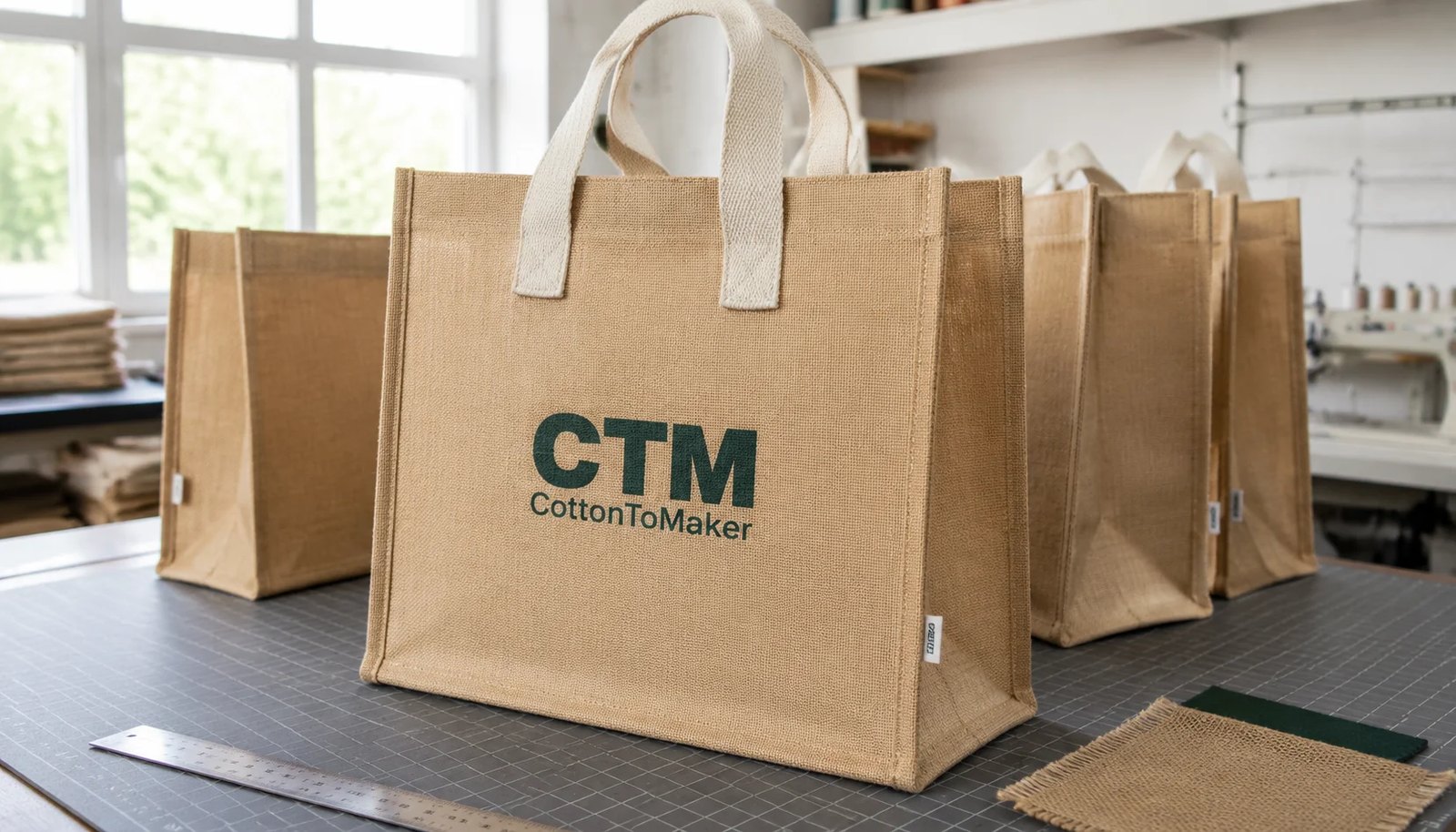
Why logo placement on jute grocery totes needs its own specification
Jute tote bags for natural grocers are usually bought for a practical reason: shoppers need a sturdy reusable bag and the store wants visible branding. The problem is that jute is not a smooth cotton canvas. It has open weave, uneven slubs, hairiness, natural shade variation, and often a laminated back side. These features affect where the logo can be printed, how sharp it will look, and how the bag will present at store level.
A buyer who only sends artwork and a bag size will usually receive supplier interpretations. One factory may center the logo on the cut panel before sewing. Another may center it on the finished bag face. A third may enlarge the artwork to fill the front, causing the print to cross folds or fall too close to handle stitching. The RFQ should define logo position by finished bag measurements, not by visual guesswork.
- Use finished bag dimensions as the reference for all placement measurements.
- Keep the main logo on the flattest front panel unless side branding is intentionally required.
- Avoid placing artwork over seams, bottom folds, handle stitch boxes, or heavy jute slubs where possible.
- For retail display, test how the logo looks when the empty bag stands upright and when it is hanging.
Choose the bag structure before locking the artwork position
Logo placement depends on the tote construction. A flat jute tote has a simpler print area but less grocery capacity. A bottom-gusset tote stands better on a shelf and holds boxed goods, but the lower front panel may curve when filled. A full side-and-bottom gusset bag gives better shopping volume, but the front panel can pull inward when the handles carry weight. The same 180 mm wide logo may look balanced on one structure and crowded on another.
For natural grocer programs, buyers often choose laminated jute around 280-320 GSM because it has enough body for repeated use and store display. Lighter 240-260 GSM jute can work for events, subscription inserts, or limited promotions, but it feels less structured. Heavier fabric can improve perceived quality, yet it may also increase carton weight, shipping cost, and stiffness around seams. The artwork position should be reviewed after the fabric and gusset construction are selected.
- Common grocery tote size range: about 30-40 cm wide, 30-38 cm high, with 12-20 cm gusset depending on use.
- For a main front logo, keep clear space from the top seam, side seam, and bottom fold to reduce distortion.
- If the bag has a large bottom gusset, avoid placing the logo too low because the panel curves when loaded.
- If the bag is intended to stand on a checkout counter, approve the logo location on a filled sample, not only a flat sample.
Practical logo zones for front, back, gusset, and labels
The safest branding zone is the center of the front panel. On many grocery-size jute totes, a main logo area of roughly 160-220 mm wide and 100-180 mm high is practical, depending on bag size. The top of the logo often works best 60-80 mm below the top seam, leaving room for handle movement and stitch reinforcement. If the logo is too high, handles may cover it. If it is too low, the bottom gusset fold can bend the artwork when the bag is packed or filled.
Back panel printing is useful for a secondary message, website, care note, or campaign line. Gusset printing should be treated more carefully because gussets are folded and sewn with more tolerance variation. A vertical side logo can look premium if it is small, but it must allow for panel shift. Woven side labels are another option for discreet branding, especially when the main front print is intentionally simple.
- Front panel: best for store logo, campaign identity, loyalty program branding, and high visibility.
- Back panel: suitable for short message, website, QR code only after scan testing, or reuse instruction.
- Side gusset: use small marks or vertical text with wider placement tolerance.
- Side label: useful when the buyer wants a subtle private-label look or wants to avoid large ink coverage on jute.
- Bottom area: generally avoid important artwork because it folds, rubs, and is less visible.
Match print method to jute texture and logo detail
Screen printing is the usual choice for jute tote bags with simple natural grocer branding. It handles solid logos, one-color store marks, and basic two-color designs well. Because jute is coarse, very thin lines and tiny reversed letters can fill in or break. Buyers should not judge print feasibility only from a PDF. The correct test is a strike-off on the actual jute quality and lamination being used for production.
Heat transfer or digital transfer can reproduce more detail, but adhesion and hand feel must be tested. Transfers may sit on top of the jute surface and can look less natural if the graphic is large. They can also crack or lift if the coating, heat, pressure, or storage conditions are not suitable. For grocer buyers positioning the bag as natural and reusable, a clean screen print often looks more aligned with the product than a glossy photo-style transfer.
- Use screen print for one to three solid colors, simple icons, and bold store logos.
- Increase line thickness for jute; avoid very fine outlines, small serif type, and tiny reversed text.
- Specify Pantone colors, but allow realistic color variation because natural jute shade affects ink appearance.
- Request a print strike-off before the full pre-production sample when color accuracy matters.
- For QR codes, test scanning on the actual printed sample at the intended size before approving bulk.
Cost drivers behind logo placement and artwork choices
The print location itself may not sound expensive, but poor placement can create added cost. A logo that crosses a fold can require slower printing or higher rejection. A large solid print can increase ink consumption and drying time. Multiple logo versions for different store regions may create extra screens, extra setup, and smaller production batches. If each location wants its own mark but order quantity is low, the unit cost can rise quickly.
The bigger cost driver is usually the combined specification: jute GSM, lamination, handle type, print color count, number of print positions, and packing method. A quote for a 240 GSM light jute tote with one small print cannot be compared with a 320 GSM laminated grocery tote with front and back printing, cotton webbing handles, individual packing, and reinforced stitching. Procurement teams should build a comparison sheet that normalizes these details before judging price.
- One print position with one color is the most efficient structure for basic store programs.
- Two-sided printing adds setup, handling, drying space, and inspection points.
- Large ink coverage can require extra drying control to prevent transfer marks during packing.
- Different logo versions should be grouped by shared bag size and shared ink colors where possible.
- MOQ may increase when fabric color, handle color, print color, or logo version changes.
MOQ logic for natural grocer programs with multiple stores or banners
Many natural grocers do not buy only one logo. They may have corporate branding, local store names, seasonal campaign marks, or private-label program artwork. The factory sees each variation as a changeover risk. Even when the same bag body is used, each print version may require screen setup, color adjustment, line cleaning, and separate packing marks. This is why MOQ should be discussed by logo version, not only by total order quantity.
A practical sourcing approach is to standardize the bag body first, then split the print versions. For example, one approved jute tote size, one natural fabric shade, one handle type, and one carton packing method can support several logo versions more efficiently. If each store requests different handle colors, different print sizes, and different carton marks, the order becomes a collection of small custom jobs instead of one controlled production run.
- Define MOQ per finished bag size, not just per purchase order.
- Separate MOQ for front print only, front plus back print, and label-added versions.
- Group regional logos using the same ink color to reduce setup complexity.
- Clarify whether overrun and underrun tolerance applies to each logo version or the total order.
- For distributor programs, decide carton marks and inner packing by destination before production starts.
Sample approval: what the buyer should measure before production
The pre-production sample should be made with the same jute GSM, lamination, handle material, thread, stitch pattern, print method, and artwork size intended for bulk. A beautiful hand-made sales sample is not enough if production will use different fabric or a different print line. The sample should be reviewed as a production control document, not as a promotional photo.
Logo placement must be measured from fixed finished seams. For example, record the distance from the top seam to the top of the logo, from the left side seam to the left edge of the logo, and from the bottom fold to the bottom of the logo. If the bag has gussets, measure while the bag is flattened in the agreed way. Photos should include a ruler, but the approved sample itself should remain the main standard.
- Measure finished width, height, bottom gusset, side gusset, and handle drop.
- Record logo width, height, top distance, side distance, and whether the logo is visually centered on the finished front panel.
- Inspect print edge sharpness, pinholes, ink coverage, color, and rub risk after the ink is fully dry.
- Load the bag with realistic grocery weight to see whether handles cover or distort the logo.
- Fold and pack the sample as planned for bulk to see whether the print scuffs or transfers.
QC thresholds that prevent common jute tote branding defects
Jute will never look as uniform as bleached cotton canvas, so the QC standard must separate natural material character from true defects. Small shade variation and minor slubs are normal. Serious oil stains, mildew smell, large dark knots in the logo area, loose weave holes, lamination peeling, and wet cartons are not acceptable for a retail grocery program. Buyers should define which defects are critical before inspection.
For logo placement, tolerance should be realistic but controlled. On sewn jute bags, a few millimeters of movement is normal because fabric shifts during cutting, printing, and stitching. A common practical tolerance for logo placement may be plus or minus 5-10 mm, depending on artwork size and bag construction. If the logo must align with a pocket, label, or color panel, the tolerance must be tighter and the factory needs to know this before pricing.
- Critical defects: wrong logo, wrong artwork version, wet or moldy goods, broken handles, unsafe sharp parts, unreadable required mark.
- Major defects: obvious print misplacement, heavy smearing, missing stitches, open seams, large stains, lamination peeling.
- Minor defects: small natural slubs outside the logo area, slight color variation, small thread ends that can be trimmed.
- Print position should be checked on finished bags pulled from different cartons, not only top pieces.
- Carton drop, compression, and moisture exposure should be considered if bags ship long distance by sea.
Packing and shipping details that affect logo appearance on arrival
Jute is rough, and printed surfaces can scuff if bags are pressed tightly without protection. Flat packing is usually efficient for grocery totes, but the print direction matters. If the ink is heavy or the logo uses a dark color, the factory may need to face printed panels inward, use paper interleaving, or allow longer curing before packing. Individual polybags protect the product but may conflict with sustainability goals, so many natural grocers prefer master carton packing with careful moisture control.
Carton weight also matters. Jute grocery totes can become heavy quickly, especially at 300 GSM or above with reinforced handles. Overpacked cartons may crush lower bags, distort gussets, or create crease marks across the logo. The quote should include pieces per carton, carton dimensions, gross weight, and pallet recommendations if the goods will move through a retail distribution center.
- Confirm whether bags are packed flat, half-folded, or nested upright.
- Avoid folding directly through the main printed logo unless a fold line has been approved.
- Use moisture-resistant export cartons or inner liners when shipping during humid seasons.
- Keep carton gross weight manageable for warehouse handling and carton integrity.
- Require carton marks to identify logo version, bag size, quantity, PO number, and destination if needed.
Lead time and schedule risks from artwork to bulk shipment
A realistic schedule starts before sewing. Artwork review, print layout, screen making, strike-off approval, fabric preparation, cutting, printing, drying, sewing, trimming, inspection, packing, and export handling all need time. If the buyer changes logo size after the sample, the factory may need to remake screens and adjust placement marks. If a seasonal grocer campaign has a fixed launch date, artwork approval delays are often more dangerous than sewing capacity.
For planning purposes, procurement teams should build a timeline with approval gates rather than one vague production lead time. The supplier may quote production days after deposit and sample approval, but that does not include buyer artwork delay, courier time for samples, inspection booking, vessel availability, customs documents, or DC appointment windows. A jute tote program is simple only when decisions are locked early.
- Separate sample lead time from bulk production lead time in the PO schedule.
- Include time for fabric swatch approval if jute shade or GSM is important.
- Do not approve bulk production from a digital artwork proof alone when logo placement is critical.
- Book inspection after packing but early enough to allow rework if defects are found.
- For promotions, keep backup time for carton relabeling, logo version sorting, or shipping document corrections.
Specification comparison for buyers
| Spec decision | Recommended option | When it fits | Buyer risk to check |
|---|---|---|---|
| Front logo position | Center logo on the flat front panel, 60-80 mm below the top seam and away from the bottom fold | Main retail giveaway or loyalty tote where the brand must read clearly when the bag is carried | Artwork too close to handle stitch boxes can distort during sewing or be partly hidden when the bag is full |
| Printable logo size | Keep the main logo within roughly 180 x 160 mm on common 30-35 cm wide jute totes | Most natural grocer logos, store marks, and campaign badges with one or two colors | Oversized prints may cross uneven jute slubs, gusset folds, or panel curvature and lose edge definition |
| Fabric weight | Use 280-320 GSM laminated jute for structured grocery totes; 240-260 GSM for lighter event bags | Reusable grocery programs needing better shelf shape and load feel | Quote comparisons become misleading if one supplier prices lighter jute or thinner lamination |
| Print method | Screen print for simple logos; heat transfer only for detailed graphics after adhesion testing | Natural grocers with solid-color logos, certification-style marks, and repeat store orders | Fine reversed text, gradients, and tiny icons can fill in on coarse jute texture |
| Handle placement | Cotton webbing or jute handles stitched through reinforcement, with print kept outside stitch stress areas | Reusable shopping bags expected to carry produce, bottles, or boxed goods | Long handles may cover upper logo area when the bag hangs; short handles can fold into the print during packing |
| Side or gusset branding | Use small side label or narrow vertical print only after testing folding and panel alignment | Private label programs that need discreet brand ID, barcode, or campaign color | Gussets shift during sewing, so vertical logos can look tilted unless tolerance is agreed |
| MOQ structure | Separate MOQ by bag size, fabric color, handle type, and print color count | Importers combining several store banners or regional logo versions | Mixed logos below MOQ create high setup cost, leftover trims, and longer changeover time |
| Packing method | Flat pack with logo facing inward or protected by paper if ink rub risk exists | Distribution to store DCs, retail shelves, or e-commerce fulfillment cartons | Fresh ink, rough jute, and tight compression can cause scuff marks or logo transfer |
Buyer checklist before sampling
- Define bag size using finished dimensions: width, height, bottom gusset, side gusset if any, and handle drop.
- State jute GSM, lamination requirement, fabric color tolerance, and whether the inside coating may be visible at seams.
- Provide vector artwork with Pantone references, maximum print size, logo center position, and minimum distance from seams and handle stitching.
- Decide whether the logo must read when the bag is standing on a shelf, hanging from a hook, or being carried by hand.
- Limit fine lines and reversed text based on the actual jute texture, not only the artwork file.
- Approve a pre-production sample using the same fabric, lamination, handle, ink, and sewing construction as bulk production.
- Measure sample logo placement from fixed seams, not from the fabric edge before sewing.
- Set acceptance tolerances for print position, color variation, stitching, handle strength, stains, odor, and carton condition.
- Request carton packing details including pieces per carton, carton size, gross weight, polybag use, and logo protection method.
- Compare supplier quotes only after matching GSM, dimensions, handle material, print count, sample terms, packing method, and lead time.
Factory quote questions to send
- What finished jute tote dimensions are included in the quote, and what measurement tolerance do you apply after sewing?
- What exact jute GSM and lamination thickness are being quoted, and can you send a fabric swatch before sampling?
- Is the quoted print method screen print, heat transfer, digital transfer, or another process, and how many colors are included?
- What is the maximum recommended print area on this bag size without crossing seams, folds, or handle reinforcement?
- What Pantone matching tolerance is realistic on natural jute, and will you provide a strike-off before the full pre-production sample?
- What is the MOQ per size, per logo version, per fabric color, and per print color count?
- Are handle materials, handle drop, reinforcement stitching, and load testing included in the quoted construction?
- How many days are needed for artwork layout, print strike-off, pre-production sample, bulk material preparation, production, inspection, and packing?
- What packing method is included: flat pack, folded pack, individual polybag, master carton quantity, and carton dimensions?
- What quote validity, payment terms, export carton marks, HS code support, and inspection arrangement are included?
Quality-control points to confirm
- Finished bag dimensions should be measured after sewing and pressing, with tolerance agreed before production, commonly within plus or minus 5-10 mm depending on size.
- Logo placement should be measured from the top seam and side seams on the finished bag, not from loose cut panels.
- Print color should be compared under consistent light against the approved strike-off, allowing realistic variation caused by natural jute shade.
- Ink coverage should be even enough for brand recognition, with no major pinholes, smearing, ghosting, or transfer marks on adjacent bags.
- Fine text and small icons should remain readable at normal viewing distance; unreadable detail should be corrected before bulk approval.
- Handle attachment should show secure box or cross stitching with no skipped stitches, broken thread, loose ends, or fabric tearing around stress points.
- Bag panels should be free from serious oil marks, mildew odor, wet cartons, large dark slubs in the logo area, and visible lamination peeling.
- Cartons should match the approved packing plan, with correct quantity, carton mark, carton strength, and protection against moisture during transit.