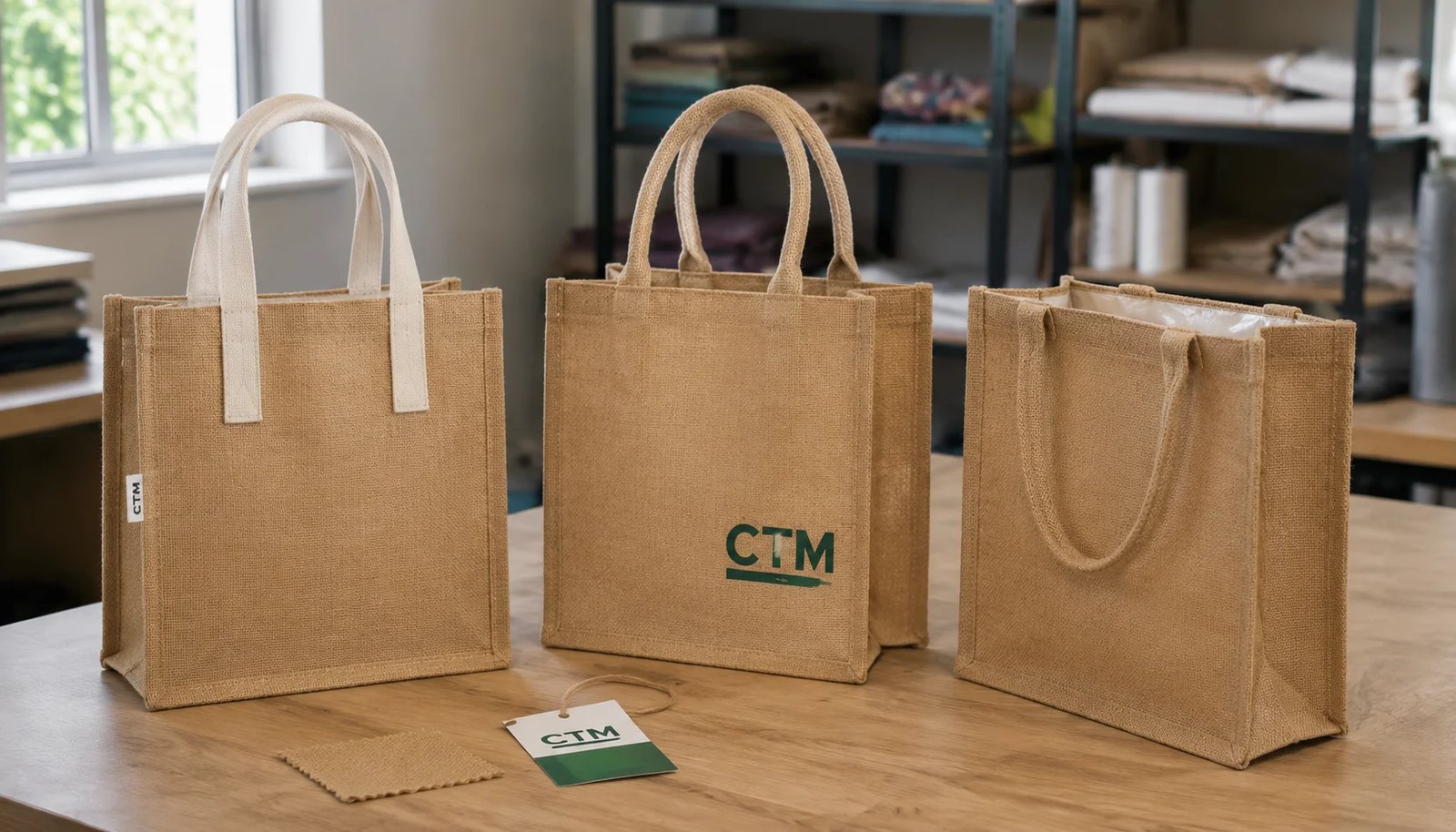
Why durability is the core buying problem for natural grocer jute totes
Natural grocers put reusable bags into a harder service pattern than many gift or promo programs. These bags carry glass jars, boxed pantry items, root vegetables, milk cartons, and occasionally overpacked impulse purchases. A jute bag can look substantial on a showroom rack yet still fail early if the weakness is in handle stitching, gusset construction, fold cracking from lamination, or poor edge finishing. That is why a durability checklist needs to be written around actual use, not only around fabric appearance.
The most expensive mistake is approving a bag that photographs well but was never tested as a loaded grocery carrier. Importers often receive quotes labeled heavy duty, eco bag, or grocery tote without any measurable standard behind those terms. A better buying approach is to translate merchandising intent into pass-fail criteria: load weight, carry cycles, seam behavior, handle retention, wipe-clean performance, print rub resistance, and carton protection against moisture. That gives comparable supplier quotes and reduces arguments after production.
- Typical failure points: handle pull-out, side seam slippage, bottom distortion, edge fray, lamination cracking, print rub-off
- Retail pain points: customer returns, poor online reviews, repacking damage, odor complaints after opening cartons
- Quote pain points: light fabric substituted, weak handles, non-matching samples, moisture damage during shipment
Start with the right construction, not just the right look
For grocery use, bag construction matters more than surface style. A typical starting range for the jute body is around 280-320 GSM cloth, often marketed as a 13 oz equivalent class once finished into a laminated shopping tote. Lighter fabric can work for event use, but daily grocery carrying usually benefits from a firmer body and better seam integrity. If the bag is intended for wine bottles, jars, or boxed goods, the gusset and bottom panel become as important as the front panel GSM.
Inside PP lamination is commonly worth the cost for natural grocer programs because it improves wipe-clean behavior and reduces fiber shedding. It also helps the bag keep shape under mixed loads. The tradeoff is fold performance: if the lamination film is too stiff or too thick, repeated crease stress can cause visible cracking. Buyers should therefore specify both lamination presence and intended fold behavior rather than leaving the factory to select whatever film is cheapest.
- Useful starting spec: 280-320 GSM jute body, 10-15 cm gusset, inside lamination
- For shoulder use: handle drop around 23-27 cm depending on bag width and opening
- For heavier loads: cotton webbing handles often outperform decorative rope handles
- For cleaner retail presentation: folded mouth with inside binding tape reduces fray
Choose durability tests that reflect grocery use, not showroom handling
A simple lift test is not enough. Many factories will hang a weighted sample for a short period and call it passed. That may detect obvious stitching failure, but it does not show seam creep, lamination stress whitening, or handle fatigue from repeated movement. Grocery bags are carried from shelf to cart, cart to car, and car to kitchen. The test plan should therefore include both static load and carry cycle stress.
A practical baseline for natural grocer programs is a static load test of 12-15 kg for 24 hours, followed by a dynamic carry cycle test at 8-10 kg for around 200 cycles. The exact target depends on bag size and intended contents. If your merchandising team wants a wide-format tote that suggests bulk buying capacity, increase the test severity. If the bag is for lighter mixed produce and dry goods, the lower end of the range may be enough. What matters is that the RFQ names the method and the failure threshold.
- Static load test: filled bag suspended for 24 hours with no handle tear-out and no seam burst
- Carry cycle test: repeated lifting and lowering to simulate store-to-home handling
- Flatness recovery: after unloading, bag should still hold usable shape without severe bottom collapse
- Print and surface check after test: no major ink crack, excessive rub-off, or lamination split
Handle design is usually the real make-or-break detail
On many failed jute totes, the body fabric survives while the handle area fails first. That is because the handle attachment concentrates force in a small stitched zone. For grocery programs, cotton webbing handles with box-X reinforcement or equivalent multi-point reinforcement are usually safer than decorative padded rope handles unless the rope attachment is very well engineered. Rope can still be used, but it needs deeper insertion, secure lock stitching, and enough internal reinforcement to spread the load.
Handle width also affects performance and user comfort. Narrow handles may cut into the hand and place more stress on the stitch line. Wider cotton webbing improves comfort and load distribution. Buyers should request close-up sample photos and a handle cross-section description, not just a statement such as strong handles. If the supplier does not identify stitch count, reinforcement pattern, and handle insertion depth, the quote is incomplete.
- Preferred for grocery use: cotton webbing around 2.5-3.8 cm wide
- Reinforcement: box-X or extended bar tack at approved stitch density
- Avoid relying on glue, hidden staples, or decorative only stitching
- Inspect inside finish where handle stitching passes through laminated jute
Printing on jute needs realistic artwork limits and rub testing
Jute has a coarse, uneven weave. That texture affects line sharpness, small text legibility, and solid coverage. Buyers who approve artwork on a digital mockup often discover that the actual logo edge is rougher than expected. For simple one-color or two-color branding, screen print is usually the most practical option. It handles bulk production reliably and gives acceptable adhesion when ink and curing are matched to the jute surface. Heat transfer can work for detailed graphics, but the transfer film and bonding layer must tolerate fold stress.
Print approval should include a rub test, not only a color sign-off. Grocery bags get dragged across counters, packed tightly in cartons, and flexed repeatedly. A logo that flakes or abrades after modest use creates a quality issue even when the bag structure remains intact. If your artwork includes fine type, reverse details, or large dark solids, request a production-method recommendation from the factory and approve a sample printed on the same jute quality intended for bulk.
- Best use of screen print: bold logos, simple shapes, medium detail
- Watch for on jute: filled-in counters, uneven ink edge, inconsistent dark solid coverage
- Sample test: dry rub and light damp rub on printed panel after curing
- Do not approve artwork based only on flat paper proof or digital render
Write MOQ and quote logic around what really changes the factory cost
MOQ on jute totes is rarely driven by one number alone. The practical MOQ changes with bag size, print color count, lamination, handle type, and whether the supplier is running a standard pattern or a custom structure. A bag that uses common body dimensions and one-color screen print may fit a lower MOQ. Once you add custom gusset width, inside pocket, piping, woven labels, or multiple print positions, setup loss and labor increase quickly.
To compare quotes properly, break the price into visible drivers. Ask for unit price by quantity break, sample charge, print setup if any, carton count, and whether the quote includes export carton liner. If one supplier is substantially lower, it is often because the fabric is lighter, the handle reinforcement is simpler, or the packing is weaker. Without that breakdown, the cheapest offer can become the most expensive after repacking, claims, or reorders.
- Common cost drivers: GSM, lamination, handle material, print colors, gusset depth, labels, packing method
- Useful quantity breaks to request: 1,000 / 3,000 / 5,000 / 10,000 pieces
- A lower MOQ may mean using available fabric color, shared print schedule, or standard size only
- Example quote note: a stronger handle and better lamination may raise unit price but reduce return risk
Use sample approval to lock bulk reality, not just dimensions
A development sample often proves only that the pattern can be made. It does not prove that the bulk product will perform the same way. For durability-sensitive grocery bags, the pre-production sample should be made with the intended fabric class, lamination spec, handle tape, and print process. Otherwise the buyer may approve shape and logo placement while still leaving the structural risk unresolved.
The approval sheet should record measurable observations: panel GSM range, handle width, handle drop, stitch type, gusset width, bottom squareness, print size, print feel, odor level, and packing fold orientation. If you are using more than one SKU size, approve a sample for each size because handle geometry and load angle change with width and height. A larger bag with the same handle attachment as a smaller bag may not pass the same stress target.
- Approve against a signed sample card with fabric, handle, print and label references
- Measure real dimensions after the bag is stitched, not only pattern dimensions
- Record visual tolerances for natural fiber variation so inspection is realistic
- Photograph inside seam, handle base, top edge and bottom construction for production reference
Packing details matter because jute is vulnerable to moisture and shape distortion
Jute is a natural fiber and can pick up odor and moisture if poorly packed or stored. Carton planning is not only a freight issue; it affects quality on arrival. Flat packing is standard, but carton counts should be set with attention to handle creasing, print rubbing, and warehouse handling weight. Overpacked cartons can distort the bag mouth and cause visible fold marks, especially on laminated interiors.
A moisture barrier liner inside the export carton is often a small cost for a meaningful reduction in risk, especially for sea freight or humid storage conditions. Buyers should also set a maximum carton gross weight that warehouse teams can handle safely. If cartons are too heavy, they are more likely to be dropped or crushed, and the bags inside can develop edge damage or compressed shape memory.
- Request: flat packed orientation, piece count per carton, and whether handles are tucked or laid straight
- Use carton liner to reduce moisture pickup and contamination risk
- Set gross weight target appropriate for warehouse handling, often under practical manual limits
- For printed faces, consider interleaving or print-to-print orientation if rub risk is high
Lead time risk on jute programs usually comes from materials and seasonality
Jute bag lead times are affected by more than sewing capacity. Material availability, lamination scheduling, print queue, and peak seasonal demand all matter. If the supplier buys base jute cloth only after order confirmation, your timeline needs to include sourcing and incoming inspection. If your design uses custom handle tape color, woven labels, or special packaging inserts, those components can become the actual critical path.
Procurement teams should ask for a stage-by-stage timeline instead of one bulk lead time number. A realistic schedule separates sample time, sample revision if any, material booking, print approval, cutting, sewing, inspection, and packing. This makes it easier to compare supplier reliability. A factory that quotes a short total lead time but cannot explain the sequence is often taking schedule risk that the buyer will absorb later.
- Break lead time into: development sample, pre-production sample, materials, bulk sewing, final inspection, packing
- Peak risk periods can affect jute cloth, printing capacity and vessel booking
- Custom trims and labels should be approved early to avoid production hold
- Build time for durability retest if the first sample needs handle or seam revision
Compare landed cost by usable life, not only by unit price
For retail buyers and distributors, the real commercial question is not whether one bag is a few cents cheaper ex-factory. The better question is how many acceptable uses the bag will survive and what support cost follows if it fails. A jute tote with a stronger handle base, cleaner lamination, and better packing may cost more at origin but reduce returns, negative customer feedback, and emergency reorders. If the program is tied to store branding, failure also carries reputational cost.
A practical landed-cost comparison includes ex-factory price, sample and revision cost, freight impact from carton efficiency, expected defect allowance, and replacement exposure. This does not require invented exact numbers. Even a range-based evaluation helps. If one supplier saves 5 percent on unit cost but ships with no moisture liner, weak handle construction, and inconsistent print, the total program risk is often too high for a grocery environment.
- Useful comparison factors: unit price, carton utilization, QC reject risk, return risk, reorder risk
- Cheaper bags can cost more if they trigger repacking, markdowns or customer complaints
- For distributor programs, consistent repeatability often matters more than the absolute lowest first order price
- Document tradeoffs internally so the buying team can justify a stronger spec
Specification comparison for buyers
| Spec decision | Recommended option | When it fits | Buyer risk to check |
|---|---|---|---|
| Base fabric weight | 13 oz equivalent laminated jute or about 280-320 GSM cloth body | Daily grocery use with moderate to heavy pantry items | Suppliers may quote lighter cloth that looks similar but fails faster at fold lines and handle stress points |
| Lamination choice | Thin PP lamination inside only | Best for spill resistance and easier wipe-clean use in grocery environments | Over-thick lamination can crack on folds; no lamination can shed fibers and absorb moisture |
| Handle construction | Cotton webbing handles stitched with box-X reinforcement | Higher reliability than glued rope inserts for repeated carrying | Short stitch length and weak reinforcement can tear out before fabric body fails |
| Handle drop | 23-27 cm shoulder/hand carry depending on bag width | Works for mixed-use grocery tote programs | Too short causes customer complaints; too long changes load angle and increases seam stress |
| Side and bottom gusset | 10-15 cm gusset with full bottom support | Needed when shoppers carry jars, cartons, produce and boxed items | Narrow gusset shifts weight into side seams and reduces real carrying stability |
| Printing method | Screen print for simple logos; heat transfer only for detailed multicolor panels | Screen print bonds better on jute for standard retail branding | Fine lines fill in on rough weave; transfer films can delaminate if bag folds hard |
| Top edge finishing | Folded mouth with inside binding tape | Improves edge stability and reduces fray during store handling | Raw or weakly folded edges fray in cartons and after repeated use |
| Load test target | Static 12-15 kg for 24 hours plus 200 carry cycles at 8-10 kg | Suitable baseline for natural grocer reusable bag programs | Many factories only do a simple lift test, which does not reveal seam creep or handle fatigue |
| Carton packing | Flat packed in export carton with moisture barrier liner | Protects from humidity, odor pickup and handle creasing during transit | Loose packing can distort shape; no liner raises risk of moisture stains and mildew smell |
Buyer checklist before sampling
- Define the real use case: produce, jars, bottles, boxed groceries, or mixed basket load
- State target fabric weight or acceptable range in GSM, not only 'heavy duty jute'
- Specify whether inside lamination is required and whether the bag must be wipe-clean
- Set bag dimensions, gusset width, and handle drop based on shelf use and customer carry style
- Require handle material, width, stitch pattern, and reinforcement points in the tech pack
- Match print method to artwork detail and jute surface limitations before sampling
- Include load test method, load weight, test duration, and pass/fail criteria in RFQ
- Approve a pre-production sample that uses bulk fabric, bulk handle tape, and intended print
- Define acceptable odor, fray level, loose fiber level, and color tolerance
- Specify inner polybag, carton count, carton liner, and carton gross weight limits
Factory quote questions to send
- What is the exact jute fabric GSM for body, gusset and facing, and what tolerance do you allow in bulk?
- Is the bag made from natural jute cloth only, or does it include PP lamination, cotton lining, or other hidden material layers?
- What handle material, width, and stitch reinforcement do you use, and can you provide close-up photos of the handle attachment area?
- What static load test and carry cycle test do you run in-house, and can you share the test method rather than only a pass statement?
- Will the pre-production sample use the same fabric batch type, lamination spec, handle tape, and print process as bulk production?
- How does your print method perform on coarse jute weave for fine lines, small text, and dark ink coverage?
- What is your MOQ by size, print color count, and whether inside lamination is included?
- What are the main unit price breakpoints at 1,000, 3,000, 5,000 and 10,000 pieces, and what changes at each level?
- How many pieces per carton, what are carton dimensions and gross weight, and do you use a moisture barrier liner inside export cartons?
- What is your sample lead time, pre-production lead time, and bulk lead time in peak season for jute items?
Quality-control points to confirm
- Fabric GSM within approved tolerance and consistent across body panels and gusset
- Color and weave appearance reasonably uniform for natural jute lots, with no excessive shading beyond approved sample
- No strong oil, chemical, mildew, or damp odor on opening carton
- Lamination bonded evenly with no bubbling, cracking, peeling, or exposed sharp film edges
- Top edge fold and binding tape neat, continuous, and without skipped stitches
- Handle attachment uses approved reinforcement pattern and passes specified load test
- Seams straight, secure, and free from seam grin, seam slippage, or burst at stress corners
- Bag stands and opens to intended dimensions with bottom shape stable under load
- Print registration, ink adhesion, and coverage match approved sample within agreed tolerance
- No major loose fibers, holes, broken yarns, needle cuts, or visible repair stitching on retail-facing panels