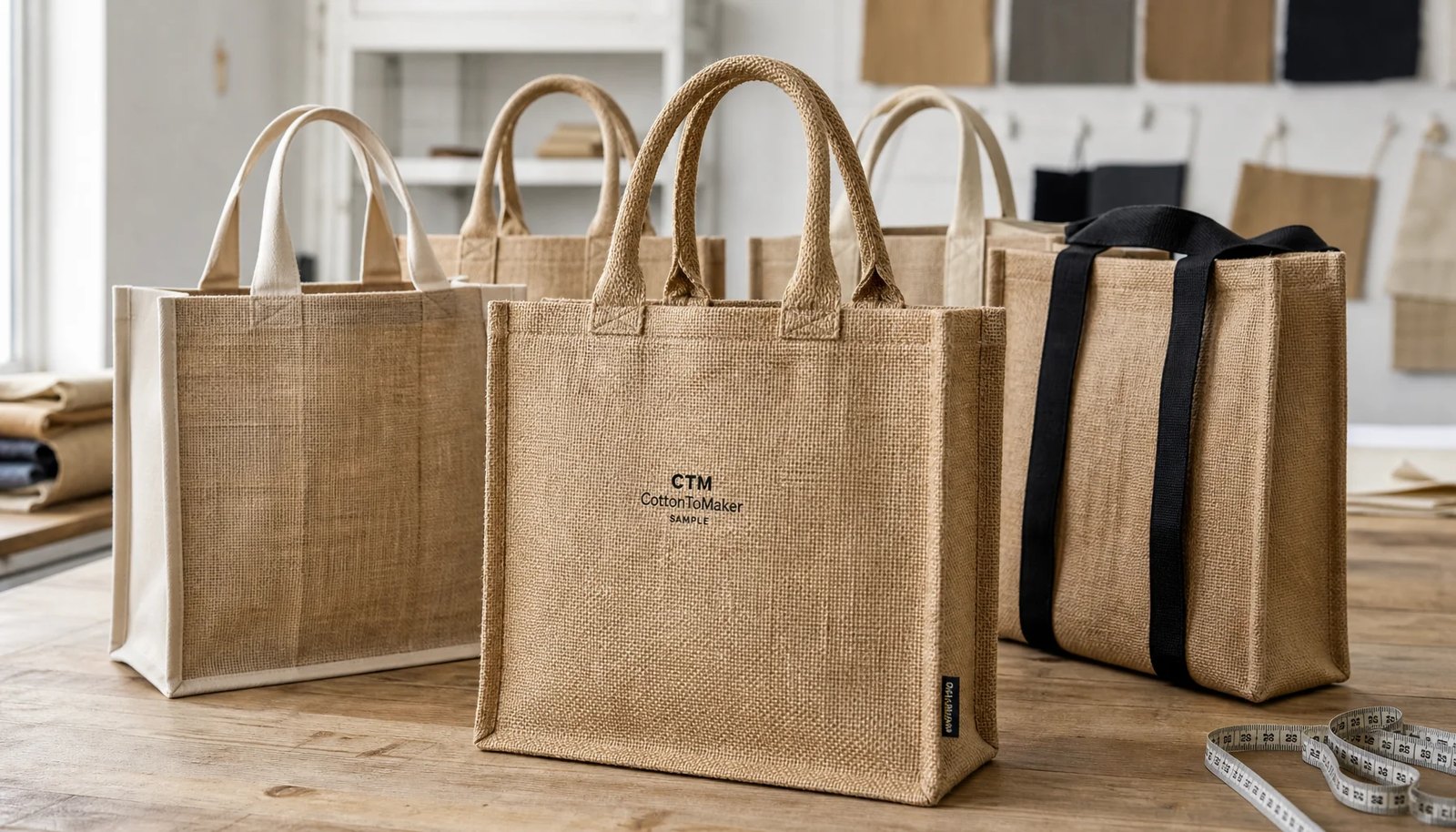
Start With The Booth Load, Not The Bag Photo
For trade show exhibitors, the wrong jute tote usually fails in a very practical way: it looks good on the quote sheet but cannot carry the actual booth contents. A visitor may receive a catalog, two brochures, a water bottle, a small product sample, a notebook, and another sponsor item before leaving the aisle. That can turn a decorative bag into a load-bearing item. Material selection should therefore start with the expected contents, walking time, and brand value, not only with a reference photo from a previous event.
A light literature bag can use a different fabric and handle structure than a premium gift bag for invited buyers. The procurement team should define the load target in kilograms, the required handle drop, and whether the bag needs to stand upright on a booth counter. These three details influence jute weight, gusset depth, handle reinforcement, and packing volume more than most buyers expect.
- Light literature use: 270-300 GSM natural jute, basic cotton webbing, flat or shallow gusset.
- General exhibitor giveaway: 300-340 GSM jute, 35-40 mm cotton webbing, reinforced top hem.
- Premium buyer gift: tighter 340 GSM plus jute or laminated jute, clean stitching, box gusset, stronger handle anchoring.
- Heavy sample kit: test handle pull and bottom seam instead of relying on fabric weight alone.
Choose Jute Weight By Function And Finish
Jute weight is often quoted in oz, GSM, or vague words such as regular, heavy, and premium. For a reliable RFQ, convert the discussion into measurable fabric weight and surface expectations. Many trade show tote bags sit around 13-15 oz jute, roughly 270-320 GSM depending on the yarn and weave. Heavier 16-18 oz material can feel more substantial, but it is not automatically better if the weave is rough, the yarn has many slubs, or the print area needs fine detail.
Natural jute varies more than cotton canvas. Yarn thickness, weave openness, and finishing create visible differences between batches. A buyer comparing quotes should not accept a lower price until the supplier identifies the real material weight, lamination status, and expected tolerance. If the event bag must support a premium brand position, require a fabric swatch and a pre-production sample made from the intended bulk fabric before approving mass production.
- Use 270-300 GSM when cost and volume matter more than structure.
- Use 300-340 GSM for most exhibitor totes that need a better hand feel and stronger shelf presence.
- Use 340 GSM plus or laminated jute when the bag must stand upright or be reused after the event.
- Avoid approving only by photo; jute density and hand feel are difficult to judge from images.
Decide Early On Lamination
Lamination is one of the biggest material decisions for jute tote bags. Unlaminated jute has a more natural feel, folds more softly, and can support a simple sustainability message if the full construction is consistent with that claim. Laminated jute is cleaner inside, more structured, more resistant to damp surfaces, and easier to wipe. For trade shows with food samples, cosmetics, beverages, or outdoor loading docks, lamination can prevent complaints that are hard to fix after delivery.
The tradeoff is that lamination changes the bag's character. It may increase stiffness, add odor risk if poorly cured or stored, reduce folding flexibility, and complicate end-of-life claims. If you choose lamination, specify whether it is inside only or both sides, the lamination material, approximate thickness, and whether the finished bag can be packed flat without permanent creasing. A common range is 18-25 microns for a practical interior layer, but the exact choice should match the bag size and structure.
- Use unlaminated jute for soft natural texture, simple folding, and lower material complexity.
- Use inside lamination for booth bags carrying samples, food, cosmetics, or damp items.
- Use laminated box-gusset construction when the bag needs to stand upright for kit packing.
- Include odor, crease, and delamination checks in the approval sample and final inspection.
Match Handles To Visitor Comfort
Many low-cost jute bag quotes save money in the handle. That is risky for trade shows because the user carries the bag for hours, often while walking between halls. Cotton webbing is the common choice because it feels better on the shoulder than jute rope or narrow tape. For most exhibitor totes, 35-40 mm wide cotton webbing is a sensible starting point. A 55-65 cm handle length works for shoulder carry, while shorter handles are better for hand-carry gift bags but less comfortable for long exhibition use.
Handle strength depends on both material and sewing. A wide handle stitched into a weak top hem can still fail. For heavier bags, specify cross-stitching, box stitching, or extended handle insertion into the bag body. If the artwork sits near the handle area, make sure the reinforcement does not distort the logo placement. The sample should be loaded with the intended booth contents and carried for a practical trial, not just pulled once in the sample room.
- Specify handle material: cotton webbing, jute webbing, rope, or padded cotton if needed.
- Confirm handle width and drop, not only total length.
- Use reinforced stitching for bags carrying catalogs, bottles, or boxed samples.
- Reject samples with skipped stitches, uneven handle positions, or webbing that twists under load.
Print Method Depends On Jute Texture
Jute is not a smooth print surface. Open weave, yarn slubs, and uneven fibers can break fine lines and absorb ink unpredictably. Screen printing is usually the most practical method for solid exhibitor logos, booth slogans, and sponsor marks. It works best with bold shapes, limited colors, and artwork that allows small texture breaks. Large solid ink blocks need enough curing time and rub testing because a rough jute surface can hold ink unevenly.
For complex artwork, gradients, small QR codes, or detailed product illustrations, the buyer should consider a sewn label, heat transfer label, cotton patch, or printed canvas panel instead of forcing the design directly onto jute. This is especially important when the bag will be photographed at the booth or given to VIP buyers. A supplier should review the actual vector file and warn about line thickness, color contrast, registration tolerance, and print size before quoting final production.
- Best for direct screen print: 1-3 solid colors, bold logos, large type, simple sponsor marks.
- Risky for direct print: thin serif text, small QR codes, gradients, skin tones, detailed icons.
- Alternative branding: cotton label, woven label, printed canvas patch, or transfer panel.
- Approval standard: compare the sample under normal room light and perform a dry rub test after curing.
Use MOQ Logic To Compare Quotes Fairly
MOQ is not only a factory preference. It is driven by fabric sourcing, cutting efficiency, print setup, handle material, and packing labor. A standard natural jute tote in a common size may be workable around 500-1,000 pieces, depending on the factory and current material stock. A dyed jute body, custom handle color, special lamination, private label, or unusual size can push the practical MOQ to 2,000-3,000 pieces or more because the supplier must buy and process material as a batch.
When two suppliers quote very different MOQs, compare what is included. A lower MOQ may use stock jute, stock handles, a smaller print area, simplified packing, or a higher unit price. That can be acceptable for a one-time show, but it should be visible in the decision. For distributor programs serving several exhibitors, consolidating orders under one material and handle specification often reduces cost and batch variation while still allowing different printed logos.
- Low MOQ works best with natural jute, standard size, stock handle, and one-color print.
- Higher MOQ is normal for dyed jute, custom webbing, special labels, or nonstandard gussets.
- Screen setup cost should be separated from unit cost when comparing small orders.
- For multi-event orders, negotiate one base bag spec with variable artwork runs.
Sample Approval Should Simulate Bulk Production
A jute tote sample is useful only if it represents the intended production method. A showroom sample can confirm approximate size and construction, but it may not match the fabric, handle, lamination, or print of the order. For trade show deadlines, this difference matters because there may be no time to remake the goods if the bulk fabric feels lighter or the print bleeds. The RFQ should separate reference sample, custom sample, and pre-production sample so both sides know what is being approved.
The strongest approval sample uses the final bag size, intended jute weight, real handle material, actual print method, and proposed packing fold. Measure the sample, weigh it, load it, photograph it, and keep it as the retained standard. For repeat orders, request the factory to reference the same retained sample or update the standard if material availability changes.
- Measure finished width, height, gusset, handle drop, and print placement from the seam.
- Weigh the bag and compare it with the expected fabric weight and construction.
- Load the bag with representative booth materials for at least a practical carry trial.
- Review inside seam finishing, lamination adhesion, fiber shedding, and odor after 24 hours in a closed carton.
- Approve the packing fold because creases can affect front-panel appearance.
Set QC Thresholds Before The Cartons Close
Jute bags have natural variation, so the QC standard should define which variation is acceptable and which defects affect shipment. Color shade, small slubs, and minor fiber irregularity are part of the material. However, oil stains, strong odor, open seams, broken yarn holes, loose handles, serious print bleeding, and wet cartons are not acceptable for a trade show order. A clear inspection checklist prevents arguments after the event warehouse receives the goods.
Use measurable thresholds where possible. For example, handle pull can be tested against a defined load based on the expected contents. Bag dimensions can follow agreed tolerances, often tighter for retail resale and looser for pure giveaways. Print placement should allow a small tolerance from the approved sample, but not drift into the seam or handle area. If the order is time-sensitive, perform inline inspection before full packing so the factory can correct sewing or print issues while production is still open.
- Fabric defects: reject visible stains, holes, brittle areas, or severe color mismatch across panels.
- Sewing defects: reject open seams, skipped stitches at handles, loose top hems, and exposed sharp thread ends.
- Print defects: reject severe bleeding, wrong color, off-position artwork, tacky ink, or poor curing rub-off.
- Packing defects: reject damp cartons, mixed SKUs without marks, crushed gussets, and wrong pack count.
- Documentation: keep inspection photos tied to PO number, carton range, and approved sample.
Packing And Freight Can Change The Real Cost
A jute tote bag can be inexpensive per unit but inefficient in freight if it has a deep gusset, laminated structure, bottom board, or rigid handle arrangement. Trade show buyers also need to consider the destination handling route. Goods may go to a central warehouse, a distributor, a booth builder, or directly to an advance show warehouse with strict receiving labels. If cartons arrive crushed, wet, or unmarked, the unit price no longer matters very much.
Flat packing is common, often 25-50 pieces per export carton depending on bag size and material. Too much compression can crease laminated jute or distort box gussets. Too loose a pack increases volume and freight. Ask for carton dimensions, gross weight, net weight, and pieces per carton before comparing landed cost. For show delivery, carton marks should include event name, booth number if available, PO number, SKU, quantity, and destination instructions required by the logistics provider.
- Flat bags reduce volume but may create front-panel creases if pressure is high.
- Box-gusset bags need controlled folding to protect the base shape.
- Individual polybags add handling cost and plastic use but may protect premium bags during distribution.
- Moisture protection is important for sea freight and humid warehouse conditions.
- Carton drop resistance matters when bags are shipped by courier to multiple booth locations.
Build A Lead Time That Allows Corrections
Trade show deadlines punish optimistic schedules. A practical jute tote timeline includes artwork review, sample making, sample shipping, approval revisions, material procurement, cutting, printing, curing, sewing, trimming, inspection, packing, and freight. Standard natural jute bags with simple printing move faster than custom dyed or laminated constructions. The biggest schedule risks are late artwork, changed logo size, unavailable fabric, print rework, and freight routing to a show warehouse.
For planning, treat the quoted production lead time as the factory phase after all approvals are complete, not the whole calendar from first email to delivery. If the event date is fixed, work backward from the required arrival date and include buffer for customs, warehouse receiving appointments, and possible inspection findings. A slightly simpler bag specification delivered on time is usually better than a more elaborate construction that arrives after the booth has opened.
- Artwork review: allow time for print-size adjustment and Pantone confirmation.
- Sample stage: include sample production and courier transit, especially for overseas sourcing.
- Bulk material: confirm whether jute is in stock or needs batch procurement.
- Printing and curing: do not compress curing time for large solid logos.
- Final inspection: schedule before the goods leave the factory, not after arrival at the event city.
Specification comparison for buyers
| Spec decision | Recommended option | When it fits | Buyer risk to check |
|---|---|---|---|
| Jute body weight | 13-15 oz jute, roughly 270-320 GSM depending on weave density | General trade show giveaways carrying brochures, catalogs, drink bottles, and small samples | Very loose weave can look large but feel weak; compare actual GSM, not only oz wording |
| Premium booth bag material | 16-18 oz jute or laminated jute with tighter yarn and cleaner face | Retail-grade exhibitor gifts, sponsored event bags, and brand stores after the show | Higher weight increases freight and can reduce print sharpness if the surface is too uneven |
| Interior treatment | LDPE or PP lamination inside, usually 18-25 microns | Food sampling, cosmetics, damp booth floors, or buyers who expect wipe-clean interiors | Lamination can change feel, smell, folding method, recyclability claims, and heat behavior during packing |
| Handle type | Cotton webbing 35-40 mm wide, full-length stitched into the top hem or cross-stitched patch | Comfortable shoulder carry during long exhibition days | Short handles and narrow webbing make the bag cheaper but lower perceived value and user retention |
| Print method | Screen print for solid logos; heat transfer label only for complex artwork on uneven jute | Most 1-3 color exhibitor logos, booth themes, and sponsor marks | Fine text below 1.5 mm, gradients, and pale ink on dark jute often fail without artwork adjustment |
| Bag construction | Box gusset with bottom insert only when load presentation matters | Kits with catalogs, apparel, bottled goods, or retail shelf display after the show | Bottom board adds cost and packing volume; weak board corners can crease through the jute |
| MOQ logic | 500-1,000 pcs for standard size and stock jute; 2,000-3,000 pcs for custom dyed, custom webbing, or special lamination | Small exhibitor runs versus multi-event distributor programs | Low MOQ custom dye or special trim usually means higher unit cost, longer sampling, or mixed-batch color risk |
| Packing style | Flat pack 25-50 pcs per export carton with moisture protection | Sea freight, warehouse receiving, and booth advance shipments | Compressed packing may crease laminated jute and distort box gussets before the event |
| Compliance evidence | Material declaration, azo-free dye statement when dyed, needle detection when required, and carton drop test for heavy loads | Retail brands, EU importers, and distributors selling to corporate programs | Certificate names alone are not enough; match documents to the actual material batch and purchase order |
Buyer checklist before sampling
- Define the booth use: light literature bag, premium visitor gift, retail resale item, or heavy sample carrier.
- Specify finished bag size, gusset depth, handle drop, loading target, and whether the bag must stand upright.
- State jute weight in GSM or oz with tolerance, and require a physical swatch for approval before bulk fabric purchase.
- Decide whether lamination is needed for moisture resistance, shape retention, or cleaner interior handling.
- Provide artwork as vector files with Pantone colors, minimum line thickness, print size, and placement from seams.
- Set acceptance criteria for logo registration, ink coverage, odor, loose fibers, stains, handle strength, and carton condition.
- Request sample photos of inside seams, handle reinforcement, bottom gusset, label placement, and packed carton.
- Confirm packing method, carton size, gross weight, carton marks, pallet limits, and whether bags are shipped to a show warehouse.
- Build in time for pre-production sample approval, fabric procurement, printing, curing, packing, and any inspection.
- Compare quotes using the same Incoterm, material weight, print area, packing method, and document requirements.
Factory quote questions to send
- What is the actual GSM or oz weight of the proposed jute fabric, and what tolerance do you control in production?
- Is the jute laminated or unlaminated, and what material and thickness is used for the lamination?
- What handle material, width, length, and stitching pattern are included in the quoted price?
- Which print method is recommended for our artwork, and what minimum line thickness and color limits apply on this jute surface?
- What is the MOQ for this size with standard natural jute, and how does MOQ change for dyed jute, custom handles, or special packing?
- Can you provide a pre-production sample using bulk-intended fabric, final handle material, and final print method?
- What are your normal production lead time and sample lead time after artwork and deposit approval?
- How many pieces are packed per export carton, what is the carton size and gross weight, and can the packing survive courier or show-warehouse handling?
- Which QC tests are performed for handle pull, seam strength, print rub, odor, stain, and carton drop?
- What quote data is included: Incoterm, port, HS code suggestion, packing details, sample charge, tooling or screen fee, and validity period?
Quality-control points to confirm
- Fabric weight should match approved swatch within the agreed tolerance, commonly plus or minus 5 percent for bulk jute.
- Bag size should be measured flat with tolerance agreed before production, especially gusset depth and handle drop.
- Handle attachment should pass the agreed pull test without seam tearing, skipped stitches, or webbing slippage.
- Print should match approved artwork placement and should not show excessive ink bleeding into the open jute weave.
- Ink rub resistance should be checked after curing, especially for dark logos, large solid areas, and laminated surfaces.
- Inside lamination should be continuous without bubbling, brittle cracking, delamination, or strong chemical odor.
- Seams should be clean enough for the intended price level, with loose threads trimmed and no needle holes tearing the fabric edge.
- Cartons should match the approved pack count and keep bags flat, dry, and identifiable during warehouse receiving.