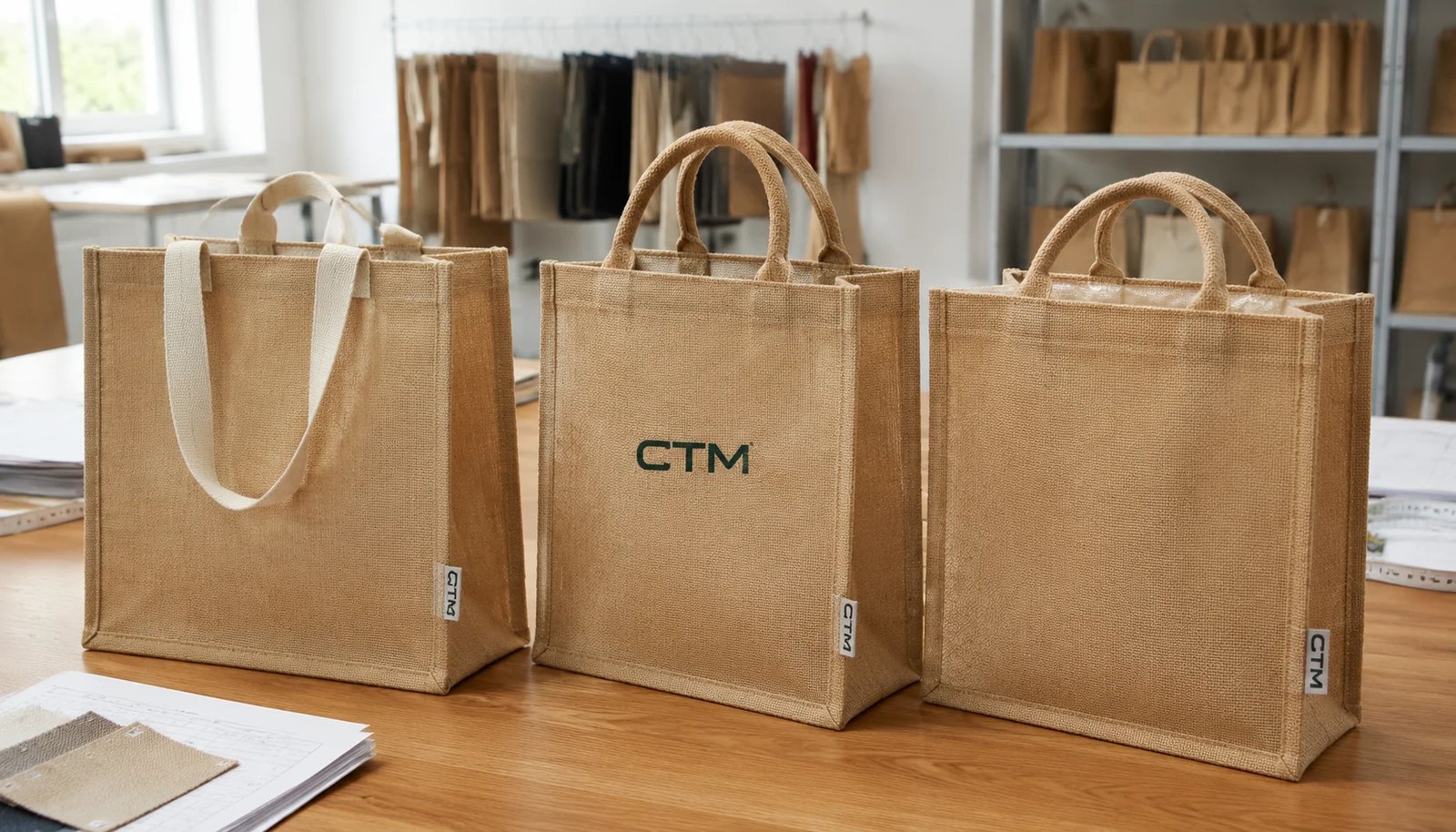
Why natural grocer buyers get jute specs wrong
The usual mistake is treating jute tote bags as a simple eco substitute for canvas. In grocery retail, the bag is a working load carrier, not only a brand message. It has to hold mixed product shapes, survive repeated lifting, and still look good enough to sell at checkout or use in a loyalty program. That means material selection should start with load profile and use case, not with a stock photo or a price target alone.
Natural grocers also face a specific tension: shoppers want a visibly natural look, but store operations want structure, print clarity, and resistance to damp items. Jute can do this well, but only if the buyer chooses the right fabric weight, interior finish, handle build, and panel size. Most quote gaps between suppliers come from hidden construction differences, not from obvious size changes.
- A bag for produce and bakery has different requirements from a bag expected to carry bottles and jars
- Unlaminated jute looks more rustic but stains faster and can soften after moisture exposure
- The cheapest jute quote often removes seam binding, lowers fabric weight, or simplifies handle anchoring
Start with the load profile, not the artwork
Before comparing materials, define what the bag must carry in real store use. A natural grocer checkout bag often sees heavier point loads than a promotional gift tote. Glass bottles, canned goods, nut butter jars, boxed cereal, and produce all create different stress patterns. If your team starts by approving logo size and then later widens the gusset or upgrades the handles, the final quote will move and the original factory comparison becomes unreliable.
A practical approach is to build two or three retail load scenarios and source against them. For example, one scenario may be a light basket of produce and bakery goods; another may be mixed groceries with three bottles; a third may be a paid retail bag intended for weekly reuse. This gives the factory a performance target and helps your team decide where stronger construction is worth paying for.
- Light use scenario: loose produce, herbs, bread, snacks
- Medium use scenario: mixed dry goods, cartons, one or two bottles
- Heavy reuse scenario: jars, bottles, canned food, repeat weekly carry
- Useful RFQ note: include estimated max carry weight and typical item mix
Choose the right jute weight and weave for grocery use
For natural grocer programs, the practical sweet spot is usually jute around 260-300 GSM, though suppliers may describe it differently by ounce equivalent or weave grade. Lower-weight jute can work for event bags, but for grocery carry it often feels too soft, prints less sharply, and may deform when loaded. Heavier jute improves body and shelf presence, but after a point the bag gains cost and stiffness without solving the real weaknesses, which are more often handle build and seam finishing.
Weave consistency matters almost as much as nominal GSM. Two bags can both be quoted at similar weight while performing differently because one uses a more open weave with more visible variation. A tighter, more even weave gives better print edges and a fuller hand feel. Ask suppliers to send cut swatches and finished bags, because jute appearance in a swatch card can hide how the body collapses once sewn into a gusseted tote.
- Around 260-280 GSM: often suitable for basic grocery totes with moderate structure
- Around 280-300 GSM: stronger choice for paid retail bags or mixed-load reuse programs
- Below roughly 240 GSM: use carefully, mainly when cost is the first priority and load is light
- Request both swatch and sewn sample; panel behavior changes after cutting and stitching
Laminated versus unlaminated jute: the key tradeoff
For natural grocers, lamination is not only a cost adder; it changes how the bag works in the store. An inner PP lamination helps the bag stand better, reduces fiber shedding, and makes occasional wiping easier when produce moisture or bottle condensation is involved. It also supports cleaner print presentation because the bag body holds a flatter face. For many checkout or branded resale programs, inside lamination is the most commercially balanced option.
Unlaminated jute gives a more raw natural feel and can fit an organic, low-processing brand position. The downside is faster staining, more internal dusting, and a softer body that may disappoint shoppers expecting a premium reusable bag. If your brand strongly prefers unlaminated construction, offset the performance loss with a slightly stronger fabric weight and better seam finishing. Otherwise the bag may look attractive on display but underperform after only a few shopping cycles.
- Inner lamination only: common balance of structure, cleaner use, and natural outside appearance
- No lamination: best for rustic visual positioning, but expect lower wipe-clean performance
- Full lamination feel can appear less natural and may not suit all brand stories
- Add lamination status clearly to RFQ to avoid suppliers quoting different constructions
Handle construction drives comfort, complaint rate, and true durability
Buyers often focus on body fabric and overlook the handle system, even though most user complaints start there. For grocery loads, cotton webbing handles in the 2.5-3.0 cm width range are usually the safest choice. They are more comfortable than narrow rope, easier to color coordinate, and more stable under repeated lifting. The best construction inserts the handle into the side seam with reinforcement stitching rather than only top-sewing onto the face panel.
Handle drop also matters in daily retail use. A drop around 24-28 cm usually gives enough room for shoulder carry while still keeping the bag manageable at checkout. Short handles make the bag feel more like a basket substitute; long handles can drag or distort when the bag is heavily loaded. If your bag will be sold in stores rather than given away, shopper comfort is part of product value, not only a technical detail.
- Preferred for grocery use: cotton webbing with reinforced seam insertion
- Self-jute handles can suit rustic low-cost programs but are usually less comfortable
- Rope handles can look premium yet twist under load if not anchored well
- Include handle width, material, insertion method, and drop in the quote request
Printing on jute: what artwork survives the actual fabric surface
Jute is not a smooth print substrate. The coarse and uneven surface means fine lines, small reverse text, and delicate tonal transitions can break up. For most natural grocer branding, screen print is the practical method for one to three solid colors. It offers better cost control at scale and usually gives a stronger retail look than trying to force photographic detail onto a textured surface.
If your artwork contains small ingredient-style text, thin outlines, or detailed illustration, either simplify the art or consider a sewn label or patch application instead of direct front print. Heat transfer may help for certain detailed logos at lower volumes, but adhesion and look should be tested carefully on the chosen jute face. Do not approve artwork based only on digital proof. The only reliable standard is a printed pre-production sample on the actual fabric lot or equivalent weave.
- Best use for screen print: bold logos, solid shapes, simple messaging
- Poor fit for direct jute print: small legal text, fine serif lettering, tight registration artwork
- Alternative branding routes: woven side label, cotton patch, sewn logo tab
- Request print size, color count, and artwork line-thickness limits in writing
MOQ logic and quote data: where the real cost moves
Natural grocer programs often start regionally or seasonally, so MOQ strategy matters. A supplier can usually support lower quantities if you stay close to stock materials: natural jute body, standard cotton handle colors, common sizes, and simple screen print. Once you add custom-dyed handles, exact Pantone matching, interior lamination changes, or multiple artwork versions, the quote can shift sharply because setup and material waste increase faster than buyers expect.
When comparing quotes, separate fixed development costs from repeat unit costs. Sample charges, print screens, color matching, and first-run setup should not be mixed blindly into per-piece price. Also compare what the supplier has included in the base unit: seam binding, reinforcement stitching, polybagging, export carton strength, and print coverage area. Two offers that look close on price can represent very different finished bags.
- Lower MOQ path: stock natural jute, standard handles, 1-color or 2-color print
- Higher customization threshold: Pantone handles, complex print, special lining, branded labels
- Useful quote fields: ex-works or FOB basis, sample cost, tooling cost, carton count, CBM, lead time
- Do not compare unit price alone; compare included construction and packing scope
Sample approval should simulate use, not just appearance
A strong approval process uses at least two stages. First, review a blank or simple sample to verify size, gusset depth, handle drop, and load fit. Put actual store items inside it. Test bottle standing room, checkout opening, and whether the bag collapses too much when partly loaded. This catches layout errors early before the factory prepares print screens or books the wrong fabric.
Second, approve a printed pre-production sample that reflects actual material, handle, seam finish, and artwork. At this stage, evaluate edge sharpness of print, stitching consistency, and whether the lamination or fabric texture changes the bag feel in a way that affects brand perception. The sample should also be checked for practical warehouse and store concerns, such as whether flat-packed bundles recover shape well after unpacking.
- Load sample with real grocery items including at least one bottle and one boxed item
- Measure actual handle drop while the bag hangs under light load
- Review print legibility from normal shopper distance, not only from close inspection
- Photograph approved sample with ruler and signed notes to reduce bulk-order disputes
Packing and carton planning affect landed cost more than many buyers expect
Jute totes are bulky relative to many small textile accessories, so packing method influences freight efficiency and receiving labor. Flat packing is usually the best route, but the factory should fold the bag consistently to avoid permanent panel creasing and handle distortion. If front prints are bold or dark, some separation material may be justified to reduce rubbing during ocean transit, especially on laminated surfaces where scuffs show more clearly.
Carton planning should match your downstream handling. A factory may prefer high piece counts per carton to save carton cost, but importers and retail DC teams often need manageable carton weights and dimensions. It is worth collecting quote data for pieces per carton, gross weight, carton size, and estimated CBM because the lowest ex-factory bag cost can lose its advantage once freight cube and warehouse handling are considered.
- Typical decision points: loose flat pack, bundle pack, or individual polybag if retail-ready is required
- Heavy carton loading can crush handles and create hard fold memory on front panels
- Include carton weight limit if your warehouse has manual handling constraints
- For humid shipping seasons, moisture control inside master cartons may be worth specifying
Lead time risks and how to build a safer sourcing schedule
Jute bag timelines are affected by more than sewing capacity. Material booking, handle component readiness, print scheduling, and sample signoff all create risk. If your program includes custom accessories or exact color matching, those steps can easily become the bottleneck instead of assembly. Buyers who give artwork late and then compress production often end up accepting weaker sample review or rushed print quality.
A safer schedule works backward from in-store date and separates approval gates. Leave time for blank sample confirmation, print proofing on actual fabric, and bulk production after final approval. Also clarify whether lead time starts from deposit, artwork approval, sample approval, or all materials confirmed. Different factories define the starting point differently, which creates confusion when comparing offers.
- Protect time for pre-production sample review, especially for first orders
- Clarify lead time trigger in writing: deposit only is not the same as complete approval package
- Custom handles and labels can add hidden time even when body fabric is available
- Book vessel space early if shipping against a seasonal promotional window
Specification comparison for buyers
| Spec decision | Recommended option | When it fits | Buyer risk to check |
|---|---|---|---|
| Body fabric weight | 13-14 oz equivalent jute, commonly around 260-300 GSM depending on weave and finish | Best for daily grocery carry where bags must hold produce, jars, and boxed items without feeling too soft | Some suppliers quote lower GSM jute with loose weave; bag looks similar at first but loses shape and prints less cleanly |
| Lamination | Thin PP lamination on inner face only | Useful when shoppers carry leafy greens, chilled items, or bottles and the retailer wants easier wipe-clean performance | Unlaminated bags absorb moisture and stain faster; fully laminated bags can feel less natural and may affect brand positioning |
| Front panel structure | Laminated jute with inside binding on seams | Fits retail programs needing a boxier shelf-ready bag that stands open at checkout | Without seam binding, raw jute frays internally and creates a rougher finish that can trigger complaints on premium store programs |
| Handle material | Cotton webbing, 2.5-3.0 cm width, stitched into side seams with box reinforcement | Works for most natural grocer private-label bags because it is comfortable, stable, and easy to color match | Rope handles can twist under heavy loads; narrow webbing cuts into the hand and makes a heavy grocery bag feel cheaper |
| Handle drop | 24-28 cm for shoulder/carry hybrid use | Suitable for grocery shoppers who carry mixed loads from car to home and may wear a jacket | Too short becomes hand-carry only; too long causes the bag to drag against checkout counters and affects pack-out |
| Printing method | Screen print for 1-3 solid colors on flatter weave panels; heat transfer only for detailed artwork and small runs | Screen print gives stronger color hold and lower unit cost at volume for natural retail branding | Coarse jute texture limits fine lines and small type; artwork approved on paper may still fail on open weave fabric |
| Gusset width | 15-20 cm side and bottom gusset | Needed for grocery loads such as produce clamshells, cereal boxes, bottles, and bakery packs | Shallow gussets look neat when empty but disappoint in actual store use; buyers often underestimate bottle fit |
| MOQ route | Use stock-color jute and standard handle colors for 1,000-3,000 pcs; custom dye and more complex print from 5,000 pcs up | Helps natural grocers test a seasonal or regional program before committing to full custom development | Custom colors on low MOQ orders create cost spikes and shade inconsistency risk between bulk lots |
| Retail pack method | Flat packed in export cartons with tissue or PE separation only if printed face rub is a risk | Best for importers balancing freight cube and store distribution efficiency | Overpacking increases landed cost; underprotected print surfaces can scuff during ocean transit and carton compression |
Buyer checklist before sampling
- Define the real in-store load: produce only, mixed groceries, or heavier glass-and-can baskets
- Set target fabric range in GSM or oz equivalent and note whether tolerance is by finished panel or greige cloth
- Decide early on laminated or unlaminated construction based on wipe-clean need and natural brand positioning
- Specify finished size, bottom gusset, and handle drop from actual item fit testing, not only visual preference
- Match print method to artwork detail; avoid fine reverse text on coarse jute weave
- State whether inside seams must be bound to control fraying and improve perceived quality
- Align MOQ with customization level: stock body plus standard handles for trials, full custom only when volume supports it
- Approve a pre-production sample with load test, print placement, seam finish, and carton pack details all signed off
- Set carton weight limits for warehouse handling and retail replenishment, usually based on importer SOP rather than factory convenience
- Include moisture-control packing requirements for ocean freight if shipping in humid seasons or long-transit lanes
Factory quote questions to send
- What is the actual jute fabric specification in GSM and weave type, and is that measured before or after lamination?
- Is the bag body made from 100% jute or a jute blend, and where is cotton used if cotton handles or lining are included?
- If laminated, what lamination type and approximate thickness are used, and is it applied to one side or both sides?
- What handle construction is quoted: cotton webbing, self-jute, or rope, and how exactly are handles anchored into the side seams?
- Does the quote include top hem fold, seam binding, bottom reinforcement, and box-X stitching at stress points?
- Which print method is assumed in the price, how many colors are included, and what artwork limitations apply on jute texture?
- What is the MOQ by size, print color count, and custom handle color, and can mixed artwork versions run in one order?
- What sample stages are available: blank fit sample, printed pre-production sample, and bulk production swatch approval?
- How many pieces per carton, what is the carton size and gross weight, and are bags bundled, poly-packed, or packed loose?
- What is the estimated lead time for sample, material booking, bulk production, and vessel-ready date after artwork approval and deposit?
Quality-control points to confirm
- Fabric weight should stay within the agreed tolerance range and feel consistent across bulk lots; random panels should not show visibly open or thin sections
- Finished size tolerance should be defined for width, height, and gusset because jute can vary more than canvas if the cutting and stitching are not tightly controlled
- Handles must be symmetrically placed with matched drop length and no visible twist when the bag is hung straight
- Stress stitching at handle entry points should be complete, back-tacked, and free from skipped stitches or loose thread ends
- Lamination, if used, should be bonded evenly with no bubbling, cracking at fold lines, or excessive chemical odor on unpacking
- Screen print coverage should be legible from retail distance and not flood into the weave enough to distort logo edges
- Inside seam binding should fully cover raw edges where specified, with no exposed fraying longer than the agreed threshold
- Cartons should arrive dry, correctly marked, and packed to avoid panel creasing, handle crushing, and front-print abrasion in transit