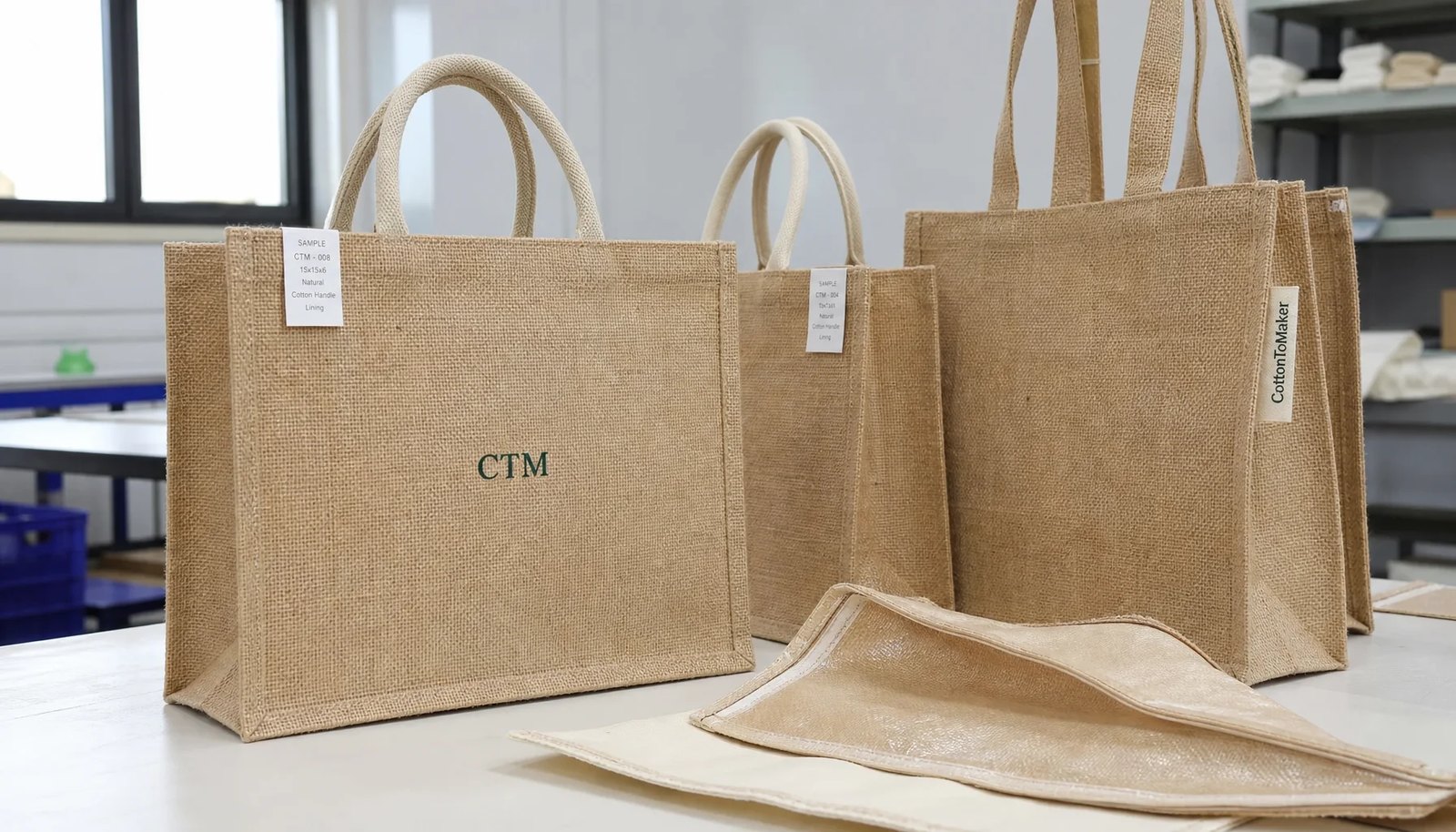
Start With the Hotel Retail Use Case
A jute tote for hotel retail is not the same product as a cheap giveaway bag. It lives in a boutique, spa reception area, lobby store, resort market, or guest room program where the bag becomes part of the hotel's commercial presentation. The material therefore has to do two jobs at once: look natural and tactile, while still meeting retail expectations for size consistency, clean print, strong handles, and packing that does not flatten the shape before the bag reaches the shelf.
The first buying decision is not the fabric weight. It is the use case. A resort guest carrying sunscreen, a towel, and a paperback needs a different structure from a city hotel selling a small amenity tote or a minibar bundle. If the bag is too light, it looks promotional and underpriced. If it is too heavy, landed cost climbs quickly through fabric, sewing time, and freight volume. A clear use case gives the factory enough direction to quote the right jute weight, gusset depth, handle style, and packing method instead of offering a vague lowest-price tote.
- For welcome bags, prioritize appearance, logo clarity, and controlled packing because the guest sees the bag immediately.
- For hotel shop resale, prioritize handfeel, upright shelf presentation, barcode or hangtag needs, and repeat-order consistency.
- For spa and pool programs, prioritize lamination, moisture resistance, and handles that feel comfortable on bare shoulders.
- For food or wine carry bags, prioritize bottom strength, gusset depth, and carton packing that keeps the bag square.
Translate Retail Positioning Into a Material Spec
Buyers often ask for a jute tote in general terms and then wonder why quotes vary so much. The missing step is translation: convert the brand position into a spec that the factory can actually build. A rustic eco-shop tote, a premium resort retail bag, and a practical conference carry bag can all be made from jute, but they should not share the same material and construction assumptions. The level of stiffness, fiber visibility, print sharpness, and handle comfort should reflect how the bag is priced and where it is sold.
A good spec starts with the retail story. If the bag is being sold next to premium body care or packaged gifts, the weave should be even, the print should be clean, and the bag should stand upright. If it is for a beach resort or casual gift shop, the buyer can accept a more relaxed natural look, but the bag still needs to survive travel, daily handling, and repeated use. Material selection should be made with that retail context in mind, not just with an eye toward minimum unit cost.
- Premium retail bags need cleaner weave, stronger shape retention, and more controlled packing.
- Casual resort bags can tolerate more texture and shade variation if the print and handles are still well finished.
- If the bag will be resold, do not spec it like a giveaway; retail buyers notice seam quality and handle comfort quickly.
- Keep one primary spec and one backup option so the supplier can quote an alternate if the preferred material is unavailable.
Choose Jute Weight by Structure, Not Guesswork
Jute weight is commonly discussed in GSM, but GSM is only useful when it is linked to structure. A lighter fabric may be acceptable for a soft shopper, but hotel retail usually needs a bag that holds its shape, looks intentional on display, and does not collapse the moment it is set on a counter. For many hotel retail programs, a natural jute in the approximate 280-320 GSM range offers a practical balance of handfeel, visual density, and durability. Heavier materials can feel more premium, but only when the sewing, folding, and reinforcement are also upgraded.
Two suppliers can quote the same GSM and deliver very different results. Jute yarn count, weave tightness, finishing, storage conditions, and lamination all affect the final handfeel and print performance. A buyer should not compare price from a catalog photo alone. Ask for current production swatches, compare them under similar lighting to the intended retail environment, and check whether the fabric looks thin at the corners, along the gusset, or under direct store lighting. That is where weak material shows up first.
- Use around 240-260 GSM only when the bag is small, soft, and cost-sensitive.
- Use around 280-320 GSM for most medium hotel retail totes with gusset and logo print.
- Use around 340 GSM or above only when the retail concept needs a heavier handfeel and can absorb the higher freight and sewing cost.
- Approve by swatch and finished sample, because jute shade and weave variation cannot be controlled as tightly as cotton canvas.
Decide on Lamination, Lining, or Raw Jute
Lamination is one of the most important material choices for hotel retail jute tote bags. An inner PP lamination can reduce fiber shedding, improve structure, make the inside cleaner, and add light moisture resistance. That is useful for beach resorts, spa shops, minibar gifting, and any program where the bag may touch packaged food, bottled products, or guest clothing. The tradeoff is that lamination changes the handfeel and introduces risks such as odor, bubbling, or poor bonding if the factory uses low-grade film or weak adhesive control.
Raw unlaminated jute has a more natural and rustic feel, and it can suit an eco-forward brand position, but the buyer must accept more dust, softer structure, and more variation in the final appearance. A cotton lining can create a more refined interior and may be appropriate when the bag is sold as a premium retail item, but it adds cost, sewing steps, and lead time. The key is to make the interior finish a deliberate decision in the RFQ. If the buyer does not specify it, the factory may assume the lowest-cost approach and still technically meet the vague request.
- Use inner PP lamination when the tote needs to stand upright or carry spa, pool, food, or gift items.
- Use unlaminated jute when the buyer accepts a softer, more rustic bag and wants fewer synthetic components.
- Use cotton lining when the bag is positioned as premium retail merchandise and the order quantity supports extra sewing cost.
- For laminated bags, approve odor, peel resistance, and fold behavior on the actual sample before bulk production.
Match Construction, Gusset, and Handle to the Load
Hotel buyers often focus on the print and miss the construction, then discover the bag does not display well. Construction controls the shelf presence. A box bottom, side gusset, and reinforced top fold help the tote stand, hold folded goods, and look intentional in retail. A soft flat tote may cost less, but it usually hangs or collapses unless it is filled. In a boutique hotel setting, that can make the product look like a giveaway rather than a retail item.
Finished dimensions should be written as width x height x gusset, with the handle drop stated separately. The gusset determines whether the bag can carry slippers, robe packaging, bottled products, towels, or food items without bulging. Buyers should also think about the top opening and reinforcement. A wide opening helps staff load the bag, but if the top fold is weak, the bag can bow outward and lose structure. Reinforcement at the top edge and stress points is a small cost compared with the damage caused by handle failure or poor shelf presentation.
- For small amenity bags, use compact dimensions with a modest gusset so the tote does not look oversized when lightly filled.
- For resort totes, allow enough height and gusset for towels, sunscreen, books, and bottled water.
- For wine or food retail, use a stable bottom and confirm the load path from bottom seam to handle attachment.
- For premium hotel shops, request photos of the sample upright, filled, and flat-packed to judge the real retail look.
Handle Selection Affects Cost, Comfort, and Returns
Handles are a frequent failure point because buyers often write broad terms such as jute handle or cotton handle without defining width, drop length, attachment, and reinforcement. Hotel guests may reuse these bags during travel, so the handle must be comfortable and strong enough for real carrying loads. Cotton webbing handles are common because they feel softer on the hand and shoulder. Jute handles keep a natural look, but they can feel rough unless they are finished carefully. Rope handles may look decorative, but their attachment method needs to be tested carefully.
The correct handle drop depends on use. A short hand-carry tote may suit a small gift bag, while a resort retail tote usually needs enough drop for shoulder carry. Handle color also matters. Natural cotton can soften the bag visually, black or dark green can align with a hotel brand palette, and dyed handles may require additional MOQ or color tolerance approval. The quote should specify handle material, width, length, drop, reinforcement stitch, and any rivet or eyelet detail. Without those details, two quotes can look comparable while hiding very different strength and comfort levels.
- Use 25-35 mm cotton webbing for many hotel retail totes where comfort matters.
- Use reinforced cross-stitching or box stitching at each handle end to spread load.
- Avoid very narrow handles on larger totes because they cut into the hand and make the bag look cheaper.
- Run a loaded hang test on the approved sample using the expected carrying weight plus a safety margin.
Align Print, Branding, and Labeling to Jute Texture
Jute is a coarse woven material, so artwork that prints well on paper or cotton may not print cleanly on jute. Screen printing is usually the safest method for solid hotel logos, simple resort marks, and one- or two-color designs. It gives good coverage when the ink and mesh are matched to the fabric texture. Fine serif text, thin lines, gradients, and small icons can break or blur because the surface is uneven and the weave can absorb the edges of the ink.
Heat transfer can reproduce more detail, but it requires adhesion testing and may change the natural look of the bag. Embroidery is possible in selected areas, but dense stitching can distort loose jute and may need backing. Woven labels or sewn side tags are useful when the hotel wants a consistent brand marker across several bag sizes or seasonal collections. Buyers should approve the actual print on bulk jute fabric, not only a digital proof. The sample should show color, edge quality, placement, and how the logo behaves when the bag is folded and opened.
- Provide vector artwork with Pantone references and state whether color matching is critical or approximate.
- Keep fine text large enough for coarse jute; very small legal lines are better on a hangtag or inner label.
- Avoid placing large prints across side seams, bottom folds, or obvious fabric slubs.
- For multi-property hotel groups, create a controlled print placement standard so repeat orders stay consistent.
Set MOQ and Color Strategy Before You Compare Quotes
MOQ for jute tote bags is driven by fabric procurement, lamination setup, cutting efficiency, printing setup, handle material, and packing requirements. A factory may accept a lower quantity for natural jute with a simple one-color print because the base fabric is already available. MOQ rises when the buyer requests dyed jute, custom handle color, special lining, multiple sizes, or several logo versions. When a quote looks unusually low, the buyer should ask which part of the spec was simplified to make the MOQ possible.
Hotel buyers often split one program into many small versions: one logo for the spa, one for the beach club, one for the restaurant, and one for the rooms team. That can be managed, but the sourcing route should be planned. One natural base material with multiple screen prints is usually more efficient than several fabric colors. If the hotel group wants multiple property logos, the best approach is to keep the same size, same handle, and same packing, then separate only the print screens and carton marks. That keeps the production flow stable and lowers the risk of mixed specifications.
- MOQ may apply per size when cutting patterns differ.
- MOQ may apply per print design when screens and setup time change.
- MOQ may apply per fabric color when dyeing or fabric sourcing is separate.
- MOQ may apply per handle color if webbing must be dyed or specially purchased.
- Lower MOQ is easier when the buyer keeps the same fabric, same construction, and only changes the print artwork.
Build a Sample Approval Process That Survives Production
A hotel retail tote should not go to bulk production based only on a photo sample. The buyer needs a physical pre-production sample made with the intended jute, lamination or lining, handle, stitching, and logo method. The sample should be handled like a guest would handle it: filled, carried, folded, opened, placed on a shelf, and checked under retail lighting. Jute odor should also be evaluated after the bag has been sealed and then opened, because warehouse and carton conditions can make the smell more noticeable than a factory sample suggests.
Sample approval should create measurable acceptance criteria. Write down the approved dimensions, handle drop, print size, print position, fabric shade range, interior finish, and packing fold. Keep one signed or tagged sample with the buyer and one with the factory. For repeat orders, the approved sample becomes the reference for shade and workmanship, even though natural jute will still vary. The best sample process is simple but specific. If the buyer leaves any of these variables open, the factory will treat the sample as a visual guide only, and the next bulk batch may drift in ways that are expensive to correct.
- Measure finished width, height, gusset, and handle drop on the sample before approval.
- Load the bag with the intended products and leave it hanging to test handle and seam stress.
- Rub the printed area lightly after curing to identify weak ink adhesion or surface cracking.
- Open the packed sample after several days to judge odor, fiber dust, and crease marks.
- Photograph the approved sample from front, side, interior, bottom, and packed condition for production reference.
Control Packing, Cartonization, and Retail Presentation
Jute tote bags can lose retail value before they reach the hotel if packing is treated as an afterthought. Over-compressed cartons create hard crease lines, crushed gussets, and distorted handles. Loose packing can allow bags to shift, collect dust, or abrade the print surface. For premium hotel retail, flat packing with a controlled fold direction and a carton liner is often worth the extra carton volume. For lower-cost bulk distribution, tighter packing may be acceptable if the buyer accepts more steaming or reshaping at destination.
Carton data also affects landed cost. Jute bags are bulky compared with thin cotton pouches, and a slightly larger gusset or stiffer handle can increase CBM. Importers should compare carton quantity, carton dimensions, gross weight, and pieces per carton before selecting a supplier. The cheapest unit price may not be the lowest landed cost if the packing method creates high volume or requires rework at the hotel warehouse. Hotel retail buyers should also define barcode stickers, hangtags, inner polybags, carton marks, and property-level sorting if the order will be distributed across multiple locations.
- Use carton liners or inner polybags when fiber dust transfer is a concern.
- Use kraft or tissue dividers if print scuffing is visible during transit testing.
- Avoid extreme compression for laminated jute because fold marks may become permanent.
- Request carton dimensions and CBM in the quote, not only unit price.
- For multi-property rollouts, require clear carton marks by property, design, size, and purchase order.
Specification comparison for buyers
| Spec decision | Recommended option | When it fits | Buyer risk to check |
|---|---|---|---|
| Main jute fabric weight | Approx. 280-320 GSM for most hotel retail totes | Gift shops, resort boutiques, welcome bags, and amenity kits where the bag must feel structured without becoming board-like | Low GSM can look thin under retail lighting; heavy GSM can raise freight and create stiff fold lines if sewing or lamination is weak |
| Fabric count and weave | Tight, even weave with visible natural texture | Programs that need a premium natural look and cleaner print edges | Loose weave can make print bleed, distort small logos, and shed more fiber dust |
| Lamination choice | Inner PP lamination, usually around 18-25 micron, for cleaner structure and light moisture resistance | Hotels near pools, spas, beaches, or food retail where the inside should resist dust and light moisture | Cheap lamination can bubble, smell, or separate at seams; ask for film type, thickness, and peel behavior on the sample |
| Interior finish | Raw jute only when the brand wants an intentionally rustic look; cotton lining when premium interior presentation matters | Eco-positioned retail, or higher-value retail merchandise with enough MOQ | Raw jute transfers more dust and fiber; cotton lining adds cost, sewing time, and lead time |
| Bag construction | Box bottom with side gusset and reinforced top fold | Retail shelves, minibars, conference kits, and product bundles that need the bag to stand upright | Soft flat construction is cheaper but often collapses when lightly filled and looks weaker at point of sale |
| Handle material | Cotton webbing or padded jute handle with reinforced stitching | Higher-use hotel retail where guests may carry the tote during travel | Narrow or unreinforced handles can cut into the hand, fail at the seam, or pull through under load |
| Print method | Screen print for bold logos; heat transfer only after adhesion testing on actual jute | Hotel branding, resort marks, and simple retail graphics with one or two colors | Fine text, gradients, and tiny details can break on coarse weave; approve on production fabric, not paper proof only |
| Packing method | Flat packed with tissue or kraft divider for premium retail; bale packing only for low-cost bulk programs | Boutique hotel retail, airport shops, and any order where crease marks affect shelf presentation | Over-compressed cartons can create permanent folds; natural jute can shed dust, so carton lining may be needed |
Buyer checklist before sampling
- Define the actual use case: retail sale, guest welcome bag, spa kit, conference tote, or food-and-wine carry bag.
- Specify finished size with width, height, gusset, handle drop, and target internal capacity.
- Request swatches for at least two fabric weights before locking the RFQ.
- Decide whether inner lamination, raw jute, or cotton lining is required for the brand standard.
- Provide vector artwork with Pantone references, maximum print size, and exact placement from seams and top fold.
- Set handle material, width, drop, and reinforcement stitch instead of writing only standard handle.
- Ask for a pre-production sample made with bulk fabric, real handle material, real lamination or lining, and production print method.
- Define acceptable natural variation, including shade range, slub level, weave irregularity, odor, and fiber hairiness.
- Confirm carton packing style, carton strength, pieces per carton, carton marks, barcode needs, and any hotel-property sorting.
- Compare quotes using the same fabric weight, construction, handle, print area, packing, and port terms.
Factory quote questions to send
- What jute count and approximate GSM are you quoting, and can you send current swatches or recent production samples?
- Is the bag laminated, lined, or raw, and what exact film thickness or lining material is included in the quote?
- What handle material, width, length, and stitch pattern are included in the quoted price?
- Which print method are you using for our artwork, and what is the maximum printable area on this jute weave?
- Does the MOQ apply per bag size, per fabric color, per print design, or per total order quantity?
- What sample cost and sample lead time apply for a real material sample with our logo and final construction?
- What production lead time applies after sample approval and deposit, and what seasonal capacity limits should we plan around?
- How many pieces are packed per export carton, what are the carton dimensions and gross weight, and can you estimate CBM?
- Which quality checks are performed before packing, and can you share inspection photos for stitching, print, handle pull, and carton packing?
- What quote validity period applies, especially if jute yarn, lamination film, or freight cost changes?
Quality-control points to confirm
- Finished size should usually stay within plus or minus 5 mm for small and medium totes, or within a buyer-agreed tolerance for larger gusseted bags.
- Fabric weight should match the approved swatch within a practical tolerance, commonly around plus or minus 5 percent unless the buyer sets a tighter range.
- Handle attachment should pass a loaded hanging test using the intended carrying weight, with no stitch tearing, eyelet pulling, or seam distortion.
- Screen print should show clean edges at normal viewing distance, correct registration, and no major ink cracking after light folding.
- Lamination should not bubble, peel, or give off a strong odor after the bag is opened and aired under normal warehouse conditions.
- Top fold, side seams, and bottom gusset should be straight enough for the bag to stand and present properly on a retail shelf.
- Natural jute variation such as slubs and shade differences should be judged against the approved sample range, not against cotton or canvas expectations.
- Cartons should protect against moisture, compression, dust, and fiber transfer during export handling.
- Artwork placement should remain consistent across sizes, with measured distance from the top edge, side seam, and gusset fold.
- Bulk packing should preserve the approved fold direction so the retail bag does not arrive with permanent stress creases or handle distortion.