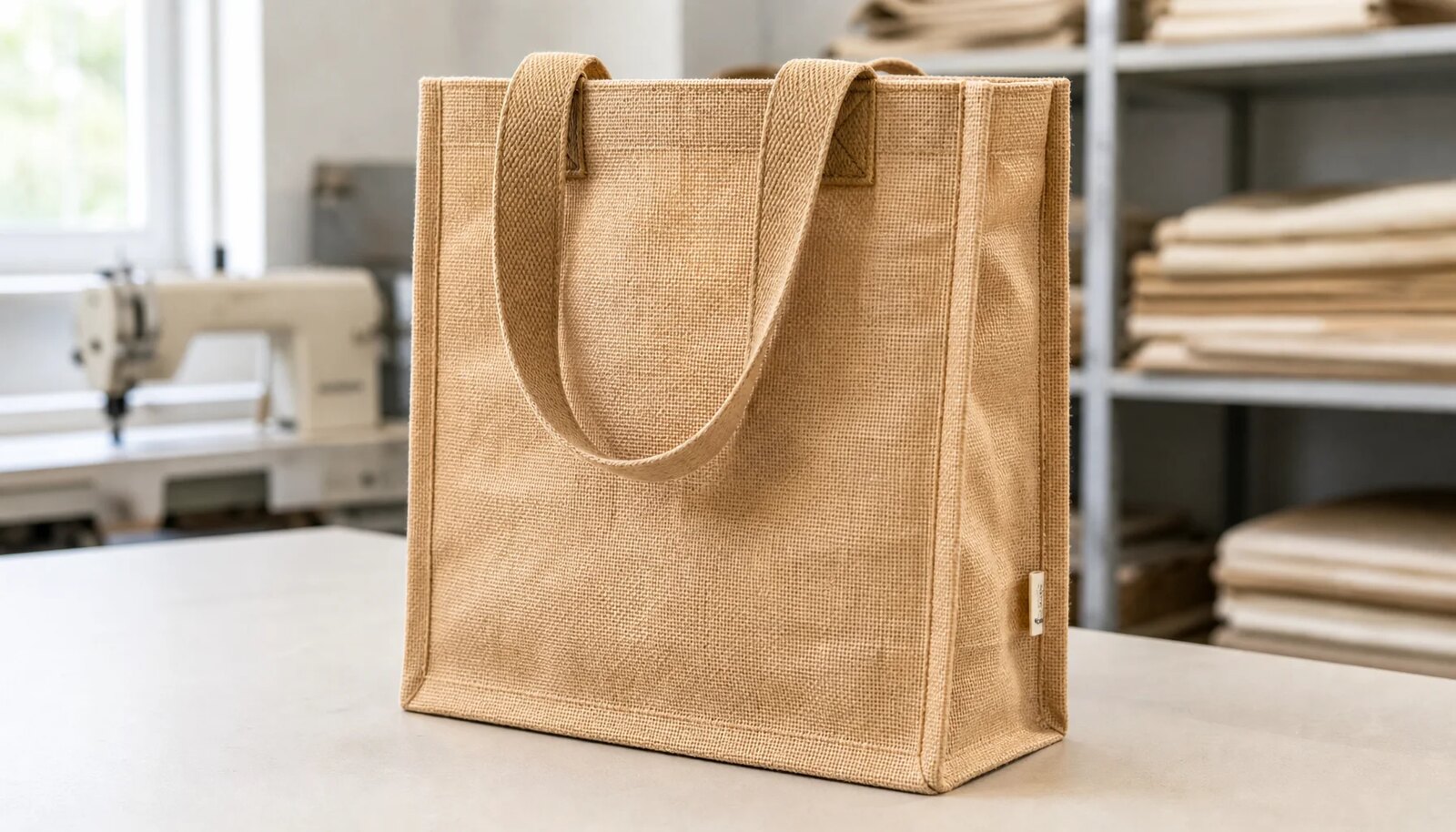
Why material choice matters more than artwork on jute totes
A jute tote can make an eco apparel brand feel grounded and tactile. It can also feel dusty, flimsy, or poorly printed if the material spec is too loose. That is why sourcing jute tote bags should start with construction, not artwork. The logo is important, but the fabric decides how the bag stands, how much fiber sheds onto garments, how clean the print edge looks, and whether the handles stay secure after repeated use.
If an RFQ only includes a size and a design file, the supplier has to fill in the blanks. They may use whatever jute roll is available, quote a lighter GSM, skip reinforcement, or assume a basic packing format. None of that may be malicious. It is simply what happens when the buyer leaves the specification open. The result is quality drift: samples look acceptable, bulk production feels different, and reorders do not match the first run.
For procurement teams, the goal is not to over-engineer a simple tote. The goal is to define the details that affect cost, durability, presentation, and repeatability. A store carry bag has a different job from a premium retail add-on. A trade show giveaway can tolerate a more basic build than a branded tote sold alongside apparel. Once the channel is clear, material choices become easier to defend internally and easier for suppliers to price accurately.
Start with the bag's real job, not the standard size
The same jute tote can be perfect in one channel and wrong in another. A trade show giveaway may be judged mainly on unit price and logo visibility. A boutique apparel tote needs cleaner panels, better shape, and a handle that feels comfortable when the customer leaves the store. An e-commerce insert faces a different test again: it must survive folding, carton pressure, warehouse handling, and unboxing without looking crushed or shedding heavily onto garments.
Before asking for prices, write down how the bag will be used. What will it carry? How far will a customer carry it? Will it be sold, given away, or used as packaging? Does it need to stand upright on a shelf? Will it be packed flat in a master carton or nested to protect shape? These questions are not theoretical. They influence GSM, gusset depth, handle drop, print placement, lining, and packing method.
Common retail tote dimensions often sit near 38 x 42 x 10 cm, but that number is only a starting point. A folded sweatshirt, boxed accessory, or multi-item gift set may require a different footprint. Test the bag around the actual product mix instead of approving dimensions from a drawing. Put the garments in the sample, set it on a counter, lift it by the handle, and check whether the base collapses or the opening distorts.
It also helps to state what the bag should not do. If the handles must not twist, write that into the brief. If the front panel cannot collapse on shelf, say so. If the customer must be able to shoulder-carry the tote, specify a shoulder-length handle drop. Clear negative requirements prevent a supplier from optimizing only for price while missing the user experience.
Choose jute by GSM, weave, and surface behavior
GSM is usually the first material number buyers discuss because it affects structure, cost, sewing effort, and perceived quality. For many eco apparel brand applications, 300-350 GSM is a sensible starting range. It gives a retail-ready feel without making the bag unnecessarily heavy. If the tote must stand more firmly, carry heavier apparel, or feel more premium in hand, 400-450 GSM is often a better target. The tradeoff is higher material cost and more resistance during sewing.
Do not treat GSM as the full material spec. Two jute fabrics with the same weight can behave differently if the weave, yarn quality, finish, or lamination changes. A tighter weave generally prints more cleanly and sheds less. A looser weave can look rustic and natural, but it is more likely to fray, release dust, and break up fine artwork. Neither look is automatically better; the right choice depends on whether your brand wants polished retail presentation or a rawer natural texture.
Clarify whether the bag is natural jute, laminated jute, or a blend. Natural jute has a straightforward plant-fiber story and a strong tactile character, but it shows slubs, shade variation, and weave irregularity. Laminated jute can improve shape retention and provide a cleaner inner face, which may help with retail display and reduced visible shedding. A blend may soften the hand feel or change surface roughness, but it needs to be documented because it affects product description and sustainability messaging.
Shade is another sourcing detail that deserves attention. Natural jute can vary from lot to lot. That variation is normal, but it should still stay within an agreed range. If your brand relies on a particular natural tone, approve a physical reference rather than judging color from a website photo or PDF mockup. Keep one signed sample as the standard for bulk inspection and future reorders.
Understand lamination, lining, and inside finish before approving the story
Many buyers ask for a 'jute tote' and later discover that the approved bag includes lamination, a cotton lining, synthetic webbing, coated labels, or zipper tape. Those additions may be useful, but they change the product. They can improve structure, reduce shedding, protect the inner face, and help the bag hold its shape. They can also change cost, lead time, recyclability claims, and the way the product should be described online or in retail packaging.
Lamination is common when a brand wants the tote to feel stiffer or look cleaner inside. If you use it, ask the supplier to state the film type and thickness in microns. A very thin laminate can make panels look tidier at first while doing little for long-term durability. During sampling, fold and flex the bag the way it will be packed. Look for bubbles, edge lift, cracking at fold lines, or delamination near seams and corners.
A lining can also improve presentation, especially for a tote sold as a retail item rather than used as a one-time carry bag. Cotton lining gives a cleaner interior and can protect apparel from loose fibers. Laminated lining can add stiffness and wipeability. Both add labor. Both should appear as line items in the quote. If the lining is included in one supplier's price but not another's, the quotes are not comparable.
For eco apparel brands, the sourcing file should describe the finished product as built. A natural jute bag with cotton handles is different from a laminated jute bag with polyester webbing and a zipper. Accurate composition language protects the brand from overclaiming and helps customer service, retail partners, and e-commerce teams answer questions later.
Specify handles and reinforcement like load-bearing components
Handles are where many tote failures start. The fabric body can look strong while the anchor points are underbuilt. A handle can look neat in a sample photo and still pull loose after real use if the stitch pattern is shallow, off-center, or decorative. Treat handles as load-bearing components and specify them with the same care you give the fabric.
For repeated use, 25-38 mm webbing is often easier to standardize than handmade jute handles. Webbing width, thickness, color, and fiber content should be stated in the tech pack. Jute handles can create a cohesive natural look, but they need clean folding, even cutting, and secure anchoring to avoid twisting or fraying. Ask the supplier to show the handle cross-section and anchor stitching, not just the front view of the finished bag.
Handle drop should match how the customer will carry the tote. A 14-18 cm drop usually works for hand carry. A 24-28 cm drop is more suitable for shoulder carry, depending on the bag size and fill weight. If the bag will hold bulky folded apparel, test the handle drop while the bag is loaded. A handle that feels fine when empty may become awkward once the tote is full.
Reinforcement should be named, not assumed. State whether you expect bar-tacks, a box-X pattern, double stitch rows, or another anchor method. Also ask how many stitch rows are used on load-bearing seams. During QC, inspect symmetry, skipped stitches, loose thread tails, and whether the reinforcement is centered where the stress actually lands. Good reinforcement is not just extra thread; it is thread placed in the right location.
Match print method to jute texture and logo detail
Jute is not a smooth cotton canvas. Its uneven surface is part of its appeal, but that texture limits print precision. Screen print is usually the safest choice for bold logos, simple shapes, and one- or two-color branding because it can lay down enough ink to remain visible over the weave. It is not magic, though. Fine type, thin rules, delicate icons, and gradients can break apart when the ink meets slubs and open spaces in the fabric.
A useful print brief should define the print area, print position, color references, smallest text height, and minimum stroke width. As a practical rule, many buyers avoid text under 5 mm high and lines under 1.5 mm on rough jute, although the exact limit depends on weave and ink behavior. If the logo includes tiny registration marks, small taglines, or detailed illustrations, consider enlarging the artwork or simplifying the design rather than expecting the printer to overcome the substrate.
Transfer methods may work for certain graphics, but they should not be approved from a digital proof alone. The question is not whether the PDF looks sharp. The question is whether the image survives the jute surface at production scale. Ask for a strike-off on the actual material and, ideally, on the actual bag panel. Review ink density, edge sharpness, registration, and how the print behaves near folds, seams, and gussets.
For repeat orders, keep a signed print standard. Natural jute shade changes can make the same ink appear different from lot to lot. A physical standard gives the factory and inspector something real to compare against instead of relying on memory, screen color, or a photographed sample.
Build the quote around construction, not just unit price
A low unit price is not useful if the construction behind it is unclear. Jute tote costs come from fabric, cutting, sewing, handle material, reinforcement, printing, lining, labels, closures, packing, and setup charges. If those elements are bundled into one number, the buyer cannot tell whether two suppliers are quoting the same product. One price may exclude lining. Another may include one-side printing only. A third may use lighter handles or fewer stitch rows.
Ask for a line-item quote or, at minimum, a quote that states exactly what is included. The print price should say whether it covers one side or two sides and whether setup is charged by color, by size, or by artwork version. Packing should identify whether the bags are folded flat, nested, individually sleeved, or packed in bulk. Carton count, carton dimensions, and gross weight should be available before shipping planning begins.
Stepped pricing is especially useful for eco apparel brands testing a new tote program. Ask for prices at 500, 1,000, 3,000, and 5,000 pieces. The ladder shows where setup, material yield, sewing efficiency, and packing labor start to improve. It also helps the team decide whether the first order should be a small market test, a launch quantity, or a replenishment program.
A professional quote should also list exclusions. Samples, courier fees, desiccants, special carton marks, individual polybags, hangtags, and third-party inspection support may or may not be included. It is better to see those costs early than to discover them after the purchase order has been issued.
Keep the first MOQ simple, then add complexity later
The cleanest first order is usually one size, one fabric, one handle type, and one print version. That sounds conservative, but it protects both the buyer and the factory. A simple first run gives you a reliable baseline for cost, production timing, print outcome, packing behavior, and customer response. Once the base construction is proven, you can add colors, pockets, closures, labels, or additional sizes with fewer surprises.
Complexity multiplies inspection risk. Multiple artwork versions can be packed into the wrong cartons. Mixed sizes can be mislabeled. Pockets and zippers create extra sewing operations and more possible defects. Lining introduces another measurement and alignment check. None of these features are wrong when they serve a purpose, but they should be introduced intentionally rather than added because they looked good on a concept render.
MOQ should be treated as both a supplier requirement and a pricing signal. If a supplier pushes for a higher MOQ, ask what drives it. It may be fabric roll minimums, print setup, carton packing, or machine changeover. Those are legitimate constraints. It may also be that the supplier prefers larger, easier runs. A disciplined buyer separates technical reasons from commercial pressure.
For a first program, avoid changing the spec after sampling unless the change is necessary. Every late change can reset lead time, create confusion between approved and revised samples, and increase the chance that bulk production follows the wrong version. If the order is small and the timeline matters, simplicity is a procurement advantage.
Sample approval should test structure, not only appearance
A sample is not a photoshoot prop. It is a physical test of the future production order. Start with measurement: finished width, finished height, gusset, handle drop, handle placement, print size, and print position. Compare each point against the tech pack. If the sample is already outside tolerance, do not assume bulk production will correct itself without a written revision.
Then handle the bag the way a customer will. Load it with the actual target product mix. Lift it repeatedly. Set it down on a counter. Check whether the base keeps its shape, whether the handles twist, and whether the top edge puckers. For a basic promotional tote, a 3-5 kg static load test may be enough. For an apparel retail tote, 5-8 kg may be more realistic depending on the expected fill. The purpose is not to certify a universal strength rating; it is to reveal weak seams, poor anchor placement, and fabric distortion before bulk production.
Sampling should also include packing behavior. If the tote will be folded flat, fold it as the warehouse will fold it and inspect the surface afterward. Laminated bags should be checked for cracking, edge lift, and bubbles after flexing. If the bag needs to stand on shelf, leave it loaded and unloaded for a short period and check whether it slumps, leans, or loses its base shape.
Use a written sample sign-off sheet. Record the approved material, GSM, lamination status, handle construction, thread color, print version, label placement, packing method, and tolerance limits. Keep one sealed approval sample for comparison. If bulk production later deviates, the team should not have to debate what was approved.
Write QC requirements into the purchase order
Quality control works best when the purchase order already defines what quality means. For jute tote bags, that usually includes dimension tolerance, handle-drop tolerance, stitch expectations, print alignment limits, odor standards, surface-defect rules, and packing requirements. If the PO only says 'good quality,' the inspector has little leverage and the supplier has too much room to interpret.
A practical tolerance band might allow body dimensions within plus or minus 1 cm and handle drop within plus or minus 0.5 cm. Print misalignment over 2 mm on a simple logo should be flagged, especially if the artwork is central to the brand presentation. Loose thread tails longer than 10 mm, skipped stitches, uneven bar-tacks, seam puckering, oil marks, mildew, strong odor, heavy dust, and visible fiber clumps in display-critical zones should be part of the inspection checklist.
Inspect more than the front panel. Check load-bearing seams, bottom corners, top hem, handle anchors, label attachment, lining alignment, and closure function if a zipper or snap is used. For laminated bags, add flex checks for delamination and cracking. For packed goods, verify carton marks, carton count, carton dimensions, gross weight, and whether the packing method matches the approved standard.
Pre-shipment evidence can save time. Ask for clear photos of finished goods, handle reinforcement, print close-ups, inner finish, carton marks, and packed cartons. Photos are not a replacement for inspection, but they often catch obvious mismatches before goods leave the factory. If cartons will be stacked during storage or transit, request a carton compression check or a simple three-high static stack test.
Specification comparison for buyers
| Spec decision | Recommended option | When it fits | Buyer risk to check |
|---|---|---|---|
| Jute grade | Standard natural jute or laminated jute, with the laminate stated clearly in the quote | Retail totes, brand merch, gift-with-purchase bags, and bags that need to hold shape on shelf | Confirm whether the price is for fabric only or finished laminated panels; a thin laminate can make a weak weave look cleaner than it is |
| Fabric weight | 300-350 GSM for general retail use; 400-450 GSM for a firmer premium tote | When the bag must stand upright, carry folded apparel, or feel substantial in hand | Ask for base fabric GSM, not finished bag weight; they are not interchangeable |
| Weave and finish | Tighter weave with clean trimming and controlled fiber shedding | When print clarity, shelf appearance, and visual consistency matter | Loose weave can look rustic, but it increases fraying, dust, and print break-up |
| Handle construction | 25-38 mm webbing or well-folded jute handles with reinforced anchors | Repeated use, heavier garment fills, and bags customers may carry on the shoulder | A neat handle can still fail if anchor stitching is decorative instead of load-bearing |
| Handle drop | 24-28 cm for shoulder carry; 14-18 cm for hand carry | Match the customer carry method, bag size, and expected fill weight | Too-short handles reduce comfort and can create avoidable complaints |
| Print method | Screen print for bold logos and 1-2 colors; transfer only when artwork and texture support it | Simple branding, repeat orders, and designs with strong contrast | Fine text under 5 mm height, thin rules under 1.5 mm, and gradients are high-risk on rough jute |
| Inner build | Unlined for low-cost promotion; cotton or laminated lining for retail presentation or added stiffness | When shape, inside finish, or reduced fiber shedding matters | Line-item the lining because it changes labor, cost, lead time, and sustainability language |
| Closure and features | Open top unless the use case genuinely needs a zip, snap, pocket, or label | When speed, cost, and lower defect risk matter more than feature density | Each added feature raises sewing time and inspection scope; check whether MOQ also increases |
| Supplier route | Direct factory for repeat programs; trading house only if you need consolidation or multi-sourcing | When you need control over spec, QC, revision handling, and production timing | Ask who owns cutting, printing, sewing, packing, and final inspection if the supplier is not the factory |
Buyer checklist before sampling
- Define the bag's actual job first: retail carry bag, garment add-on, trade show giveaway, premium merch tote, or e-commerce insert.
- Write the target finished size, expected fill weight, customer carry style, and display role before requesting prices.
- Lock the base fabric GSM, weave tightness, lamination status, handle material, handle width, and handle drop in the brief.
- Send vector artwork and state print colors, print area, print position, and the smallest text height you will accept.
- Request a physical sample on the exact fabric, lamination, handle construction, and print method, not a generic jute swatch.
- Ask for a line-item quote that separates fabric, cutting, sewing, printing, handles, lining, labels, closures, setup charges, and packing.
- Confirm carton pack count, carton dimensions, gross weight, folding method, and whether bags are packed flat, nested, or individually sleeved.
- Set dimensional tolerances, stitch expectations, print alignment limits, odor standards, and acceptable surface defects in the purchase order.
- Require a production schedule that starts only after written sample approval and final artwork sign-off.
- Request pre-shipment photos of finished goods, detail shots of handles and print, carton marks, and packed cartons before release.
Factory quote questions to send
- What is the exact base fabric GSM before lamination, and what tolerance do you hold on incoming rolls?
- Is the fabric natural jute, laminated jute, or a blend, and if laminated, what film type and thickness in microns are used?
- What are the finished size, gusset, and handle-drop tolerances you commit to on mass production?
- What handle construction is included, how wide is the handle material, and what reinforcement method is used at the anchor points?
- How many stitch rows, bar-tacks, or box-X reinforcements are used on load-bearing seams?
- What is the minimum line weight and smallest text size you can reproduce cleanly on this weave?
- Are setup charges separate for each print color, each side, and each size, or bundled in the unit price?
- What are the sample lead time, bulk lead time, and the date the production clock starts after final approval?
- What is the MOQ by size, color, and print version, and how does the unit price change at 500, 1,000, 3,000, and 5,000 pieces?
- What packing format is included, and what QC evidence can you provide before shipment, such as in-line photos, final inspection notes, and carton photos?
Quality-control points to confirm
- State a measurable tolerance band in the purchase order, such as body dimensions within plus or minus 1 cm and handle drop within plus or minus 0.5 cm.
- Measure at least 5 units from each production lot for width, height, gusset, handle drop, and handle placement before release.
- Check stitching on load-bearing seams for skipped stitches, loose thread tails longer than 10 mm, seam puckering, and uneven bar-tacks.
- Inspect handle anchors for symmetry and placement; if a box-X or bar-tack is specified, the pattern should be centered and consistent.
- Review print registration under natural light and flag misalignment over 2 mm on simple logos or any visible bleed into the weave.
- Reject bags with oil marks, mildew, strong odor, heavy dust, or visible fiber clumps in display-critical zones.
- For laminated bags, check for bubbles, edge lift, cracking at fold lines, and delamination after a controlled flex test.
- If the bag includes a zip, pocket, snap, or label, confirm the component is aligned, functional, and securely sewn before packing.
- Verify that the carton count matches the packing list exactly and that master carton markings match the approved order data.
- If cartons will be stacked in storage or transit, ask for a carton compression check or a simple 3-high static stack test before shipment.