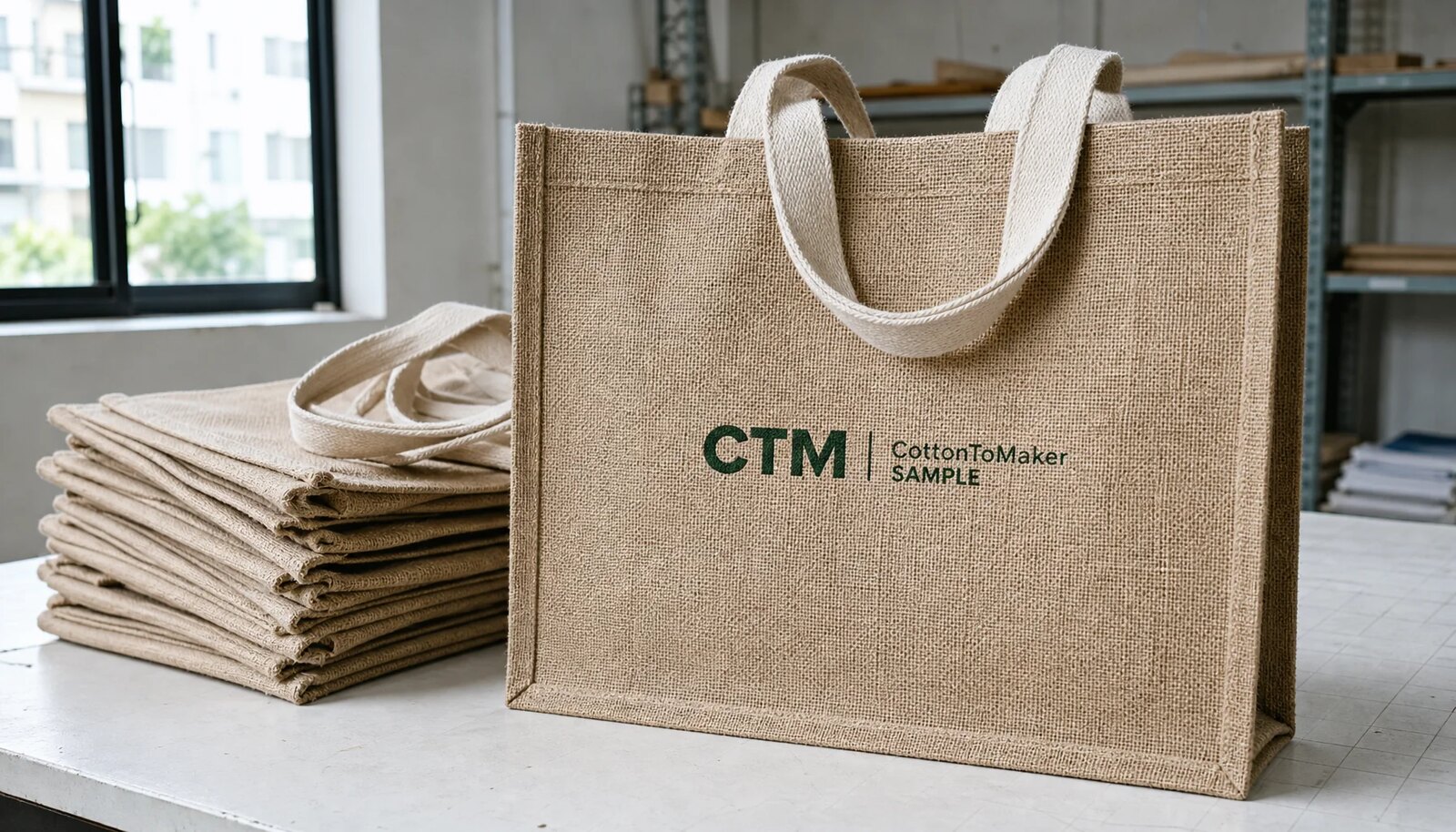
Start with the event moment, not the mockup
A useful jute tote bags logo placement guide for event planners begins away from the screen. A tote at registration is seen in motion, often while attendees are holding phones, wearing badges, and moving through queues. A hotel welcome bag is usually viewed flat under warm indoor light. A merchandise tote is judged while stacked, handled, and compared with other paid or premium items. Those moments change the best logo size, position, decoration method, and packing requirement.
For procurement buyers, logo placement is also a production-risk decision. A large front-center print gives strong sponsor visibility, but it increases ink coverage and can expose unevenness in the jute weave. A smaller lower-front mark can look more reusable and less promotional, yet it may disappear when the bag is carried or placed behind table signage. A stitched patch may raise the perceived value, but it adds tooling, sewing time, inspection points, and another approval loop.
Before requesting quotes, define how the bag will actually be used. Will it carry brochures only, or will it be loaded with catalogs, bottles, apparel, product samples, or tech accessories? Will the tote be photographed at check-in? Will it be laid on beds in guest rooms? Do sponsor names need to be readable from 2 meters away, or is the goal a quieter post-event gift? A supplier can recommend a safe print area with much more accuracy when the use case is specific.
- Registration giveaway: prioritize front-center visibility, fast carton opening, and labels by event zone.
- Sponsor welcome kit: prioritize logo hierarchy, color contrast, and consistent placement across every carton.
- VIP or retail-style tote: prioritize cleaner negative space, better panel structure, and tighter finishing inspection.
- Hotel room drop: prioritize flat presentation, crease control, odor control, and destination-specific carton labeling.
- Post-event reuse: prioritize durable decoration, strong handles, and artwork that does not feel like temporary signage.
Lock construction before artwork placement
Logo placement should not be finalized until the tote construction is fixed. Jute is a woven natural fiber, and the visible front panel changes when the buyer changes GSM, lining, lamination, gusset depth, base shape, top hem, or handle style. A logo centered on a digital template may sit too close to a fold on the real bag. A design that looks balanced on an unlined 240 GSM tote may shift visually when the order moves to a stiffer 320 GSM lined tote with a reinforced base.
The important construction details are finished width, finished height, gusset depth, fabric weight, lining, handle attachment, and top hem. The front-panel print area is not the same as total bag width. If the tote has side gussets, part of the width folds away when the bag is flat. If handles are stitched low on the body, the anchor box can interrupt the upper print zone. If the top hem is thick, artwork placed too high can feel crowded and may be harder to decorate cleanly.
For many event orders, 220-260 GSM jute can suit lightweight giveaways and empty registration bags. For heavier attendee kits, catalogs, product samples, bottled items, or higher-value sponsor gifts, 280-320 GSM is usually a stronger starting point because the panel is more stable and the tote feels more substantial. Lining or lamination can improve structure and reduce show-through, but it also affects cost, folding, carton volume, and placement tolerance. Treat construction changes as artwork changes until a revised proof is approved.
- Confirm finished dimensions in millimeters, not only approximate inch descriptions such as 14 x 16.
- Measure the visible front panel after excluding gusset folds, seams, and base shaping.
- Keep artwork away from top hems, handle anchor boxes, side seams, bottom seams, fold lines, and reinforced areas.
- Choose GSM according to fill weight, desired structure, and decoration quality, not only target unit price.
- Request a revised placement proof if lining, lamination, handle style, or gusset depth changes after initial approval.
Define the safe print area in millimeters
A safe print area is the part of the jute tote where a logo can be decorated repeatedly without distortion, seam interference, poor ink transfer, or inconsistent appearance. It should be shown as a measured zone on the final bag drawing. Phrases such as large logo, centered on front, or same as mockup are too loose for B2B orders because they do not define where the operator measures from or what tolerance is acceptable in bulk production.
A practical approval proof should show finished bag width and height, visible front-panel width and height, logo width and height, vertical center line, horizontal center line where relevant, distance from top hem, distance from side seams, and all no-print zones. For a front-center logo, the center should normally be based on the visible flat front panel, not the full fabric width before gusset folding. For a lower-front logo, the proof should include the distance from the bottom seam or base fold because that area can shift when the bag is filled or folded.
Placement tolerance must be written before bulk production. For screen-printed jute totes, many buyers use a 5-10 mm tolerance from the approved reference point, depending on bag size, fabric stability, and print method. Very small bags, premium patches, or tightly framed artwork may require more careful handling, but the tolerance still needs to be realistic for a sewn natural-fiber product. A zero-tolerance placement requirement on jute is not a usable production spec.
- Show logo width and height in millimeters on the proof and purchase order.
- Identify the measurement reference: top hem, bag opening, visible-panel center, side seam, bottom seam, or approved sample.
- Mark no-print zones around seams, handles, gussets, reinforced bases, curved corners, and fold lines.
- Set a written placement tolerance, commonly 5-10 mm for many screen-printed event totes.
- Approve the safe print area on the final physical construction, not on a generic smooth tote template.
Choose placement by brand hierarchy
Front-center placement is the most reliable option for primary event branding. It gives the clearest viewing angle, the easiest production setup, and the simplest quality-control process. It works well for registration bags, conference totes, sponsor welcome kits, and trade-show handouts. The logo should be large enough to read against the natural jute texture, but not so large that it approaches seams, handle stitching, or fold zones.
Lower-front placement creates a more restrained retail-style look. It can be a strong choice when the tote is intended to feel reusable rather than purely promotional. A mark in the lower third gives more negative space and can suit premium destination events, executive gifts, and merchandise tables. The tradeoff is visibility. If the mark sits too low, it may be hidden by a table edge, the attendee's arm, or the base fold once the bag is filled. Ask for flat, filled, and carried sample photos before approving a low placement.
Back-panel, gusset, and label placements are useful when several brands need to share the bag. A main event logo may sit on the front while sponsor names appear on the back. A side label or small gusset mark can add detail without crowding the main panel. These options should not be treated as free add-ons. Each extra position can require additional screens, setup charges, handling time, sample review, inspection criteria, and packing separation.
- Use front-center for the main event logo, title sponsor, or registration handout branding.
- Use upper-front placement when photography at registration tables and queue visibility matter most.
- Use lower-front placement when reuse, subtle branding, or merchandise styling matters more than long-distance visibility.
- Use back-panel placement for secondary sponsor groups, event dates, or supporting messages.
- Use gusset marks, woven labels, or patches for subtle secondary branding after confirming visibility on flat, filled, and carried bags.
Match decoration method to artwork reality
Screen printing is often the best starting point for event jute totes because it handles bold shapes, simple logos, and medium to high quantities at a manageable cost. It is strongest for one- or two-color artwork with solid fills and clean edges. The limitation is the fabric. Natural jute has an open and uneven weave, so thin lines can break, small counters in letters can fill in, and light ink colors can look weaker than expected on tan fiber. A logo that is crisp on coated paper may need adjustment before it becomes crisp enough on jute.
Heat transfer can support more detail on selected laminated or prepared jute surfaces, but it should be tested rather than assumed. On rough natural jute, adhesion, edge cracking, heat marks, and uneven surface contact can become issues. Woven patches, cotton patches, printed patches, and stitched badges can create a more tactile premium finish for reusable merchandise or VIP gifts. They also introduce patch MOQ, patch tooling, sewing tolerance, thread color, edge finish, and puckering control.
Artwork risk should be reviewed before sampling. Gradients, distressed textures, QR codes, tiny sponsor grids, fine serif type, and thin legal lines are all higher-risk on jute than on smooth cotton canvas or polyester. If readability is essential, ask the supplier for the minimum recommended line weight and text height for the exact surface. In many event programs, the better procurement decision is to simplify the tote artwork and move detailed sponsor lists, QR codes, or legal copy to a printed insert card.
- Screen print works best for bold logos, solid fills, one or two colors, and clear sponsor marks.
- Screen print is risky for hairlines, small legal copy, fine serif type, gradients, distressed effects, and low-contrast colors.
- Patches work best for premium programs, simple shapes, reusable merchandise, and designs that benefit from texture.
- Patches are risky for tiny sponsor names, complex grids, tight event deadlines, and very price-sensitive orders.
- Request the supplier's minimum line weight, smallest readable text height, and maximum recommended print coverage for the selected jute.
Control color, contrast, and readability
Color approval on jute needs a physical reference. Natural jute is not a white printing base, and its tan, brown, or golden tone can shift the apparent color of ink. A dark green, navy, black, deep red, or strong single-color mark often reads more clearly than pale yellow, light gray, or low-contrast beige. If the brand requires a precise color, the buyer should approve the printed result on the actual jute surface rather than relying only on Pantone, CMYK, or a digital PDF.
Readable size depends on weave openness, logo shape, ink coverage, and viewing distance. For sponsor names viewed at an event, test the smallest text at the distance where it will be seen, not only at desk distance. Small text that looks acceptable in a vector proof may blur once ink bridges across uneven fibers. QR codes are especially sensitive: the code needs enough size, contrast, quiet zone, and scanning distance, and it should be tested on an actual printed sample with common phones before bulk approval.
Procurement teams should define what approval means. A color match may be based on the signed strike-off under normal indoor light, not on a theoretical standard that cannot be achieved on natural fiber. Readability may be based on whether sponsor names remain legible at a defined distance. This converts subjective review into practical QC language that a supplier and inspector can follow.
- Approve printed color on the actual jute, especially for brand-critical logos.
- Use high-contrast colors when sponsor visibility matters in expo halls or registration areas.
- Avoid tiny sponsor grids unless a strike-off proves readability on the final fabric.
- Test QR codes at the final printed size, with the final quiet zone, on the final jute surface.
- State whether the signed physical sample or a formal color reference controls bulk acceptance.
Plan versions, MOQ, and sponsor deadlines early
Event programs often become complicated after the first quote. One tote may be needed for general attendees, another for VIPs, another for speakers, another for sponsors, and another for staff. Each version can change artwork, placement, print color, bag color, carton label, and destination. From the supplier's side, these are separate production variables, not just small design edits.
MOQ is shaped by fabric purchasing, cutting efficiency, sewing setup, print setup, patch tooling, and handling time. A standard natural jute tote with one front screen print can have a lower practical minimum than a custom-lined tote with colored handles, a side-gusset print, and a stitched badge. Changing placement may require a new screen or jig even when the logo itself is unchanged. Ask for MOQ by artwork version, placement position, and packing version instead of assuming that one total program quantity covers every variation.
Sponsor approval timing is another procurement risk. If six sponsors must approve files, one late logo can delay sampling or force a separate production run. The order should include an artwork freeze date and a rule for late changes. Late sponsor edits may be excluded, quoted as a new version, or handled by a separate decoration run if timing allows. The important point is to make the decision before production slots and freight bookings are at risk.
- List all versions before quoting: attendee, VIP, speaker, staff, sponsor, merchandise, city, or regional event.
- Ask whether each version requires a separate screen, setup fee, sample, MOQ, carton label, or packing instruction.
- Confirm whether a placement change counts as a new setup even if artwork is unchanged.
- Set an artwork freeze date that leaves time for proofing, strike-off review, correction, bulk production, inspection, and freight.
- Keep carton labels version-specific so event teams can distribute bags without opening every carton.
Use samples as production approval gates
A digital mockup is useful for internal alignment, but it does not prove that the logo will work on the final jute tote. The sample should answer production questions: Is the logo the right size? Is it straight? Does the color hold against the jute tone? Are the edges clean enough? Does the mark remain visible when the bag is filled? Does folding create a crease through the ink or patch? These questions require a strike-off or pre-production sample on the final or production-equivalent material.
A disciplined sample path has clear gates. First approve the construction: size, GSM, lining, handles, gusset, base, and color. Then approve the decoration: method, logo size, color, placement, and finish. Finally approve packing if the logo might be affected by fold direction or carton compression. For time-sensitive events, name the person who can approve samples and set a response deadline. A sample waiting in an inbox for several days can cause as much schedule damage as a factory delay.
Sample approval should be documented with measurements, photos, and revision references. If the approved sample places the logo 95 mm below the top hem and centered on the visible front panel, the purchase order should repeat those measurements. If a sponsor later asks for a larger logo or a lower position, the supplier should confirm whether that change requires a new screen, new sample, revised tolerance, or longer lead time.
- Approve bag construction before decoration files are released for bulk setup.
- Approve decoration on actual or production-equivalent jute, not only on a smooth digital template.
- Measure the sample from the same reference points listed in the purchase order.
- Photograph the approved sample flat, filled, carried, and folded if those views matter to the event.
- Tie sample approval to one artwork revision, one placement drawing, and one purchase order revision.
Write QC tolerances into the purchase order
Jute is a natural material, so some variation in fiber tone, slubs, yarn thickness, and weave texture is normal. That does not mean quality control should be vague. A strong purchase order defines acceptable and rejectable conditions for placement, color, ink coverage, line clarity, stitching, dimensions, odor, moisture condition, packing, and carton count. This is essential for event orders because defects are often discovered close to the event date, when replacement options are limited.
Logo placement should be measurable. A typical screen-print tolerance may allow movement within 5-10 mm from the approved center line or edge reference, depending on bag size and construction. Patch placement may need a separate tolerance because the patch is sewn after positioning and can shift or pucker. The PO should also state that decoration cannot enter seam allowances, top hems, handle anchor stitching, gusset folds, or base reinforcement unless specifically approved in the artwork drawing.
QC must inspect the tote as a product, not only the logo. Handles should be secure enough for the intended fill weight, with the specified stitching pattern and no skipped stitches at load points. Seams should be closed, loose threads trimmed, and edges controlled. Jute should not arrive with mildew odor, wet storage damage, oil stains, water marks, or excessive contamination. Cartons should be counted and labeled by version so venue teams can distribute the right bags quickly.
- Placement tolerance: define allowed movement from top hem, side seam, center line, bottom seam, or approved sample.
- Print tolerance: define color approval basis, ink coverage standard, edge clarity, and small-text readability.
- Construction tolerance: define finished size, gusset depth, handle drop, stitch pattern, seam closure, and loose-thread standard.
- Material tolerance: allow natural fiber variation but reject mildew, stains, wet storage damage, strong odor, and excessive shedding.
- Packing tolerance: define pieces per carton, inner pack method, carton label content, version separation, and count variance.
Protect the logo through packing, freight, and receipt
Packing is part of logo placement because a poor fold can damage the decorated area before the bags reach the venue. If a tote is folded directly across heavy ink, the print can crease or develop a visible line. If a patch is compressed under heavy carton weight, it can leave an impression on adjacent bags. If cartons are overfilled, front panels can distort and handles can press into the print. Fold direction, inner packing, carton count, and stacking limits should be specified before production.
The right packing method depends on the event workflow. Registration bags may need bulk flat packing so staff can open cartons quickly. VIP kits assembled before the event may need cleaner inner protection to prevent abrasion. Merchandise totes may need better presentation with fewer compression marks. Natural jute can absorb moisture and odor during long transit or humid storage, so route and season should influence packing decisions. Moisture-control material may be appropriate when goods move by sea, wait in warehouse storage, or ship into humid destinations.
Receipt checks should happen before the event team is under pressure. Count cartons against the packing list, confirm version labels, open a sample of cartons from different parts of the shipment, and inspect logo placement, odor, moisture, and packing condition. For multi-sponsor or multi-destination events, carton labels should show style, color, artwork version, quantity, carton number, destination, and event reference. Good labeling protects the work already done on artwork and QC.
- Define whether bags are packed flat, folded once, folded with handles inside, or individually protected.
- Avoid fold lines through the main logo, patch edge, heat-transfer boundary, or heavy ink area.
- Specify pieces per carton, carton dimensions, gross weight, destination label, and version label.
- Use moisture-control planning for long sea freight, humid storage, or natural jute orders with tight event dates.
- Inspect cartons on receipt before venue setup, not only when bags are already being distributed.
Specification comparison for buyers
| Spec decision | Recommended option | When it fits | Buyer risk to check |
|---|---|---|---|
| Primary event logo placement | Front-center on the visible flat panel, measured after gusset folds are excluded | Registration bags, sponsor giveaways, expo kits, attendee welcome totes | Require a measured artwork proof showing the center line, logo width and height, and distance from top hem and side seams. Do not approve a proof that centers the logo on the total bag width if part of that width folds into the gusset. |
| Premium or retail-style placement | Lower third of the front panel with clear space above the logo, often 40-60 mm or more on medium totes | VIP gifts, destination events, merchandise counters, executive programs | Confirm how the logo looks when the bag is flat, filled, carried, and stacked. A low mark can be hidden by hands, table edges, bag creases, or the filled base. |
| Secondary branding placement | Back panel, side gusset, woven label, cotton patch, or small stitched badge | Multi-sponsor events, co-branded programs, bags with one dominant front mark | Gusset printing can distort when the bag is flat or filled. Labels and patches add sewing tolerances, edge finishing, and extra inspection steps. |
| Decoration method | One- or two-color screen print on the final jute surface | Bold event logos, simple sponsor marks, medium to high quantities, controlled budgets | Specify minimum line weight, smallest readable text height, ink color reference, and placement tolerance. Fine details can fill in, break, or soften on open jute weave. |
| Decoration method | Woven patch, cotton patch, printed patch, or stitched badge | Premium reusable totes, retail-style gifts, high-touch sponsor merchandise | Quote patch tooling, patch MOQ, sewing cost, stitch color, edge finish, and placement tolerance separately. Watch for puckering, crooked stitching, and frayed patch edges. |
| Bag fabric | 220-260 GSM unlined natural jute | Light handouts, empty registration bags, budget-driven giveaways | Open weave, softer panels, and natural slubs can reduce print sharpness and increase placement variation. Test artwork before promising detailed sponsor visibility. |
| Bag fabric | 280-320 GSM jute with lining, lamination, or reinforced base when needed | Catalog packs, sample kits, bottles, heavier gifts, or bags filled before distribution | Confirm finished dimensions after lining, pressing, and folding. Added structure changes the safe print zone, carton volume, and how the logo sits when the bag is filled. |
| Safe print area | Measured zone excluding top hem, handle anchors, seams, gusset folds, base seam, and reinforcement | Any order where logo position matters to sponsor approval | Ask for the usable print area in millimeters and write a realistic placement tolerance into the PO, commonly 5-10 mm for many screen-printed jute event totes. |
| Supplier route | Direct factory or integrated supplier with controlled sewing, decoration, packing, and inspection process | 500+ pieces, repeat events, locked artwork, fixed event delivery window | Ask whether printing is in-house or subcontracted, who approves strike-offs, and who owns rework decisions if placement or print quality fails inspection. |
Buyer checklist before sampling
- Confirm finished bag width, height, gusset depth, handle drop, fabric GSM, lining or lamination, base construction, handle material, and handle attachment before approving artwork.
- Request the usable print area in millimeters, excluding top hem, side seams, handle anchor boxes, gusset folds, bottom seams, rounded corners, and reinforced base zones.
- Supply vector artwork plus a placement drawing showing logo width, logo height, center line, distance from top hem, distance from side seams, and distance from bottom seam if the logo sits low.
- Specify the measurement reference point: top hem, bag opening, visible front-panel center line, side seam, bottom seam, or approved physical sample. Avoid relying on the phrase centered on bag.
- Ask the supplier to confirm minimum line weight, smallest recommended text height, maximum solid ink coverage, and expected color behavior on the selected jute surface.
- Approve a strike-off or pre-production sample on production-equivalent jute, not only a digital mockup on a smooth tote template.
- Check sponsor names, trademark clear space, registration marks, small type, and color contrast at the viewing distance expected in the venue, commonly 1-3 meters for hand-carried bags.
- Quote bag body, decoration setup, per-unit decoration, patch tooling, sample charge, inspection, inner packing, carton packing, moisture-control material, and freight as separate cost lines.
- Define MOQ by artwork version, bag color, print color, print position, patch style, and packing version so sponsor or attendee variations do not create surprise minimums.
- Write QC tolerances for logo position, print color, ink coverage, line clarity, handle strength, seams, dimensions, odor, moisture condition, carton quantity, and labeling into the purchase order.
Factory quote questions to send
- What finished bag size in millimeters, gusset depth, jute GSM, lining or lamination, handle material, handle drop, handle stitching pattern, and base construction are included in the quoted unit price?
- What is the usable print area in millimeters after excluding top hem, side seams, gusset folds, handle anchor stitching, bottom seam, base reinforcement, and any curved or uneven areas?
- Where will the logo be placed in millimeters from the top hem, visible-panel center line, side seams, and bottom seam, and what placement tolerance will you commit to in bulk production?
- Which decoration method will be used for each logo position, and what setup cost applies by screen, color, patch, woven label, artwork version, and placement location?
- What minimum line weight, smallest readable text height, QR code limit, and maximum solid print area do you recommend for this exact jute fabric and finish?
- Can you print the requested Pantone, brand, or CMYK reference on natural jute, and will approval be based on lab value, Pantone tolerance, or the signed physical strike-off?
- Is decoration completed in your facility or by a named partner, and who is responsible for reprint, repair, discount, or rejection decisions if placement or print quality fails inspection?
- What is the MOQ by bag color, artwork version, print color, placement position, patch type, and packing version, and how does MOQ change for gusset print or stitched labels?
- Can you provide a strike-off or full pre-production sample on production-equivalent jute before bulk printing, and what is the sample lead time after final artwork approval?
- What placement, color, stitching, dimension, odor, moisture, carton-count, and packing tolerances will you accept in the purchase order and inspection checklist?
Quality-control points to confirm
- Logo placement stays within the written tolerance, commonly within 5-10 mm from the approved center line or edge reference for screen print, with tighter or looser limits agreed according to construction and decoration method.
- The decoration remains inside the approved safe area and does not run into top hems, handle anchor stitching, side seams, gusset folds, bottom seams, or reinforced base panels unless the artwork intentionally specifies that position.
- Printed color matches the signed strike-off under normal indoor light; on natural jute, acceptable variation should be defined against the approved physical sample rather than a screen-only color proof.
- Ink coverage is even enough for the approved standard, with no major skipped areas, heavy bleed, clogged small letters, cracked transfer edges, heat scorch marks, or adhesive marks visible during random carton checks.
- Fine lines, sponsor names, registration marks, and small text remain readable at the agreed viewing distance and do not fill in, break apart, or disappear into the jute weave.
- Patch or label decoration has consistent placement, straight sewing, secure edge stitching, no loose thread tails, no puckering that distorts the panel, and no frayed edges beyond the approved sample standard.
- Handle attachment points are secure, with consistent X-box stitching or bar-tacks as specified, no skipped stitches, no torn tape, and no loose yarns at load-bearing areas.
- Finished bag dimensions, gusset depth, handle drop, top opening, and base shape stay within the written PO tolerance after pressing, folding, and carton packing.
- Natural jute variation stays within the approved color and texture range, with rejection for mildew odor, wet storage damage, oil stains, water marks, excessive fiber shedding, or contamination that affects event presentation.
- Cartons carry correct SKU, artwork version, bag color, quantity, carton number, gross weight, destination label, and event reference, and inner counts match the packing list.