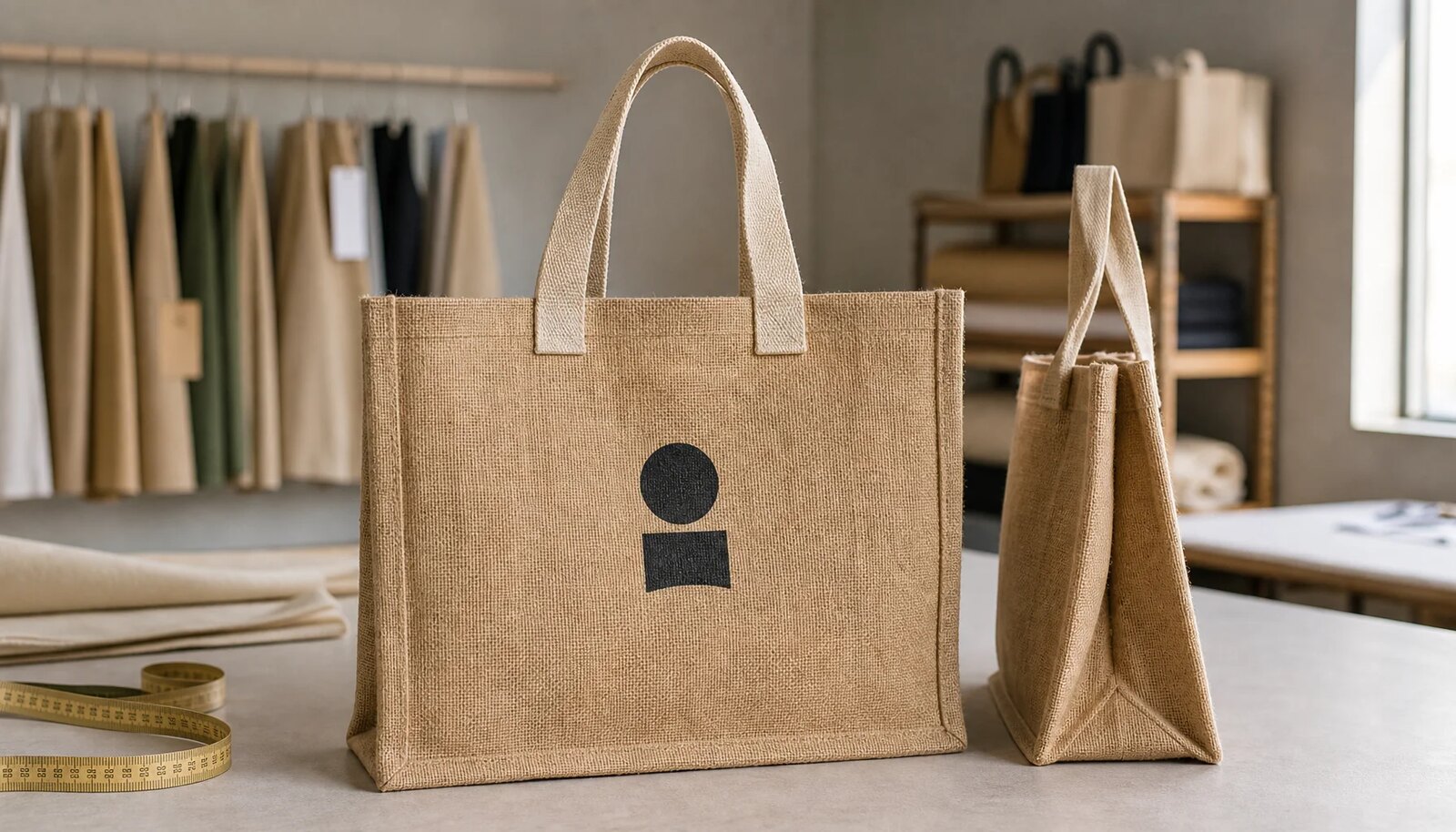
Logo Visibility Is a Production Spec
A craft fair tote is rarely seen as a perfect flat rectangle. It hangs from booth hooks, sits in checkout stacks, swings from shoulders, folds into cartons, and gets filled with candles, jars, ceramics, soaps, yarn, prints, packaged foods, and boxed gifts. A logo that looks centered in a mockup can sit too low once the bag is loaded. It can slide into the bottom crease, bend into a gusset, or hide behind a shopper's hand.
For procurement teams, logo placement is not just a design preference. It is a measurable manufacturing requirement. The buyer needs a finished bag size, printable zone, logo dimensions, decoration method, surface specification, placement tolerance, sample approval process, and inspection plan. If those details are missing, suppliers quote different assumptions and the unit prices no longer compare cleanly.
The common mistake is approving a front-view mockup without connecting it to the sewn bag. Jute totes are cut-and-sewn products. Seam allowance, gusset folding, handle stitching, pressing, and carton compression all change how the front panel behaves. Use physical reference points instead: top opening, side seams, bottom fold, gusset fold, and handle stitch boxes. That turns a vague creative instruction into something a factory and inspector can measure.
- Primary objective: keep the logo readable when the tote is flat, hanging, filled, and carried.
- Best RFQ habit: specify millimeter placement from sewn-bag reference points, not words like centered, high, or middle.
- Commercial risk: poor placement reduces sponsor value, weakens retail display, and can create rework before a fixed event date.
- Procurement control: compare suppliers on the same GSM, lamination, print size, handle construction, packing method, and tolerance.
Start With the Sewn Tote
Begin with the bag construction, then place the artwork. A flat jute tote gives the most predictable front panel and is usually easier to print before sewing. A gusseted tote carries more craft fair purchases, but the front panel bends where it meets the side and bottom gussets. The nominal front width may look generous, while the true print-safe zone is much smaller.
Useful craft fair sizes include about 300 x 350 mm for light purchases, 350 x 400 mm for general merchandise, and 400 x 450 mm or larger for bulky goods. Gussets commonly range from 80 mm to 150 mm. A 350 x 400 x 120 mm tote is a practical all-purpose format for many event programs, yet the logo still needs clearance from side seams, base creases, handle stitching, and the visual curve created by filled goods.
Handles also change what shoppers see. Short hand-carry handles keep the upper panel open, while longer shoulder handles add value for walking shoppers but may fall across the logo or pull the bag mouth inward. If bags will hang on a display rail, approve the sample in that position. If the tote will be sold as merchandise, plan the logo, handle drop, hang tag, barcode label, and front-facing display as one system.
The cleanest decision order is finished bag size, gusset, fabric weight, lamination, handle material, handle drop, closure or pocket if used, and then logo placement. When the artwork comes first, buyers often force a large mark into a weak location. When the structure is fixed first, the designer can scale the mark to the real print window and the supplier can price with fewer assumptions.
- Flat tote: easiest print control, lower packing volume, and suitable for lightweight checkout or promotional use.
- Medium gusset tote: useful for candles, soaps, textiles, stationery, packaged foods, and small gift items.
- Large gusset tote: better capacity, but it needs wider side margins and a logo that avoids curved zones.
- Shoulder-handle tote: stronger user value, but the sample must prove the handles do not cover the logo.
- Retail version: align logo, hang tag, barcode, carton label, and SKU naming before production release.
Specify Jute GSM and Finish
Fabric weight is one of the biggest quote variables. Many craft fair tote programs use 270-320 GSM laminated jute or 300-350 GSM unlaminated jute. Laminated jute usually feels more structured and gives a cleaner print face. Unlaminated jute looks more rustic, but ink can spread into the coarse fiber and soften the edges of fine artwork.
Ask suppliers to define GSM clearly. Does the number refer to the jute fabric before lamination, the laminated sheet, or the final material construction? Also set a tolerance. A range such as +/-5% can be a useful starting point if the supplier confirms it can be controlled, although natural-fiber programs may need another agreed tolerance. The important point is to write it down before price comparison.
Lighter fabric may lower unit price and freight weight, but it can collapse on display, wrinkle more easily, and distort around the print. Below about 250 GSM, the bag may still suit very light giveaways, but it deserves extra caution if shoppers will carry glass jars, ceramics, or multiple purchases. Heavier jute can improve perceived value, yet it may add seam bulk, carton weight, and freight cost.
Surface finish affects both appearance and risk. On laminated jute, screen prints and transfers usually show cleaner edges, but gloss, film marks, and delamination need checking. On unlaminated jute, artwork should be bolder: thicker strokes, larger text, stronger contrast, and less detail. Natural jute shade can vary by batch, so pale inks and thin metallic effects are harder to control than dark solid colors such as black, navy, deep green, or brown.
- 270-320 GSM laminated jute: useful for cleaner print edges, stronger structure, and retail presentation.
- 300-350 GSM unlaminated jute: suitable for natural craft positioning when artwork is bold and simple.
- Below 250 GSM: consider mainly for light promotional use unless seams and handles are tested for the intended load.
- Above 350 GSM: can feel premium but may increase sewing bulk, carton weight, and freight cost.
- RFQ requirement: state GSM, tolerance, lamination status, measurement basis, and approved sample reference.
Build a Real Logo Safe Zone
A good logo safe zone protects the artwork from seams, folds, handles, and packing creases. For a common 350 x 400 mm jute tote, a practical starting point is to center the logo horizontally, place the logo top edge about 80-100 mm below the top opening, and keep the bottom edge at least 50-65 mm above the bottom fold or sewn base seam. A 180-230 mm logo width often gives strong visibility without pushing too close to the sides.
Adjust those numbers for the exact tote. A deep gusset needs more side clearance. A wide horizontal logo needs more caution than a compact vertical mark. A shoulder-handle design needs a check for handle interference. If the logo has a tagline, sponsor line, or small date, measure the outer artwork bounding box rather than only the main icon.
For production, decide how placement will be measured. The artwork bounding box is usually clearest because it includes all letters, icons, taglines, and registration marks. The RFQ should state the distance from top opening to logo top, distance from side seams to left and right artwork edges, distance from bottom logo edge to bottom fold, and horizontal centerline position.
Avoid handle stitch boxes, seam allowance, pockets, gusset folds, and heavy base creases. A factory may be able to print near those areas, but the result can distort after sewing or when filled. If a sponsor insists on a very large logo, consider a taller bag, a smaller icon with larger text, or a two-level layout that keeps the main event mark in the safest zone.
Placement tolerance needs to be realistic. Jute tote bags are sewn items, not rigid molded products. A starting tolerance of +/-5 mm horizontally and +/-8 mm vertically is practical for many orders, but tighter limits should be confirmed before pricing. Borders, circles, frames, and pocket-aligned artwork make small shifts more visible.
- Reference points: top opening, side seams, bottom fold, gusset folds, handle stitch boxes, pocket edge, and label edge.
- Medium tote starting point: logo top 80-100 mm below top opening and logo bottom 50-65 mm above bottom fold.
- Side clearance: keep 45 mm from side seams on flat bags and 60-75 mm from gusset folds on wide-gusset bags.
- Artwork size: reduce logo width before reducing bottom clearance on small or gusseted totes.
- Inspection rule: define whether tolerance is measured from centerline, top edge, or full artwork bounding box.
Choose the Print Method Early
Screen printing is usually the practical choice for craft fair jute tote bags with one to three solid colors. It works well for bold event names, simple icons, vendor logos, and sponsor graphics. It can also be efficient for bulk production. The limits show up on rough jute: thin strokes, tiny reversed letters, distressed textures, and low-contrast colors can break into the fiber texture.
For direct screen print on jute, a useful starting point is 1.0-1.5 mm minimum stroke thickness and 4-5 mm minimum text height. Treat those as sample-proven limits, not assumptions. Coarser unlaminated jute may need larger details. If the artwork includes a QR code, dense sponsor list, social handle, or fine tagline, it may belong on a cotton patch, paper hang tag, or printed insert card instead of the jute face.
Heat transfer can help when the artwork has gradients, many colors, detailed illustration, or photographic content. It generally suits smoother laminated panels better than rough unlaminated jute. Buyers should check image clarity, hand feel, edge adhesion, gloss level, flexibility after folding, and behavior under carton pressure. A transfer can look bright on the table and still feel too plastic for a handmade or natural craft fair position.
For premium programs, a woven label, printed cotton patch, or stitched cotton front panel may protect the brand better than direct printing on coarse jute. These options add material, labor, and sometimes separate MOQs, but they reduce risk when the logo includes fine type or detailed linework. The quote should name the exact decoration method included in the unit price; one-color screen print, full-color transfer, and sewn patch are not interchangeable.
- Screen print: best for bold one- to three-color logos, event names, and repeat production.
- Heat transfer: best for detailed or full-color artwork on suitable laminated jute after adhesion and fold testing.
- Woven label: useful for subtle premium branding when the front panel should stay natural.
- Cotton patch: useful for small text, fine lines, or high-contrast logo detail that jute cannot hold cleanly.
- Artwork control: confirm line thickness, text height, color count, ink reference, registration tolerance, and acceptable edge variation.
Separate Cost, MOQ, and SKUs
A clean RFQ makes price comparison possible. One supplier may include the base bag and one-color print only. Another may include screen setup, artwork separation, sample charge, color matching, hang tag, barcode label, inner packing, export carton, inspection support, and inland delivery. A low unit price may also assume lighter GSM, smaller artwork, shorter handles, fewer stitches, or looser carton packing.
MOQ is not only a bag count. It may be driven by fabric purchase, lamination batch, cutting efficiency, print setup, ink changes, handle color, labels, carton marks, and inspection lots. A buyer ordering 1,000 totes across five event logos may see one total volume. The factory sees five screens, five setup runs, five packing controls, and five chances for carton mixing.
For distributors and event agencies, use a SKU matrix. Each row should show finished bag size, fabric, lamination, handle color, logo version, ink color, quantity, packing method, hang tag, barcode, carton mark, delivery destination, and required arrival date. This is especially useful when one base tote serves several craft fairs or sponsor versions.
Compare landed cost, not just unit price. Carton dimensions and gross weight affect freight, warehouse handling, parcel moves, and event-site receiving. A slightly higher unit price with stable packing, clear SKU labels, and fewer defects can cost less than a cheaper bag that needs repacking, replacement, or urgent air shipment before the fair.
- Separate quote lines: base bag, print, screen or transfer setup, sample, label, hang tag, inner packing, carton, and delivery charges.
- State quantity per artwork version rather than only total order quantity.
- Confirm MOQ per logo, handle color, packing method, barcode version, carton mark, and shipment release.
- Compare GSM, lamination, logo size, handle width, and stitch reinforcement before treating unit prices as equal.
- Use a SKU matrix for multi-logo craft fair programs to control packing, inspection, and delivery.
Approve Samples Like Buyers Will Use Them
The pre-production sample should be as close to bulk production as possible. It should use the agreed jute GSM, lamination status, handle material, handle width, ink or transfer film, print size, placement, stitching method, and packing orientation. If substitute fabric or a different print process is used, record that limitation and request a true production sample before bulk release.
Review the sample in four conditions: flat, hanging, filled, and folded. Flat review checks alignment and print edges. Hanging review shows whether handles cover the logo or pull the bag mouth out of shape. Filled review shows whether the logo falls into the bottom fold, wraps around the gusset, or looks tilted under load. Folded review checks whether packing creases or scuffs the printed area.
Document the approved sample. Record logo width, logo height, distance from top opening to logo top, side margins, bottom clearance, handle drop, finished bag dimensions, and acceptable natural jute variation. Photograph the sample with a ruler or measuring tape. Keep a physical reference sample available for production and final inspection.
Sample approval should include basic functional checks. Rub the print after curing, fold the bag as it will be packed, check odor, inspect handle stitching, and stack it in a carton-like bundle to look for scuffing. If the tote will carry heavier craft products, test with a realistic load such as 8-12 kg, or another buyer-defined load based on the product mix. These checks do not replace lab testing, but they catch practical problems early.
- Sample match: fabric, lamination, handle, ink or transfer, logo size, placement, stitching, and packing orientation.
- Review conditions: flat on table, hanging by handles, filled with realistic products, and folded for packing.
- Record measurements: logo top, centerline, bottom clearance, side margins, handle drop, gusset, and finished bag size.
- Check function: ink rub, transfer adhesion, handle pull, seam security, odor, carton scuff risk, and fold marks.
- Control revisions: link approved sample, artwork file, placement drawing, and packing plan under the same approval code.
Set QC Tolerances Before Bulk
Quality control must cover branding and usability. A perfect print on a weak bag is not acceptable. A strong bag with a crooked sponsor logo is not acceptable either. The inspection plan should include logo placement, print quality, dimensions, fabric weight, handle strength, seam construction, lamination condition, odor, stains, packing, and carton marks.
Measure logo placement on a random sample from each production batch and artwork version. Inspectors should check horizontal center deviation, vertical placement from the top opening, side clearance, bottom clearance, and whether handles or folds block the logo. For many sewn jute totes, +/-5 mm horizontally and +/-8 mm vertically is a useful starting point, but framed logos, circular logos, or multi-panel designs may need different limits.
Compare print quality against the approved sample, not a perfect digital file. Natural jute will show fiber character. Still, major ink gaps, heavy bleeding, double images, transfer peeling, scorch marks, wrong color, severe opacity differences, or mixed logo versions should be treated as serious defects. For screen print, check coverage and curing. For transfers, check edges, adhesion, flexibility, and gloss. For labels or patches, check position, stitching, and fraying.
If the buyer uses AQL inspection, define defect classes before production. A common framework is critical defects at 0 acceptance, major defects around AQL 2.5, and minor defects around AQL 4.0, but the final level should match the buyer's risk standard and order value. Wrong logo, wrong material, contamination, mold risk, failed handle, or severe print failure should not be treated as normal cosmetic variation.
- Major logo defects: wrong artwork, wrong placement, severe bleeding, missing ink, peeling transfer, wrong color, or mixed SKU carton.
- Major bag defects: broken handle stitch, open seam, hole, heavy front stain, mold risk, strong odor, wrong size, or wrong material.
- Minor controlled defects: small slubs, slight shade variation, tiny fiber marks, and small print specks within agreed limits.
- Measurement checks: logo position, finished dimensions, handle drop, gusset depth, GSM, bundle quantity, and carton count.
- Inspection evidence: require photos of measured logo, handle reinforcement, side gusset, bottom seam, inside finish, bundle packing, and carton marks.
Protect the Printed Panel in Packing
Packing can damage a logo that passed inspection. Jute is coarse, and printed panels can scuff when they rub against raw fiber under carton pressure. Over-compressed cartons can crease the logo area, distort handles, and increase fiber shedding. For many craft fair orders, flat packing in controlled bundles of 25-50 pieces is safer than forcing too many bags into a carton.
Define the packing method in writing. Include bundle size, printed-face direction, whether print faces print or fabric, paper separation if needed, carton dimensions, carton strength, carton markings, moisture protection, and barcode controls. If the buyer avoids individual polybags for environmental reasons, add an alternative protection plan such as paper bands, master polybags, carton liners, desiccant where appropriate, or print-facing rules.
Multi-logo programs need extra discipline. Each logo version should have clear inner bundle labels and carton marks. If event teams receive mixed cartons without clear identification, booth distribution slows down and mistakes become more likely. Barcode labels, hang tags, sponsor tags, and retail price labels belong in the SKU matrix and inspection checklist.
Packing also affects how the tote looks when unpacked. Heavily creased bags may need steaming, pressing, or extra handling before display. Specify whether the logo side faces outward in bundles, whether handles are folded inside or aligned upward, and whether bags must be easy for event staff to count quickly. Small packing choices can save real setup time.
- Use flat inner bundles of 25-50 pieces based on bag size, stiffness, print method, and carton weight.
- Control printed-face direction to reduce ink scuffing, transfer marks, and fiber contamination.
- Keep carton gross weight practical for handling and avoid crushing the logo area.
- Mark cartons by PO, SKU, logo version, quantity, color, destination, carton number, gross weight, and net weight.
- For plastic-reduced packing, still specify moisture control, carton liner, paper band, or other scuff-prevention method.
Manage Lead Time Around Event Dates
Craft fair dates do not move easily, so sourcing delays become commercial risk quickly. A realistic schedule includes artwork review, file correction, screen or transfer preparation, sample making, sample shipment, buyer review, sample correction if needed, material preparation, cutting, printing, curing, sewing, trimming, inspection, packing, and shipment. Production lead time is not only the sewing window.
Artwork approval is a frequent bottleneck. Suppliers need vector artwork, color references, logo size, placement drawing, and print method confirmation before screens or transfers can be prepared. If a sponsor name changes after screens are made, both cost and schedule change. Multi-logo orders should lock all artwork versions before production release or separate late logos into a later batch.
Material availability matters as well. Standard natural jute, standard cotton handles, and one-color screen printing usually move faster than custom dyed handles, unusual lamination, multiple transfer designs, retail packing, or split shipments. Ask whether the quoted lead time assumes current stock of fabric and handles or new material procurement.
Build a buffer for one sample correction when logo visibility matters. If the first sample is too low, too small, too close to a gusset, or not legible on the chosen jute, the buyer needs time to adjust before bulk. Do not compress final inspection to recover lost artwork time. Skipping inspection before a fixed event date simply moves the risk to the warehouse or booth team.
- Fastest specification: standard natural jute, standard handles, one-color screen print, simple front placement, and master-carton packing.
- Slower specification: custom handle color, many logo versions, full-color transfer, cotton patch, retail barcode packs, or special carton sorting.
- Critical path: artwork approval, sample approval, material readiness, print setup, curing time, final inspection, and shipment booking.
- Schedule buffer: allow time for one sample correction if logo visibility or sponsor approval is important.
- PO control: release production only after artwork, placement drawing, packing plan, SKU matrix, and inspection criteria are aligned.
Specification comparison for buyers
| Procurement decision | Recommended specification | Best use case | Risk to control before PO |
|---|---|---|---|
| Front logo placement | For a 350 x 400 mm tote, center horizontally; place logo top edge 80-100 mm below top opening; keep bottom edge 50-65 mm above bottom fold or sewn base seam | Craft fair checkout bags, vendor merchandise totes, sponsor giveaways, and reusable shopper bags where the logo must read while hanging or carried | A low logo can disappear into the base crease; a high logo can be crowded by handle stitch boxes or hidden by the shopper's hand |
| Printable logo size | For a 350 x 400 mm front panel, use 180-230 mm logo width for most one-color marks; keep minimum text height 4-5 mm and minimum stroke 1.0-1.5 mm unless the sample proves otherwise | Event names, booth sponsor logos, maker-market branding, simple icons, and high-contrast one-color artwork | Fine strokes, small reversed text, distressed fonts, and pale inks can break up on coarse jute fibers |
| Side margin and gusset clearance | Keep artwork at least 45 mm from side seams on flat totes; keep 60-75 mm from gusset fold lines on 100-150 mm gusset bags | Bags filled with candles, jars, ceramics, boxed soaps, textiles, stationery, or packaged food | Wide artwork near a gusset bends around the load and can look distorted or partially hidden |
| Finished bag tolerance | Specify finished sewn size tolerance, typically +/-5 mm on width and height, +/-5 mm on gusset, and +/-10 mm on handle drop unless tighter tolerance is confirmed | Orders where carton count, display fixtures, insert cards, or retail labels depend on consistent bag dimensions | Quotes based only on nominal cut size may not match finished sewn dimensions after seams, pressing, and folding |
| Jute fabric weight | Specify 270-320 GSM laminated jute or 300-350 GSM unlaminated jute; define whether GSM is measured before or after lamination and set a tolerance such as +/-5% or supplier-confirmed equivalent | Retail-ready craft fair totes that need enough body for display and repeated shopper handling | Low quotes may assume lighter fabric, looser weave, different lamination, or no measured GSM tolerance |
| Surface finish | Use laminated jute for cleaner print edges and better wipe-clean structure; use unlaminated jute for a more natural rustic look with simpler artwork | Laminated for sharper logos and event merchandising; unlaminated for handmade, eco-positioned, or rustic craft branding | Unlaminated jute absorbs ink unevenly; laminated surfaces can show gloss, transfer edge marks, or delamination if not tested |
| Print method | Screen print for 1-3 solid colors; heat transfer for detailed full-color graphics on suitable laminated panels; cotton patch or woven label for small detail and premium branding | Most craft fair logos, sponsor marks, and event names work best as bold screen prints on the main front panel | Choosing the method after price comparison can cause poor opacity, peeling, heavy hand feel, blurred detail, or unreadable small text |
| Handle construction | 25-35 mm cotton webbing handles; define handle drop, box-cross or reinforced stitch pattern, thread color, and load-test requirement | Bags expected to carry mixed craft fair purchases for several hours | Weak handle stitch, narrow webbing, short handle drop, or missing reinforcement may fail before the jute body fails |
| MOQ and SKU planning | Quote total quantity plus quantity per logo, print color count, handle color, packing version, barcode version, and inspection lot | Distributors, event agencies, and market organizers buying one base tote for several craft fairs or sponsor versions | Five 200-piece logos are not the same cost or production risk as one 1,000-piece logo run |
Buyer checklist before sampling
- Lock the finished sewn bag specification before artwork approval: width, height, gusset depth, handle width, handle drop, handle material, stitch pattern, lamination, jute GSM, and intended carrying load.
- Define logo placement from physical reference points: top opening, side seams, gusset folds, handle stitch boxes, bottom seam or bottom fold, pocket edge, label edge, and barcode position if used.
- Provide vector artwork with Pantone, CMYK, or other color reference, exact logo width and height, color count, minimum text size, minimum line thickness, and approved artwork revision code.
- Create a print-safe zone that keeps artwork away from side folds, bottom crease, handle reinforcement, seams, pockets, hang tags, care labels, barcode stickers, and carton-pressure fold lines.
- Ask the supplier to confirm the maximum recommended print area on the exact sewn construction, not only the theoretical fabric panel before cutting and sewing.
- Request a physical pre-production sample using actual or production-equivalent jute, lamination, handle material, ink or transfer film, stitch construction, and final logo placement.
- Review the sample flat, hanging by handles, filled with a realistic craft fair load, and folded in the proposed packing orientation before approving logo size and position.
- State acceptable natural jute variation for shade, slubs, fibers, smell, surface marks, and weave irregularity so QC separates normal fiber character from true defects.
- Separate quote lines for base bag, printing, screen or transfer setup, color changes, sample charge, artwork separation, labels, hang tags, barcode labels, inner packing, export cartons, and inland or documentation costs.
- Confirm MOQ per base bag, per logo, per ink color, per handle color, per packing method, per barcode version, per carton mark, and per shipment release.
Factory quote questions to send
- What finished sewn bag size are you quoting, including width, height, gusset depth, handle width, handle drop, seam allowance assumption, and finished-size tolerance?
- What jute GSM is included, is it measured before or after lamination, what test method or internal weighing method is used, and what bulk tolerance will be accepted?
- Is the jute laminated or unlaminated, what lamination thickness or finish is included if applicable, and will the logo be printed on the laminated face, natural face, cotton patch, or label?
- What is the maximum safe print area for this exact bag after sewing, gusset folding, handle attachment, and pressing?
- What print method is included in the quoted unit price, and how many logo colors are included before extra screen, transfer, setup, or color-change charges apply?
- What minimum line thickness, minimum text height, and minimum gap between letters do you recommend for screen printing on this jute surface?
- What placement tolerance can your factory hold in bulk, measured horizontally from the bag centerline and vertically from the top opening to the logo bounding box?
- Will the pre-production sample use actual bulk fabric, actual handle material, actual ink or transfer film, actual stitch method, and the final approved logo size?
- How do you price multiple craft fair logos on the same base tote, including screen setup, color changes, packing labels, barcode versions, carton marks, and separate inspection lots?
- What is the MOQ per logo, artwork version, handle color, fabric color, packing method, barcode version, and shipment release?
Quality-control points to confirm
- Verify finished bag dimensions after sewing and pressing, including width, height, gusset depth, handle width, handle drop, and tolerances against the approved specification and sample.
- Measure logo placement using the outer artwork bounding box; use a practical starting tolerance of +/-5 mm horizontally and +/-8 mm vertically unless the PO or approved sample requires another limit.
- Confirm logo safe-zone clearance from top opening, side seams, gusset folds, handle stitch boxes, pockets, labels, barcode stickers, and bottom fold before bulk packing starts.
- Check print quality against the approved sample for ink gaps, low opacity, heavy bleeding, double image, blurred edges, color mismatch, scorch marks, transfer lifting, excessive gloss, wrong artwork, or wrong SKU mix.
- Perform rub, scratch, wash-free adhesion, or fold checks appropriate to the print method after curing and before cartons are sealed; define pass/fail in the inspection checklist.
- Check jute GSM against the quoted specification and tolerance using a documented sample cutting and weighing method or the supplier's agreed internal material-control method.
- Inspect natural fiber condition for unacceptable stains, oil marks, holes, heavy slubs through the logo area, loose fiber contamination, dampness, mildew risk, and strong chemical or musty odor.
- Test handle attachment and seam security with a realistic static load based on the buyer's product mix; document weight, duration, stitch condition, and any seam distortion.
- Inspect seam construction for straight stitching, skipped stitches, broken thread, open seams, poor bottom corners, distorted gussets, exposed raw edges, and loose trimming.
- Confirm lamination, if used, is even and free from bubbling, cracking, delamination, sharp edges, and interference with folding or sewing.