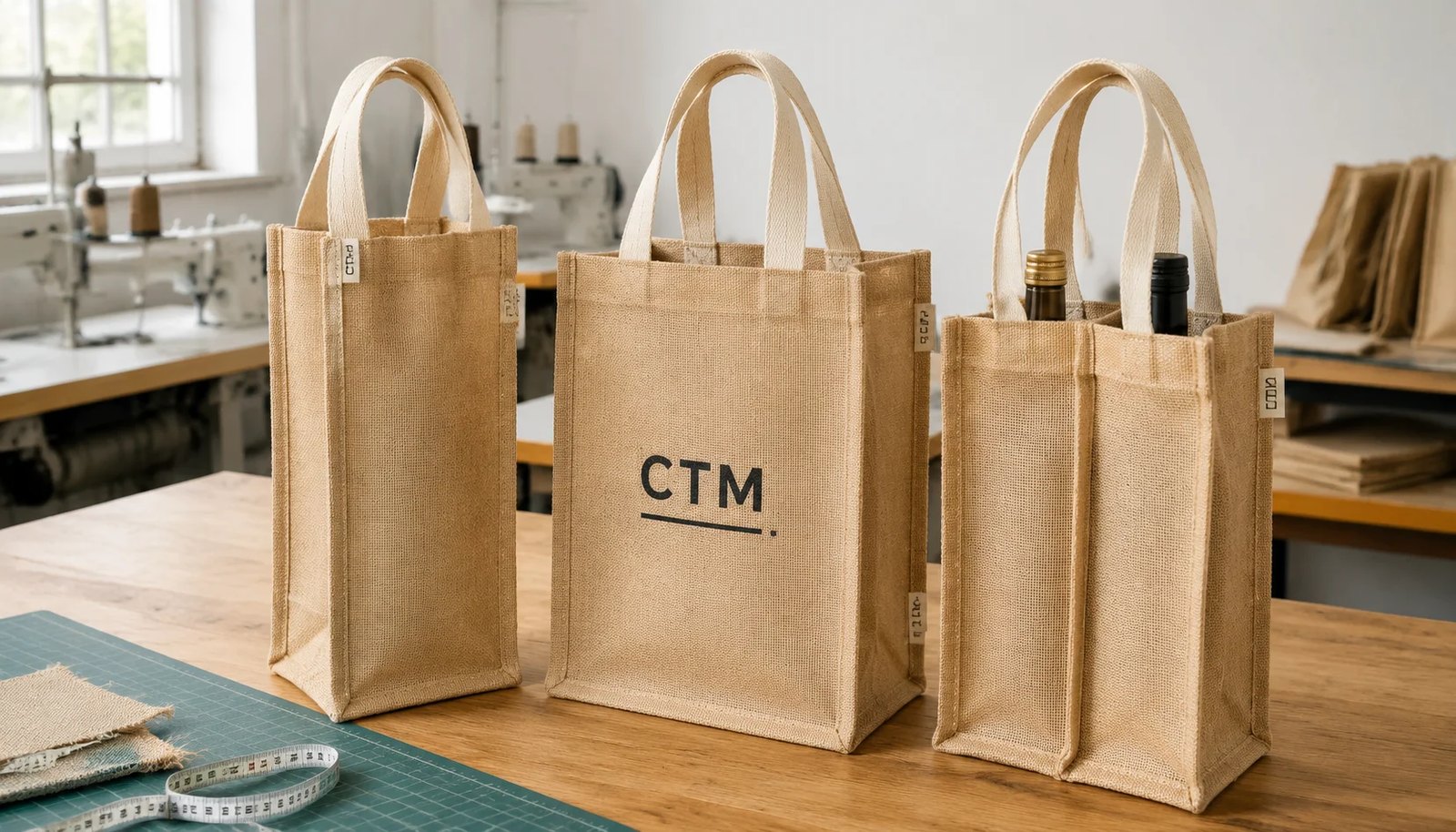
Why lead time slips on jute liquor bags more often than buyers expect
Jute tote bags for liquor retail look simple on paper, but lead time usually slips because the product is carrying glass, has a shaped gusset, and needs to present well at point of sale. That combination creates more approval steps than a basic grocery tote. Buyers often lock the ship window before they lock the bag geometry, handle comfort, or print limits. Then the supplier spends the first week clarifying dimensions, revising die lines, and rebuilding the sample.
The bigger issue is that liquor retail runs are often tied to a seasonal event, tasting promotion, holiday gift program, or distributor launch. Missing by ten days can make the order commercially useless even if the bags eventually arrive. Good planning is less about getting the shortest quoted factory lead time and more about removing avoidable pauses: slow artwork approval, wrong bottle fit, underdefined packing, and unrealistic mixed-SKU requests.
- Most delays happen before bulk production starts, not during sewing
- Bottle-fit errors cause more rework than print errors on this category
- Laminated jute, divider construction, and reinforced handles add process steps
- Peak selling seasons for wine and spirits should be treated as high-risk booking periods
Start with the bag format, because bottle count drives the whole schedule
The fastest jute tote program is usually a standard single-bottle or two-bottle upright bag with one body size and one print layout. Once buyers introduce mixed bottle sizes, stitched dividers, wrap-around artwork, and a retail gift presentation requirement, the timeline stretches. The factory has to verify base dimensions, divider depth, handle drop, and top opening clearance so staff or consumers can load bottles without forcing the seams apart.
For liquor retail, the first RFQ line should not be logo size. It should be the bottle format: standard wine bottle, champagne, tall spirits bottle, or a mixed bottle range. A bag that fits a 750 ml wine bottle may not fit a broader spirit bottle cleanly, especially if there is a stitched divider. If the product team is buying before final bottle selection, the quote should be requested in two or three dimension options rather than pretending the size is settled.
- Single-bottle format: simpler construction, faster approvals, lower sample risk
- Two-bottle divider format: stronger commercial value for gifting, but slower to approve
- Three-bottle carry: only practical if base width, divider spacing, and handle strength are clearly engineered
- State bottle height and diameter range in the RFQ, not only bag dimensions
Choose jute construction by load and presentation, not by the cheapest GSM line
For liquor applications, the body fabric has to balance stiffness, appearance, and seam performance. Many buyers simply request 'jute bag' and compare prices, but the quote can vary because one supplier prices a lighter open weave while another prices a laminated, more stable body. For bottle bags, a typical practical range is around 260-320 GSM body material when converted into equivalent construction language used by many suppliers, often with PE lamination to help the bag stand upright and reduce fiber shedding.
Unlaminated jute can work for rustic gifting or lightweight promotional use, but it tends to print less cleanly and can stretch more under bottle load. Laminated jute is usually the safer choice for retail shelf presentation and repeated carry use. If the bag is intended to be reused by consumers after purchase, handle comfort matters as much as body weight. A heavy body with a narrow rough handle is not a better bag; it is just a heavier complaint.
- Laminated jute: cleaner print surface, better shape retention, less internal fiber dust
- Unlaminated jute: lower material cost in some markets, softer rustic look, but less stable for sharp graphics
- Handle width for bottle loads should generally be 2.5-3.2 cm, not decorative string handles
- If using cotton webbing handles, specify colorfastness expectations if dark handles are paired with natural bodies
Print method decisions can add or remove a full week
Jute is not a smooth paperboard carton. The weave texture, surface variation, and lamination condition all affect artwork output. For most liquor retail programs, one-color or two-color screen print is the practical route. It is durable, commercially familiar, and easier to control on natural-colored jute. The problem starts when brand teams send packaging artwork designed for offset cartons with fine serif text, thin lines, gradients, or metallic effects and expect the same result on woven jute.
If the artwork has small legal text, intricate crests, or photographic elements, a transfer patch or sewn label may be more realistic than direct print. This needs to be decided at quote stage because setup, approval path, and production sequence change. A direct screen print can move quickly once separations are approved. A heat transfer patch, woven label, or embossed PU badge adds material sourcing and application time. Buyers should choose the branding route based on what must be readable from one meter away, not what looks best in a flat PDF.
- Best lead-time route: 1-color bold artwork on front panel only
- Longer route: multiple print positions, inside print, side print, or transfer patch application
- Minimum line thickness and text size should be factory-approved before final artwork sign-off
- Natural jute body color affects ink appearance; request a printed strike-off or color standard
MOQ logic: what actually changes price and timing
MOQ on jute tote bags is not only about total pieces. It is about how many times the line has to stop, reset, print, and repack. Buyers sometimes focus on negotiating the lowest unit MOQ while unintentionally creating a high-complexity order: two sizes, three logo colors, two handle colors, mixed bottle dividers, and retailer-specific carton labels. The headline MOQ may still be accepted, but the real cost appears in setup charges, slower output, and a longer ex-factory date.
For a cleaner first order, one size, one artwork, one handle color, and one packing method usually gives the strongest quote and shortest schedule. If the business needs variants, the buyer should separate which variations are commercially essential and which are only internal preferences. A line that produces 5,000 identical bags is very different from a line that produces 5,000 bags split across five SKUs of 1,000 each.
- Lowest-risk price break usually comes from one bulk SKU with simple screen print
- Additional print color may add setup time even if unit material cost changes only slightly
- Dividers, custom labels, and retail assortments often increase labor more than fabric cost
- If importer needs multiple store brands, request quote by common base bag plus branding variants
Sample approval should test fit, load, and print realism, not just appearance
A digital mockup is not enough for liquor bags. The pre-production sample should be built from the intended jute construction, handle material, and print method. The key test is whether the target bottle or bottle set loads smoothly, stands upright, and does not distort the gusset beyond what is visually acceptable. If the buyer only signs off on flat photos of an empty sample, the first real issue may appear after 30 cartons are already sewn.
The smartest sample review uses a simple acceptance sheet. Measure finished size. Insert actual bottles. Lift by the handles for several cycles. Place the bag on a flat surface and photograph front, side, and top opening. Review if the divider holds spacing, whether the top edge cuts into the bottle neck area, and whether the print lands in a visually centered position once the bag is filled. This is much more valuable than discussing whether the natural jute color is slightly warmer than the monitor image.
- Approve with real filled-bag photos, not empty-bag photos only
- Test load using the heaviest expected bottle combination
- Review print after filling, because panel tension can change logo appearance
- Keep one signed sample as the production reference for QC and dispute resolution
Packing choices affect landed cost and retail condition more than many teams budget for
Packing on jute liquor bags is often treated as an afterthought, but it has direct impact on freight cost, bag shape, and store-ready condition. Over-compressing laminated jute reduces carton cube but can flatten the box gusset and leave visible pressure marks, especially on printed panels. Under-packing protects shape but may raise freight cost sharply if the bags are bulky relative to their value.
A good middle-ground export pack usually folds the body neatly, tucks handles inward, and loads 50 to 100 pieces per master carton depending on bag size and divider construction. Divider styles generally need lower carton counts than flat totes. If the buyer ships to a distributor who re-picks for stores, the carton label format matters too. A cheap factory quote with poor outer carton labeling can create expensive downstream handling errors.
- State target pieces per carton and maximum gross carton weight acceptable for warehouse handling
- If retail-ready bags must look crisp, request no over-compression on laminated bodies
- For e-commerce or gift channel, consider inner bundle counts for easier downstream counting
- Carton marks should include style code, color, quantity, PO, and destination if cross-docking is used
Build the schedule backward from launch date, not from the supplier estimate
A realistic planning calendar for custom jute tote bags should include internal approval time, sample shipping time, revision time, mass production, export booking, and destination clearance. Buyers often use only the factory production number and leave no room for artwork correction, retail compliance review, or transit variation. For liquor retail promotions, that is risky because launch dates are usually fixed by campaign timing, not by bag readiness.
In a normal season, many custom jute runs can be planned around roughly 45-60 days ex-factory after final approval for a straightforward order. But this only holds if artwork is clean, sample sign-off is fast, and materials are standard. Add one to three weeks of buffer if the order falls before holiday gifting season, involves multiple SKUs, or requires special components such as custom woven labels, interior dividers, or nonstandard handle treatments.
- Typical internal path: RFQ to final PO can consume 1-3 weeks before factory lead time even starts
- Physical sample courier time can add several days each round depending on destination
- Peak season booking pressure affects both factory capacity and vessel space
- Leave launch buffer for customs exam, drayage delay, or port rollovers if importing by sea
How to compare supplier quotes without getting trapped by the cheapest unit price
A quote on jute tote bags is only comparable when the construction and service assumptions are aligned. One factory may quote a lighter body, no reinforcement, fewer pieces per carton, and no pre-production sample in the price. Another may quote laminated jute, stronger handle stitching, and better carton efficiency. The second quote can look higher on unit price while being safer on total program cost and timing.
For liquor retail, compare at least these quote lines side by side: body construction, handle spec, divider inclusion, print method, sample charge policy, carton quantity, ex-works versus FOB basis, and stated lead time after artwork approval. If one supplier cannot state tolerances or production assumptions clearly, the lower number is not a real saving. It is an undefined risk that usually comes back as rework, claim friction, or missed launch cost.
- Normalize quote basis before comparison: EXW, FOB, or landed estimate
- Request carton dimensions and gross weight to compare freight efficiency
- Separate tooling or setup charges from unit price so repeat-order economics are visible
- Do not treat sample cost as waste; it is often the cheapest insurance in the whole project
Set QC thresholds early so the factory knows what is rejectable
Jute is a natural material, so buyers should not write unrealistic cosmetic standards that no factory can meet at scale. At the same time, 'natural variation' should not be used to excuse poor sewing, unstable handles, severe print offset, or obvious panel distortion. The practical route is to define what variation is acceptable and what is rejectable before production starts. This keeps inspections factual instead of emotional.
For liquor retail use, the highest-risk defects are usually seam strength issues, base instability, divider misfit, rough print execution, and inconsistent dimensions that affect bottle fit. Cosmetic weave variation is secondary unless the retailer needs highly uniform visual merchandising. The QC sheet should focus on function first, then retail appearance, then carton compliance. This aligns with how the product fails in the real world.
- Critical: seam opening, handle failure, severe wrong size, wrong artwork, missing divider where specified
- Major: print placement outside tolerance, unstable base, obvious skewed panel, carton marking errors
- Minor: moderate natural weave variation, slight shade difference within approved range, thread ends that are trim-correctable
- If using third-party inspection, send approved sample and QC criteria before final booking
Specification comparison for buyers
| Spec decision | Recommended option | When it fits | Buyer risk to check |
|---|---|---|---|
| Fabric weight | 14 oz equivalent laminated jute, typically 260-320 GSM body with PE lamination | Best for single or double bottle carry where shape retention matters on shelf and at checkout | Some suppliers quote lower GSM or lighter weave that looks similar in photos but sags under bottle weight |
| Bag construction | Box-bottom gusset tote with stitched side seams and handle cross reinforcement | Suitable for wine and spirits retail where bottles must stand upright and base stability matters | Flat totes without proper base support can tip, crease, or distort after loading |
| Handle material | Cotton webbing or padded jute-cotton blend handles, 2.5-3.2 cm width | For shoppers carrying 1-3 glass bottles where hand comfort affects store experience | Twisted jute handles may look rustic but can shed fibers and feel rough when carrying heavy bottles |
| Print method | 1-color or 2-color screen print on laminated jute, or heat transfer patch if artwork has fine lines | Screen print works for bold retail branding and event promotions with moderate quantity | Small text and tight registration on uneven jute weave often print poorly; buyer should approve artwork limits before deposit |
| Inner bottle support | Removable or stitched divider for two-bottle or three-bottle packs | Useful for gift sets, holiday promotions, and breakage control during local store handling | If divider thickness and stitch points are not defined, bottles can collide and seams can split in transit |
| MOQ route | Single-size bulk run with one print color and one handle color | Best for first orders needing sharper price and easier production scheduling | Mixed sizes, mixed artwork, and low-volume variants often trigger longer lead time and hidden setup charges |
| Packing method | Export carton with bag body folded, handles tucked inward, 50-100 pcs per carton depending on size | Good balance of freight efficiency and crease control for distributor or chain retail replenishment | Over-compressed cartons reduce cube but can flatten gussets and crack print on laminated surfaces |
| Sample approval route | Pre-production sample from final materials plus print strike-off | Necessary when bag dimensions must match bottle heights, divider fit, and POS appearance | Skipping PP sample often causes approval disputes on gusset width, print placement, or handle drop |
| Lead time planning | Reserve 45-60 days ex-factory for custom run after approval in normal season | Works for stable designs and standard jute colors ordered before peak gifting periods | Holiday season, port congestion, or late artwork approval can easily add 1-3 weeks |
Buyer checklist before sampling
- Define bottle count per bag: single, double, or three-bottle carry format
- State finished size with gusset and bottom dimensions in cm and tolerance
- Specify fabric construction: laminated or unlaminated jute, target GSM or weight range
- Confirm handle material, width, total length, and cross-stitch reinforcement requirement
- Declare max load target in kg and expected use case: gift bag, shopper, or repeat-use retail tote
- Provide artwork format and minimum readable text size for the selected print method
- Approve print location with measurements from top seam and side seam
- Decide whether inner divider is stitched in, removable, or not required
- Set packing quantity per carton and whether inner polybag packing is allowed or restricted
- Request pre-production sample made from final jute, final handle, and final print method
Factory quote questions to send
- What exact jute construction are you quoting: laminated or unlaminated, and what body GSM or weight range will be used?
- What is the finished bag size including bottom gusset, side gusset, and handle drop tolerance?
- How many bottles and what typical bottle height or diameter is this size designed to hold?
- What print method are you quoting, and what are the practical limits on fine text, line weight, and color registration on this jute surface?
- Is the quoted MOQ based on one size, one artwork, and one print color only?
- What setup charges apply for additional colorways, divider versions, or mixed carton assortments?
- Will you provide a digital artwork layout plus a physical pre-production sample from final materials?
- What seam reinforcement is included at the handle joint, and has the bag been tested for a stated load range?
- How many pieces per export carton, what carton size, and what estimated gross weight per carton?
- What is the production lead time from artwork approval and deposit, and how does it change during holiday peak season?
Quality-control points to confirm
- Measure finished width, height, side gusset, bottom gusset, and handle drop against approved spec with stated tolerances
- Verify body fabric appearance for excessive loose fibers, color inconsistency, weave gaps, or lamination wrinkles
- Check print placement from top edge and side seam; compare color density to approved standard
- Inspect handle attachment for cross-stitch count, stitch tension, and reinforcement patch if specified
- Load-test random samples with the agreed bottle weight to confirm base stability and seam integrity
- Inspect divider alignment and fit if applicable so bottles do not collide or lean excessively
- Confirm carton packing quantity and folding method match approved packing standard
- Smell test packed goods for strong chemical odor from lamination, ink, or storage conditions
- Review barcode, carton mark, and assortment labeling before sealing final cartons
- Confirm no needle damage, seam skipping, broken threads, or exposed lamination edges on visible retail faces