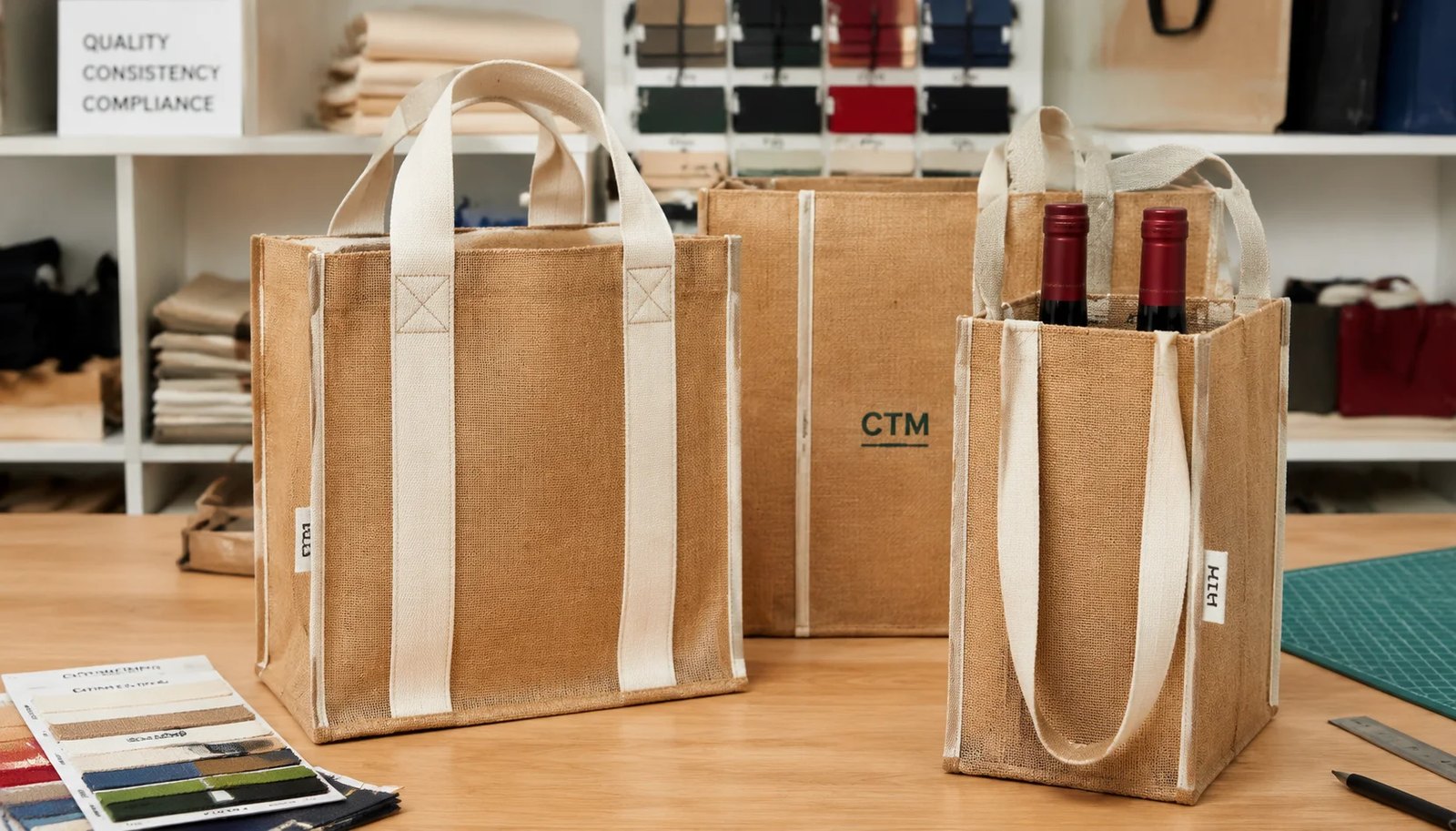
Why compliance is the main buying problem for liquor retail jute totes
Jute tote bags for liquor retail look simple, but procurement problems usually start after the first attractive quote arrives. Retail buyers are not only buying a carry bag. They are buying a store-use product that holds heavy glass, faces customer handling at checkout, carries branded print, and may be reviewed by internal compliance teams for material declarations, packaging rules, and country-of-origin marking. A supplier that can sew a basic jute bag is not automatically a supplier that can support a retail compliance file and repeatable production controls.
The most common failure in this category is buying from quote sheets that compare only size and print count. That misses the issues that create rework and claim cost later: finished GSM ambiguity, weak handle anchoring, odor from lamination, print inconsistency on coarse jute, and unclear evidence for restricted substances in inks or accessory materials. For liquor retail, the bag often carries 1-2 bottles, so the real buying problem is balancing presentation, carrying strength, and document readiness without over-specifying a promotional item into an expensive specialty bag.
- Retail use raises load-bearing risk because glass bottles create concentrated bottom and handle stress.
- Jute is variable by nature; weave irregularity must be managed in print and appearance standards.
- Compliance requests may cover fabric, lamination, ink, labels, and export carton markings, not only the bag body.
- A low quote with missing documentation often becomes the most expensive option once approvals begin.
Start with the right bag specification for bottle retail use
For liquor retail, the bag spec should begin with use case, not with a stock size copied from an old PO. A single-bottle gift carry bag has different stress points than a two-bottle takeaway tote. Typical body constructions in this category use laminated jute in a finished range around 260-320 GSM, which gives enough body for shelf appearance and moderate carry strength. If the bag is expected to hold two 750 ml bottles regularly, the bottom panel and handle reinforcement matter more than increasing fabric weight alone.
Size also changes cost and freight efficiency more than many buyers expect. A common retail tote format may be around 30-35 cm wide, 30-35 cm high, and 15-20 cm gusset, but dimensions should be driven by actual bottle pack-out and whether customers insert protective tissue or gift items. Oversized bags waste material, reduce carton efficiency, and allow bottles to shift. Undersized gussets force seam stress and distort the print panel.
- Useful baseline for general liquor retail tote: laminated jute, finished 260-320 GSM, cotton webbing handles, reinforced bottom seam.
- For heavier use, specify handle width such as 2.5-3.8 cm and reinforcement patch or cross stitch at attachment point.
- If an internal bottle divider is needed, quote it separately; it changes labor, material, and flat-packing volume.
- State whether the bag must stand upright when empty; this may require piping or a bottom insert, which affects cost.
How print method and artwork affect compliance and claim risk
Most liquor retailer artwork on jute totes works best with simple screen printing in 1-2 colors. This is not only a cost choice; it is a quality-control choice. Coarse jute texture naturally produces small interruptions in large solid print areas, and buyers should build that into the acceptance standard. If your artwork includes fine serif type, thin reverse lines, or exact color matching across multiple store campaigns, jute may not be the right substrate without artwork adjustment.
Print compliance is not just visual. Buyers should know what ink system is used and whether the print supplier can support declarations or test data relevant to the retailer's restricted substances framework. If the supplier outsources printing, document control becomes weaker unless the main factory owns approval samples and production records. A pre-production sample on actual jute, with final color and final lamination condition, is much more useful than a paper color proof.
- Best practice artwork for jute: bold logo, limited colors, moderate coverage, and margins away from gusset fold and seam line.
- Screen print usually offers the best cost-to-control ratio for promotional liquor retail totes.
- Large dark fills may show inconsistency because jute yarn thickness varies across the panel.
- If exact Pantone match is essential, note acceptable variance in the PO instead of assuming paper proof accuracy.
MOQ logic: what low minimums hide in jute tote quotes
MOQ in this category is often presented in a misleadingly simple way. A supplier may offer a low total quantity, but the quote only works if all units share one size, one base material color, and one print setup. The moment a retail buyer splits by regional logo, festive artwork, or separate bottle capacity, setup cost spreads over fewer units and the effective unit price rises fast. Procurement teams should compare MOQ at SKU level, not only at order level.
Jute also has material batching effects. Natural color variation between fabric lots can create visible tone shifts if repeat orders are too fragmented or replenishment is placed against a moving target. If the program is likely to repeat, it is often better to lock one core spec and one standard natural shade rather than chase tiny MOQs across multiple custom variants. That reduces compliance maintenance, sample churn, and claim arguments over appearance variation.
- Separate MOQ review by bag size, jute base color, print color count, and any added accessory like divider or inside pocket.
- Low MOQs usually carry one of three penalties: higher unit cost, narrower material choice, or weaker quality consistency.
- For repeated retail programs, standardization often saves more than first-order MOQ negotiation.
- If multiple stores need different artwork, ask for one master spec with artwork-only split pricing.
Supplier evidence: what to collect before approving a jute bag factory
A compliance-ready supplier should be able to show more than finished bag photos. Procurement teams need evidence that the supplier controls incoming material, stitching standards, printing coordination, and carton marking accuracy. For jute tote programs, the practical document set usually includes material descriptions, test report references where applicable, restricted-substance declarations for relevant inputs, and a clear statement of which production steps are subcontracted. This matters because the bag may be cut and sewn in one workshop but printed or laminated elsewhere.
When comparing suppliers, focus on traceable process ownership rather than broad claims. A strong supplier can explain how fabric rolls are checked, how handle webbing is matched to approved color, how print positioning is controlled on cut panels, and how packed cartons are protected from moisture before loading. These details are more useful than generic 'high quality' language. If a supplier cannot explain production flow, they usually cannot support a retailer when a claim appears.
- Request current workshop photos of cutting, stitching, print coordination, sample room, and packed export cartons.
- Ask whether lamination, printing, and labels are in-house or subcontracted, and who signs off final QC.
- Review document names and scope carefully; old generic reports may not match the actual material combination quoted.
- Look for process clarity: incoming fabric check, inline stitching review, print approval record, final inspection method.
Sample approval should simulate production, not just design sign-off
Many jute bag issues could be prevented if the approval sample were treated as a production control tool instead of a branding preview. A real approval sample should use the same jute weave class, lamination type, handle material, and print process intended for bulk. If the sample is made from cleaner stock fabric or hand-screened more carefully than production, the buyer is approving the wrong standard. For bottle retail, the sample should also be filled with representative weight to check handle comfort, body distortion, and bottom balance.
Sample comments should be specific enough to carry into bulk inspection. 'Looks good' is not an approval record. Better notes define body size tolerance, handle drop, acceptable print texture, seam neatness, and color expectation under normal store lighting. If there are known limitations, such as natural jute slubs or minor print interruption due to weave texture, note them in the signed sample record. This protects both sides from disputes later.
- Approve at least one pre-production sample made from actual production material before mass cutting starts.
- Photograph front, side, bottom, and handle attachment area of the approved sample for inspection reference.
- Do a simple weighted carry test with bottles or equivalent load during sample review.
- Record approval comments for odor, print edge sharpness, handle comfort, and carton pack count if possible.
Packing rules matter because jute is bulky, abrasive, and moisture-sensitive
Packing is a major hidden cost driver in jute tote sourcing. Jute is thicker and more abrasive than cotton sheeting, so poor carton design causes rubbing, frayed edges, and crushed shape during long transit. Liquor retail buyers also care about store-ready appearance, which means bags cannot arrive overly creased or with laminated panels stuck together. Flat packing is usually best for freight efficiency, but compression must be controlled. A cheap quote can hide over-packed cartons that save carton count while increasing defect rate.
Moisture is another concern. Jute naturally responds to humidity, and laminated constructions can trap odor if packed too soon after printing or finishing. Export packing should therefore consider airing time, carton lining if appropriate, and warehouse conditions before loading. If retailer policy restricts individual polybags, the supplier still needs an alternative way to reduce dust transfer and moisture pickup inside cartons.
- Define carton quantity, maximum carton dimensions, and maximum gross weight for warehouse handling.
- Use flat packing with shape consistency, but avoid excessive compression that creates permanent panel creases.
- If no individual polybag is allowed, consider inner carton liner or grouped protective wrapping subject to retailer policy.
- Require carton marks for SKU, quantity, PO, country of origin, and any retailer-specific barcode placement.
Lead time planning: where jute tote orders usually slip
Jute tote lead time is not just sewing time. The real schedule includes fabric sourcing, lamination availability if used, handle webbing matching, print screen preparation, sample approval, bulk production, airing and packing, and booking for shipment. For a custom order, a rough market example might be 5-10 days for sample development and approval circulation, followed by around 25-40 days for production after final approval, depending on season and order size. These are planning ranges, not promises, and they move quickly during promotional peaks.
The biggest delays usually come from incomplete approvals rather than factory speed. If artwork files are late, if the buyer changes handle width after sample sign-off, or if compliance review starts after bulk has already been quoted, the schedule becomes unstable. Retail teams should lock key decisions in the RFQ stage so suppliers can reserve the right materials and build an accurate timeline.
- Separate sample lead time from bulk lead time in every quote comparison.
- Identify long-lead components early: dyed webbing, custom labels, special lamination, or added bottle divider.
- Plan extra buffer if the order needs retailer compliance review before PO release.
- Do not book promotion dates from first quote timing; book from approved sample and confirmed material status.
How to compare quotes without being misled by a lower unit price
A lower unit price on jute tote bags often reflects omitted construction details rather than real factory efficiency. Quote comparisons should normalize for finished GSM, lamination, handle width, reinforcement, print coverage, packaging method, inspection level, and document support. If one supplier quotes on a raw jute basis and another quotes finished laminated construction, the apparent gap can be large but meaningless. Procurement teams need a line-by-line comparison sheet to avoid selecting a weak quote that later grows through extras or claims.
Freight and duty exposure also matter because jute bags are bulky. A bag that is a few cents cheaper ex-factory may ship in fewer units per carton or per container if the gusset is oversized or the bag includes unnecessary rigid inserts. That raises landed cost. In many retail programs, the best commercial choice is the supplier that offers the most stable spec, strongest packing discipline, and lowest claim risk rather than the nominally cheapest ex-works unit.
- Normalize all quotes to the same size, finished GSM basis, handle spec, print coverage, and packing count.
- Include sample cost, tooling or screen charges, inland transport assumptions, and inspection costs in the comparison.
- Calculate carton utilization and estimated freight impact if one design packs much less efficiently.
- Treat compliance documentation support as a commercial factor, not a free afterthought.
Practical acceptance criteria for final QC and claim prevention
Final QC for liquor retail jute totes should focus on the defects that create store complaints quickly: handle failure, poor print, dirty fabric, odor, open seams, and wrong count. AQL methods may be used, but the checklist itself should match the product. For example, a minor slub in natural jute may be acceptable, while a misaligned print or uneven handle drop on a branded retail bag may not be. The key is defining critical, major, and minor defects before inspection begins.
Load testing should be practical, not theatrical. If the bag is intended for one or two bottles, the inspection plan can use agreed sample units loaded with representative weight and held for a defined period to observe seam strain and handle security. Retailers should also verify barcode or carton label accuracy if the program feeds directly into distribution centers. Many shipment disputes come from packing and labeling mistakes, not from sewing alone.
- Critical defects: handle pull-out, open seam, wrong country-of-origin marking, severe odor, or gross count mismatch.
- Major defects: obvious print misplacement, heavy smudge, wrong handle length, visible lamination bubble, carton damage affecting goods.
- Minor defects: acceptable natural weave irregularity within approved sample standard, slight color variation within agreed tolerance.
- Retain approved sample photos and inspection notes as the basis for any shipment claim review.
Specification comparison for buyers
| Supplier option | What to verify | Commercial advantage | Buyer risk to control |
|---|---|---|---|
| Direct sewing factory | jute roll photos, lamination sample, odor-control process, handle pull evidence, and pre-shipment carton condition photos | Better sample-to-bulk control and faster production feedback | May be weaker on export paperwork or branded packing unless checked early |
| Trading company | Factory name, production photos, trim-source proof, and who owns QC decisions | Can coordinate small mixed orders and extra services | Markup can hide real factory capability and slow defect decisions |
| Specialized bag workshop | handle stitching, side gusset, lamination edge control, inner seam cover, and fiber shedding tolerance | More practical for detailed construction, trims, and repeat programs | Capacity may be limited during peak seasons |
| Low-price general supplier | laminated or unlaminated jute, cotton-jute blend, inner coating, odor control, yarn thickness, and color shade variation | Useful for simple promotional runs with loose specs | Material downgrades, weak packing, and vague inspection scope can erase savings |
| Retail-ready supplier | airing time, moisture absorber, carton liner, bundle wrap, odor separation, and warehouse ventilation before loading | Can handle labels, SKU separation, carton marks, and receiving rules | Higher unit cost must be compared against reduced warehouse work |
| Compliance-focused supplier | Fabric records, labeling review, test plan, and production traceability | Safer for retail programs and repeat brand orders | Documentation claims need evidence, not only sales language |
| Local sample room plus bulk factory | Signed sample, bulk factory handoff, first-piece photos, and deviation owner | Good for complex branding before large production | Sample room quality may not match bulk line unless handoff is controlled |
Buyer checklist before sampling
- Define bag use clearly: single bottle, double bottle, gift set, or general takeaway tote; bottle weight changes handle and bottom reinforcement needs.
- State finished size with tolerance, including gusset and handle drop, not only flat body width and height.
- Specify whether GSM is required as finished fabric weight including lamination or raw jute cloth only.
- List handle material, width, length, stitching pattern, and reinforcement patch requirement.
- Name print method, artwork size, print location, and acceptable color variation on coarse jute texture.
- Require sample made in actual jute weave and actual print method before bulk approval.
- Set odor acceptance standard for laminated jute and inks, especially for in-store retail use.
- Define carton count, carton size limit, gross weight limit, and moisture protection method for export packing.
- Request compliance file list: material declaration, test report scope, carton markings, country-of-origin labeling, and any retailer-specific packaging restrictions.
- Align inspection criteria for seam defects, loose fibers, handle pull strength, print placement, and count accuracy before PO release.
Factory quote questions to send
- What is the exact finished fabric construction, including jute weave, lamination type, and estimated finished GSM range?
- Is the quoted handle cotton webbing, self-jute handle, or mixed material, and what width and stitch reinforcement are included?
- Does the price include bottom board, piping, inside lamination, bottle divider, or any hidden upgrade from the sample?
- What is the MOQ by size, color, and artwork version, and what surcharge applies for split assortments?
- Which print method is planned for this artwork, and what artwork areas are risky on coarse jute texture or near seams?
- Can you provide a pre-production sample in production material with final stitching and print before bulk starts?
- What compliance documents can you supply for fabric, ink, lamination, and accessories, and are they batch-specific or generic references?
- What are the standard tolerances for size, handle drop, print placement, and carton quantity per case?
- How do you pack to prevent moisture pickup, abrasion, and lamination sticking during sea transit?
- What is the production lead time by sample approval date, and which steps are most likely to delay shipment during peak season?
Quality-control points to confirm
- Finished size tolerance should be defined, for example within about +/-1 cm on body dimensions and consistent gusset opening after shaping.
- Fabric should match approved weave appearance, color tone, lamination feel, and finished GSM range agreed in sample notes.
- Handle attachment must show clean reinforcement stitching with no skipped stitches, twisted webbing, or uneven handle drop.
- Seams at side, gusset, and bottom must be straight, locked, and free from open stitching, seam grin, or excessive raw fiber shedding.
- Print should match approved position, color reference, and coverage standard, with no major pinholes, smudging, or obvious misregistration.
- Bags intended for bottle carry should pass agreed load test using actual weight simulation, with no seam tear or handle pull-out after hold period.
- Laminated bags should have no strong chemical odor, no lamination bubbling, and no sticking between packed units.
- Cartons must meet agreed count, labeling, barcode placement if required, and gross weight limit for warehouse handling.