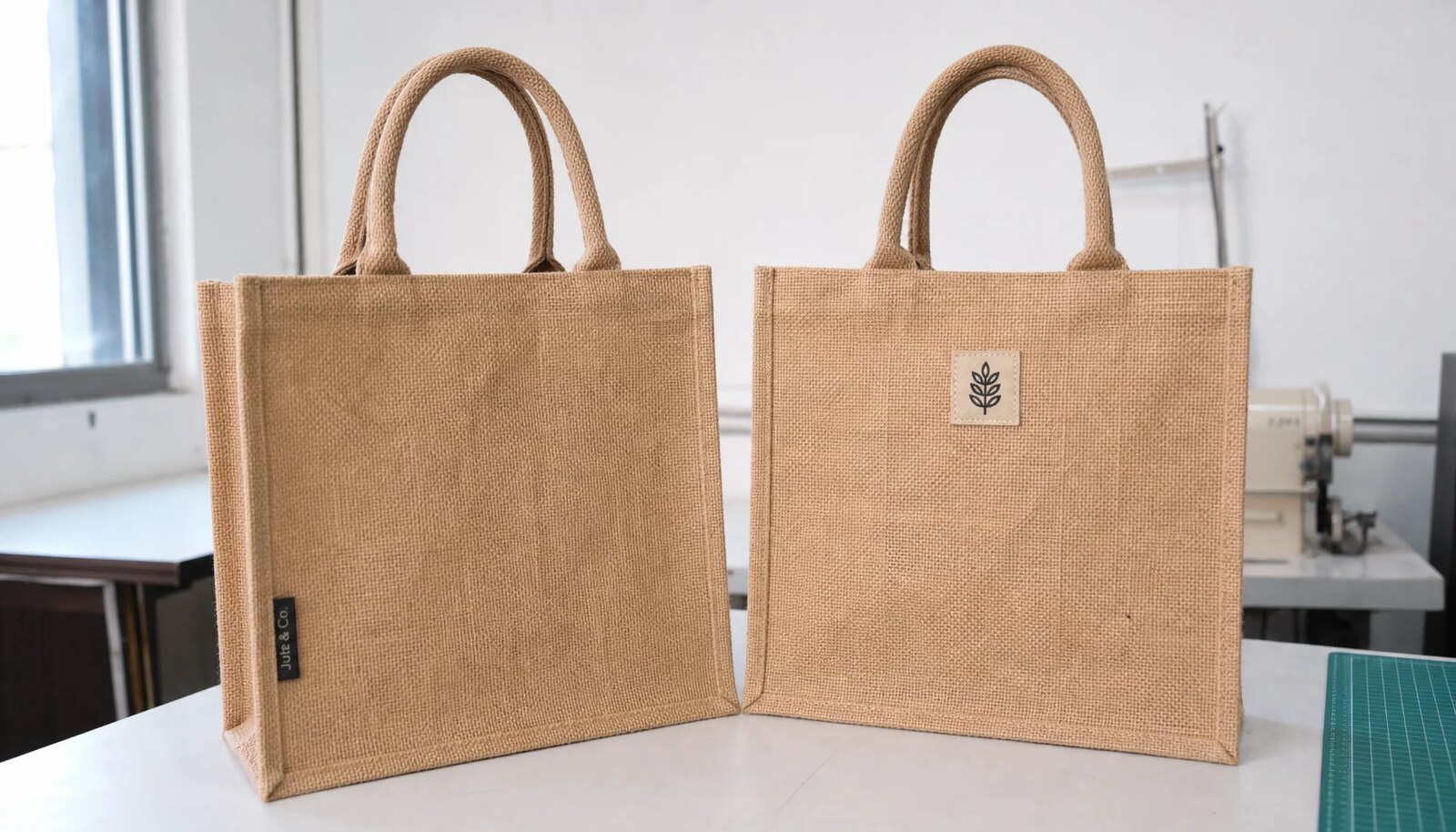
Why lead time planning is different for jute totes
If you are planning jute tote bags for eco apparel brands, lead time is not just a factory issue. It is a chain of approvals: material confirmation, artwork cleanup, sample making, buyer review, bulk sewing, inspection, packing, export documents, freight, and receiving. Missing any one of those steps can push the tote past the launch window even when the factory says production is quick.
That matters because these bags are often tied to date-sensitive work: store openings, seasonal drops, loyalty gifts, wholesale kits, ecommerce inserts, trade events, and holiday packaging. If the totes arrive after the commercial moment, the unit cost may still be acceptable, but the business value drops fast.
Jute also adds normal natural-fiber variation. Shade, weave openness, slubs, odor, and fiber roughness can vary by lot and origin. That is fine when the tolerance is clear. It is not fine when buyers expect a perfectly uniform synthetic look without writing the limit into the spec.
The safest approach is to plan backwards from the required arrival date and then give each stage a buffer. A realistic schedule does not assume the first sample is perfect, the freight booking is immediate, or the cartons clear the warehouse without questions.
Use this guide as a procurement tool: tighten the spec, compare apples to apples, and leave enough time for one controlled revision instead of three rushed ones.
- Plan from the required warehouse or store date, not the factory finish date.
- Separate sample time, production time, inspection time, export handling, and freight.
- Treat natural jute variation as a quality topic with written acceptance limits.
- Freeze artwork, construction, and packing before committing production capacity.
Start with a production-ready spec
A supplier can only quote accurately when the tote is described in production language. List finished width, height, gusset depth, handle drop, handle width, body GSM or approved handfeel, lining or lamination, print size, print position, packing method, and intended load. Words such as premium, sustainable, or standard do not help a factory make the right bag.
For many apparel retail uses, 320-400 GSM is a practical planning range, but it is not a universal rule. A lighter body may work for giveaways, while a heavier body may be better for a reusable retail tote or gift-set carrier. If the tote must stand upright, carry folded apparel, or hold a shoe box, say that directly instead of assuming GSM alone will control performance.
Construction changes affect both cost and timing. Unlined jute is usually the fastest and most natural-looking option. Cotton lining adds cutting and sewing steps. PP lining or lamination can improve stiffness and cleanliness, but it should be aligned with the brand's packaging policy because it may conflict with a plastic-reduction claim. Zippers, pockets, snaps, reinforced bases, and special trims all add approvals and potential rework.
Handles are a frequent source of returns because they carry the real load. Define the handle material, attachment method, reinforcement pattern, and the load the bag must survive in normal use. For a folded garment tote, that may be a modest load. For a retail carry bag, it should be higher and tested accordingly.
- Write the finished dimensions and tolerances before asking for quotes.
- Use GSM as a planning reference, then approve handfeel on a sample.
- Specify unlined, lined, laminated, or reinforced construction at RFQ stage.
- Tie handle reinforcement to the intended use and expected load.
- State display and fit needs such as shelf standing, garment fit, or flat storage.
Choose the sourcing route that matches launch risk
The right sourcing route depends on the date risk and the amount of design control you need. A stock finished tote with custom print is usually the fastest option, but it limits size, handle choice, and fabric weight. Stock fabric with custom cut-and-sew gives more control while avoiding full material development. Fully custom construction gives the most brand control, but it adds more approval gates, higher MOQ pressure, and more ways for the schedule to slip.
For a first campaign, pop-up event, or trial run, the fastest route often protects the launch better than a perfect but late bag. For a recurring retail tote, gift-with-purchase program, or wholesale presentation item, the extra development time can be justified because the bag becomes part of the brand system.
Do not compare suppliers until the route is normalized. One factory quote may be for a stock body with one-color print. Another may include custom fabric, lining, reinforced handles, and retail packing. The second may look slower and more expensive, but it may simply reflect a more complete spec.
Internal alignment matters. Marketing may want a sharper brand presentation, sustainability may want plastic-free packing, operations may need carton counts that fit a 3PL, and procurement may want repeatability. Resolve those priorities before the PO is issued, not during sampling.
- Use stock routes when the date is fixed and the design is flexible.
- Use custom cut-and-sew when fit, gusset, or handle drop matters.
- Use fully custom development for repeat programs with a higher brand standard.
- Keep the chosen route visible in the quote so later revisions do not reset the schedule.
Build the calendar backwards
A useful lead-time plan shows each stage, owner, and buffer. The factory production window is only one part of the calendar. Buyer-side approval, courier time, inspection scheduling, export documentation, freight booking, customs clearance, and warehouse receiving can each add a few days or a few weeks.
The table below is a planning model, not a promise. Ask each supplier to replace the assumptions with route-specific timing. If your order is seasonal, add extra buffer for peak production, holiday congestion, port delays, or a slower review cycle inside your own team.
The key is to lock the required arrival date first and then work backwards. If the tote must be in the distribution center two weeks before launch, that date is the real deadline. If the bags are for an event, use the venue delivery window, not the shipping date, as the target.
Do not let the calendar hide a revision loop. If the sample is not approved on the first round, the delay is usually in the approval chain, not the sewing line.
- Use the warehouse, store, or event date as the master deadline.
- Add buffer for sample courier time, internal review, and freight delays.
- Seasonal programs need more slack than simple replenishment orders.
- If a stage is not owned by one team, it is easy to lose days there.
Read quotes and Incoterms carefully
A strong quote should state the product, route, assumptions, exclusions, and delivery basis. If a supplier gives only a unit price and a production day count, procurement cannot judge landed cost or schedule risk. Ask for a versioned quote tied to the spec sheet, artwork file, quantity, packing method, and Incoterms.
Separate first-order costs from repeat-order costs. Screen setup, sample fees, artwork preparation, special packing, inspection, and courier charges may not repeat in the same way on the next order. If the print screens will be stored, ask how long they are kept and whether a new setup fee applies after a design or size change.
The Incoterm changes the buyer's workload. EXW usually means the buyer handles pickup and export. FOB usually moves risk at the named port once goods are loaded. CIF includes cost, insurance, and freight to the destination port, but not always destination clearance or final delivery. DAP or DDP may be offered, but you still need to check what taxes, duties, brokerage, and last-mile delivery are actually included.
Payment terms should match risk. For a first launch-critical order, it is reasonable to tie the balance to inspection results or document copies rather than paying everything before the shipment is visible and packed.
- Tie every quote to a dated spec sheet, artwork file, quantity, and packing instruction.
- List setup, sample, packing, inspection, domestic transport, and freight costs separately.
- Clarify EXW, FOB, CIF, DAP, or DDP before comparing landed cost.
- Confirm payment milestones and what evidence is needed before balance payment.
- State whether the delivery target means factory completion, port handover, or destination receipt.
Sustainability documents and claim control
Jute supports an eco-positioned bag program because it is a plant-based natural fiber, but the claim language still has to be controlled. Do not use broad claims such as 100% sustainable, zero impact, fully compostable, or plastic-free unless the full construction and packaging support that wording and the brand has evidence for it.
Start with a material declaration. Confirm the composition of the jute body, handles, thread, lining, lamination, labels, ink, and packaging. If the bag has a PP lining, plastic hangtag loop, or individual polybag, it may still be a good commercial product, but it should not be described as plastic-free. If recycled content is claimed, ask for supplier evidence appropriate to the material. If organic is claimed, request a valid certificate that covers the relevant material and supplier scope.
Packaging policy should be part of the product spec. Eco apparel brands may prefer bulk flat packing, paper belly bands, kraft inner wraps, cotton ties, or no individual wrap. That can reduce packaging waste, but it may also increase abrasion or moisture exposure if the carton and handling plan are not designed for it.
Also request any restricted substances statements or ink-related compliance documents needed by your destination market or brand policy. If the tote will be resold, confirm any country-of-origin, care, or fiber labeling rules that apply to the sales channel.
- Collect a material declaration for body, handles, lining, thread, labels, ink, and packaging.
- Do not use recycled, organic, biodegradable, compostable, or plastic-free claims without evidence.
- Align belly bands, hangtags, wraps, and carton liners with the packaging policy.
- Check whether PP lining or lamination conflicts with marketing language.
- Keep sustainability documents with the PO so marketing, compliance, and procurement use the same facts.
Print, handles, and construction details that create delays
Decoration often creates hidden delay because jute is not a smooth print surface. The coarse texture can soften edges, break thin lines, and reduce small-text legibility. Screen printing is often efficient for one- or two-color artwork, but it still needs separation, screen setup, and approval on the actual material.
Complex artwork should be tested before bulk. Gradients, thin serif text, tight multicolor registration, and large solid areas may look clean on a monitor and uneven on burlap. If the supplier suggests another method for detail, approve the handfeel, edge behavior, and durability before you treat it as production-ready.
Print placement should be measured from finished edges after sewing, not from the cut pattern. Jute can shift during cutting and stitching. Set an acceptance band for the logo position so inspection is objective. Do the same for handle drop and gusset shape, especially if the bags will hang on a retail fixture or be packed into a display.
The handle and seam structure must match the intended load. A tote for folded tees has different stress than a bag carrying denim, shoes, or a gift bundle. Ask the supplier to confirm reinforcement at the anchor points and to explain the stitch path before production starts.
- Approve the ink color, opacity, and edge sharpness on actual jute.
- Avoid tiny text and thin lines unless a strike-off proves they are legible.
- Define print placement from finished edges with an allowed tolerance.
- Confirm whether screens and setup can be reused for repeat orders.
- Match handle reinforcement to the expected use and load.
Sampling and approval gates
A pre-production sample should verify the actual bag, not just the concept. It should show the final fabric feel, finished dimensions, gusset, handle drop, reinforcement pattern, print scale, print position, seam finish, and approximate packing. That sample becomes the buyer's reference for the first bulk inspection.
Comments should be measurable. "Move the logo up" is too vague. "Move the logo up 20 mm and keep 60 mm clearance from the bottom seam" is usable. "Stronger handle" should become a handle width, reinforcement pattern, stitch density target, or load expectation. Precision in the sample stage prevents rework later.
Approval time inside the buyer team is often the hidden delay. Marketing, packaging, sustainability, and procurement may all need a look. Assign one decision owner and combine comments into one revision note. Sequential feedback can turn a one-week sample cycle into a three-week delay.
After approval, treat changes as schedule changes. A new artwork file may need new screens. A new handle may require a sewing trial. A different packing format can change carton size and freight cost. Freeze the spec unless the launch date can absorb another round.
- Approve a physical sample for first orders or brand-critical programs.
- Measure size, gusset, handle drop, print scale, and print placement before approval.
- Test the sample with the actual apparel load or a realistic substitute.
- Consolidate internal comments into one written list with dimensions.
- Freeze artwork, construction, and packing after approval unless timing is formally revised.
QC, AQL, and load testing
Quality control should focus on defects that affect use and brand presentation: wrong size, weak handles, open seams, poor print alignment, odor, damp cartons, fabric contamination, and packing errors. Natural jute variation is normal, but the buyer and supplier need the same definition of acceptable variation.
A practical first-order inspection plan is to use ANSI/ASQ Z1.4 or an ISO 2859-1 equivalent at General Inspection Level II, then set the AQL by defect class. Many buyers use 2.5 major and 4.0 minor for launch-sensitive tote orders, but the exact standard should match the risk level and your house policy. For a mid-size lot, the sample pull often lands somewhere in the 80-200 unit range depending on lot size and code letter.
Set tolerances before production starts. As a working example, many teams allow about +/-5 mm on print placement and handle drop and about +/-10 mm on overall body dimensions for larger sewn totes, unless the design needs tighter control. The point is not to chase perfect symmetry; it is to keep the approved sample and the bulk goods aligned.
Load testing should reflect actual use. For a promo tote, a 3-5 kg hang test held for 10 minutes is often enough to expose weak stitching. For a retail tote carrying folded apparel, use the agreed target load or a practical substitute such as 8 kg. Accept no seam opening, handle slip, or broken stitches, and document the result with photos.
- Use the approved sample and spec sheet as the inspection standard.
- Measure finished dimensions, handle drop, gusset, and print placement from a defined sample set.
- Inspect seams, top hems, gusset corners, and handle anchors for strength and consistency.
- Check print opacity, centering, registration, rub resistance, and legibility.
- Reject damp cartons, mold risk, oil marks, major stains, strong odor, and unstable packing.
- Release shipment only after critical defects are corrected or accepted in writing.
Packing, export, and warehouse receiving
Packing affects cost, presentation, and receiving speed. Bulk flat packing is usually efficient for jute totes, but very tight cartons can crease the body, crush the gusset, or deform a structured base. Retail-ready packing with belly bands, hangtags, inserts, or individual wrapping adds labor and approval time, and it changes carton cube.
Moisture control deserves specific attention. Jute can absorb moisture and may develop odor or mildew risk during humid storage or long transit. Confirm that goods are dry before packing, cartons are stored off wet floors, and any treatment or fumigation requirements are confirmed with the freight forwarder or broker instead of assumed.
Export documents should be agreed before shipment. Typical documents include a commercial invoice, packing list, bill of lading or airway bill, certificate of origin if required, and any treatment or inspection declarations requested by the buyer or destination market. The invoice and packing list should match the PO, SKU count, carton count, gross weight, and carton marks.
If the bags are going to a 3PL, retail DC, store allocation center, or kitting partner, include routing requirements in the RFQ. State label format, pallet rules, appointment needs, SKU separation, and whether mixed SKUs can share a carton. That prevents receiving delays that have nothing to do with the factory itself.
- Collect carton dimensions, gross weight, pack count, and CBM before freight booking.
- Decide whether plastic-free packing is feasible without moisture or abrasion risk.
- Confirm drying, odor checks, and carton storage conditions before loading.
- Align invoice, packing list, carton marks, and PO details.
- Give warehouse routing rules early, including labels, pallets, appointments, and SKU separation.
Specification comparison for buyers
| Stage | Primary owner | Typical timing | Suggested buffer | What must be confirmed |
|---|---|---|---|---|
| Artwork cleanup and signoff | Buyer | 1-3 business days | 2 days | Vector files, Pantone references, print size, and placement from finished edges |
| Physical sample or strike-off | Factory with buyer review | 5-10 working days plus courier | 3-5 days | Approved sample, revision notes, and final sign-off before bulk |
| Material booking | Factory | 3-7 days for stock material, 1-3 weeks for custom fabric or finishing | 5 days | Fabric reserved, shade matched, and not left to spot buying |
| Bulk production | Factory | 15-30 working days | 5-7 days | Sewing slot confirmed, prints approved, and carton plan locked |
| Inspection and corrective work | Buyer QC or third-party inspector with factory support | 1-3 days | 2 days | AQL result, defect list, and rework closure before release |
| Export docs and freight booking | Factory with freight forwarder | 2-5 days | 3 days | Invoice, packing list, carton count, booking status, and routing details |
| Transit and destination receiving | Freight forwarder and buyer logistics team | Route dependent | 7-14 days | Warehouse appointment, pallet rules, and launch date buffer |
Buyer checklist before sampling
- Set the real delivery target: warehouse receipt, store delivery, or event arrival, not just the factory finish date.
- Write the finished size, handle drop, gusset depth, print area, and acceptable tolerances on one spec sheet.
- State the intended use and load, such as folded tees, hoodies, shoeboxes, gift sets, or giveaway distribution.
- Confirm the sourcing route: stock finished bag, stock fabric with custom sewing, or fully custom construction.
- Approve artwork as production artwork, not a marketing mock-up, and include Pantone or brand color references.
- Choose packing early: bulk flat pack, belly band, hangtag, inner wrap, pallet plan, or plastic-free packing.
- Ask for the exact Incoterms quote basis and separate sample, setup, packing, inspection, and freight costs.
- Collect the sustainability documents that match the claim language, including material declaration and packaging declaration.
- Set the QC method, AQL standard, and load test before bulk production starts.
- Name one internal decision owner so sample comments are consolidated into a single approval or revision note.
Factory quote questions to send
- Which sourcing route are you quoting: stock finished tote, stock fabric with custom cut-and-sew, or fully custom material and construction?
- What is included in the quoted lead time: material booking, sample approval, production, packing, inspection, export docs, and domestic handling?
- Is the material already reserved, or does the schedule depend on fabric availability, color matching, or factory capacity?
- What are the MOQ and setup fees for standard size, custom size, lining, lamination, multiple colors, or repeat orders?
- Which print method is included, and what are the limits for minimum line thickness, text size, registration, and opacity on jute?
- What tolerances do you allow for finished size, handle drop, gusset depth, and print placement?
- What sample rounds are included, and how long does courier transit add to the total approval cycle?
- Which Incoterms are you quoting, and which local charges are excluded from the unit price?
- What quality standard will you inspect against, and what AQL or equivalent acceptance level do you propose?
- What sustainability and compliance documents can you provide for the body fabric, handles, lining, ink, labels, and packaging?
Quality-control points to confirm
- Agree a written inspection standard before production; many buyers use ANSI/ASQ Z1.4 or an ISO 2859-1 equivalent at General Inspection Level II, with an AQL such as 2.5 major and 4.0 minor for first orders.
- Set measurable tolerances on the spec sheet, such as +/-5 mm for handle drop and print placement and +/-10 mm for overall body dimensions on larger sewn totes unless the design needs tighter control.
- Use the approved sample as the reference for fabric appearance, seam finish, reinforcement pattern, print color, print opacity, and packing style.
- Check fabric lot quality for dampness, odor, stains, oil marks, heavy discoloration, loose weave, and excessive shedding beyond what the approved sample shows.
- Inspect handle anchors, side seams, bottom seams, and top hems for skipped stitches, loose threads, seam opening, and weak reinforcement around stress points.
- Test print quality for centering, edge clearance, color density, rub resistance, and legibility on the actual jute surface, not only in digital proof.
- Run a functional load test with the agreed weight: for example, 3-5 kg for a promo tote or the actual intended load, held for 10 minutes with no seam opening, no handle slip, and no broken stitches.
- If the tote must stand upright for retail presentation, confirm base stability before and after the load test.
- Inspect cartons from multiple locations in the shipment, not only top layers, and verify carton labels, PO references, carton count, and destination marks.
- Keep photo evidence of the approved sample, first bulk output, packed carton, and any rework so procurement, QC, and receiving teams use the same reference.