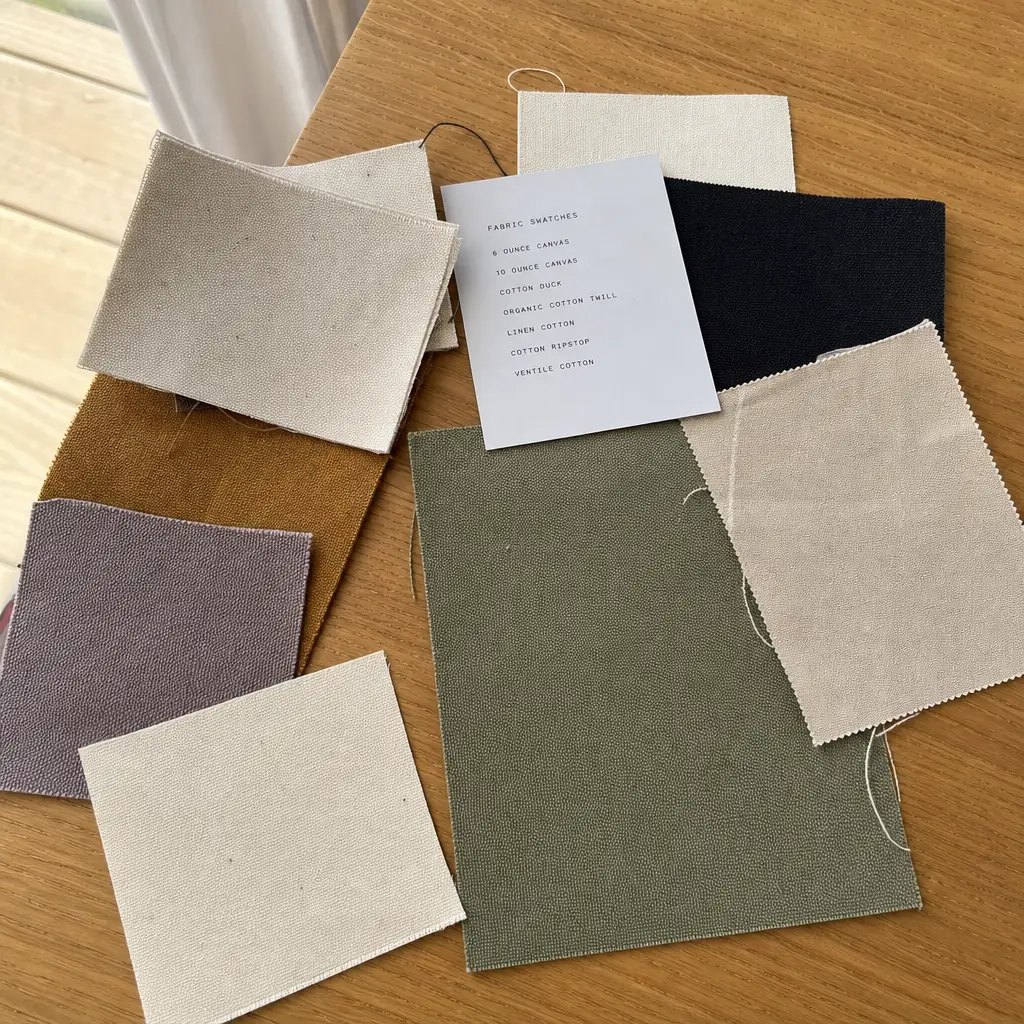
Why jute works for startup tote programs
Jute earns its place in startup merch programs when the buyer wants a tote with visible texture, a natural story, and more body than a thin promotional cotton bag. It is not the right choice because it is trendy; it is the right choice when the bag needs to feel substantial in the hand, look more premium than a disposable giveaway, and hold up to repeated short-haul use.
For a tech startup, the buying context matters more than the material trend. Conference handouts, onboarding kits, investor gifts, and retail-style merch each create different pressure on the bag. A conference tote might only need to carry printed collateral and a notebook. An onboarding kit may include a charger, notebook, pen set, and small boxed accessory. A partner gift might need to arrive with a cleaner finish and more stable shape. The fabric spec should follow that reality, not the logo reveal deck.
Jute is also a material with tradeoffs that procurement teams need to state clearly. The weave can be open or tight, the surface can be natural, bleached, dyed, or laminated, and the inside can be bare or lined. Those choices affect cost, print clarity, odor risk, shipping weight, and how the bag presents when a recipient first opens it. A buyer who defines the use case first will get cleaner quotes and fewer sample revisions later.
The simplest test is this: if the bag must support a heavier fill, survive repeated folding, or look decent on a desk or at a booth, the spec needs more than a generic eco-tote description. If the tote is purely a one-day handout, the build can be lighter and simpler. Buying jute well is mostly about matching finish level to actual use, not chasing the thickest fabric in the catalog.
- Use jute when the bag needs a natural look with more body than cotton.
- Avoid coarse, open weaves if the logo includes small text or thin lines.
- Match the fabric spec to the heaviest item the tote must carry, not just the visual brief.
Define the use case before you ask for quotes
A custom tote quote becomes more useful the moment the buyer describes how the bag will be used in the field. The same jute tote can be a giveaway, an onboarding kit carrier, or a merch item for resale, and each of those uses changes what counts as acceptable. Giveaway bags can tolerate looser cosmetic variation, simpler finishing, and lower-cost handles. Merch or gift bags usually need better seam consistency, cleaner edge finishing, and tighter print placement.
The biggest sourcing mistake is asking for a “custom jute tote” with no further guidance. Suppliers will default to a standard bag shape, a common fabric weight, and the least expensive reasonable finish. That may sound efficient, but it often produces a tote that misses the real requirement. A bag meant for desk use might need to stand upright. A bag meant for conference giveaways might need to fold flatter for carton efficiency. A bag intended as a premium gift may require lining or a more polished handle finish.
Procurement teams should translate the use case into measurable requirements. State the heaviest item the tote must carry, the approximate packed weight, whether the bag must hold its shape on a table, and whether it should ship empty or pre-filled. If the program has multiple touchpoints, such as event distribution and mailer fulfillment, note which use case sets the spec. That prevents the supplier from quoting the easiest version of the bag instead of the version you actually need.
A useful shortcut is to classify the order as one of three types: disposable promo, reusable internal kit, or retail-grade merch. Each class drives a different acceptable threshold for fabric consistency, handle feel, print sharpness, and packing presentation. Once that class is clear, the rest of the RFQ becomes much easier to compare.
- State the heaviest item and total packed weight the tote must carry.
- Say whether the bag should stand upright, fold flat, or ship pre-filled.
- Decide whether the tote is disposable, reusable, or retail-grade before requesting samples.
Material choices that change performance and cost
For jute tote bags, the fabric weight is usually the first number buyers compare, but it is not the only number that matters. Supplier quotes may refer to 14x14 to 16x16 oz fabric construction or roughly 320-450 GSM equivalent, depending on how the mill defines the weave. That range is useful as a buying reference, but the exact conversion can vary by supplier and by how the jute cloth is built. Treat the quoted weight as a typical range, not as a universal standard.
At the lower end of the range, the bag is easier to produce and lighter to ship, but it is more likely to sag, show weave gaps, or look uneven when filled. At the higher end, the bag has more body and a stronger hand feel, which is helpful for retail-style presentation or heavier kits. The tradeoff is higher cost, more stiffness, and sometimes a less flexible fold. That matters if the tote has to fit into a mailer or be packed in dense cartons.
Finish is just as important as raw weight. A tighter weave gives a cleaner print surface and reduces the chance that the logo drops into the gaps of the fabric. Bleached jute can look more uniform, which some brands prefer, but the buyer should confirm whether the bleaching step affects lead time, shade stability, or odor. Laminated backing adds stiffness and moisture resistance; cotton lining improves inside presentation and reduces fiber shedding. Neither upgrade should be assumed automatically. Use them when the bag’s purpose justifies the added cost and sewing complexity.
A buyer-friendly way to compare material options is to ask three practical questions: how does the bag feel in the hand, how well does it hold its shape after filling, and how cleanly does the logo print on the actual weave? If the answer needs to be “premium” for all three, the specification should move toward tighter cloth, cleaner edge finishing, and likely lining or lamination. If the bag is a low-stakes event handout, a simpler unlined construction may be the better commercial decision.
This is also where sourcing language should stay grounded. Instead of asking whether a material is “eco-friendly enough,” ask whether the chosen construction is appropriate for the intended life of the tote. That keeps the discussion on load, appearance, repeat use, and defect tolerance rather than on generic sustainability wording that does not help the factory build the right product.
- Natural jute gives the strongest eco look but can shed fiber and vary more in shade.
- Lamination adds body and reduces weave irregularity, but it changes feel and foldability.
- Cotton lining improves presentation and internal finish, but raises sewing time and unit cost.
Handle, seam, and structure decisions buyers should specify
Handles are one of the easiest ways for a tote to fail in real use, so they should never be left to the supplier’s default. Cotton webbing is usually the most comfortable and predictable option for repeated carrying because it distributes pressure better than a narrow natural-fiber strip. Jute-cotton blend handles can work when the brand wants a more natural aesthetic, but the attachment point still needs reinforcement. Without reinforcement, the handle may feel fine in sample form and still fail when the bag is loaded repeatedly in a field program.
For most standard tote sizes, the handle width usually lands around 25-40 mm, with a drop of roughly 18-24 cm depending on whether the tote is meant for hand carry or shoulder carry. That range is only a starting point. Shorter drops are easier to pack and look neat on a shelf, but they can be awkward over a jacket or when a buyer is carrying multiple items. Longer drops improve shoulder use but can distort the front panel and shift the logo lower than planned. If the tote will be worn over clothing at winter events, that should be part of the spec discussion from the start.
Structure matters beyond the handle. Ask how much seam allowance the factory uses, whether the bottom panel is reinforced, and whether the side seams are finished to control fraying. If the tote carries heavier content or will be reused often, bartacks at the handle joins are worth specifying. They are small features, but they are often the difference between a bag that survives repeated handling and a bag that looks acceptable in a photo but develops stress points after a few uses.
If the supplier offers a sample, load it with the actual intended contents rather than a light placeholder. A fabric sample can pass visual review and still fail when the handle flexes, the bottom seam opens slightly, or the bag tips over under weight. The best structure decision is the one that survives the actual contents, not the one that looks neat in the sample room.
When buyers ask for “stronger handles,” that request is too vague to be useful. Better language is to specify material, width, attachment method, reinforcement, and expected load. That gives the supplier enough information to build a bag that can be measured and inspected.
- Specify handle width, handle drop, and attachment style in the RFQ.
- Require bartacks or reinforced stitching at the handle joins.
- Ask whether the bottom seam includes reinforcement for heavier loads.
Print and branding options by order type
Screen print remains the default branding method for most jute tote bags because it is economical, durable enough for normal use, and easy to scale once the artwork is set. It works best when the brand mark is bold, the type is readable at a distance, and the design does not rely on very thin strokes. On textured jute, small letterforms and fine hairlines can lose definition because the ink sits across an uneven surface. That is not a print failure so much as a material constraint that needs to be designed around.
When the artwork is more detailed, buyers can consider transfer print, patch application, applique, or a sewn-on label. These methods can improve legibility or add a more premium feel, but they also change the production plan. Transfers may show wear differently depending on fold points and handling. Patches need clean edge finishing and controlled placement. Embroidery can look elevated, but it should be tested carefully on coarse jute because dense stitching can pull the weave or distort the panel.
The best buyer question is not “Which decoration method is the nicest?” It is “Which method preserves the logo requirements on this fabric, at this quantity, with the least risk of rework?” If the logo must include small text, a nested mark, or a delicate line, the design may need simplification before production. In some cases, the right answer is to move details to a hangtag or insert and keep the tote print itself bolder and cleaner.
Approval should happen on real fabric, under real light, and at the real print size. A PDF can hide problems that show up immediately on cloth, especially when the weave is visible through the ink or the logo sits too close to a seam. Ask for a strike-off or decorated sample before bulk approval. That small step often prevents the most expensive type of mistake: discovering too late that the logo looks technically correct but visually weak on the bag itself.
- Use screen print for simple, bold brand marks and event bags.
- Use transfer, patch, or applique when the artwork needs finer detail or a more premium appearance.
- Avoid tiny lettering directly on coarse weave unless the sample proves legibility.
MOQ, color count, and how they affect unit price
MOQ should be discussed alongside setup effort, not as a stand-alone number. Direct factories typically need more pieces because cutting, sewing, printing, and packing are all tied to machine setup and labor allocation. A trading company may offer a lower visible MOQ because it is drawing from stock shells or coordinating among multiple sources, but that convenience can reduce control over the exact fabric lot, color consistency, and finishing sequence. The buyer should understand which cost is being traded for the lower entry point.
A useful comparison is to ask for two pricing paths: one for a stock shell with decoration, and another for a fully custom bag build. The stock shell route can work well when speed matters or when the startup is testing demand. The fully custom route becomes more worthwhile when the tote is tied to a long-running brand program and needs a specific fit, color, or structural detail. Those are not the same product, even if they carry the same logo.
Color count is another silent cost driver. One body color with one logo is much easier to manage than multiple colors, multiple placements, or mixed handle options. A buyer who is planning a launch kit should ask whether each variation changes fabric procurement, print setup, or carton packing. That is where hidden costs appear. The quote may look simple, but the operational burden can multiply quickly once the spec branches into several versions.
The clearest MOQ question is not “What is your minimum?” It is “What is the minimum per exact specification?” Ask whether the MOQ is per color, per size, per logo version, or per shipment, and confirm whether sample approvals reset the count. Procurement teams often lose time because the supplier and buyer are both using the term MOQ but meaning different things.
If the program is small, it is usually better to simplify the spec than to force a complex custom build at a low quantity. Fewer variants usually mean better quality control and cleaner cost comparison. For startup teams, that is often more valuable than squeezing every possible decoration option into the first order.
- Single-color, single-logo runs are the easiest to quote and scale.
- Multiple body colors usually raise setup time and inventory risk.
- Tie MOQ to one exact spec, not a loose family of options.
Supplier routes and what each route is best for
The right supplier route depends on how much control the buyer needs and how many hands the order needs to pass through. Direct factories are usually the best fit for repeat custom volume because they control cutting, sewing, decoration, and packing in one place. That gives procurement teams better visibility into material sourcing and defect ownership. Trading companies can be useful when the startup is buying a broader merch package and wants one contact to coordinate several items. Local decorators can work for urgent or very small orders, especially if the base bag is already in stock and only the branding needs to be added.
Each route should be evaluated on accountability as much as on price. The buyer should know who approves the fabric, who signs off on the sample, who controls print color, and who owns corrective action if the handles fail or the dimensions drift. A quote that is cheap but unclear on responsibility can become expensive in time, especially if defects are discovered after production starts. The point of sourcing is not just to find a seller; it is to find a party that can be measured against the specification.
A practical decision rule: if the jute tote is a repeat brand item, go as close to the factory as the team can manage. If the order is bundled with other merchandise or the internal buying team is short on time, a trading company may be the better orchestration layer. If the ask is small, urgent, and standard, a local decorator can be the most efficient route. The key is to verify the base bag source, not just the branding vendor, because decoration quality can only be as consistent as the material beneath it.
Procurement buyers should also ask for production photos or a line view when possible. Not because every order needs a deep audit, but because the visual of the production environment often reveals whether the supplier is working from stable, repeatable methods or improvising around the order. If the route is unclear, the production risk is also unclear.
- Direct factory suits repeat volume and tighter spec control.
- Trading route suits mixed-product sourcing and simpler communication.
- Local decorator suits speed, but verify the base bag source and finishing quality.
Sample approval and QC thresholds before bulk cutting
A strong sample flow starts with the fabric swatch, then moves to the pre-production sample, then to bulk cutting only after the buyer confirms the spec in writing. That sequence matters because jute is a natural material and the appearance of the weave, shade, and hand feel can vary from one batch to another. The buyer should expect variation within a controlled band, not perfect uniformity. The job of the sample process is to define that band before the factory commits to full production.
The sample should be treated as a working product, not just a presentation piece. Measure the finished bag dimensions, inspect how the handles are stitched, check whether the seams are symmetrical, and confirm that the logo sits where the artwork proof says it will sit. If the bag is intended to carry a specific load, put that content inside the sample and carry it. A bag that looks right on a table can still fail once it is loaded, folded, and handled by end users.
The QC plan should focus on the failure modes that create the most friction for a buyer: crooked print, weak handle stitching, asymmetry, odor, crushed packing, and size drift. Natural-fiber variation can be accepted, but only inside the agreed tolerance. That tolerance should be in the purchase order or spec sheet before bulk starts. If the supplier cannot state what they will hold, the buyer is not yet reviewing a production-ready quote.
Useful threshold language for buyer conversations: finished width and height are often held within about +/- 5 mm to +/- 10 mm for small and medium totes, while handle drop and print placement should also have a defined acceptable band. The exact tolerance depends on bag style, construction method, and production scale, so the supplier should confirm what they can actually hold. The point is not to force an arbitrary number; it is to force an accountable one.
If the order is time-sensitive, resist the urge to skip the pre-production sample. The day saved up front often comes back as days lost in rework, freight delays, or receiving disputes. For jute tote bags, the sample stage is where most avoidable production mistakes can still be stopped.
- Approve fabric and construction before bulk cutting begins.
- Inspect stitch quality at handles, side seams, and bottom corners.
- Set a written tolerance for size, placement, and shade variation.
Packing, moisture control, and freight risk
Jute is sensitive to moisture and can pick up odor if it is packed poorly, which makes export packing part of the product spec rather than a warehouse afterthought. That matters on long sea-freight routes, in humid climates, and in storage rooms that do not have tight climate control. If the tote will be delivered alongside paper inserts, notebooks, or other gift items, packing also affects whether the whole kit arrives looking clean or tired.
Inner polybags are common, but the carton specification matters just as much. Ask for carton dimensions, gross weight, number of units per carton, and whether the handles are laid flat or folded into the bag body. Overfilled cartons can crush the handles and distort the shape. Underfilled cartons may look safer but can raise freight cost and reduce pallet efficiency. If the shipment is going to a distribution center, confirm whether the cartons need barcode labels, PO numbers, SKU codes, or carton counts on multiple sides.
Moisture control should be discussed directly when the shipment crosses long distances or sits in inventory before launch. Desiccant, moisture-barrier packing, and lined cartons are simple controls, but they reduce the risk of fiber odor, staining, and carton weakening. Buyers do not need to over-engineer packing for every order, but they should not accept a generic “standard export packing” answer when the destination is humid or the bags contain paper goods.
The folding method also affects the end result. A tightly folded jute bag can save space but leave strong crease lines. A flatter pack protects appearance but may lower carton density. Procurement teams should choose the method based on where the bag will be unpacked and how much presentation matters at first touch. That is a logistics choice with a branding impact, so it belongs in the RFQ.
If there is a chance the bags will be stored for more than a short period before use, ask the supplier how they protect against smell transfer from cartons, adhesives, or nearby materials. It is a small question, but it often separates a clean delivery from a shipment that needs airing out before deployment.
- Use moisture protection on export shipments and long storage moves.
- Keep handles laid flat to reduce carton bulge and deformation.
- Print carton marks clearly for faster warehouse receiving.
Landed-cost comparison for a real buying decision
The lowest factory price is not always the lowest landed cost. For jute tote bags, total cost depends on more than the unit sewing price. Fabric weight, print method, packing standard, carton density, freight mode, and receiving labor all change the final number. A heavier tote can cost more at the factory but reduce damage and complaint risk. A lighter tote can look economical until it arrives crushed, uneven, or hard to repack into kits.
A practical landed-cost model should include the bag price, sample cost, tooling or screen setup, export packing, inland freight, international freight, duties if applicable, and receiving labor. If two suppliers look close on paper, ask them to quote the exact same finished size, fabric weight, handle material, decoration method, and packing standard. Otherwise the buyer is comparing different products under the same name. That is how procurement teams end up making false savings decisions.
The quote should also state what is included and what is not. One supplier may include carton labeling, extra swatch approvals, and basic packing inserts. Another may charge separately for each of those items. The second quote might still be better, but only if those differences are visible up front. Hidden assumptions create the most friction once the order moves into production.
When the order volume is small, setup costs are a bigger part of the landed total, which is why the cheapest custom-looking route may not be the most cost-efficient. In that case, simplification can be a cost strategy: one logo placement instead of two, one shell color instead of three, and a standard handle instead of a custom one. Those choices reduce the risk of expensive small-order complexity without changing the utility of the tote.
Procurement buyers should use the same discipline they would use for any other packaging or merch item: compare like for like, request a line-item quote where possible, and keep the spec stable long enough to get valid pricing. That approach is more reliable than chasing the lowest unit number on an incomplete RFQ.
- Compare factory price and freight density together, not in isolation.
- Include sample cost, setup cost, and packing cost in the first budget pass.
- Treat packing quality as part of landed cost, not as an optional extra.
Specification comparison for buyers
| Spec decision | Recommended option | Buying threshold / context | Buyer risk to check |
|---|---|---|---|
| Fabric weight | 14x14 to 16x16 oz jute, or roughly 320-450 GSM equivalent | Use the lighter end for event giveaways with low fill weight; move toward the heavier end when the tote must hold notebooks, chargers, boxed kits, or repeated carry | Below about 300 GSM, bags are more likely to sag, show open weave, and lose shape after packing; ask the supplier how they measure GSM or oz because methods vary by mill |
| Handle material | Cotton webbing or a jute-cotton blend with reinforced stitching | Choose cotton webbing when comfort, grip, and repeat use matter; choose a blended natural look only if the handle is still tested for load and edge wear | Thin or stiff handles can twist, dig into the hand, or fail at the join; ask for stitch count, bartack length, and pull-test expectations |
| Handle dimensions | 25-40 mm width, with 18-24 cm drop depending on carry type | Shorter drops suit hand carry and desk-side kits; longer drops suit shoulder carry or winter outerwear, but require stronger balance in the bag body | Overlong drops can distort the front panel and push the logo too low; too-short drops make the tote feel awkward even when the bag itself is strong |
| Lining choice | Unlined for simple campaigns; cotton-lined or laminated for structure | Use unlined for low-cost handouts and high-volume promos; use lining or lamination when the tote is visible in retail, contains small items, or must look neat on opening | Unlined jute may shed fibers, show contents, and look uneven if the weave is open; lined or laminated versions add cost, sewing time, and sometimes weight |
| Print method | Screen print for bold logos; transfer or patch for finer detail; embroidery only on select premium builds | Screen print is usually best for one- to two-color startup branding; transfer or patching is better when small text or fine graphics must remain legible | Fine text can fill in on rough jute, so approve the artwork on actual fabric before bulk cutting; embroidery can pucker or distort coarse weave |
| Supplier route | Direct factory for repeat volume; trading company for mixed items; local decorator for urgent low volume | Direct sourcing works best when spec control matters; trading routes help when the startup is buying bags with inserts, tags, or other merch; local decorators can be useful when timing is tight | A middleman quote can hide fabric changes, unclear defect ownership, or inconsistent packing responsibility; ask who owns each production step |
| MOQ logic | 1,000-3,000 pcs for custom direct factory orders; lower only on stock shells | Use lower-MOQ routes only when decoration is light and the base bag already meets the target spec; for new programs, compare stock-shell and fully custom pricing separately | Very low MOQs often mean higher unit cost, fewer finish options, or less control over fabric and handle quality; clarify whether MOQ is per color, per size, or per print version |
| Packing method | Inner polybag plus export carton, or bulk stack with moisture protection and desiccant if needed | Use stronger packing on sea freight, humid destinations, or long warehouse storage; keep the packing spec aligned with the destination channel | Jute absorbs moisture and odor; weak packing can lead to staining, crushed handles, odor transfer, or carton collapse during transit |
| Sample approval stage | Fabric swatch approval first, then pre-production sample, then bulk cutting | Use a multi-step sample process whenever color, texture, logo position, or bag shape must be controlled closely | Approving only a digital artwork file often causes surprises in texture, shade, print coverage, or handle balance once the real fabric is cut |
Buyer checklist before sampling
- Confirm final bag size, gusset depth, handle drop, usable loading weight, and whether the bag must stand upright on a table or shelf.
- Specify fabric type, target GSM or oz weight, color tolerance, expected shrinkage, and whether the jute is natural, bleached, dyed, laminated, or lined.
- Send vector artwork, define logo dimensions and placement, and state Pantone references or the acceptable visual-match range.
- Request fabric swatches first, then a physical pre-production sample before bulk cutting or screen setup begins.
- Agree carton count, inner packing, moisture protection, barcode or hangtag needs, and shipment marks before production starts.
- Set inspection checkpoints for stitch quality, print alignment, odor, size tolerance, and final count accuracy.
- Ask the supplier to confirm whether waste allowance, tooling, screen setup, sample fees, and carton labeling are included in the quote.
Factory quote questions to send
- What exact jute construction are you quoting, including weave style, measured weight, and whether the fabric is natural, bleached, laminated, or dyed?
- Can you break out fabric, handles, lining, print, sewing, packing, and carton cost separately so we can compare like for like?
- What is the MOQ by color, print method, and size, and does mixing sizes or handle types change pricing or lead time?
- What finished-size tolerances do you hold for width, height, gusset, handle drop, and print position?
- Will you send fabric swatches, a pre-production sample, and photo approval before bulk cutting begins?
- What defect rate do you accept for stitching, print registration, odor, stains, and size deviation, and how are defects counted?
- How do you pack the bags for export so they resist moisture, crushing, and handle deformation during transit?
- Are tooling, screen setup, sampling, carton marks, and master-carton labels included in the price or charged separately?
Quality-control points to confirm
- Inspect fabric for uneven weave, broken fibers, holes, frayed edges, and shade inconsistency before cutting starts.
- Measure finished width, height, gusset, and handle drop against the approved spec sheet and confirm the tolerance band in writing.
- Check stitch density at handle joins, side seams, and bottom corners for skipped stitches, loose thread ends, or weak bartacks.
- Verify print alignment, ink coverage, edge sharpness, and rub resistance after a light fold-and-rub check on actual finished bags.
- Check odor, moisture, and dust level, especially on unlined jute, before packing finished goods into cartons.
- Count carton quantity against the packing list, confirm inner protection, and inspect carton corners for crush risk and correct shipping marks.
- Hold a random carton-open inspection at receiving to verify the packed condition matches the pre-shipment approval standard.