Start With the Retail Use, Not the Material
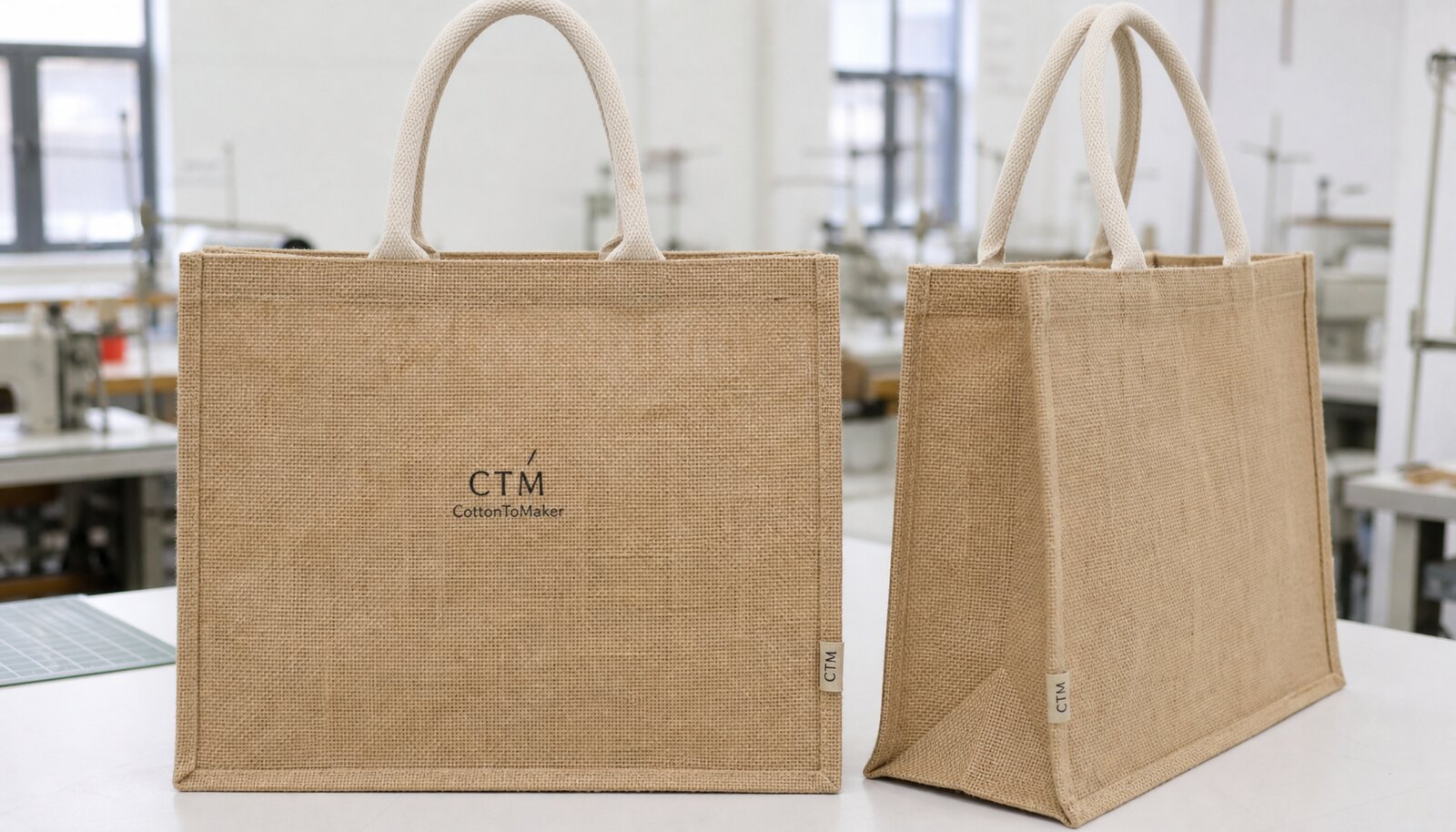
Jute tote bags for retail are not judged the same way as a giveaway bag. A store buyer or merchandiser looks at how the bag presents on shelf, how it feels in hand, how the print reads at arm's length, and whether the pack stays consistent across cartons. If the tote is meant for gift shops, garden centers, farm markets, or private label grocery, the bag has to look intentional, not just functional.
That is why the first sourcing decision is not the logo. It is the use case. A retail bag needs enough structure to stand up, enough print clarity to carry branding, and enough packing discipline to avoid arriving dusty, creased, or out of shape. Once those points are set, the quote becomes much easier to compare because you are buying the same product definition from each supplier.
- Treat the tote as a retail SKU, not only as a promotional item.
- Decide whether the bag must stand upright, fold flat, or both.
- Launch with one core size first if the program is still untested.
- If the bag will sit on shelf, prioritize appearance consistency over the lowest unit price.
Choose the Right Jute Build
Plain jute, laminated jute, and juco do different jobs. Plain jute keeps the rustic look and often suits light retail loads or lower-cost programs. Laminated or lined jute gives the bag more body, improves print appearance, and makes the inside cleaner. Juco, which blends jute and cotton, usually prints more cleanly and sheds less fiber, but it may not deliver the same rustic texture that some retail concepts want.
GSM matters, but it is not the whole answer. A 320-400 GSM body can work well for moderate retail use if the weave is tight and the seams are reinforced. Heavier bags in the 400-500 GSM range usually look more structured and premium. Once you go beyond that, you should verify whether the bag still folds cleanly and whether the material creates edge cracking at the seams or around the gusset.
- 300-350 GSM often fits lighter carry and display use.
- 400-450 GSM is a common range for structured retail tote programs.
- 500 GSM and above can suit heavier grocery or premium gift use, but it should be tested for fold behavior.
- Handle material should match the load, not just the look of the body fabric.
Print Choices That Survive Real Retail Handling
Jute is rough enough that fine artwork can disappear into the weave. For most retail programs, screen print is the safest choice because it gives solid coverage, predictable color, and decent repeatability. If the artwork is simple, bold, and not too detailed, screen print is usually the most commercial option. If the logo has thin lines, small type, or tight registration, you should expect a higher reject rate unless the supplier proves otherwise.
Your print spec should define more than the logo file. It should state the print size, the exact placement from the bag edge, the Pantone target, and the allowable shift. If the bag is folded and packed tightly, the print must also hold up against rubbing and creasing. For artwork that does not suit direct printing, a sewn patch, woven label, or side label can be a cleaner retail solution than forcing detail onto a coarse surface.
- Use bold lettering and thicker strokes whenever possible.
- Keep print placement away from seam intersections and heavy fold points.
- Avoid full-bleed coverage unless the buyer accepts some rubbing over time.
- If a supplier proposes transfer print, ask for a rubbed and folded sample before you approve the method.
How MOQ and Factory Setup Actually Move the Quote
MOQ on jute tote bags is driven by more than fabric yardage. The cut layout, handle source, print screens, thread color, lining or lamination, and pack format all affect the factory's minimum. A supplier can look flexible on paper, then raise the MOQ once you add a second size, a different handle, or a second print color. That is normal factory logic, but it needs to be visible in the quotation.
The quote should show whether the minimum applies per size, per artwork, per color, or per material combination. That one line often decides whether procurement can build a low-risk pilot or whether the order must be scaled up immediately. If the supplier only gives a lump sum and refuses to separate setup from unit cost, you cannot tell whether the quote is competitive or just hiding its setup charges.
- Keep the first order narrow: one size, one body spec, one artwork version.
- Separate setup fees from unit price so the real cost of change is visible.
- Ask whether mixed sizes or mixed colors can share the same production run.
- Be careful with quotes that look low but carry a high screen or packaging charge.
Compare Supplier Routes Before You Compare Price
The right supplier route matters as much as the spec. A direct factory with in-house sewing, printing, and packing usually gives the best control over a retail program, but only if those steps are actually in-house and documented. A trading company can still be useful when you need communication support, consolidation, or access to several product lines, but you should know who is really making the bag and who owns the quality result.
Stock plus customization is the fastest route, but it is also the weakest for precise retail presentation. It works when the bag size and construction are already acceptable and only a small logo change is needed. For repeat retail programs, an integrated supplier or specialist bag maker is usually the better long-term option because sampling, printing, packing, and final inspection stay under one quality system.
- Direct factory suits tighter control and better repeatability.
- Trading companies suit consolidation, but the real maker must be named in writing.
- Stock customization suits speed, not exacting retail specs.
- Use the supplier route that matches your risk, not the lowest headline price.
Build a Quote That Can Be Compared Line by Line
A useful RFQ for jute tote bags should include exact dimensions, gusset depth, handle type, GSM, lining or lamination, artwork file, print size, target pack count, carton spec, and delivery window. If those inputs are vague, the supplier has room to substitute fabric, trim, or packing in ways that change both cost and product quality. A vague RFQ almost always creates quote noise later.
It helps to force the supplier to break the quote into the parts that actually move cost: body fabric, handles, lining or lamination, printing, labels, packing, and cartonization. That lets procurement compare where one supplier is cheaper and another is adding value. It also reveals whether the lower quote comes from a lower-spec bag or simply from a better factory layout and less waste.
- Ask for the quote on the same incoterm basis across all suppliers.
- Make sure setup charges are separate from recurring unit cost.
- Request packing details in the quote, not only in the sample notes.
- Ask the factory to state any assumptions that would change the price.
Approve the Sample as a Production Reference
The sample is not just a visual check. It becomes the reference for seam direction, handle drop, print position, bag stiffness, and the way the tote behaves after folding. For jute, the sample should also be examined after it has been out of its packaging for a while. That gives you a better read on odor, shape recovery, and whether the laminate or lining relaxes in a way that would matter on shelf.
A pre-production sample should use the same material and build that the shipment will use. If the supplier sends a generic sample body with your logo added later, the approval is weaker than it looks. Sign off only after the dimensions, print placement, color tone, carton mark, and pack method all match the final order structure.
- Measure the sample against the approved drawing, not against memory.
- Check handle drop on the actual filled bag, not on the empty sample.
- Review the sample after unpacking so you can judge odor and crease behavior.
- Do not approve production until the sample and the packing spec match.
Use QC Limits That Catch the Expensive Failures
Quality issues on jute totes are usually visible, but they are not always obvious until the bag is in the carton. Typical misses include crooked handles, weak seam ends, uneven cut panels, broken yarns, print shift, and rough trimming around the edge. Because jute is a natural material, buyers should set measurable limits instead of relying on a vague acceptable quality expectation.
A practical QC plan should include size tolerance, print placement tolerance, seam inspection, and a pull test on representative samples. If the order is going directly to a retailer or distributor, carton accuracy matters as much as the individual bag. One bad pack count or one wet carton can create a receiving problem that is more expensive than a cosmetic defect.
- Set written tolerances for body size, handle length, and print placement.
- Inspect for loose threads, skipped stitches, and seam damage at the handle anchor.
- Reject bags with strong odor, damp cartons, or visible mildew.
- Check one filled sample from each lot for carry performance before shipment release.
Make Packing Part of the Product Spec
Retail buyers often lose control at the packing stage. A tote that looked acceptable in the sample room can arrive creased, dusty, or compressed if the factory packs it the wrong way. Decide early whether the product will ship bulk, inner-packed, polybagged, banded, or fitted with a hangtag and barcode. Once the packing format is approved, the factory should treat it as part of the order spec, not a warehouse afterthought.
If the order goes to a retail DC or a distributor with its own receiving rules, carton marks and barcode placement must match that system exactly. Jute can shed, and natural-fiber dust can build up if the factory overhandles the bags. That means you may need carton liners, cleaning steps, or a better folding instruction to protect the final presentation.
- State the inner pack count and outer carton count in the PO.
- Use barcode labels and carton marks that match the buyer's receiving format.
- Protect against moisture and compression damage during carton loading.
- Treat hangtags, stickers, and retail labels as part of the product spec.
Control Lead Time Before It Controls You
Jute tote lead time is not just sewing time. Material sourcing, print screen preparation, sample signoff, packing inserts, and carton artwork can each add days. If artwork approval drifts, the factory may hold the job even if fabric is ready. In practice, the critical path is often the sample and art loop, not the stitch line.
A realistic production plan breaks the job into stages: spec confirmation, sample approval, material booking, production, inspection, and dispatch. If the retail launch is fixed, build buffer into each stage because natural-fiber programs are more exposed to rework than synthetic bag orders. Trying to shave too much time usually pushes the delay into packing or inspection, which is where retail buyers feel it most.
- Get artwork and carton text approved before production starts.
- Allow time for real material sample review, not only digital approval.
- Reserve a buffer for rework if handle length or print placement is off.
- Ask the supplier for a stage-by-stage schedule, not just one total lead time.
Specification comparison for buyers
| Spec decision | Recommended option | When it fits | Buyer risk to check |
|---|---|---|---|
| Source route | Direct factory with in-house sewing, printing, and packing | When you need control over structure, artwork placement, and retail packing | Confirm the supplier is not outsourcing the key steps without written disclosure |
| Fabric build | 320-400 GSM laminated jute or juco for retail display | Gift shops, seasonal retail, grocery merchandising, and premium private label | Check shape retention, odor, and whether the bag folds without cracking or puckering |
| Print method | 1-2 color screen print with bold artwork | When the logo is simple and the bag surface is naturally textured | Fine text, gradients, and tight registration can disappear into the weave |
| Handle construction | Cotton webbing or reinforced jute handles with box-X stitching | When the bag will be carried repeatedly or loaded with heavier retail goods | Pull strength, stitch density, and handle comfort can vary by factory |
| Internal finish | Lamination or lining for a cleaner inside and better body | When the bag sits on shelf or needs a more polished retail feel | Watch for delamination, wrinkles, and strong laminate odor |
| MOQ strategy | One size, one body fabric, one handle spec, one artwork version | When launching a new retail program or testing the market | Mixing sizes, colors, or print versions can raise setup cost sharply |
| Packing route | Bulk or inner-packed cartons with barcode and carton marks | When the buyer or retailer handles final labeling and receiving | Missing labels, crushed handles, and moisture damage are common if packing is vague |
| Supplier type | Specialist bag maker with sample room and retail packing experience | When the order needs repeatability across seasons and replenishment cycles | If the supplier only works from catalog items, spec drift is more likely |
| Quality gate | Pre-production sample plus inline and final carton checks | When launch timing is fixed and rework would delay retail delivery | Late discovery of print shift or seam weakness is expensive to correct |
Buyer checklist before sampling
- Final bag dimensions, gusset depth, handle drop, and the allowed tolerance on each measurement
- Jute GSM, whether the body is plain, laminated, or lined, and the required natural color tone
- Artwork file, Pantone targets, logo size, print position, and the minimum line thickness that must stay readable
- Target use case, expected fill weight, and the seam reinforcement points that must carry the load
- Packing method, inner pack count, carton size, barcode format, and any retailer-specific carton marks
- Sample approval owner, approval deadline, and the exact sample stage that must match production materials
Factory quote questions to send
- Is your quote based on direct factory production, or are any sewing, printing, or packing steps outsourced?
- What exact GSM, laminate or lining, and handle material are included in the quoted price?
- How many print colors are included, and what setup fee applies for each screen or plate?
- Is the MOQ per size, per artwork, per color, or combined across the order?
- What sample stages are available, what does each stage cost, and which one matches production material?
- What packing is included in the quote, including polybag, inner pack, barcode sticker, and master carton marks?
- What lead time applies after sample approval and deposit, and what parts of the schedule can extend that lead time?
- What QC standard, inspection method, or pre-shipment report can you support before booking shipment?
Quality-control points to confirm
- Measure bag body, gusset, and handle drop against the approved spec, with clear tolerance limits written into the PO
- Check print placement, color density, and edge clarity on a real woven surface, not only on a flat artwork proof
- Inspect stitching for skipped stitches, loose threads, weak handle attachments, and uneven seam allowance
- Reject visible oil stains, mildew, broken yarns, heavy fiber shedding, and cut panels that are noticeably out of square
- Test one filled sample per lot for carry performance, seam creep, and handle comfort under the expected load
- Verify lamination or lining for bubbles, peeling, cracking at folds, and strong odor after unpacking
- Count inner packs and master cartons carefully, and confirm every barcode and carton mark matches the buyer's receiving format
- Check cartons for dryness, cleanliness, and compression damage so the retail-ready pack arrives in sellable condition