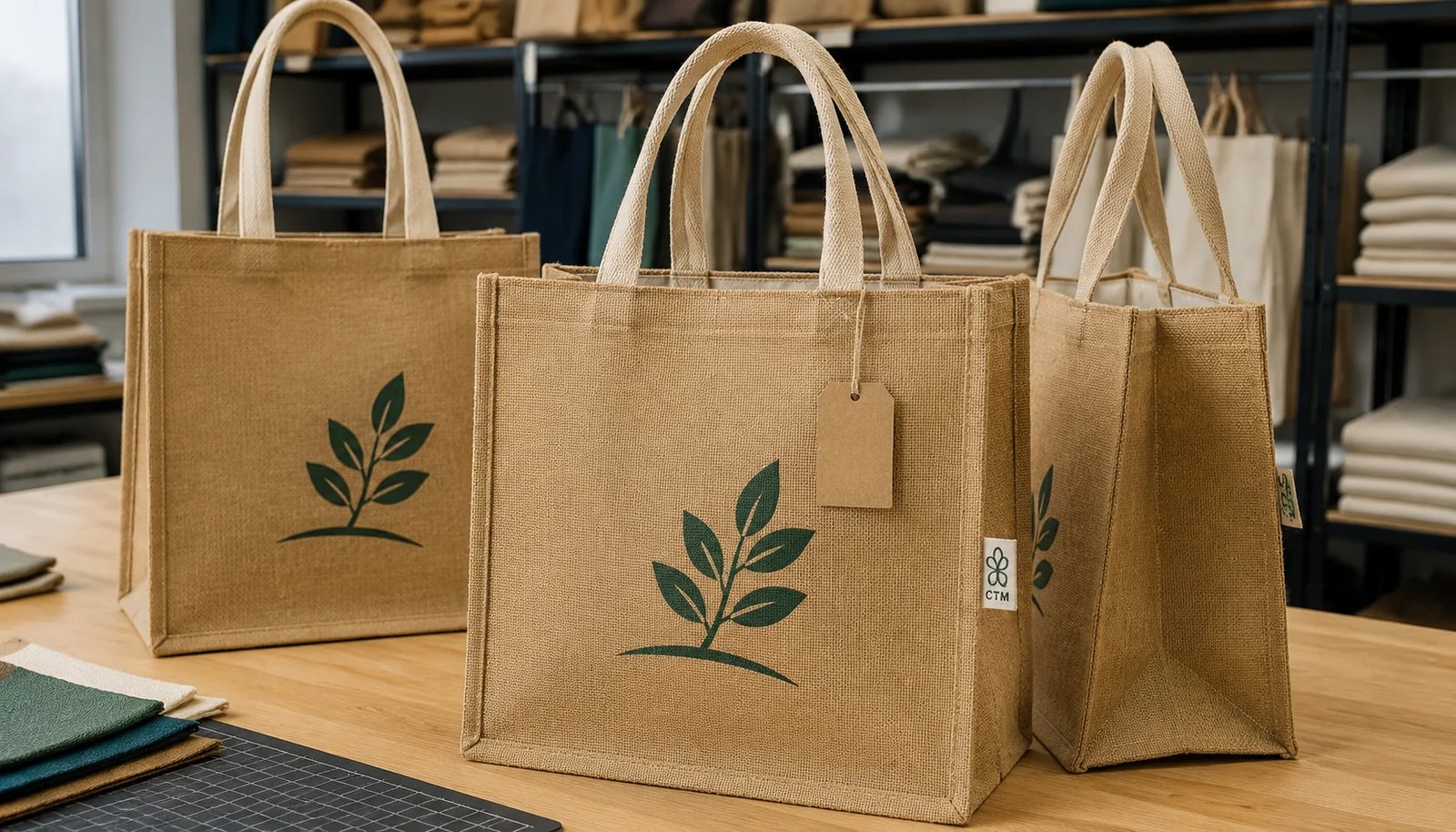
Why a tighter RFQ matters when buying jute tote bags for natural grocers
A jute tote bag looks straightforward, but the sourcing risk is high when the RFQ is light on technical detail. Two suppliers can send visually similar offers while quoting meaningfully different products: one may price a 260 GSM laminated bag with cotton webbing handles and full edge binding, while another may price a lighter cloth, narrower handles, and reduced reinforcement. On paper both are still called jute tote bags. In use, they behave very differently.
For natural grocers, the bag is usually more than a giveaway. It may be sold at checkout, used in a reusable-bag program, displayed near produce, or positioned as a branded merchandise item with a sustainability message. That means procurement is balancing cost, in-store appearance, consumer comfort, and repeat order consistency. If the RFQ leaves key decisions open, the buyer ends up comparing prices that are not truly comparable.
The goal of this jute tote bags for natural grocers RFQ template guide is to make supplier responses more apples-to-apples. The strongest RFQ does not try to control every microscopic detail. It controls the small set of variables that change cost, function, and claim exposure: fabric weight, lamination, handle build, dimensions, print method, packing, sample approval route, and final QC criteria.
A disciplined RFQ also makes internal alignment easier. Merchandising can approve appearance, QA can approve measurable standards, logistics can approve carton rules, and procurement can negotiate with a clear base specification. That is usually where claim reduction starts: not at final inspection, but at the quote package stage.
- Price gaps often come from hidden changes in fabric weight, handle specification, lamination, or packing assumptions.
- Natural grocer buyers usually need the bag to look retail-ready and function under real grocery loads.
- A stronger RFQ improves quote comparability and shortens dispute resolution later.
- The best RFQs define mandatory specs, optional alternates, and approval checkpoints clearly.
Start with end use, load expectation, and retail context
Before requesting pricing, define how the bag will actually be used. A promotional giveaway tote does not require the same structure or handle comfort as a checkout resale bag expected to carry produce, boxed foods, and jars repeatedly. A private-label reusable bag that sits on a store display may also require cleaner front-panel appearance and more consistent finishing than a one-off campaign item.
For natural grocers, practical load expectation should be written into the RFQ. If the bag is intended for short-duration carry of roughly 8 kg or 10 kg, say so. That does not replace formal load testing, but it gives the supplier a functional target when choosing cloth weight, seam construction, and handle reinforcement. Without that context, some factories optimize for look and cost only, which can produce underbuilt handles that appear fine on an empty sample but perform poorly once loaded with jars, canned goods, or heavy pantry staples.
Retail context matters too. Does the bag need to stand fairly upright in a checkout display? Should the inside be wipe-clean? Is a rustic natural look acceptable, or does the buyer want a more refined front panel for logo presentation? Is visible natural texture acceptable as long as there are no open weave holes and no major shade mismatch? Answering these questions early narrows the correct construction range quickly.
This step also helps avoid over-specifying. Some buyers ask for premium construction when the bag is only for a low-volume event. Others under-spec for a year-round checkout program. End use should drive specification, not habit.
- Define whether the bag is for resale, loyalty use, promotion, or premium branded merchandise.
- State expected contents and practical carrying use, not just visual style.
- Clarify whether shelf appearance and shape retention are important at store level.
- Decide how much natural variation is acceptable for your brand presentation.
Specify body material with real sourcing language: jute type, GSM, lamination, and tolerance
One of the most common sourcing problems is vague material language such as 'good quality jute' or 'heavy jute.' Those phrases are not quotable. Buyers should specify a target fabric range and a practical acceptance band. For many natural grocer reusable bags, 260-320 GSM laminated jute is a common working range because it tends to hold shape better and supports steadier print results than very loose, lighter constructions. If your team wants a different range, put it in writing and ask the supplier to confirm the exact quoted basis.
It is also important to distinguish nominal target weight from acceptable tolerance. Natural fibers can vary, but procurement should still ask the supplier what tolerance they are quoting against. A common commercial conversation is whether the fabric is controlled around a target with an approximate ±5% tolerance, though the exact commitment should come from the factory and be written in the offer or specification sheet. The key is to avoid a quote based on one number and a delivery based on another.
Lamination needs its own line item. 'Laminated' alone is not enough. State that the lamination is on the inside if that is the intended look, and ask for even bonding, no obvious bubbling, no peeling in normal folded condition, and no strong residual odor outside the approved sample standard. In grocery use, inside lamination is often chosen because it improves body, helps wipe-clean performance, and provides some resistance to minor moisture contact. It is not a waterproof guarantee, so the RFQ should avoid language that overstates performance.
If unlaminated jute is preferred for a more rustic or lower-cost program, that should be an intentional decision. Buyers should expect more visible texture variation, more potential fiber shedding, and less tolerance for moisture contact. Unlaminated construction can work well, but only when the retail expectation matches the material reality.
Finally, if blended content is not allowed, say so. Some buyers are comfortable only with jute body and cotton webbing handles. Others may accept blends in specific components. Leaving that point open can create later compliance or marketing issues.
- Replace subjective terms like 'heavy' or 'premium' with target GSM and clear construction notes.
- Ask the supplier to declare the exact quoted GSM basis and tolerance.
- State inside lamination if required and define visible bonding or odor concerns.
- Choose unlaminated only when its look and performance limits fit the program.
- Clarify whether any blended body material is prohibited or acceptable.
Dimensions, measurement method, and usable capacity should be fixed before quoting
Bag dimensions are a frequent source of avoidable dispute because different factories measure in different ways. Some quote flat dimensions, some quote opened dimensions, and some include seam allowance effects without saying so. A buyer may think they purchased a 35 x 40 x 15 cm bag, but the supplier may have measured width differently or treated gusset depth as a nominal cutting target rather than a finished dimension.
The RFQ should define finished external size and how each dimension is measured. Width and height are often measured with the bag laid flat and smoothed, while gusset is commonly checked with the bag opened and lightly shaped. Handle drop should also be defined from the top edge of the bag body to the highest point of the handle arc. If you do not state the method, the tolerance becomes meaningless.
Tolerance should be practical, not theoretical. If the bag is handmade or semi-manual in sewing, demanding ultra-tight tolerance can create unnecessary rejection without adding real commercial value. For this category, buyers often discuss a working dimensional tolerance by finished size, such as around ±1 cm for width and height and slightly tighter or similar practical control for gusset, but the exact tolerance should be agreed and stated in the PO. The point is consistency across quote, sample, and final inspection.
Usable capacity is driven by more than width and height. Gusset depth determines whether the bag accepts bulkier grocery items without excessive side-seam stress. A bag that looks proportioned when empty may become awkward if the gusset is too narrow. That is why a blank structural sample is so useful: it allows buyers to evaluate actual fill behavior before finalizing bulk.
If the bag must fit standard store shelving or shipper dimensions, include that too. Capacity and display compatibility are purchasing requirements, not design afterthoughts.
- Define each measurement method in the RFQ before suppliers quote.
- Use finished external dimensions, not only cutting dimensions.
- Set realistic dimensional tolerance with the supplier and carry it through sample approval and inspection.
- Review usable capacity with a blank sample, not just a drawing.
Handle build is where many low quotes hide cost reductions
Handle construction changes both unit cost and user experience, so it should never be left to supplier assumption. For natural grocer tote bags, cotton webbing handles in the 25-30 mm width range are often preferred because they are more comfortable in the hand than self-jute handles and usually support a cleaner retail finish. But width alone is not enough. A 25 mm handle can still feel weak or soft if the tape density is low or the reinforcement is inadequate.
The RFQ should state handle material, nominal width, color requirement, total handle length, target handle drop, and stitch pattern. If your team has a preferred reinforcement style, such as box-X stitch or cross stitch at each insertion point, write it down. If a reinforcement patch under the handle is required, specify that as well. Otherwise a supplier may quote a simpler attachment method that saves labor but reduces carrying confidence.
Handle alignment is another practical issue. Left-right variation can make the bag hang crooked, twist when carried, or look poor on display. This is easy to overlook in quotation and easy to regret after delivery. A proper RFQ should therefore request handle alignment consistency and a measurable handle-drop tolerance to be checked against the approved sample.
Short handles versus shoulder-length handles also need a clear decision. Buyers sometimes request a fashionable proportion but then discover the bag is uncomfortable when loaded. The sample stage should include a realistic carry check using grocery-type contents to confirm that the handle drop is usable for the intended customer. Comfort is not just a retail nicety; it affects whether a bag is reused and whether the program achieves its purpose.
If the supplier offers a cost-down alternate using self-jute handles, treat that as a separate option, not as the base quote. It is not an apples-to-apples comparison with cotton webbing.
- Fix handle width, material, color, length, and stitch pattern in the RFQ.
- Treat cotton webbing and self-jute handles as different constructions.
- Request measurable handle-drop and alignment control, not just visual approval.
- Use load-in-hand checks during sampling to confirm actual comfort.
Print method, artwork limits, and readable branding on coarse jute
Jute is not a smooth printing substrate, so artwork that works on paper or canvas may not translate cleanly. For most natural grocer branding, screen printing is the safest mainstream option when the design uses one or two solid colors. It is generally cost-efficient, scalable, and visually consistent with the natural look of the bag. However, screen print quality depends heavily on the weave texture and on whether the artwork is realistic for the substrate.
The RFQ should require the supplier to review artwork for minimum line thickness, reverse-text viability, and likely ink spread. Fine serifs, distressed details, very small negative text, and tight registration effects can become unreliable on coarser jute. If those features matter to the brand, a printed PPS on the actual bag material is essential. A digital mockup is not a print approval.
Placement controls should also be measurable. Instead of asking for the logo to be 'centered,' state print width and height, the distance from top edge, and the acceptable placement deviation in millimeters. If the print must avoid seam bulk or gusset fold lines, define no-print zones. These details help both production and inspection.
If transfer or another detail-oriented print method is being considered, ask what trade-offs apply. Large transfer areas can alter hand feel and make the bag look less natural. They can also show adhesion issues after folding or in humid storage. The buyer should evaluate whether the visual result still suits a natural grocer brand and whether the factory has proven experience with that process on jute rather than on smoother fabrics.
Color reference should be handled realistically too. Jute’s surface tone influences how ink appears. Pantone reference is useful, but final approval should be by signed sample on actual substrate. That is the standard that matters in receiving and inspection.
- Screen print is usually the default low-risk choice for 1-2 color branding on jute.
- Require printed samples for any fine linework, reverse text, or detailed logos.
- Define print size, placement, no-print zones, and tolerance in measurable terms.
- Approve color against the actual jute sample, not only against digital art.
Build an RFQ template that forces comparable supplier offers
A strong RFQ format separates mandatory requirements from optional alternates. This is one of the simplest ways to improve quote quality. Mandatory items should include body material, lamination status, target GSM, size, measurement method, handle specification, print method, print side count, packing method, and required sample route. Optional lines can include alternate handle construction, label, hangtag, barcode application, or cost-down body option.
When suppliers are allowed to improvise on the base construction, the quote comparison becomes weak immediately. One factory may remove lamination, another may reduce handle width, and a third may keep the bag construction but alter packing. All three unit prices may look attractive, but they are not pricing the same product. A standardized RFQ structure forces the supplier either to comply or to list deviations clearly.
It also helps to ask all factories to return quotes in one common sequence. That sequence might include material declaration, dimensions and tolerance, handle spec, print assumption, MOQ, sample charge, production lead time, packing details, carton dimensions, gross weight, CBM, and trade term. This reveals hidden changes fast and makes internal review easier.
Another useful B2B tactic is to request two quote lanes from the same factory: base specification and controlled alternate. For example, buyers may ask for the target laminated bag with cotton webbing, plus one alternate with self-jute handles or reduced GSM if cost pressure exists. The advantage is that cost-down discussion stays tied to a visible trade-off rather than becoming a vague demand to reduce price.
For buyers sourcing several regional versions, standardizing one common body and changing only artwork often improves price discipline and quality consistency. That should be reflected directly in the RFQ structure.
- Separate fixed specs from optional alternates so the base quote stays clean.
- Require written disclosure of every supplier deviation from the RFQ.
- Use one quote-return format covering spec, MOQ, sample, lead time, packing, and logistics data.
- Request a controlled cost-down alternative if budget negotiation is expected.
MOQ, sampling, and approval flow: where procurement control really improves
MOQ for jute tote bags is influenced by more than sewing capacity. Cloth sourcing, print setup, cutting efficiency, handle material, and SKU splits all affect the minimum practical run. That is why buyers should ask MOQ by bag size, artwork version, print color count, and handle color separately. A supplier may be able to support multiple logos efficiently if the bag body is standardized, but not if every SKU also changes dimensions and handle tape.
Very low MOQ offers deserve closer review. They may be commercially possible, but they can lead to higher unit prices, more mixed inventory usage, or less stable material matching across variants. Buyers should distinguish between a supplier's absolute technical minimum and the quantity at which production becomes commercially sensible and repeatable.
Sampling is where this MOQ reality connects to risk control. For a new shape, the best route is usually one blank structural sample first. That sample lets the buyer evaluate body proportion, gusset opening, handle drop, and retail feel without introducing print variables. Once the structure is approved, the factory can prepare a printed PPS on final or near-final material. This sequence is especially important when the bag will sit in a checkout display or carry a store-brand logo where appearance matters.
Approvals should be measurable. Instead of saying the bag must feel 'good quality,' write the approved dimensions, handle-drop range, print position tolerance, and principal appearance criteria. If the logo must remain clearly legible at normal arm's length, say so in practical terms and approve against the printed sample. If front-panel defects in the logo zone are unacceptable, put that in the quality notes.
Cross-functional approval usually saves time later. Procurement, QA, merchandising, and logistics often notice different risks. Bringing them in at PPS stage is cheaper than resolving disagreement after bulk production has started.
- Ask MOQ by size, artwork, print color, and handle color separately.
- Be cautious with very low MOQ offers if they depend on mixed stock or reduced control.
- Approve a blank sample before the printed PPS when shape or size is new.
- Turn subjective approval comments into measurable release criteria.
Quality control standards for jute bags: what to inspect and how to write it into the PO
Quality control for jute tote bags should reflect both the nature of jute and the needs of retail distribution. Natural variation exists in this material, so the buyer should define what is acceptable character and what is rejectable defect. Minor texture irregularity may be normal; open holes, severe weave distortion, obvious front-panel contamination, or major shade mismatch usually are not. If that distinction is not written down, inspections become inconsistent and claims become subjective.
The principal display area should receive special attention. For a printed natural grocer bag, the front logo panel is usually the most commercially sensitive zone. Buyers can specify that defects in the main display area are judged more tightly than equivalent imperfections on the inside or less visible bottom areas. This is practical category control, not over-engineering.
Handle and seam control are equally important. Inspection should confirm handle width, handle-drop consistency, left-right symmetry, stitch security, and neat reinforcement at every attachment point. Side and bottom seams should be checked for skipped stitches, opening risk, seam grin, and untidy raw-edge exposure. If edge binding is part of the approved sample, that finishing standard should be explicit in the PO.
For laminated bags, QC should include bonding condition after folding, not only when the bag is laid flat. Look for bubbles, peel tendency, fold-line cracking, rough cuts, trapped debris, and odor. For printed bags, compare against the approved sample under normal light. Some slight edge softness may be inherent to the substrate, but legibility, placement, and coverage still need objective review.
Packing is part of quality. Count accuracy, barcode placement, carton strength, moisture protection, and gross weight matter because downstream failures create real cost. A bag can pass sewing inspection and still fail the business requirement if it arrives crushed, damp, or mismarked.
- Define acceptable natural variation separately from rejectable defects.
- Apply tighter appearance control to the principal display area if retail presentation matters.
- Inspect handle alignment, reinforcement, seams, and binding as separate checkpoints.
- Review lamination and print after folding and bundling, not just on one flat sample.
- Treat packing accuracy and moisture protection as part of final quality, not separate from it.
Packing, shipping, and lead time controls that affect landed cost and claims
Packing rules are often the hidden link between a good factory sample and a disappointing delivered order. Jute tote bags, especially laminated and gusseted versions, can be damaged by over-compression. Cartons packed too tightly may flatten gussets, create permanent fold marks, transfer ink between surfaces, or stress laminated areas. These are not always manufacturing defects; they are often packing-spec defects.
That is why the RFQ should define pieces per bundle, pieces per carton, maximum carton gross weight, and the required moisture-protection method. Many buyers prefer export cartons below about 16 kg gross for easier DC handling, but the right figure should match the receiving operation. If the warehouse allocates by bundle, bundle count should also be fixed. If single-bag polybags are not allowed for sustainability reasons, the carton-level protection plan should be clearly stated instead.
Moisture control deserves special attention for sea freight. Jute is a natural fiber, and humid shipping conditions can affect odor, carton condition, and perceived freshness of goods on arrival. Buyers should ask whether the supplier uses carton liners, grouped inner protection, desiccant, or another method suitable for the route and season. The answer should be in the quotation, not improvised after production.
Logistics data should be collected early. Carton dimensions and estimated CBM affect landed cost and can change supplier choice when ex-factory prices are close. A slightly higher FOB unit cost can still be the better buy if packing is more space-efficient or if transit damage risk is lower.
Lead time should be planned around the real critical path. For this category, delays often come from artwork approval, cloth availability, custom handle tape, sample revision, and print scheduling rather than from sewing itself. Buyers should ask lead time separately for stock materials and fresh procurement, and tie the ex-factory date to final approval dates. A practical planning baseline may include around 7-10 days for sample revision and roughly 30-45 days for production after final PPS approval, but the supplier should confirm the actual commitment.
If launch dates are firm, milestone control should be part of the PO record: artwork release, blank sample approval, PPS approval, bulk material readiness, production start, inspection window, and ex-factory target. This gives procurement real visibility before a delay becomes a missed program.
- Packing compression can create gusset deformation, print transfer, and lamination marking.
- Define bundle count, carton count, carton weight, and moisture protection before the PO is placed.
- Request carton dimensions and CBM during quote review to compare landed-cost impact early.
- Tie production lead time to actual approval dates, not to the date of first inquiry.
- Track milestones in the PO so approval or material delays are visible quickly.
Specification comparison for buyers
| Spec decision | Recommended option | When it fits | Buyer risk to check |
|---|---|---|---|
| Fabric weight and construction | 260-320 GSM jute fabric, laminated on the inside, with written GSM tolerance and clearly stated natural-fiber appearance allowance | Best for checkout resale bags and everyday reusable grocery bags that need more shape retention and better wipe-clean function | Some suppliers quote nominal GSM only. Ask whether GSM is average fabric weight before conversion, whether tolerance is ±5% or another range, and whether lighter side panels or mixed-lot cloth may be used |
| Lamination choice | Inside PE lamination with even bonding, no obvious bubbling, and sealed finishing compatible with folding for export packing | Useful when the bag may contact produce moisture, chilled cartons, jars, or occasional spills and when a more structured hand feel is required | Thin or uneven film can crack at fold lines, smell strongly, or delaminate at seam stress points. Require sample review after folding, not only flat inspection |
| Handle material | Cotton webbing 25-30 mm width with specified thickness/weight, reinforced by box-X or cross stitch at each attachment point | Suitable for mixed grocery loads where customer hand comfort and a more premium retail finish matter | Handle substitutions are common. Factories may reduce width, use softer low-density tape, shorten handle length, or simplify stitch reinforcement unless all are fixed in the RFQ |
| Bag size | Approx. 35 x 40 x 15 cm or 14 x 16 x 6 in, with dimensions defined as finished external size and measurement method stated | Fits a typical mix of produce, pantry packs, boxed goods, and a few jars without becoming too large for checkout display | Dimension disputes often come from measuring flat versus opened. Buyers should define tolerance by dimension, for example width/height ±1 cm and gusset ±0.7 cm unless a tighter standard is truly needed |
| Print method | Screen print for 1-2 spot colors on simple logo artwork; request printed PPS for any fine detail or reverse text | Best for natural grocer branding that wants a clean but still natural jute look with controlled cost | On coarse weave, fine detail can fill in and small reverse text can close up. Do not approve art from digital mockup only |
| MOQ structure | Use one standardized body and handle construction, then vary artwork where possible across 2,000-5,000 pcs total | Works for chains, co-ops, importers, and distributors trying to balance branding variety with efficient production | Low MOQ offers may rely on partial cloth lots, mixed shades, or higher setup cost allocation. Ask MOQ separately by bag size, artwork, print color, and handle color |
| Sample approval route | Approve one blank structural sample first, then one printed PPS on final material before bulk start | Best when buyers need to confirm shape, stiffness, gusset opening, handle drop, and print clarity before fabric is cut in volume | Skipping the blank sample often leads to disputes over body shape and carrying comfort. Skipping the printed PPS creates print-position and legibility risk |
| Carton packing | 10-20 pcs per inner bundle, export carton with moisture barrier, carton count fixed, and gross weight typically kept below 16 kg | Helps warehouse handling, count control, and reduced compression damage in humid sea transit | Overpacked cartons can flatten gussets, mark laminated surfaces, and create permanent fold memory. Freight quotes can also shift if carton dimensions are not fixed early |
| Lead time plan | Allow sample revision, approval time, and 30-45 days production after final PPS approval, plus booking buffer | Reasonable for standard programs using common natural jute and standard cotton webbing | Lead time slips often come from artwork changes, custom webbing, holiday closures, print queue congestion, or delayed approval rather than sewing time itself |
Buyer checklist before sampling
- Define the exact use case: checkout resale bag, loyalty-program reusable bag, promotional giveaway, or premium branded merchandise for natural grocers.
- State finished size in width x height x gusset and define how each measurement is taken: bag laid flat, lightly shaped open, and handle drop measured from top edge to highest point of handle arc.
- Specify body construction clearly: jute, laminated or unlaminated, target GSM, acceptable GSM tolerance, and whether blended content is prohibited or allowed.
- If laminated, state inside PE lamination requirement, acceptable odor level, and whether visible lamination texture or fold-line whitening is unacceptable on the approved standard.
- List handle material, width, approximate tape weight or thickness if known, total handle length, target handle drop, stitch pattern, reinforcement patch requirement, and handle color standard.
- Attach editable artwork plus print-ready file, Pantone references if required, print size, print side count, print position from top and side edges, and acceptable placement tolerance in mm.
- State artwork limits that the supplier must review against jute texture, including minimum line thickness, minimum reverse-text size, and any no-print zones near seams or gusset folds.
- Define expected carrying use, such as short-duration carry of 8-10 kg, and require the supplier to confirm the quoted construction is intended for that use level.
- Require one blank structural sample and one printed pre-production sample, and name who approves construction, print, and packaging before bulk production starts.
- Define packing method per bag or per bundle, bundle quantity, carton quantity, maximum carton gross weight, carton dimensions target if needed, barcode placement, and moisture-protection method for export.
Factory quote questions to send
- What is the exact quoted body construction: jute only or blended, laminated or unlaminated, target GSM, GSM tolerance, and whether the quoted cloth is from a standard stock program or new production?
- How does your factory measure finished width, height, gusset, and handle drop, and what standard tolerance in cm or mm will you commit to for this bag size?
- What handle webbing is included in the price: width, approximate thickness or tape weight, color, total length, handle drop, stitch pattern, and whether reinforcement patching is included?
- What print method is included, how many colors and print sides are priced, what print size is assumed, and what artwork limitations do you see on this jute surface?
- What is the MOQ by bag size, by artwork version, by print color count, and by handle color, and can multiple artwork versions share one common material lot?
- What sample charges apply for a blank structural sample, printed PPS, label or hangtag sample, and courier, and how many revision rounds are typically needed when artwork is simple?
- What packing plan is included: pieces per bundle, bundles per carton, carton dimensions, estimated gross weight, and estimated CBM per carton and per 1,000 pcs?
- What moisture-protection method do you use for sea shipment in humid conditions: carton liner, individual bagging, desiccant, or other protection, and is it included in the quoted price?
- What are the most frequent production defects on this bag style in your line, and what in-process controls do you use for handle alignment, print registration, size control, and lamination inspection?
- What lead time applies if jute cloth and handle tape are in stock versus if fresh cloth, custom webbing color, or new print screens must be prepared?
Quality-control points to confirm
- Measure finished bag width, height, gusset, and handle drop using one written method only, and inspect against PO tolerances rather than visual judgment alone.
- Check jute fabric appearance for broken yarns, open weave holes, severe slubs, stains, oil marks, contamination, panel-to-panel shade mismatch, and visible defects in the principal display area.
- Verify fabric weight and construction against the approved sample and supplier declaration, especially if the order was quoted on a 260-320 GSM basis with a stated tolerance.
- Confirm handle webbing width, length consistency, left-right alignment, stitch pattern, stitch density appearance, and secure attachment at all handle points.
- Inspect seams, side joins, bottom joins, edge binding, and raw-edge control for skipped stitches, loose thread ends, seam grin, unraveling yarns, and uneven binding application.
- For laminated bags, inspect inside film bonding for bubbles, peel, cracking at fold lines, rough trimming, trapped debris, and strong residual plastic odor.
- Check print color, coverage, registration, and placement against the approved standard, and verify that fine lines and reverse text remain readable on the actual jute texture.
- Perform print rub checks after curing and confirm there is no unacceptable scuffing, blocking, offset transfer, or major ink pickup when bags are stacked or bundled.
- Verify packing count, bundle count, carton marks, barcode placement, carton board condition, moisture-protection materials, and carton gross weight against shipping instructions.
- Carry out practical load checks on sampled finished bags using representative grocery weight to detect seam stress, handle discomfort, distortion, or unexpected failure before shipment release.