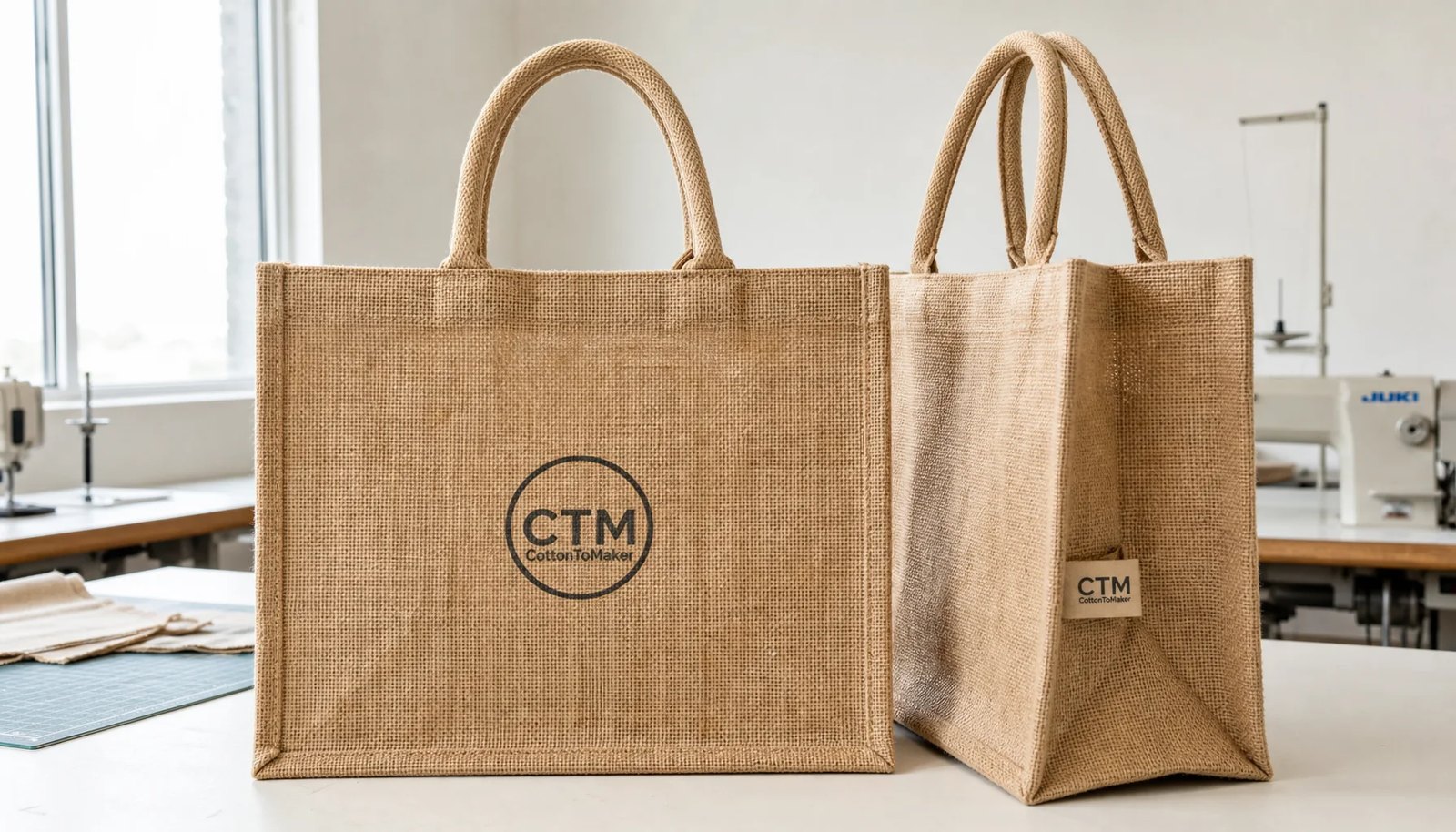
Start With the Retail Job
A jute tote sold in a hotel shop has a different job from a giveaway bag. It has to look right beside spa products, resort apparel, local gifts, or wine. It may sit on a shelf under bright lobby lighting. It may be scanned as a retail SKU. It may leave the property in a guest's hand and become part of the hotel's public-facing brand. That is why procurement should define the bag as retail merchandise first, then as packaging or a carry item second.
The easiest way for a quote to drift is to ask for a "custom jute tote" without explaining how the hotel will sell or use it. A low-cost souvenir tote, a spa boutique bag, a bottle carrier, and a premium branded merchandise bag can all be made from jute. They will not need the same GSM, handle width, lining, closure, printing method, or carton plan. If the request is too broad, suppliers usually quote their closest standard pattern. The price may look good, but the sample can arrive too floppy, too rough, too small, or too casual for the retail setting.
Put the selling context directly into the RFQ. Say whether the tote will be sold alone, bundled with merchandise, used as gift-with-purchase packaging, or replenished across several properties. List the likely contents: towels, spa bottles, books, apparel, packaged food, wine, amenities, or mixed gifts. Also state how store teams will display it. A bag that must stand upright needs different structure from one that will hang on a peg or ship flat in a back room.
- Define the channel: lobby retail, spa boutique, resort shop, event retail, destination souvenir, minibar add-on, or branded amenity program.
- State the expected contents and approximate carry weight instead of using general terms such as light, medium, or heavy.
- Decide whether the bag must stand upright when empty, hold shape only when filled, or function mainly as a carry-out bag.
- Clarify whether the tote is sold as its own SKU or supports another item, because that affects decoration, barcode, hangtag, and packing decisions.
Choose Fabric With Intent
GSM is the first material number most buyers ask for, but it does not tell the whole story. A 320 gsm raw jute panel, a 320 gsm laminated panel, and a 320 gsm bag with lining can feel different in the hand. They can also behave differently on a shelf. For value hotel retail, 300-320 gsm may be enough. For many lobby shops and resort boutiques, 320-350 gsm is a more practical starting range because it gives better structure without making the bag overly bulky. Builds above 360 gsm can work for premium programs, but the added cost and carton volume should support a real merchandising reason.
Ask the supplier exactly what the quoted GSM covers. Is it raw jute before lamination? Finished laminated material? A fabric average from the mill? What tolerance can they hold in bulk? Some suppliers may state a workable tolerance, such as plus or minus 5 percent. Others may prefer visual and handfeel approval against a sealed sample. Either can be usable if it is written down before the purchase order. What causes trouble is approving a firm, clean sample and receiving bulk bags that feel looser, thinner, or more transparent.
Lamination and lining are separate decisions. Lamination can help the bag stand better, reduce shedding, and create a steadier print surface. It can also bring odor, stiffness, bubbling, delamination, and claim-language questions if the hotel wants a plastic-reduction message. Lining makes the inside look more finished and can be helpful for cosmetics, jewelry, spa goods, or small loose retail items. It also creates more sewing work, more inspection points, and possible wrinkle or shrinkage issues. More construction is not automatically better; the right choice is the one the retail program can justify.
- Use 300-320 gsm for value retail, 320-350 gsm for most hotel retail, and 360 gsm+ only when the added structure is commercially justified.
- Ask whether GSM refers to raw fabric or laminated finished fabric and record the tolerance in the purchase specification.
- Use lamination when shape retention, reduced shedding, and a cleaner print surface matter; check odor and delamination risk.
- Use lining when the inside will be visible to guests or will hold small loose items; inspect inner seams, raw edges, and thread trimming carefully.
Lock Size and Shape
Finished dimensions are the numbers that matter. Pattern measurements, cutting measurements, and flat-panel measurements can all differ from the final sewn bag. The RFQ should state finished width, finished height, gusset depth, base width, and handle drop. For hotel retail, a small change can affect whether the tote fits a display shelf, sits neatly beside other SKUs, or looks consistent when several pieces are merchandised together.
Write tolerances before bulk production begins. A practical discussion might start with plus or minus 1 cm for body width and height, plus or minus 0.5 cm for handle drop, and a millimeter tolerance for print or label placement where symmetry matters. These numbers are not universal. They need to match the bag size, fabric behavior, sewing process, and factory capability. The key is agreement before there is a shipment to argue over.
Shape deserves the same attention as size. A flat tote may be fine for folded apparel, paper goods, or low-value souvenirs. A gusseted tote is usually better for spa bottles, gift boxes, wine, books, and mixed merchandise. A base board can add structure, but it also adds weight, cost, and another material to document. If the bag must stand empty, test that at sample stage. If it only needs to stand when filled, test it with the actual planned products or realistic substitutes.
- Specify finished width, height, gusset, base width, and handle drop in one measurement system used consistently throughout the spec.
- Record tolerances for body dimensions, handle drop, print placement, and label placement before issuing the purchase order.
- Ask for sample photos with a ruler or measurement card when reviewing remotely.
- Test the sample empty, lightly filled, and loaded with the intended merchandise to confirm shelf behavior.
Engineer the Handles
Handles are a small part of the bag visually, but a large part of the risk. A tote can photograph well and still fail in daily use because the tape is too narrow, the stitching is weak, the thread tension is poor, or the attachment points pull through the jute. Guests may carry bottles, books, towels, and gifts through airports or back to their rooms. The handle system needs to be specified, not assumed.
Cotton webbing is often a strong hotel retail option because it feels clean and comfortable. Jute webbing gives a more natural look, but the texture can be rougher and less uniform. Common widths such as 25 mm, 30 mm, and 38 mm should be chosen based on the load, the visual balance of the bag, and the desired handfeel. Handle drop matters too. A short drop suits hand carry. A longer drop is needed for shoulder carry, and the only honest test is trying the sample on real people with the bag filled.
The attachment method should appear in the spec sheet. Box-X stitching or reinforced rectangular stitching is usually better for totes expected to hold heavier retail goods. Ask what thread is included, how many stitch rows are used, and whether reinforcement patches are needed behind the jute. For QC, agree on a simple carry-load or pull check that reflects the product's intended use. Even if the supplier does not provide a formal lab report, they should be able to explain how handle strength is checked during production.
- Specify handle material, width, total length, drop, color, stitch pattern, thread color, and attachment position.
- Use reinforced stitching for bottle carry, books, spa sets, or any tote expected to hold several kilograms of goods.
- Check that the handle does not rub through raw jute edges or distort the bag opening under load.
- Ask the supplier to define their handle strength check and the number of pieces inspected during production or final inspection.
Make Branding Fit Jute
Jute has texture, slubs, and natural variation. That is part of its appeal, but it also means artwork needs to be designed for the surface. Fine serif type, hairline rules, tight spacing, gradients, and detailed hotel crests can lose clarity on coarse jute. A logo that looks refined on stationery may need to be simplified, enlarged, or moved to a different decoration method before it looks refined on a tote.
Screen printing is usually the most predictable route for simple one- or two-color hotel marks. It can keep unit cost practical and produce good results when the artwork has enough line weight. Pricing will still vary by print size, number of colors, setup, and registration complexity. For detailed branding, a woven label, printed cotton label, sewn patch, or side tab can look cleaner than forcing small details onto the jute face. This can be especially useful for multi-property groups that want the same bag body with different property labels, although label MOQ and lead time need to be checked.
Do not approve artwork from a digital mockup alone when the retail finish matters. Give the supplier vector files, final print size, placement from bag edges, ink color references, and minimum clarity expectations. If Pantone matching is important, state it, but remember that ink on jute will not read the same way as ink on coated paper or color on a screen. A strike-off on production-equivalent jute is the proof that matters.
- Use direct screen print for simple marks with adequate line weight and limited colors.
- Use woven labels, printed labels, sewn patches, or side tabs when artwork has small details or the hotel wants a more premium branded finish.
- Define logo size, placement, color references, and acceptable print placement tolerance.
- Approve a physical strike-off on production-equivalent jute before releasing bulk printing.
Compare Quotes Fairly
A low unit price only helps when every supplier is quoting the same product. Jute tote costs can move quickly with small changes: raw versus laminated fabric, unlined versus lined interior, 25 mm versus 38 mm handles, open top versus zipper, direct print versus sewn label, standard export carton versus retail-ready packing. If those details are not fixed, the quote comparison is mostly noise.
Ask for an itemized quote. At minimum, the supplier should state finished dimensions, GSM, lamination, lining, handle specification, decoration method, closure, packing, MOQ, sample cost, setup cost, lead time, Incoterm, and quote validity. When possible, request cost lines for the bag body, lamination, lining, handle, closure, decoration, label, inner packing, master carton, sample, and setup. This helps procurement see which choices are driving cost and gives merchandising a clearer path if the target retail price is tight.
MOQ also needs version-level detail. A factory may offer one MOQ for a standard natural jute tote, another for dyed jute, another for a lined construction, and another for woven labels or zippers. Multi-property hotel groups should ask whether different logo versions can share a fabric MOQ or whether each version is treated separately. This question is worth asking early, before a tidy quote turns into fragmented purchase orders.
- Require every supplier to quote against the same written spec sheet, not only a photo or logo file.
- Ask for unit price, sample cost, setup cost, label or screen charges, packing cost, and freight basis separately where possible.
- Confirm MOQ by size, color, lining, closure, print version, and label version.
- Record the Incoterm, quote validity, production lead time, and what is excluded from the price.
Use Sampling as a Gate
Sampling is not a courtesy step. It is where the buyer proves the specification. A prototype can confirm size and construction, but it may not use final materials. A print strike-off can confirm logo behavior, but it may not show the full bag. A pre-production sample should bring the approved jute, handle, lining, decoration, closure, and packing method together before bulk production starts. Procurement should know exactly which sample stage is being approved.
The golden sample should be sealed and referenced in the purchase order or production approval. It should represent the final accepted product as closely as possible: jute shade, handfeel, dimensions, logo size, handle drop, lining, labels, sewing details, and main packing method. If a sample uses substitute materials because the final fabric or label is not ready, write that exception down and require a second approval when final materials are available. Otherwise the sample stops being a reliable control.
Remote approvals need extra structure. Ask for photos from the front, back, side, inside, bottom, handle attachment, logo close-up, seam close-up, and packed carton. Include a ruler or measurement card in key images. A physical sample is still better when possible because jute handfeel, odor, stiffness, shedding, and ink texture are difficult to judge through photos. Build sample time into the calendar, especially for openings, seasonal retail, or events where late changes are expensive.
- Define whether each sample is a prototype, print strike-off, pre-production sample, or sealed golden sample.
- Approve fabric shade, GSM, dimensions, handle drop, decoration, lining, closure, and packing as separate checkpoints.
- Keep one approved golden sample for buyer reference and one for factory production reference if the program is important.
- Do not approve bulk production from a digital mockup alone when print clarity, structure, or material handfeel matters.
Define QC Early
Quality control should come straight from the buying specification. If the approved product is 320-350 gsm laminated jute with cotton webbing handles, a one-color screen print, cotton lining, and retail cartons, the inspection checklist should cover each of those points. Waiting until final inspection to decide what matters invites disagreement. The supplier should know in advance which defects are critical, major, or minor for the hotel retail setting.
Key checks include finished size, fabric handfeel, shade consistency, odor, shedding, stains, handle stitching, print clarity, print placement, seam strength, lining finish, closure function, carton count, barcode placement, and carton marks. Cosmetic issues can matter more in hotel retail than in industrial or event use. A crooked logo, dirty jute panel, loose lining thread, or crushed shape can make the bag feel unsuitable for a boutique shelf even if it technically holds weight.
Ask what evidence the supplier can share before shipment. Useful evidence may include measurement sheets, close-up sewing photos, print strike-off approval, final packed carton photos, and carton mark photos. If a third-party inspection is used, give the inspector the approved spec, golden sample, artwork file, packing instruction, and defect definitions. A generic inspection without those references can miss the details that affect retail acceptance.
- Create a QC checklist from the final spec and share it with the supplier before production begins.
- Classify defects such as mildew odor, broken handles, wrong logo, severe stains, and missing cartons as critical or major according to business impact.
- Check both function and presentation: load behavior, stitch strength, print appearance, lining finish, and shelf shape.
- Require written approval for any deviation from the golden sample before shipment.
Plan Packing and Receiving
Packing affects landed cost, product presentation, and store labor. Jute is bulky, can crease, and can absorb moisture if cartons are weak or stored poorly. A bag can leave the sewing line looking acceptable and arrive looking tired if it is over-compressed, packed in damp cartons, or folded through the printed area. Hotel retail teams should not have to reshape, relabel, recount, or clean bags before putting them on sale.
The packing specification should state whether bags are flat packed, lightly folded, individually polybagged, wrapped with tissue, bundled by inner quantity, or packed directly into a master carton. Individual polybags can protect presentation, but they may conflict with plastic reduction goals. Decide that point based on the retail requirement and the hotel's policy, not at the packing table. If the tote will be sold as a SKU, barcode placement, hangtag content, and label format should be approved before production.
Carton details need to be practical. Ask for pieces per carton, carton dimensions, gross weight, carton strength, sealing method, and carton marks. Very heavy cartons slow receiving and can increase damage risk. Very low carton counts may raise freight volume. For multi-property programs, carton marks should identify property, SKU, color, quantity, PO number, destination, and production batch where relevant. The goal is simple: protect the product and make receiving clean.
- Specify fold method, inner pack quantity, master carton quantity, carton dimensions, and target gross weight.
- Decide whether individual bags need tissue, paper wrap, polybag protection, hangtags, or barcode labels.
- Confirm carton marks include SKU, style, color, quantity, PO number, destination, and batch details where needed.
- Check packed samples or packing photos before shipment to avoid crushed shape, print transfer, moisture damage, and count errors.
Protect Reorders and Claims
Lead time begins when the specification is complete, not when the first inquiry is sent. A realistic schedule separates artwork review, sample making, sample transit, revisions, material booking, printing, sewing, finishing, packing, inspection, and shipment handover. For many custom hotel retail programs, the delay is not the sewing itself. It is late artwork approval, changed barcode rules, unclear label requirements, or a packing decision that arrives after bags are already finished.
Ask the supplier to state lead time after sample approval and deposit, then ask what assumptions sit behind that number. Standard natural jute may move faster than dyed jute. Woven labels, zippers, special linings, multi-property logo versions, and custom cartons can all change the calendar. Resort openings, holiday programs, conference retail, and seasonal campaigns should include buffer for sample revisions and inspection. Rushed orders tend to accept vague tolerances, and vague tolerances are where disappointment often starts.
Be careful with sustainability and material claims. Jute is a natural fiber, but a finished tote may include lamination, polyester thread, poly-cotton lining, plastic zipper tape, synthetic labels, or individual polybags. Do not describe the bag as plastic-free, biodegradable, compostable, organic, or recycled unless the supplier can document the exact material composition and the claim has been reviewed for the selling market. Clear and modest language is safer than a broad claim the construction does not support.
Finally, treat the first order as the start of a repeatable program if the hotel may reorder. Keep the spec sheet, artwork files, Pantone references, approved sample photos, packing instructions, carton marks, quote, inspection notes, and supplier comments together. Ask whether the same jute shade and handle tape can be repeated or whether natural variation should be expected. Reorder consistency improves when the first order is documented properly.
- Separate sample time, approval time, production time, inspection time, and shipment handover in the timeline.
- Ask which inputs can delay the order: artwork, fabric booking, labels, zippers, packing materials, or barcode approval.
- Verify material composition before making public sustainability, plastic-free, biodegradable, compostable, organic, or recycled claims.
- Keep a complete reorder file so future hotel retail purchases match the approved product as closely as possible.
Specification comparison for buyers
| Spec decision | Recommended option | When it fits | Buyer risk to check |
|---|---|---|---|
| Fabric weight | 300-320 gsm for value retail; 320-350 gsm for most hotel retail; 360 gsm+ for structured premium programs | Choose by target retail price, expected load, and shelf presentation standard | Confirm whether GSM is for raw jute only or finished laminated fabric; ask the supplier for tolerance, commonly +/-5% if they can control it |
| Lamination | LDPE/PP laminated backing when shape, print surface, and reduced shedding matter | Lobby shops, destination retail, bottle/gift sets, and bags displayed upright | Check odor, bubbling, delamination, stiffness, and whether lamination changes recyclability claims or customer-facing labeling |
| Lining | Cotton, poly-cotton, or nonwoven lining with bound or neatly overlocked inner seams | Premium hotel shops, spa retail, cosmetics, jewelry, or small loose merchandise | Lining can wrinkle, shrink differently, trap lint, or add sewing defects; require a sample with the final lining |
| Handle system | Cotton webbing or jute webbing, 25-38 mm wide, with box-X or reinforced rectangular stitching | Guest carry, bottles, books, amenity kits, and airport use after checkout | Specify handle drop, tape width, stitch type, thread quality, and load test method rather than accepting a generic handle description |
| Size and shape | Finished dimensions with gusset and base width stated separately | Retail shelves, hanging fixtures, bundled products, or bags sold as standalone SKUs | Pattern size is not finished size; write dimensional tolerances such as +/-1 cm for width/height and +/-0.5 cm for handle drop if acceptable |
| Decoration method | 1-2 color screen print for simple marks; woven label or sewn patch for detailed hotel branding | Simple logos, property names, destination marks, or premium retail labels | Fine lines and small type can fill in on coarse jute; approve a print strike-off on actual bulk fabric, not only a digital proof |
| Closure | Open top for cost-efficient display; zipper, magnetic snap, or button loop for higher-value retail | Open-top souvenir bags, spa sets, wine retail, or premium guest merchandise | Zipper alignment, slider quality, edge finishing, and added labor can change lead time and rejection rate |
| Packing | Flat packed or lightly folded, with defined inner quantity, carton quantity, and moisture protection | Programs with store replenishment, barcode receiving, or multi-property distribution | Over-compression can crease laminated jute; cartons need realistic gross weight, clear marks, and protection from moisture |
| Source route | Direct factory for repeat custom programs; trading company for mixed SKUs; domestic stock for urgent tests | Match route to order volume, customization level, and delivery pressure | Ask who controls raw material booking, print approval, in-line QC, and final inspection; vague answers create accountability gaps |
Buyer checklist before sampling
- Define the hotel retail use case: souvenir tote, spa retail, wine or bottle carry, general gift bag, amenity retail, or premium branded merchandise.
- Lock finished dimensions for width, height, gusset, base, and handle drop; state tolerances instead of accepting open-ended factory variation.
- Specify jute fabric weight in GSM, weave appearance, color shade range, lamination status, lining material, and whether the quoted GSM includes backing.
- State the minimum acceptable bag performance, including expected carry weight, handle pull strength method, and whether the bag must stand upright when empty.
- Define handle material, webbing width, total handle length, handle drop, attachment position, stitch pattern, thread color, and reinforcement requirements.
- Provide vector artwork with final print size, placement from bag edges, ink colors, Pantone references if needed, and minimum acceptable logo clarity.
- Choose the decoration route before price comparison: screen print, heat transfer if suitable, woven label, printed label, sewn patch, or embroidery where practical.
- Request a strike-off or pre-production sample made from the same jute, lining, handle, ink, and packing method planned for bulk production.
- Ask for MOQ by size, color, lining option, print version, and packing version; do not rely on one blanket MOQ for the whole program.
- Require an itemized quote that separates bag body, lamination, lining, handles, closure, decoration, labels, packing, sample cost, setup cost, and freight basis.
Factory quote questions to send
- What is the exact jute GSM, GSM tolerance, weave style, fabric color range, and is the quoted material raw, laminated, lined, or both laminated and lined?
- Is the fabric natural jute, dyed jute, blended jute, or burlap-style material, and can you state the material composition used for labeling?
- What are the finished dimensions for width, height, gusset, base, and handle drop, and what tolerances will you accept in bulk production?
- What handle material, webbing width, total length, stitch type, and reinforcement method are included in the price?
- What carry-load or handle-pull check can you perform, and how many samples will be checked during production or final inspection?
- Can you itemize the unit price for body fabric, lamination, lining, handles, closure, decoration, label, inner packing, master carton, setup, and sample fees?
- What is the MOQ by size, color, lining, closure, print color count, and label version, and what price breaks apply at higher quantities?
- Can you make a print strike-off on the same jute used for bulk production, and what is the expected print placement tolerance in millimeters?
- If we use a woven label or sewn patch instead of direct print, how does that change MOQ, lead time, unit price, and sampling cost?
- What sample stages do you recommend: prototype, artwork strike-off, pre-production sample, or sealed golden sample?
Quality-control points to confirm
- Check finished width, height, gusset, base, handle length, and handle drop against the approved spec using a written tolerance table.
- Verify fabric weight, weave appearance, jute shade, lamination backing, lining material, and overall handfeel against the golden sample.
- Inspect for odor, dampness, mildew marks, oil stains, dark fiber contamination, excessive shedding, broken yarns, and visible slubs that affect retail presentation.
- Test handle anchoring visually and physically: stitch pattern, stitch density, thread tension, reinforcement patch if used, and pull points under load.
- Review print clarity on the actual jute surface, especially small fonts, thin lines, reversed-out text, logo edges, and multi-color registration.
- Measure print placement from defined bag edges and check that the logo is not tilted, stretched, under-cured, smudged, or blocked by seams.
- Check lining fit, inner seam finish, loose threads, exposed raw edges, label placement, and whether the inside appearance is acceptable for retail sale.
- Inspect closures if used: zipper straightness, slider movement, end stops, puller quality, button loop strength, snap alignment, and sewing around the closure area.
- Confirm bags stand, fold, or hang as intended after packing; reject over-compressed cartons that permanently crease laminated or structured bags.
- Audit carton count, inner pack count, barcode placement, SKU labels, carton marks, batch identification, carton sealing, and gross weight.