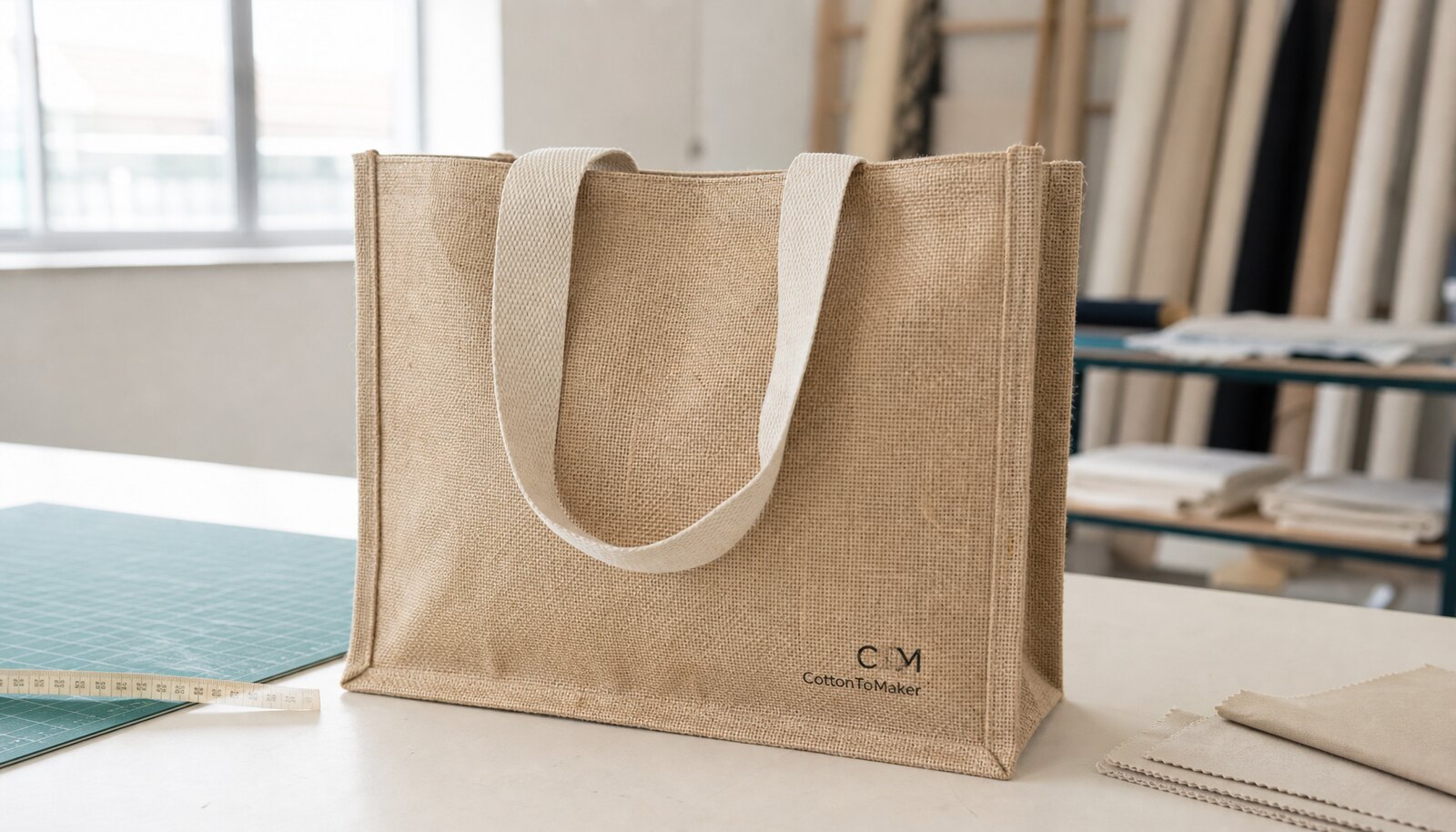
Start with the retail job the bag must do
Jute tote bags for gift shops are not all bought for the same reason, and that matters before you ever ask for a unit price. A museum shop may need a clean, giftable carrier that feels like a souvenir customers will keep. A tourist gift shop may need a lower-cost impulse item with a visible logo and enough structure to sit well at the checkout. A premium brand store may want a tote that feels sturdy enough to reuse many times and still look respectable after being carried around town. The commercial role of the bag decides the spec more reliably than a factory catalog does.
Before you send RFQs, write the product role in one sentence and keep that sentence visible while you compare suppliers. Use plain language such as souvenir carrier, merch tote, premium gift bag, event giveaway, or seasonal campaign bag. That one line controls the rest of the buying decision: fabric weight, handle type, print complexity, lining, packing, and whether you can accept natural variation or need a more controlled finish.
If the tote will be sold at retail, it is part packaging and part product. Shelf appearance matters, not just carrying capacity. If it is a giveaway, you can usually simplify the structure and focus on cost and print clarity. If it must hold boxed gifts, books, candles, or bottled items, then the handle and seam build become non-negotiable. Buyers often lose money by ordering a bag that is cheap on paper but wrong for the way the store actually sells and ships it.
- If the bag must sit upright for display, ask for gusset dimensions and whether a stiffener is needed.
- If customers will carry heavier souvenirs, set a minimum handle drop and reinforcement method early.
- If the bag is seasonal, decide whether you need a one-time promotional style or a repeatable platform for future artwork changes.
Choose the jute construction before pricing the order
Most quote confusion starts with the base fabric. Suppliers may say “natural jute tote” while meaning very different constructions, finishing levels, and hand feel. For a general gift-shop tote, a 10x10 weave around 320–400 GSM is a common starting point. For a firmer retail feel, an 11x11 weave around 380–450 GSM usually gives more structure and better shape retention. Heavier is not automatically better. Very coarse fabric can feel rustic in a good way, but it can also make detailed print harder to read and can raise the risk of broken-looking edges after cutting.
The fabric choice should reflect what the bag has to do after it leaves the store. If the tote is mainly a souvenir carrier, a moderate-weight body may be the better balance of price and appearance. If the store wants a bag that stands upright and looks premium on a hook or shelf, discuss gusset width, bottom shape, and whether the bag needs light starching or another finishing treatment. If the bag is too soft, it can collapse in the retail display and look cheaper than it really is. If it is too rigid or coarse, it may feel less giftable and print less cleanly.
Ask the supplier to state the fabric spec in a way that you can repeat on the next reorder. That means GSM or weave count, fiber blend if any, finish treatment, and any washed or coated effect. A quote that only says “good quality jute” is not procurement-ready. It does not give you a basis for comparing a second supplier or claiming a miss later if the bulk run feels different.
- Use GSM or weave count in the RFQ; do not accept a quote that says only “good quality jute.”
- If the design uses a bright logo or fine text, ask for a print test on the actual jute cloth, not on a smooth substitute.
- For souvenir programs, some color variation is normal, but set the acceptable range before production starts.
- If the bag must stand upright, ask whether a board, insert, or bottom support is included in the price.
Compare sourcing routes by control, documentation, and reorder consistency
For repeat programs, direct factory sourcing usually gives you better control over fabric, sewing, and print approval. You can lock the same stitch pattern, handle tape, label position, and carton spec across reorders. You also get a clearer line of responsibility if the bulk order drifts from the sample. That matters when the buyer needs to show an approval trail to a retail chain, distributor, or internal quality team.
A trading company can still be useful when the order is small, the assortment is mixed, or the buyer needs a more managed communication process. The tradeoff is that sample ownership may be less clear, production may shift between factories, and repeat consistency can become harder to prove. If the intermediary cannot tell you who actually sews, prints, and packs the tote, your risk goes up even if the quote looks tidy.
The cheapest quote is often not the cleanest quote. One supplier may be offering blank bags only, another may include one-color screen print, and a third may have a low MOQ but heavy setup fees or a smaller carton pack that pushes freight costs higher. Compare the full production path, not just the headline unit price. A procurement buyer should ask who owns the fabric lot, who controls the print screens, and whether any process is subcontracted without written approval.
For reorder business, ask for batch traceability and a repeat-spec file. The supplier should be able to tell you what fabric lot was used, what print run it came from, and whether any material substitution happened. If they cannot keep the same handle tape, thread type, or lining spec on reorder, the line will drift and the buyer will spend time re-approving products that should have been routine.
- Direct factory route: best for stable repeat orders, tighter spec control, and cleaner corrective action.
- Trading route: useful for small mixed assortments, but ask who actually makes the bag and who approves sample revisions.
- Local converter route: often faster to communicate, but cost can rise if fabric, decoration, or packing is handled in separate steps.
- Ask every supplier whether subcontracting is allowed and whether it must be pre-approved in writing.
Use the comparison table to separate real value from cheap quotes
When suppliers quote jute totes, the price gap is usually driven by five things: fabric weight, handle build, print method, lining, and packing. That is why a spreadsheet with only unit price and MOQ gives a false sense of clarity. You may think one supplier is cheaper when in fact they are quoting a lighter bag, a simpler print, or a looser packing method that increases the freight bill. Procurement teams should force every quote into the same structure before comparing it.
A practical comparison should include the bag body, handles, decoration, packing, sample charge, and lead time. If one item is missing, write it back into the RFQ and re-request the quote. This sounds basic, but it is the fastest way to stop a supplier from winning on a partial quote that later turns into add-ons. For gift shop bags, the hidden cost is often not the bag itself; it is the extra carton volume, repacking work, or print rework that appears after the order is already placed.
The table is most useful when buyers apply decision logic, not just specs. If the store sells low-cost souvenirs, a moderate GSM bag with simple screen print may be the right commercial answer. If the store sells premium gifts, a firmer body, cleaner edging, better handle reinforcement, and more exact print placement may justify the higher unit price. Compare the cost against the selling channel and the item margin, not against another unrelated tote category.
- Match fabric weight first, then compare print and stitching.
- Do not compare lined and unlined bags as if they were the same product.
- Convert every quote into landed cost per sellable unit, not just FOB price.
- If suppliers quote different carton sizes, normalize freight cost before deciding the winner.
Print method should follow artwork, shelf distance, and reorder plan
For most gift-shop orders, screen print is the practical default. It handles simple logos, city names, and seasonal messages at a reasonable cost, and it is usually easier to control on rough jute than more delicate decoration methods. It also has a useful commercial advantage: repeatability. Once the screen, ink, and placement are approved, the buyer has a stable path for reorder. That is important for museum shops, tourist shops, and branded retail where the same tote may be reordered across a season or a store network.
Heat transfer can work for short runs or more complex artwork, but it should not be assumed to behave like smooth-fabric printing. On jute, the surface texture can make edges look less integrated, and durability can depend heavily on how the tote is used. If the bag is likely to be reused often, leaned against rough surfaces, or carried in wet weather, ask the supplier to explain how the decoration will age. A lower setup fee is not a win if the graphic fails early.
For any artwork with fine lines, gradients, or small text, require a sample print on the actual bag fabric before mass production. Do not approve from a digital mockup alone. Also ask where the print sits relative to the seam and bottom edge, because rough jute can make a centered design appear visually off-center if the placement margins are not planned carefully. The same design can look polished or sloppy depending on print size, blank space, and the thickness of the fabric weave.
- Simple, bold logos: screen print is usually the safest cost/performance choice.
- Complex artwork: ask for a real print sample on the actual jute before approving production.
- If the bag is sold as premium merchandise, insist on clean edges, strong opacity, and consistent placement.
- If there is more than one artwork version, make the supplier show how screens or plates are stored for repeat orders.
MOQ logic should match your SKU plan, not the factory's convenience
Gift-shop buyers often need more than one SKU: different city names, seasonal art, store-specific versions, or alternating language variants. That is where MOQ can become expensive fast. A low MOQ per version can look attractive, but if each split version carries its own screen setup, packing change, or fabric change, your true cost rises sharply. Ask whether the supplier prices by design, by color, by screen count, or by total order value. Those differences matter more than the MOQ headline itself.
The best way to manage MOQ is often to group orders by shared components. Keep the same bag size, fabric spec, and handle construction across several designs, then vary only the print artwork. That allows the factory to stabilize cutting, sewing, and handle attachment while changing only the decoration step. In other words, reduce variation in the expensive parts of the process and move the variable cost into the artwork, where it is easier to control.
If your assortment plan includes many small versions, ask for a real cost ladder, not a single MOQ number. A useful quote should show what happens at 500, 1,000, and 3,000 pieces, and whether the lower quantity is genuinely workable or only a sample-style production run. If the supplier can only make the order work by overcharging on setup or packing, that is not a healthy wholesale arrangement for a gift-shop program that may need regular replenishment.
- Use one base construction and vary artwork where possible.
- Separate the quote into bag cost, printing cost, packing cost, and setup cost.
- Ask whether the MOQ applies per style, per color, per print version, or per shipment.
- If the supplier offers a very low MOQ, confirm whether it is repeatable at the same price or only a one-time exception.
Samples should prove the weak points, not just the appearance
The first sample should answer a procurement question, not a design question. Does the tote actually meet the job in the store, in transit, and at receiving? Check body shape, handle length, stitch cleanliness, print alignment, and whether the bag stands well in a display tray or collapses into a stack. Jute has natural surface variation, so the acceptance standard should be based on a written reference sample, a signed photo set, and a tolerance sheet. A vague “looks good” approval creates trouble later.
A useful sample workflow is simple. First, approve a construction sample to confirm size, handle build, gusset shape, and seam logic. Second, approve a print strike or decorated sample on the actual fabric to confirm placement and color behavior. Third, if the order is large or the artwork is critical, keep a final signed reference sample for production comparison. That third step is often skipped, yet it becomes the fastest way to settle disputes when the bulk run arrives.
Do not let a supplier swap materials after sample approval without notice. If they change fabric batch, handle tape, lining, or print method, they should tell you before production starts and show proof that the new material still matches the approved standard. Ask for revised photos or a corrected sample if the change affects appearance, feel, or durability. The sample is only useful if it is still the same product the factory will actually make.
For larger programs, define defect thresholds in advance. For example, decide what size variance is acceptable, what amount of print shift is tolerated, and whether loose threads or natural fiber fuzz are minor or major defects. This keeps approval objective and prevents the buyer from arguing after the fact over issues that should have been settled before the PO.
- Measure the finished size after pressing, not only before packing.
- Inspect handle stitching, print placement, and inside seams if lining is included.
- Keep one signed sample or marked photo record for production comparison.
- Record the fabric lot, print color code, and packing method tied to the approved sample.
Build a QC plan with AQL, defect grades, and load checks
Quality control for jute totes should not stop at visual inspection. A commercial buyer needs a simple standard that says what is pass, what is hold, and what is reject. A useful starting point is an AQL-based inspection plan such as AQL 2.5 for major defects and AQL 4.0 for minor defects, unless your retailer or internal policy is stricter. The supplier should know this standard before bulk production begins, not after the shipment is already at the port.
Define defect grades before the inspection starts. Critical defects are immediate rejects: failed handles, wrong size outside tolerance, missing print when print is required, or contamination that makes the bag unsellable. Major defects are problems that affect appearance or function enough to require repair, hold, or replacement: severe print misalignment, open seams, broken stitching at load points, or obvious moisture damage. Minor defects are cosmetic issues that do not stop sale but should remain within the agreed percentage, such as light thread trimming issues or small natural-fiber irregularity beyond the reference sample.
A practical check list should include a simple load test. You do not need lab-level complexity to catch most wholesale problems, but you do need a consistent method. Use a random sample from the lot, fill the tote to an expected retail load, and hold it for a defined short period while checking seam behavior and handle stability. The goal is not to prove the bag can hold a marketing claim; the goal is to see whether the construction behaves consistently at the expected retail use level.
If the order is for a chain, museum group, or distributor network, add documentation controls. Ask for in-line photos, final packing photos, batch identification, and carton count verification. This gives you a traceable record if a defect later shows up in only one batch. Also require the factory to disclose any subcontracted printing or packing step, because subcontracting is where traceability often gets weak. If the factory cannot explain where each step happened, it is harder to hold anyone accountable for a defect.
- Use an AQL plan and make the supplier acknowledge it in writing.
- Grade defects as critical, major, or minor before inspection begins.
- Run a simple load check on random samples using the bag’s expected retail use.
- Require carton count verification and batch traceability for repeat orders.
Packing details affect freight cost and retail recovery
A jute tote that looks fine in the sewing room can arrive bulky if it is packed badly. Flat-packing usually reduces carton volume and makes sea freight more efficient. If the bag has a stiff insert, lining, or boxed bottom, the packing plan needs to be agreed early because those features change carton size quickly. For gift-shop distribution, carton efficiency can matter more than a small difference in unit price, especially when the order is moving through a warehouse, not directly to one store.
Moisture protection matters because jute absorbs warehouse humidity. But overpacking can create its own problems. Too much inner wrapping adds cost, slows packing, and can trap creasing that retail staff then have to remove. The best practice is to protect the product just enough for transit and storage, then keep the pack format simple enough for store teams to handle without extra work.
Write packing terms into the quote with enough detail to compare suppliers fairly: carton size, bags per carton, inner protection, carton marks, stacking limit, and whether the bags are folded, flat, or inserted with paper supports. Ask for a carton photo or packing diagram if the tote has unusual dimensions. If the supplier cannot tell you the carton volume until after production starts, freight budgeting becomes guesswork and the quote is not complete.
Retail recovery matters too. Some packing methods create hard crease lines that look acceptable in a warehouse but not on a gift-shop shelf. If the store must steam or press bags before display, that labor cost belongs in the decision. A cheaper ex-factory price may disappear once the receiving team has to rework every carton before the bags can be merchandised.
- Confirm whether the bags ship flat, lightly folded, or inserted with paper supports.
- Ask for carton dimensions before approving freight estimates.
- Check whether the packing method creates visible crease marks that retail staff must remove.
- For humid destinations, agree the moisture barrier level without overpackaging the bag.
Lead time risk is usually a material and artwork problem
For standard jute tote bags, 30–45 days after sample approval is a common working range, but that estimate only helps if all inputs are final. The clock should start after the approved sample, not after the PO date. If artwork is still changing, the schedule is not real. If the supplier is waiting for jute cloth, handle tape, labels, or carton materials, the delay usually shows up late, when the order has already been committed to a store calendar.
Seasonal gift-shop buying is especially sensitive to late delivery. Back-to-school, tourist season, holiday fairs, and exhibition openings all create demand spikes, and one missed shipment can make the tote worthless for the intended campaign. Build time into the plan for artwork correction, sample signoff, and freight booking. Buyers often underestimate the small delays that happen before production starts and then overestimate how fast the finished goods can still recover lost time.
Ask the supplier to show a milestone schedule: sample approved date, material reservation date, bulk start date, mid-production checkpoint, packing date, and ready-to-ship date. If they cannot provide a milestone view, they probably do not have a controlled production plan. For repeat programs, ask how they prevent reorder drift when the second batch is produced months later. A supplier that can make one sample well but cannot repeat the same output six months later is not a reliable wholesale partner.
For urgent orders, check the tradeoff between speed and process control. Faster lead time often means fewer approval steps or lower ability to modify artwork once production starts. That can be fine if the spec is frozen. It is risky if the buyer still expects changes after the PO. The shortest path is not the best path if it increases the chance of a rejected batch.
- Ask when raw material is actually reserved for your order.
- Get a milestone schedule for sample, bulk start, mid-production, and ready-to-ship.
- For seasonal launches, do not place the order without final artwork and packing confirmation.
- Ask what happens to the schedule if a print proof is rejected once.
Specification comparison for buyers
| Spec decision | Recommended option | When it fits | Buyer risk to check |
|---|---|---|---|
| Jute body weight | 10x10 weave around 320–400 GSM or 11x11 around 380–450 GSM | Gift shops that want a structured tote with enough stiffness to display well and carry souvenirs | Too light and the bag collapses on shelf; too heavy raises cost, reduces softness, and can make detailed printing look rough |
| Handle construction | Cotton webbing or jute-webbing handles with box-X reinforcement | Retail use where customers may carry books, boxed gifts, bottles, or layered purchases | Stitch density, handle length, and seam slippage under load are common failure points; check for even reinforcement on both sides |
| Print method | Screen print for simple 1–3 color art; heat transfer only for short runs or complex full-color art | Brand logos, city names, museum shops, and seasonal graphics with limited color count | Ink cracking on rough jute, poor registration, low-opacity colors, and inconsistent print placement |
| Supplier route | Direct factory sourcing for repeat programs; trading company for very small mixed assortments | Buyers with stable volumes, planned reorders, or a need to lock a repeatable spec | Middleman markup, slower sample control, unclear production ownership, and hidden subcontracting risk |
| MOQ structure | Split MOQ only by color or print version if fabric and trim are standard | When you need assortment planning across several gift-shop SKUs but want to keep the base bag constant | Setup fees can make a small split order more expensive than a single larger style; verify cost per version |
| Interior finish | Unlined for low-cost souvenir programs; thin cotton or nonwoven lining for premium retail | Stores that sell higher-ticket gift sets, fragile items, or bags that must feel more finished | Lining adds labor, inspection points, and lead time; it can also hide construction issues until bulk production |
| Closure option | Open top for low-cost gift bags; zipper or magnetic snap only for premium retail use | When contents need added security or a more polished presentation | Hardware adds labor, rust risk, and more QC checkpoints; confirm pull strength and alignment |
| Carton packing | Flat-packed with size-controlled cartons and moisture protection | Sea freight, central warehouse distribution, or programs with multiple store deliveries | Bulging cartons raise freight costs, increase damage risk, and can create receiving problems |
| Lead time expectation | 30–45 days after sample approval for standard specs; longer for custom lamination or special trims | Routine wholesale buying with known artwork, materials, and pack format | Artwork delays, raw material availability, and holiday congestion can push delivery past the retail window |
Buyer checklist before sampling
- Define the bag’s job in one line: souvenir carrier, merch tote, premium gift bag, or seasonal campaign bag.
- Fix exact dimensions, gusset depth, handle drop, and whether the bag must stand upright on shelf or in a display tray.
- Choose a jute body spec using GSM or weave count before asking for price; never compare quotes that do not state fabric construction.
- Specify print method by artwork complexity, color count, and expected reorder volume.
- State whether the bag is unlined, partially lined, or fully lined, because this changes cost, weight, and sewing time.
- Request handle construction details, reinforcement method, and seam photos, not just a finished front view.
- Confirm packing format: flat-packed or inserted, carton quantity, carton dimensions, inner protection, and moisture barrier.
- Approve one pre-production sample against a written reference standard that covers fabric tone, print position, stitching, and pack format.
- Align MOQ, unit price breaks, and setup charges before comparing suppliers; ask for separate pricing by bag body, print, lining, and hardware.
- Ask for lead time from sample approval, not from order placement, and make the supplier show when materials are actually reserved.
Factory quote questions to send
- What exact jute weave count or GSM are you quoting, and what finishing treatment or coating, if any, is included?
- Is the quoted price for blank bags only, one-color screen print, multi-color print, or fully finished retail packing?
- What is your MOQ per design, per color, per print version, and per hardware option if closure or lining is added?
- How many samples are included, what is the sample charge, and is the sample charge refundable against mass production?
- Can you separate the quote into fabric, cutting, stitching, handle making, printing, lining, packing, and any setup fees?
- What carton size, carton quantity, and packing method are included in the quote, and what is the estimated carton weight?
- What is the lead time after artwork approval and after pre-production sample approval, and what step usually creates the most delay?
- Which parts of the bag are subcontracted, if any, such as printing, handle attachment, lining, labels, or packing?
- What size and placement tolerances do you hold for the finished bag and print position, and how are those measured?
- What documents can you provide before shipment, such as packing list format, carton marks, sample photos, inspection photos, and commercial invoice details?
Quality-control points to confirm
- Fabric should match the agreed weave count or GSM with no weak spots, thin bands, excessive slubs, or uneven color zones that would stand out on a retail shelf.
- Use an agreed acceptance reference sample. Natural jute variation is normal, but the supplier should not drift beyond the approved tone range or surface texture.
- Stitching should be straight enough for retail display, with secure seam ends, no skipped stitches, and no loose thread clusters at handle anchors or gusset corners.
- Handle attachment should be checked with a simple pull test on random samples. For a practical wholesale screen, set a minimum that the handles must hold at least the expected retail load without seam opening, stitch breakage, or visible distortion.
- Print should be centered within the agreed tolerance and should not show cracking, bleed, pinholing, poor opacity, or jagged edges on the rough jute surface.
- Bag dimensions should stay within the written tolerance after pressing and after packing, especially for shelf-facing gift-shop assortments that need matching visual rows.
- If lining is included, inspect the lining attachment, corner finish, and stitch concealment. Loose lining, twisted corners, and exposed raw edges are common complaints.
- Cartons should protect against moisture, compression, and edge crush. Bags should not arrive wrinkled beyond practical retail recovery or require excessive steaming.
- Use an AQL-based inspection plan for bulk orders. For most wholesale retail buyers, AQL 2.5 for major defects and AQL 4.0 for minor defects is a useful working reference unless your internal standard is stricter.
- Grade defects before inspection begins: critical defects mean reject, major defects mean repair or hold, and minor defects are acceptable only within the agreed percentage.