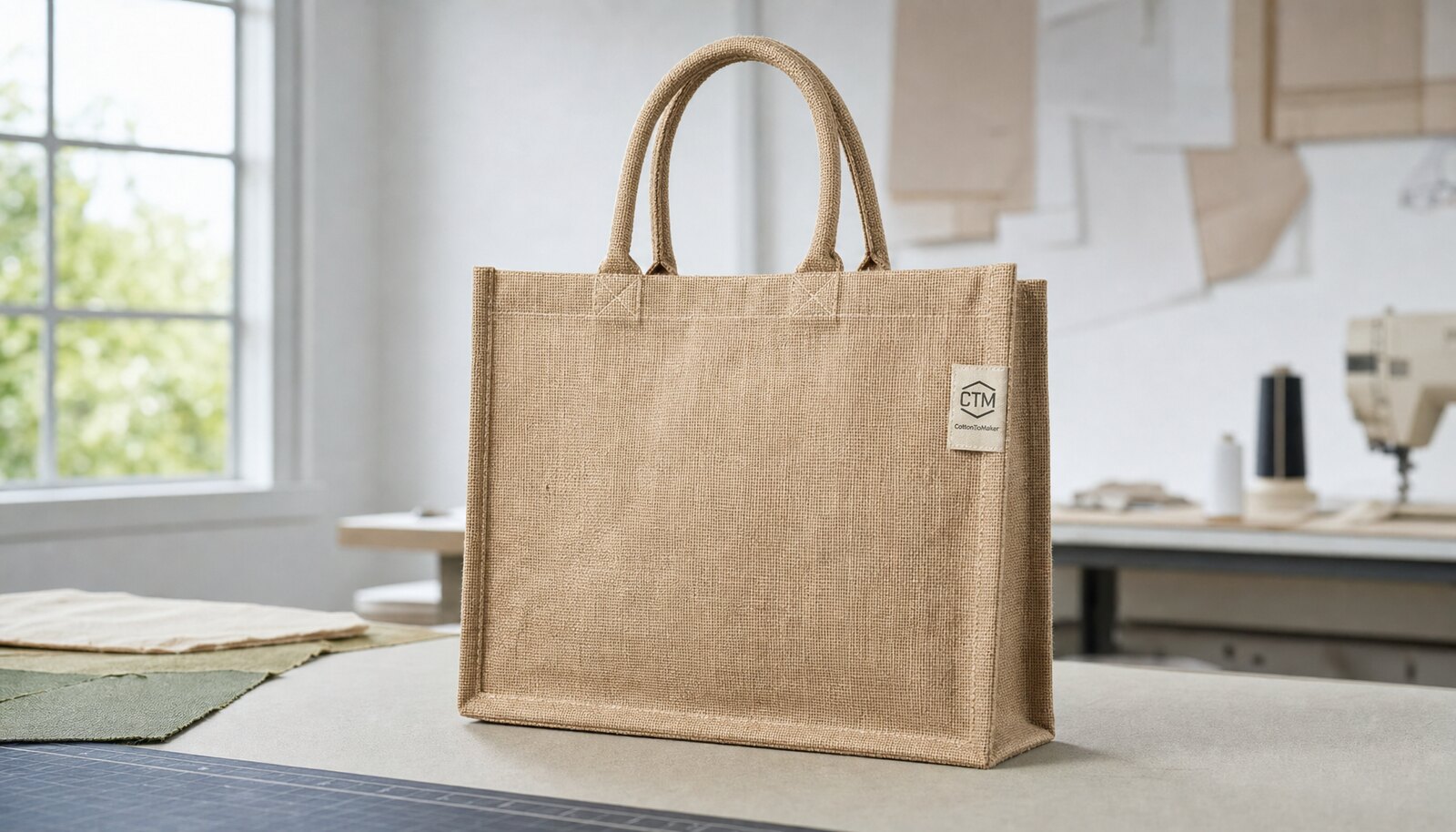
What a gift-shop jute tote is actually being asked to do
A jute tote bag for a gift shop is not just a carry bag. It is part of the retail environment, part of the brand impression, and often part of the purchase itself. Buyers are usually balancing shelf presentation, perceived value, carrying performance, and landed cost at the same time. That is why a bag that looks acceptable in a sample room can still fail as a retail SKU if it slumps on the shelf, sheds fibers onto merchandise, or prints badly under real handling.
The buying mistake is to spec the bag from the outside in. A pretty mockup does not tell you whether the bag will keep its shape, whether the handles will stay aligned after repeated use, or whether the print will remain readable on a textured surface. For gift-shop programs, the product has to look deliberate from three feet away and remain functional when loaded with small gifts, books, bottles, or souvenir bundles.
- Treat the bag as a retail display item first and a transport item second.
- Define the typical load before you choose fabric weight or handle reinforcement.
- Decide early whether the bag must stand upright on a shelf or only perform after purchase.
Material choice starts with fiber behavior, not with color
For jute tote bags for gift shops material selection guide work, the real decision is not simply natural versus laminated. It is how the fiber behaves in the full product build. Natural jute delivers the raw, tactile look that many gift shops want because it signals texture and eco positioning. Laminated jute is easier to wipe, more consistent for printing, and usually better when the buyer needs a cleaner retail appearance with less fiber fuzz.
A practical GSM range depends on the final structure. For laminated builds, 280–350 GSM is usually enough for medium retail use if the bag has a firm base and reinforced handles. For natural jute, 300–450 GSM is a more realistic range when shape retention matters. Below those ranges, bags tend to feel limp, deform in cartons, and read as value-grade rather than gift-grade. Above them, cost rises quickly and sewing becomes slower, especially at corners and handle anchors.
The wrong material tradeoff is usually visible in one of two places: the bag slumps on display, or the print looks decent but the overall item feels rough and unfinished. Buyers should ask for the actual build used in the sample, not a generic fabric description. If the factory quotes "heavy duty" without a GSM sheet or a production-level sample, the number is not procurement-ready.
- Use natural jute when the tactile fiber look is part of the retail story.
- Use laminated jute when print consistency, wipeability, and surface uniformity are priorities.
- Add a lining when rough interior fibers could snag merchandise or reduce perceived quality.
How weight, lining, and structure interact
Fabric weight alone does not determine whether a tote performs well. A lighter bag with a proper base insert and well-controlled side seams may outperform a heavier bag that collapses because the build is too soft. The reverse is also true: a heavy fabric without good seam control can still bow, wrinkle, or tilt when loaded. Procurement teams should therefore evaluate the whole structure, not a single fabric number.
Lining changes both the look and the failure profile. A cotton or polycotton lining improves hand-feel, hides the raw inner weave, and gives the bag a more finished interior. It also raises sewing complexity and makes dimensional consistency more important because inner and outer layers can drift during assembly. If the bag is meant for small gift items, lining is often worth the extra cost. If the bag is only a bulk carrier for a larger retail item, the value may not justify the added labor.
Base inserts are a separate decision from fabric weight. A cardboard insert can make a medium-weight bag stand upright, but it also introduces humidity sensitivity and carton-fit issues. A removable PE insert is more resilient in damp transit, but it may increase unit cost and approval complexity. The buyer should ask whether the bag needs shape retention at the point of sale or just during transit, because those are not the same requirement.
- Do not use GSM as a substitute for structure design.
- Choose lining when merchandise protection and interior finish matter more than lowest cost.
- Use a base insert only when shelf presentation or upright packing is truly part of the product requirement.
Handle construction is where retail returns often begin
Handles are one of the easiest places for a supplier to save cost and one of the fastest ways for a tote to fail in the field. A gift-shop buyer should not accept a generic note like "strong handle" without a defined material, anchor style, and reinforcement method. Webbing handles are typically easier to keep consistent and can look clean on simple retail graphics. Rope handles can feel more premium, but they need better hole finishing, tighter anchor control, and more disciplined sewing.
The most useful handle spec includes the final drop length, the reinforcement stitch pattern, and the load assumption. A handle that feels fine on a display sample may become awkward once the bag is filled with a hard item such as a bottle, candle set, or boxed souvenir. Short handles can make the bag uncomfortable to carry, while long handles can drag or twist, especially if the bag is lightweight. The buyer should test with the actual likely merchandise, not with an empty bag.
Handle attachment should be evaluated visually and mechanically. Even stitching, tight bar-tacks, and symmetrical anchor placement matter because handle skew makes the whole bag look cheap even if it technically holds weight. In a retail setting, visible handle imbalance is often noticed before failure occurs.
- Specify handle material, width, drop length, and reinforcement method in the RFQ.
- Use cross-stitch or bar-tack reinforcement where the handle loads into the bag body.
- Check handle alignment on a filled sample, not just on an empty sample.
Print method should be chosen from artwork and surface behavior
Jute is not a forgiving print surface. Its open weave and irregular texture can break up detail, especially in thin fonts and small linework. That is why the choice of print method should follow the artwork, not the other way around. Screen print is usually the safest option for simple logos, destination names, and one- to three-color graphics because it gives strong opacity and predictable unit cost at volume.
Heat transfer and digital print can be the right answer for short runs or detailed artwork, but only when the supplier has a proven process on the same jute construction. A detailed print that looks sharp on a screen can still blur, crack, or fade unevenly once it hits the textured surface. Buyers should ask for a strike-off on the real bag fabric, then inspect color density, registration, and edge sharpness after the sample has been folded and reopened.
There is also a merchandising question. Some gift shops want the logo to disappear into the natural texture while others need a crisp, legible brand block. That choice affects ink coverage, print size, and even the amount of dead space around the artwork. Small text is especially risky because it can vanish on the weave unless the supplier proves readability at retail distance.
- Use screen print for simple, repeatable graphics.
- Use digital or heat transfer only when the artwork needs detail and the supplier can prove the result on the exact fabric.
- Avoid tiny type, hairline strokes, and gradients unless the print method has been tested on the real bag.
Comparing quotes requires more than line-item price
Procurement errors often come from comparing bags that are only nominally the same. One supplier may quote a natural jute tote with no lining, another a laminated build with a base insert, and both will call it a "gift-shop tote." Those are not comparable products. A useful RFQ needs enough detail that each supplier is bidding the same fabric weight, the same handle build, the same print method, and the same packing method.
The best quote is the one that explains what is included and what is excluded. If the supplier gives a low unit price but leaves out inserts, inner packing, carton labeling, or freight-ready moisture protection, that price is incomplete. Buyers should also ask for carton count and estimated CBM because jute bags are bulky. A slightly higher factory quote can still create a lower landed cost if the packing is denser and the receiving labor is lower.
Lead time should also be compared on a build basis, not as a single promise. Printing, sewing, and packing do not move at the same speed. A supplier that quotes a fast sample but slow bulk production may still be the right choice if the launch date is flexible. A buyer who knows the bottleneck can plan around it instead of discovering it after the PO is issued.
- Compare only like-for-like builds, not just the same approximate size.
- Ask for separate pricing for fabric, print, lining, handle reinforcement, inserts, and packing.
- Use landed cost, not unit price alone, when the bags are bulky or highly branded.
MOQ, setup cost, and the hidden price of customization
MOQ in this category is usually driven by setup cost, not by an arbitrary factory rule. Custom fabric weight, multi-color artwork, special handles, lining, or inserts all add setup time and coordination cost. A supplier may offer a low MOQ for a blank tote and then require a much higher quantity once printing and packing are added. That is normal and should be treated as a production constraint rather than a negotiation flaw.
The procurement risk is believing that all MOQ statements are interchangeable. They are not. One supplier may quote 500 units for a plain bag but 3,000 units for a printed, lined version. Another may absorb setup cost into a higher unit price but offer a lower MOQ. The only way to compare is to keep the full build constant. If the quantities still differ, the buyer should ask which process step drives the threshold.
For a gift-shop program, it is often more practical to optimize for repeatability than for the lowest possible opening order. A slightly higher MOQ may be justified if it gives you consistent color, stable printing, and fewer receiving issues. The wrong low-MOQ purchase often costs more later through rework, repacking, or unsold inventory that does not match the original plan.
- Separate MOQ by blank, printed, lined, and fully packed versions.
- Ask the factory which step creates the MOQ constraint: cutting, printing, sewing, or packing.
- Do not use MOQ alone as a proxy for supplier flexibility or quality.
Sample approval should prove the product, not just the appearance
A proper sample process is the cheapest quality-control tool in the whole program. The most useful sample is a pre-production sample made from the actual bulk material, with the real print method, handle build, lining, and insert. A similar-looking sample from a different cloth lot or a different print setup is useful as a reference, but it is not enough to approve mass production.
Sample approval should test the bag in a way that mirrors retail use. Fill it with a realistic load, check how it hangs, confirm that the handles do not twist, and verify that the bottom stays flat if the product is meant to stand upright. If the bag includes packaging elements such as tissue, tags, or inserts, those should be visible in the sample too because the final customer sees the whole presentation, not only the bag shell.
The approval record should be specific. Capture color reference, print position, dimensions, handle length, and any acceptable variation. The more precise the approval, the less room there is for disagreement when the bulk lot arrives. If the sample already reveals a weak stitch line or a fuzzy logo, that issue should be corrected before the order is released.
- Approve the exact material and print method used for bulk.
- Test the sample under realistic retail load and handling.
- Keep one sealed golden sample for incoming inspection and dispute resolution.
Packing and shipping decisions affect receiving quality
Jute is sensitive to humidity, dust, and compression. That matters because many gift-shop orders travel in cartons for long periods before they are unpacked and displayed. If the packing is too loose, bags shift and crease. If it is too tight, they deform, and the print can pick up fold marks. Good packing protects the bag shape without creating unnecessary repacking labor at receiving.
Inner packing should be defined by product and route. A polybag or tissue wrap can help protect a retail-ready bag, but it may be unnecessary for a short domestic move and very useful for a sea shipment to a humid market. Carton labeling should identify size, color, and PO clearly enough that a warehouse can receive without opening every carton. If the supplier mixes colors in one carton without a written packing plan, inbound sorting becomes slow and error-prone.
Lead time should be treated as a sequence of gates: sample, sample approval, production, and packing. Printing often adds the most variability, especially if the artwork is delicate or the supplier needs to dry or cure the print before packing. A realistic schedule includes at least one revision cycle for the sample. That is not inefficiency; it is normal risk control for a branded retail item.
- Define inner pack and carton labeling before production starts.
- Match packaging protection to the shipping lane and destination humidity.
- Ask for separate timing on sampling, bulk production, and final packing.
QC should focus on the defects customers will actually notice
Incoming inspection for gift-shop jute totes should begin with appearance because that is what customers will see first. Look for stain marks, loose fibers, uneven trimming, rough seam edges, and print misregistration. Then move to structure: check dimension consistency, handle symmetry, and base flatness where relevant. A bag can be technically functional and still be wrong for a retail shelf if it looks inconsistent from one carton to the next.
The inspection method should be simple enough to repeat and strict enough to catch drift. Randomly sample across cartons, compare against the sealed golden sample, and record visible defects with clear thresholds. If the bag is meant to stand upright, test several units on a flat surface. If the bag is supposed to carry heavier souvenir items, check handle attachment and seam integrity under a realistic load. Do not rely on verbal assurances after the shipment lands.
For repeat programs, it is worth defining defect severity in advance. A minor issue might be a stray thread that is easy to trim. A major issue might be a color shift or a crooked logo. A critical issue is anything that changes function, such as weak handles, broken seams, or a base insert that does not sit properly. That distinction keeps receiving decisions consistent across shipments.
- Set visible defect thresholds for print blur, stains, loose threads, and handle skew.
- Inspect bags from multiple cartons rather than only the top layer.
- Use a written critical/major/minor defect framework before the first bulk shipment.
Specification comparison for buyers
| Spec decision | Practical recommendation | Cost impact | Lead-time impact | QC acceptance criteria |
|---|---|---|---|---|
| Body fabric weight | 280–350 GSM laminated jute or 300–450 GSM natural jute, depending on size and load | Lower GSM reduces unit price but increases risk of slumping, seam stress, and customer returns | Heavier fabric can slow cutting and sewing, especially on dense seams | Finished bag should hold shape under a realistic retail load without visible collapse or seam puckering |
| Surface finish | Natural jute for a raw retail look; laminated jute or lined natural jute for cleaner branding | Lamination and lining add material and labor cost, but reduce rework from rough texture or print bleed | Laminated builds often require extra drying or handling time after printing | Surface should be consistent enough for logo placement, with no peeling, cracking, or exposed adhesive at folds |
| Handle build | Cross-stitched webbing or rope handles with bar-tack reinforcement at the anchor points | Reinforcement adds sewing time but is cheap insurance against failure in retail use | More complex handles can add setup time and inspection time | Handle stitches should be even, fully anchored, and free from skipped stitches, loose thread, or skew |
| Print method | Screen print for one to three solid colors; heat transfer or digital print only when artwork complexity justifies it | Screen print is usually the lowest-cost repeat option; detailed methods raise cost and rejection risk | Complex print methods can extend setup and curing time | Artwork should remain legible after folding, with no major color shift, blur, or misregistration on the actual fabric |
| Inner structure | Cardboard base insert or removable PE insert when upright shelf presentation matters | Adds packing cost and component cost, but improves retail display value | Insert sourcing and fit checks can add a full approval loop | Insert must sit flat, not warp the bottom, and not show through the outer fabric |
| Lining | Use lining when the bag needs a smoother hand-feel, better opacity, or better protection for small merchandise | Raises material and labor cost; also increases sewing complexity | Lined bags typically need more production time and tighter sewing control | No visible raw edges, excess fraying, or twisted lining seams inside the bag |
| Closure | Open top for standard pickup bags; button, zipper, or tie only when the retail use case needs security | Closures add hardware and assembly cost quickly | Closures often increase MOQ and can lengthen approval time | Closure should function smoothly, align properly, and stay attached after repeated use |
| Supplier route | Direct factory for repeat custom programs; intermediary only if speed or low-volume flexibility matters more than process control | Direct sourcing usually improves cost transparency; intermediaries may bundle hidden costs | Multi-layer sourcing can add handoff delays and more revision cycles | Final sample must match bulk output in fabric, print, packing, and finishing |
| Packing format | Export carton with moisture control and defined inner packing by color or SKU | Better packing adds some cost but often reduces receiving labor and damage claims | More defined packing usually adds planning time, not necessarily production time | Cartons should arrive dry, square, labeled, and free of odor, staining, or mixed-color errors |
Buyer checklist before sampling
- State the intended retail use case: counter pickup, souvenir carry bag, bottle carrier, or premium gift bundle.
- Specify body fabric in GSM and identify whether the number refers to natural jute, laminated jute, or a finished laminated build.
- Write finished dimensions, tolerance, seam allowance, and handle drop into the RFQ instead of using only nominal size.
- Define handle material, anchor style, reinforcement stitch count, and acceptable pull-test expectation.
- Separate print method, number of colors, artwork size, and required print tolerance so suppliers quote the same build.
- Call out lining, insert, closure, and any internal pockets as separate line items.
- Require the supplier to confirm whether printing, cutting, sewing, and packing are all in-house or partially outsourced.
- Ask for carton count, inner pack method, moisture protection, and carton labeling before the quote is accepted.
- Approve a physical sample on the exact fabric and print method that will be used in bulk.
- Keep one sealed golden sample and use it during incoming inspection for the first shipment.
Factory quote questions to send
- What exact GSM are you quoting, and does that value apply to the outer jute layer only or to the full laminated or lined build?
- Which production steps are in-house, and which are outsourced for printing, lining, closure attachment, or final packing?
- What is the MOQ for this exact combination of size, fabric weight, handle type, print method, and packing format?
- What stitch specification do you use for handle attachment, and can you confirm reinforcement points with a photo of a current production sample?
- What is included in the quoted price for inserts, lining, closures, tags, and export cartons, and what is priced separately?
- How many days do you need for the pre-production sample, and what part of the process usually becomes the bottleneck?
- What is your expected production lead time at 1,000, 3,000, and 5,000 units for this spec, not for a generic jute tote?
- How do you pack by color or SKU, and how many bags go into each carton at your standard export pack?
- What defects do you classify as critical, major, and minor during inspection?
- Can you share a recent measurement sheet or inspection report for a similar build so we can see your tolerances in practice?
Quality-control points to confirm
- Fabric weight, hand-feel, and visible weave should align with the approved sample; do not accept a visibly softer, thinner, or looser fabric without written approval.
- Dimensional checks should cover finished width, height, base width if present, and handle drop, with tolerance bands agreed before mass production.
- Handle attachment must survive pull testing without stitch breakage, anchor tearing, or handle skew that affects presentation and usability.
- Print alignment should remain readable and centered after folding, packing, and light handling; small text should not break up on the fiber texture.
- If the bag is meant to stand upright, it should stand unaided on a flat surface with the approved insert or base structure in place.
- The inside of the bag should not show loose fibers, raw seam fray, or broken thread tails that can snag merchandise.
- Cartons should arrive dry, square, and clearly labeled, with no odor, moisture staining, crushed corners, or mixed-color packing errors.
- Randomly sample bags from multiple cartons, not just the top layer, to catch packing drift and lot inconsistency.