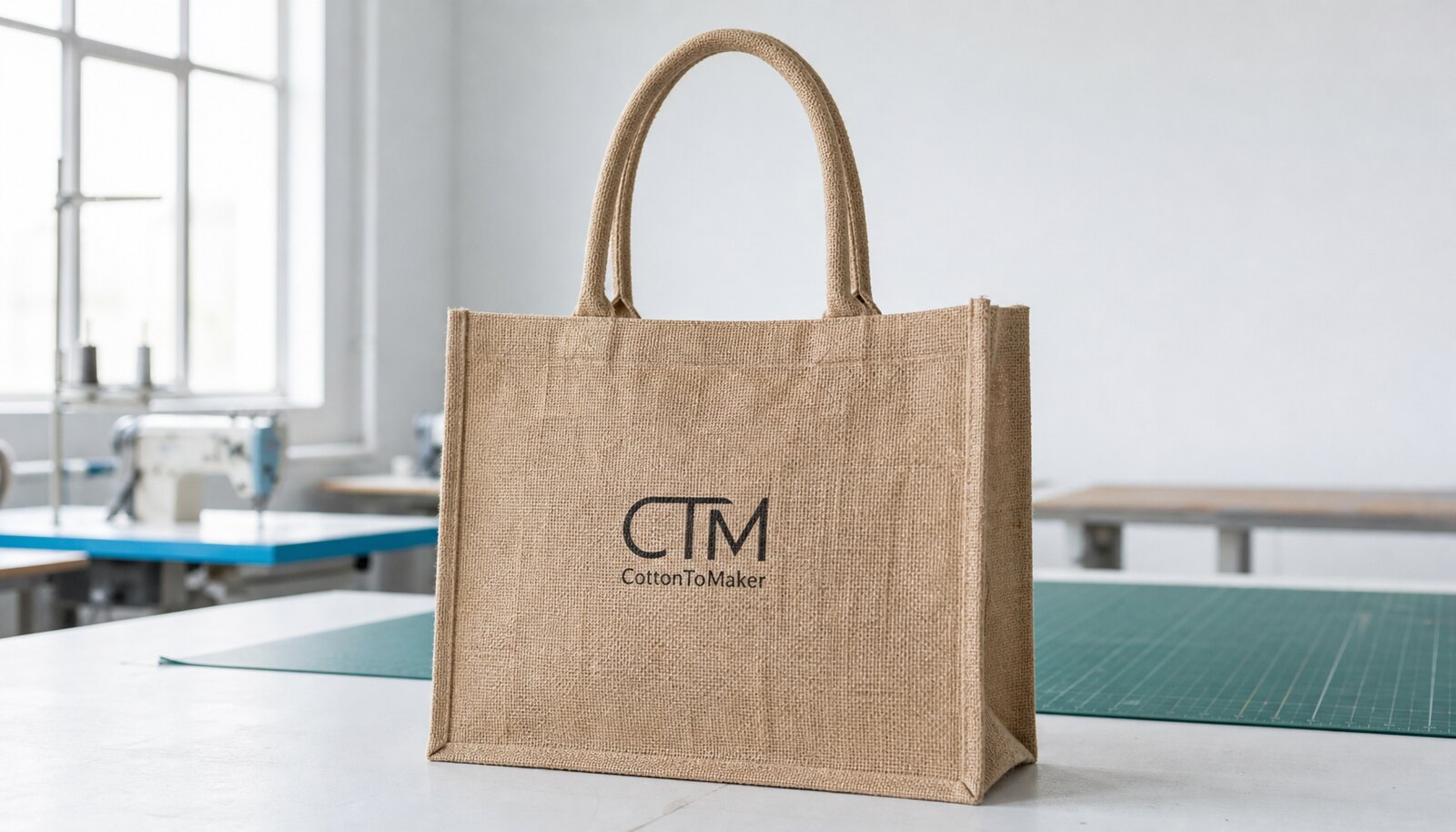
Why logo placement on jute totes matters to gift-shop buyers
For gift shops, the logo is doing several jobs at once. It has to sell the brand, look good on shelf, and stay readable when the bag is carried. On jute tote bags, those jobs are more sensitive because the weave is uneven, the seams are visible, and the bag shape changes after packing. A logo that appears centered in the sample room can still end up too close to the handle line, too low over a gusset fold, or partially hidden once merchandise goes in.
That is why logo placement should be treated as a product specification, not just an artwork note. Buyers for museum stores, souvenir shops, local gift chains, and tourist outlets need a bag that works in several real situations: on shelf, in product photos, at checkout, and in customer hands. If the logo is placed well, the tote reads as a retail item. If it is placed poorly, the same bag can look like a rushed giveaway even if the sewing and material are acceptable.
Repeatability matters as much as the first sample. Gift-shop programs often reorder season after season. If the first run is approved with a loose placement tolerance, the reorder can drift enough to create visible inconsistency across the rack. The safer process is to define the logo position in millimeters, approve it on a sewn sample, and make that signed sample the production reference.
- Treat logo placement as part of the product specification, not a last-minute artwork change.
- Check the logo on the bag empty, hanging, and lightly filled.
- Lock the approved position in millimeters if you expect repeat orders.
Start with the bag construction, not the artwork
Before choosing logo position, confirm what kind of jute tote you are buying. Natural jute, laminated jute, and jute-cotton blends behave differently in print, feel, and retail presentation. Natural jute gives the classic woven look many gift shops want, but the irregular surface can make small text and thin rules less reliable. Laminated or blended constructions often give a cleaner print surface, but the hand-feel changes and any sustainability wording may need to be reviewed before ordering.
Bag size changes placement decisions as well. A small souvenir tote does not have the same usable print zone as a larger shopping bag. A front logo that looks balanced on a medium tote may feel too small on a larger bag or too crowded on a compact bag with short handles. The usable print area is determined by the finished bag after sewing, not by the flat cut panel, so the supplier should provide a measured drawing before artwork is approved.
Ask for three items together: finished dimensions, construction details, and a factory drawing showing the maximum printable area. That drawing should show the top seam, side seams, gusset fold, handle anchor points, and any lining or reinforcement that changes the print zone. Without that, logo placement is guesswork.
- Choose construction first, then fit the artwork to the bag geometry.
- Ask for a measured line drawing of the finished bag, not only a mockup.
- Do not accept a quote that ignores seams, gussets, or handle anchors in the print area.
How to choose the best logo position on the front panel
For most gift-shop programs, front-center placement is the best default because it gives clear shelf visibility and matches how customers look at the bag. The important point is that the logo must be centered on the finished bag, not only on the flat panel. Top seam allowance, handle stitching, and gusset depth can shift the usable space. A mark that looks centered on the cut piece may still sit too high after handles are sewn or too low once the bag is filled.
Use a measured placement note. A practical spec might call for the logo centerline to align with the bag centerline, with the top of the mark set a defined distance below the finished top seam. The exact number depends on bag height, handle style, and logo height. A larger bag can tolerate a lower placement; a compact bag usually needs the logo moved higher so the front panel does not look empty or bottom-heavy.
Side placement can work for a quieter brand look, or when the front panel already carries another graphic, but it is usually secondary. Back-panel print is useful for event merchandise or bags that are often photographed from behind, but it does not replace a readable front mark for retail recognition. For most gift-shop buyers, the commercial choice is a clean front logo first, with any extra branding added only if it improves the product rather than cluttering it.
Check the bag in three states: empty on a shelf, hanging by the handles, and lightly filled. The logo should remain readable in all three. If it disappears behind the handle line when carried, it is probably too high. If it sits too close to the base fold, it may look heavy and be exposed to more wear.
- Front-center is the safest default for retail visibility.
- Measure position on the finished bag, not the pre-sewn panel.
- Review the bag empty, hanging, and lightly loaded before approval.
Placement examples and tolerance ranges you can actually specify
Many logo-placement problems come from vague wording like “centered” or “nice position.” Use a measurable layout instead. The table below gives practical starting points for common gift-shop tote sizes. These are not universal rules; they are procurement reference points to help you ask for the right drawing and sample. Final numbers should be confirmed against the actual bag construction and logo size.
A good spec separates centerline, top clearance, and printable height. For example, if a medium tote has a finished body height around 350 mm, a buyer might ask for the logo to sit on the front panel with a centerline aligned to the bag center and a top margin that leaves room above the print before the handle anchors begin. If the bag is shorter, the mark often needs to move up slightly to avoid crowding the gusset fold.
Tolerance should match the visual sensitivity of the artwork. A bold one-color logo can usually tolerate a little more variation than a logo with fine lettering. For procurement purposes, it helps to define the acceptable shift from the approved sample in millimeters and then note whether the shift is measured left-right, up-down, or both. That prevents “close enough” from becoming the default during mass production.
Decoration methods: what prints cleanly on jute and what does not
Screen printing is still the most practical method for branded jute tote bags when the logo is simple, the color count is low, and the buyer wants repeatability. It works best with thicker lines and clean shapes. On rough jute, the ink sits over an uneven weave, so very small text, fine outlines, and tight registration can soften at the edges or disappear into the fiber texture. A design that looks crisp on screen may lose clarity once it reaches the woven surface.
Heat transfer can be useful for short runs or multi-color artwork, but it needs caution. It can deliver more detail than direct print in some cases, yet on textured jute the transfer may feel less integrated with the fabric and can show film edges if the tote is folded tightly. Use it only when the artwork truly needs that level of detail and the supplier has already proven adhesion on the exact construction.
A woven label or sewn patch can solve a different problem: premium presentation. If the gift shop wants a boutique feel, or if the jute surface is too rough for a fine print, a label may be the most controlled option. The tradeoff is extra sewing, a different look, and potentially a different MOQ. Embossing or debossing is generally a fit for coated or laminated surfaces rather than standard natural jute.
The practical rule is simple. Use print for bold logos and controlled cost. Use a sewn branding element when the brand needs a more refined finish or the surface is hard to print cleanly. Rework the artwork if the design depends on fine details that the material cannot support.
- Use screen print for bold logos, repeat orders, and tighter cost control.
- Use a woven label or patch when premium appearance matters more than the lowest unit price.
- Avoid tiny serif fonts, thin outlines, and long taglines unless the supplier has already proven the method on the exact jute construction.
Comparison table: sourcing routes, decoration methods, and logo-placement tradeoffs
Not every sourcing route gives the same level of control. A buyer should weigh how much review time is available, how many SKUs are being bought, and whether the order is a test run or a repeat program. The table below compares common procurement choices from a buyer standpoint, not just a design standpoint. The best option is the one that protects the logo spec, supports the lead time, and still fits the target landed cost.
For gift-shop chains, consistency often matters more than chasing a slightly lower factory quote. A logo that lands correctly on the first lot but drifts on the reorder creates more cost than it saves. That is why a direct factory relationship is often the cleanest route when the spec is stable and documentation matters. Trading companies can still help when the order is mixed, the timeline is short, or consolidation is the priority—but buyers should ask more questions about who actually makes the bag and who controls the print step.
- Compare landed cost, not only unit price.
- Expect MOQ to rise when you add extra branding steps or tighter approval controls.
- Normalize all supplier quotes to the same packing, decoration method, and bag build before comparing.
What the pre-production sample must prove before bulk order release
A blank bag does not prove anything about logo placement. A digital mockup does not prove handle clearance, print registration, or seam interaction. The sample that matters is a sewn pre-production sample made with the real fabric, the real print method, the real logo position, and the real packing method. Anything less can hide defects that become expensive once production starts.
Inspect the sample in the same way the end customer will experience it. Lay it flat to confirm the print position and edge distances. Hang it by the handles to see whether the logo shifts visually. Lightly fill it with a representative merchandise weight to check whether the front panel puckers, tilts, or distorts. If the bag will sit on shelf, look at it from about one meter away, which is a realistic retail viewing distance.
The approval note should state exactly what was accepted: bag size, construction, logo size, position, color reference, and packing style. If the factory later changes the stitch line, handle length, or print layout, the note should make clear that the sewn sample—not a general email—is the production standard. If a correction is needed, ask for a revised sample rather than approving a promise in writing. A small placement error can repeat across the full lot.
- Measure the logo on the actual sewn bag, not on the artwork file.
- Check the bag empty, hanging, and lightly loaded under normal lighting.
- Approve the sample in writing and keep one signed reference piece for inspection.
MOQ, pricing, and the cost drivers buyers should compare side by side
MOQ is usually driven by several factors, not one. With jute tote bags for gift shops, the minimum can change when you add a second print location, a premium label, special lining, or a tighter pack-out. A simple one-color front print on a standard bag is the easiest configuration to manufacture. Add another branding step or a more complex setup, and the factory may need extra scheduling or more material reservation.
When comparing quotes, look beyond unit price. Fabric GSM, handle material, print method, pack density, carton dimensions, and sample revision charges all affect the landed cost. Freight matters because jute bags are bulky. A quote that looks cheaper at the factory can become more expensive after cartons are enlarged to protect the printed panel or after compression is reduced to avoid creasing the logo. For procurement, the useful number is landed cost per sellable unit, not the first quote line.
Watch for hidden assumption changes. One supplier may quote a laminated bag with better print clarity, while another quotes untreated natural jute with more visible weave variance. One may include a standard polybag; another may quote loose bulk packing. If those details are not spelled out, the comparison becomes misleading. Normalize each quote to the same size, same artwork, same packing, same sample route, and same delivery terms before awarding the order.
- Compare landed cost, not only unit price.
- Expect MOQ to rise when you add extra branding steps or tighter approval controls.
- Normalize all supplier quotes to the same packing, decoration method, and bag build before comparing.
QC details that matter in production, not just in theory
Quality control for jute tote bags should be tied to measurable defects. The goal is not to say the bags should look good; it is to define what good means in a way an inspector can apply. For logo placement, specify the center-point tolerance, the minimum clearance from seams, and the acceptable variation from the approved sample. Set the tolerance based on bag size and artwork sensitivity. A large logo with simple shapes can tolerate slightly more variation than a detailed mark with small text.
Inspect the print, the structure, and the pack-out as separate layers. For print, look for feathering, incomplete fill, misregistration, ghosting, and uneven ink density. For structure, check handle anchor stitches, side seams, bottom seam integrity, and whether the bag stands symmetrically. For pack-out, verify that the printed panel is not crushed and that carton markings match the SKU and artwork version. The product should pass all three layers together.
A practical inspection flow is useful. First, pull a small sample from the carton and compare it to the signed reference sample. Second, measure the logo location and bag dimensions. Third, fold and rub the printed area lightly to check for transfer or cracking. Fourth, load the bag with a representative weight to see whether the logo panel distorts under stress. Fifth, inspect the carton for handling damage and moisture exposure. That sequence catches the problems buyers actually care about.
For AQL, use the inspection plan that matches the lot size and risk level, then tighten the defect definitions when logo placement is critical. A bag may tolerate slight natural fiber fuzz, but it should not tolerate a visible shift into seam allowance, a broken handle anchor, or a logo that is hard to read at normal viewing distance. If the shipment is seasonal or time-sensitive, the first run may need stricter acceptance thresholds because there is less room for rework.
- Define acceptable placement and print variation in millimeters, not in general terms.
- Inspect print, structure, and packing as separate quality layers.
- Use a real handling test with representative weight before approving the bulk lot.
Packing, carton marks, and retail presentation decisions
Packing affects both cost and presentation. Jute tote bags can look right at the factory and still arrive with creased logo panels if the packing is too compressed or if the printed side folds against a hard edge. For gift-shop buyers, the main question is whether the bag is a warehouse item or a shelf-ready item. If it is a warehouse item, bulk packing with careful panel orientation may be enough. If it is shelf-ready or impulse-gift-ready, individual protection may justify the extra cost.
The pack-out should be specified in the RFQ because it changes freight and retail readiness. Ask the supplier to quote bags per inner, inners per carton, carton dimensions, and whether the printed panel faces inward or outward. If the logo is directional, insist on a packing method that prevents misoriented stacking. If the gift shop wants a premium unboxing feel, ask whether the factory can add tissue, inserts, or individual protection without distorting the tote shape.
Carton marks should be accurate. The SKU, color, logo version, and quantity per carton need to match the order sheet. When multiple gift-shop programs run at the same time, sloppy carton marks create receiving delays and picking errors in the warehouse. A supplier familiar with retail programs should be able to provide clear master carton identification and a clean packing list.
Before bulk, test one packed carton. Check whether the printed area creases, whether the bags can be removed without scuffing the logo, and whether the carton survives normal handling. A few minutes here can prevent a warehouse rejection later.
- Ask whether the printed side faces the same direction in every carton.
- Confirm carton marks, SKU labels, and quantity per carton before release.
- Test one packed carton for creasing and handling damage before approving mass packing.
Specification comparison for buyers
| Procurement decision | Recommended option | When it fits | Buyer risk to check |
|---|---|---|---|
| Logo placement | Front-center on the finished main panel, measured from the sewn bag edge | Gift shops that want clear shelf visibility and readable carry-side branding | Confirm top seam allowance, handle anchor position, and gusset depth before approving the mark |
| Placement target reference | Use a measured drawing with centerline, top margin, and side margin in millimeters | Any order where repeatability or reorders matter | Do not approve artwork measured on the flat cut panel only; sewing changes the final position |
| Primary decoration method | Screen print for one- to two-color logos with thicker strokes | Repeat orders, souvenir retail, and budget-sensitive programs | Thin lines and small text can fill in on rough weave; require a physical strike-off |
| Premium decoration method | Woven label or sewn patch | Boutique gift shops, museum stores, and higher-value retail packaging | Added sewing position, label size, and MOQ can change the quote materially |
| Surface construction | Natural jute for texture; laminated or blend constructions when sharper print edges matter more than raw fiber look | When the brand needs better logo definition or a cleaner front panel | Clarify sustainability language and fold behavior if lamination is used |
| Bag size control | Quote by finished size plus gusset depth and handle drop, not by generic tote type | Any SKU intended for a fixed shelf program or a recurrent reorder | A larger bag may need a larger logo or a higher placement to avoid looking sparse |
| Handle construction | Reinforced handles with box-X or bar-tack style anchoring | Bags carrying heavier purchases or reused many times | Weak anchors can distort the front panel and pull the logo out of alignment |
| Sourcing route | Direct factory for stable specs and repeatable artwork control; trading route only when consolidation is the priority | When consistency, proof control, and traceability matter | Ask who actually makes the bag and who signs off on the final sample |
| Packing method | Bulk pack with panel protection; individual wrap only when shelf presentation requires it | Warehouse-driven programs or retail-ready gifts | Over-compression can crease the logo panel and create rejectable set marks |
Buyer checklist before sampling
- Confirm finished bag size, gusset depth, handle drop, and usable print area in millimeters.
- Specify bag construction: natural jute, laminated jute, jute-cotton blend, or another surface, and ask how it affects print results.
- State logo method, number of colors, Pantone targets, minimum line thickness, and whether small text should be removed before sampling.
- Request a sewn pre-production sample with the actual fabric, actual logo position, and actual packing method.
- Ask what is included in unit price, sample price, plate or screen charge, packing, inner polybags, and carton marks.
- Set acceptance criteria for placement, print blur, seam alignment, stitch quality, loose fibers, odor, and carton condition.
- Define whether the printed panel must face the same direction in the carton and whether compression marks are acceptable.
- Keep one approved sealed sample, one signed spec sheet, and one final artwork file version as the production reference.
Factory quote questions to send
- What is the finished bag size after sewing, and what is the maximum usable print area after seams, handles, and gusset allowance are included?
- Which decoration method is included in the quote, and what does that method allow or restrict on rough jute surfaces?
- Is the quoted logo position measured from the finished bag edge, the top seam, or the cut panel, and can you show the drawing used for that measurement?
- What fabric construction, GSM range, handle material, and reinforcement details are included in the sample and bulk price?
- How many sample rounds, strike-offs, or revisions are included before bulk, and what is the charge if logo placement needs correction?
- Do you quote the same pack-out for sample and bulk, and what are the carton dimensions, inner pack quantity, and compression level?
- What is the expected bulk lead time after sample sign-off, and what events would extend that timeline?
- Can you provide inspection records or QC checkpoints for print alignment, stitch strength, dimensional tolerance, and carton damage prevention?
- If we add a second logo placement or change the logo size, how will unit price, MOQ, and lead time change?
- Who is the actual factory producing the bags, and who signs off on the final production sample?
Quality-control points to confirm
- Placement accuracy: define centerline, top margin, and side margin tolerance on the approved sample, then measure a random selection during inspection.
- Print sharpness: check for feathering, broken edges, washed-out fill, misregistration, ghosting, or ink bleed, especially on fine text and thin lines.
- Artwork durability: fold and rub the printed panel to see whether the ink transfers, cracks, or scuffs before bulk release.
- Fabric consistency: compare weave appearance, thickness feel, and surface finish against the approved sample; reject obvious material substitution.
- Stitch quality: inspect handle anchors, side seams, and bottom seams for skipped stitches, loose thread tails, broken thread, or uneven tension.
- Dimensional tolerance: verify finished length, height, gusset, and handle drop using the same method on all samples and audit pieces.
- Load behavior: test a representative bag with realistic merchandise weight to check handle pull, panel distortion, and seam strain.
- Packing condition: confirm no crushed print panels, no excessive creasing, no moisture damage, and no carton collapse during handling.
- Cleanliness: reject strong chemical odor, visible oil marks, rust marks, mildew, or heavy fiber shedding on retail-facing areas.
- AQL guidance: use a normal inspection plan matched to lot size, then tighten defect definitions when logo placement is critical or the season is time-sensitive.