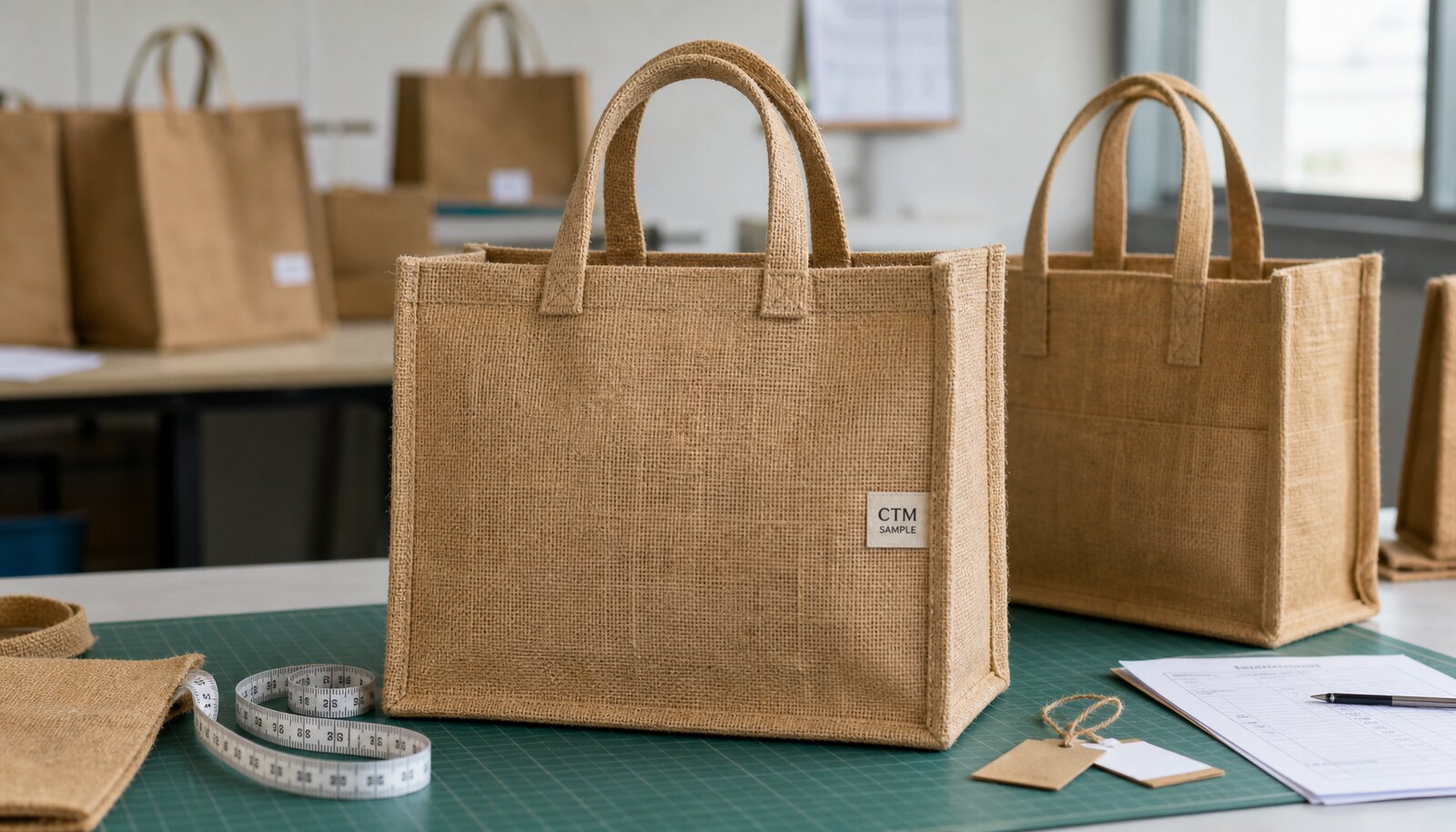
Why durability matters more for gift shop jute totes than many buyers expect
Gift shop totes are judged in two moments: at the shelf and after the customer leaves the store. That makes them different from ordinary promotional bags. A tote that looks rustic but stable on display can still disappoint if the handles soften, the print scuffs, or the body slumps after a short walk through town. For retailers, the bag becomes part of the brand experience, so durability is not a technical afterthought; it is part of the selling proposition.
The commercial risk is broader than a simple replacement claim. Weak construction can lead to returns, negative feedback at the counter, or a product that fails to justify a premium price point. In gift shops, shoppers often compare a tote against other finished retail items on the same table, so rough stitching, loose fibers, or poor print alignment stand out quickly. Procurement has to think in retail terms: presentation, repeated handling, and perceived value matter as much as raw strength.
That is why jute tote bags for gift shops durability testing checklist work best when they are tied to actual use cases. A small souvenir bag carrying postcards does not need the same construction as a large tote that will hold candles, framed prints, or boxed gifts. If the bag is supposed to survive multiple customer outings, the test plan should reflect repeated lifting, friction from clothing or car seats, and the visual wear that accumulates across ordinary use.
- Gift shop totes need both shelf appeal and repeat-use strength.
- Weak points usually appear first at the handles, print surface, or top hem.
- A durability checklist should reflect the real merchandise mix, not a generic load.
- Retail presentation matters because the bag itself is part of the gift-shop brand experience.
Start with the right jute specification: body weight, weave, and finish
The body fabric is the foundation of the bag, but body weight alone does not tell the whole story. A common procurement starting point is 300-400 GSM jute for mid-size retail totes, with higher weights reserved for larger bags or heavier gift sets. Within that range, the weave tightness, finish, and consistency matter as much as the number on the spec sheet. A loose weave at the same GSM can behave very differently from a tighter construction when the bag is loaded, folded, and packed.
Raw jute gives a natural, earthy appearance that works well for rustic or eco-themed merchandising, but it also sheds more fiber and absorbs odors more readily. Laminated or lined versions improve shape hold and clean up the interior finish, yet they can alter the hand feel and make packing more sensitive to compression. A buyer choosing between these options is really choosing the retail experience: softer and more natural versus more structured and premium.
One mistake is to let a supplier treat every natural-fiber tote as interchangeable. Gift shops often need a specific visual tone: a cleaner retail finish with less fuzz, a darker natural tone for premium collections, or a visibly rustic texture for souvenir assortments. Those are different products, and the quote should name the preferred appearance, acceptable shade variation, and any limits on loose fiber, odor, or surface staining. Clear appearance language prevents the factory from using cheaper-looking material that still counts as jute on paper.
- Specify GSM and also ask for weave tightness or weave photo.
- Decide whether the bag should look rustic or retail-refined before quoting.
- State if the tote must stand upright on shelf or can collapse softly.
- Add limits for lint, odor, and shade variation to avoid vague approvals.
Comparison matrix: construction choices and supplier routes that change durability outcomes
A useful comparison is not just about price. It should show how construction choices affect real-world durability, how much control the buyer retains, and where the quote can conceal risk. Direct factory sourcing, for example, usually gives better visibility into sewing, printing, and packing, while a trading route or integrator may bundle several steps together and make it harder to see where the material was changed. That does not automatically make a trading route bad, but it does mean the buyer has to ask for more evidence.
The matrix below separates construction decisions from sourcing routes. Use it when comparing suppliers that look similar on unit price but differ in how the bag is built or who actually performs the work. For gift shop programs, the best choice is often the one that balances presentation, repeatability, and traceable QC, not just the one that offers the lowest landed cost on the first order.
The key procurement question is whether the supplier can repeat the approved bag at scale. A pretty sample is not enough. A tote that survives a one-off demo may still fail if the handle anchors are shorter in production, the print ink changes, or the carton packing compresses the body more tightly than the sample. The comparison matrix should point the buyer toward verifiable decisions before a PO is issued.
What a real durability testing checklist should measure on jute tote bags for gift shops
Durability testing should be practical, repeatable, and tied to gift-shop use. The most useful checks are handle pull strength, top-edge distortion, seam integrity, print rub resistance, odor after unpacking, and carton protection during transit. If a tote is intended for heavier retail contents such as candles, ceramic souvenirs, or boxed gift sets, the test load should reflect those items rather than a lightweight general-purpose standard. The aim is not to simulate every possible abuse case. It is to catch the failure modes most likely to affect retail performance and customer satisfaction.
A workable checklist uses the same sample size, load weight, cycle count, and pass/fail criteria across all suppliers. That is the only way one quote can be compared to another. Without a standard method, one factory might test lightly by hand, while another uses a more meaningful pull and rub check, and both still say the bag was tested. Buyers should therefore insist on the method being written in the spec pack, not left as a verbal assurance.
There is also a useful distinction between validation and screening. Validation asks whether the construction can survive normal retail use. Screening asks whether there are weak points that will show up under repeated stress or transport abuse. The first protects customer experience; the second protects the order from hidden defects. Together they make the checklist useful for procurement rather than merely descriptive.
- Test the same way on the sample, pilot run, and pre-shipment lot.
- Use retail-relevant loads: candles, jars, books, or boxed gifts if that is the real use case.
- Capture the method in writing so every supplier is judged by the same yardstick.
- Separate normal-use validation from stress screening to expose weak construction earlier.
Durability test methods, sample sizes, and pass/fail thresholds buyers can use
The table below gives a procurement-level test plan that is operational enough to insert into an RFQ or inspection sheet. It is not a lab substitute, but it does create a shared target for sample approval and production release. The sample sizes are intentionally modest so they can be used early in sourcing, then expanded if the order is large or the product is high value. For a first-time supplier, consider raising sample counts before bulk approval.
A simple plan usually works best: inspect dimensions, run a handle pull or static hold, check seam and top hem distortion, test print rub resistance, and review odor and surface contamination. If the bag is lined or laminated, add fold recovery and crease memory after unpacking. The pass/fail thresholds below are meant for retail tote use; if the bags will carry heavier content or be sold at a premium price point, tighten the limits rather than loosening them.
Escalation matters too. If one or two samples fail at the same point, the issue is likely design or process-related, not random noise. That should trigger rework, a revised sample, or a line-side corrective action before the order continues. If the problem appears across multiple samples, hold the lot and request evidence of root-cause analysis. Procurement value increases when the checklist tells the factory what happens next, not just what should be inspected.
- Use a small but defined sample set for each lot, not a single hero sample.
- Tie every failure to a response: rework, retest, or lot hold.
- Add fold recovery if the bag is lined or laminated.
- Treat repeated failures at the same seam or handle point as a process issue, not an isolated defect.
Handle, seam, and top-edge construction details that decide real-world strength
If a jute tote fails during use, the handle is often the first place to look. The handle root concentrates stress every time the bag is lifted, swung, or set down with weight inside. A strong-looking handle can still fail if the anchor is too short, the stitch density is inconsistent, or the load is concentrated near the edge of the body panel. For that reason, handle width alone is not a useful durability indicator. Buyers need the full construction detail: material, fold method, anchor length, and reinforcement stitch.
For gift shop bags, double-fold jute handles with box-X stitching or bar-tack reinforcement are often a solid starting point. Cotton webbing handles can improve comfort and perceived quality, but the attachment still needs to be strong enough to transfer load into the bag body. If the bag uses a gusset, confirm whether the handle anchor bridges a reinforced section or only rests on a single layer. A weak top edge can deform even when the handles themselves survive, so top hem quality deserves the same attention as the handle attachment.
The top opening also influences how premium the bag feels on shelf. A hem that twists, waves, or frays gives the tote a less finished look, especially under retail lighting. For a gift shop program, that visual issue is not cosmetic fluff. It changes how the product sells. Buyers should inspect the inside and outside of the top edge, not just the front-facing logo panel.
- Ask for handle width, fold method, anchor length, and stitch type in actual measurements.
- Confirm symmetry so the handle drop matches left to right.
- Review the inside of the top hem and the handle root, not only the front panel.
- Reject short anchors or edge placement that leaves too little fabric for load spread.
Print durability and branding placement: where jute bags usually start to look tired
Print performance on jute depends heavily on artwork design and ink choice. The rough weave can make fine lines look broken, and heavy ink coverage can crack or flake if the wrong method is used. For simple gift shop logos, screen print is often the most reliable starting point because it is repeatable and easier to control on textured fabric. That said, the best method still depends on the logo size, color count, and how much surface texture the buyer can tolerate.
Artwork placement is just as important as the printing method. Logos that sit too close to a seam, fold line, or gusset edge may distort during packing or become harder to read after first use. If the design crosses a seam by intention, the buyer should approve a placement diagram with tolerance windows. Otherwise, the artwork can shift enough to look off-center even if the print is technically within factory tolerance. For retail goods, that kind of small misalignment is very visible.
Print durability should be checked on the actual production fabric using both dry rub and lightly damp rub tests. The concern is not only obvious smearing. It is also edge break-up, loss of definition around the letters, and a printed area that starts to look worn after a few handlings. A good approval sample should show what the bag looks like after handling, not just the moment it leaves the print screen.
- Use screen print for simple repeat artwork unless the fabric testing supports a different method.
- Keep logos away from seam crossings and fold lines unless the design intentionally uses them.
- Run dry and damp rub tests on the actual production bag surface.
- Approve a placement diagram with tolerance windows before mass production.
Sample approval: what to verify before a bulk order is released
The approved sample should be made from production material, with the final handles, thread, print, lining, and packing method. A presentation sample that looks cleaner than production is not enough to manage a retail order. Procurement needs to judge the real manufacturing state, including fiber texture, stitch finish, odor, and fold behavior after carton compression. If the factory cannot make a sample from the same input materials it will use in the order, the approval process has not really started.
A practical sample review checks size, handle drop, print alignment, seam quality, and the way the tote sits when empty. If the bag is lined or laminated, refold it several times and see whether permanent creases or stiff corners appear. If the bag is intended for shelf display, place it upright and see whether it collapses unevenly. This matters because a bag can be dimensionally correct and still look wrong in retail presentation.
It is also useful to record the acceptable natural variation. Jute is a natural fiber, so some shade shift, flecking, and weave irregularity is normal. The buyer should define where variation is acceptable and where it becomes a reject. Without that line, the supplier may assume that all natural irregularity is fine, while the retailer expects a more uniform finish.
- Approve only a sample made from production fabric and final packing.
- Check fold recovery, shelf stance, odor, and seam finish, not only size and print.
- Store the approved sample as the reference unit for inline and final inspection.
- Document acceptable natural variation so the factory knows the reject boundary.
QC checklist: measurable inspection standards for production and pre-shipment review
A strong QC program has three layers: incoming material checks, inline checks during sewing and printing, and final pre-shipment inspection. Each layer should use measurable limits so the factory cannot rely on vague language like checked and okay. For jute totes, the inspection program should be simple enough to execute but strict enough to catch the defects that affect shelf value and customer use. That balance matters more than a long list of generic inspection points.
Incoming inspection should verify fabric weight, weave consistency, odor, and accessory quality such as handles, labels, and thread. Inline checks should focus on handle placement, seam continuity, print registration, and trimming. The final inspection should confirm dimensions, load behavior, pack cleanliness, carton count, and master carton condition. If the tote is a seasonal retail item, the final appearance check should happen under normal retail lighting rather than only under bright factory light.
Defect classification is where the checklist becomes operational. A critical defect includes handle detachment, major seam opening, contamination, or a print issue that makes the bag unsellable. Major defects include obvious size mismatch, severe print misregistration, or strong odor. Minor defects are cosmetic issues that do not affect use, such as slight natural variation or short loose threads under the agreed limit. The supplier should know which defect level triggers rework, sorting, or lot rejection before production begins.
- Set three defect classes: critical, major, and minor.
- Mirror the same QC limits in the factory's internal sheet and the buyer's inspection report.
- Add pack cleanliness and carton count to the final inspection, not just bag appearance.
- Inspect retail-facing appearance under ordinary lighting if the bag is sold from shelf or display table.
Traceability and supplier verification: how to confirm in-house control versus outsourced steps
One reason jute tote quotes can look attractive is that some suppliers bundle multiple production steps without clearly stating who performs them. A factory may sew in-house but outsource printing, or outsource both handles and packing while still presenting itself as a full maker. That is not automatically a problem, but it becomes a quality risk if the buyer cannot see where materials are changing. The durability checklist should therefore include process traceability, not just product dimensions.
The most useful evidence is a simple process map: where the fabric is cut, where the handles are made, where printing happens, where sewing is completed, and where final packing occurs. If any step is outsourced, ask for the subcontractor's role, control method, and lot identification practice. The goal is not bureaucracy. It is to know whether the approved sample and the bulk order share the same production chain. If they do not, the buyer should expect more variability and maybe tighter pre-shipment review.
Verification should also reach beyond a certificate logo. Ask for recent in-house inspection records, a named person responsible for final release, and proof that production lots can be traced back to fabric, handles, and ink batches. When a defect appears after shipment, traceability is what tells the buyer whether the issue is isolated or systemic. A supplier that can show lot-level traceability is usually easier to manage on repeat orders because claims can be investigated faster and corrective action can be tied to specific production inputs.
- Request a process map showing cut, print, sew, pack, and release steps.
- Confirm which steps are in-house and which are outsourced.
- Ask for lot traceability from finished cartons back to fabric and handles.
- Request the name or role of the person who signs off final release.
Specification comparison for buyers
| Construction or supplier route | Best fit for gift shops | Durability upside | Watch-out | How to verify before PO |
|---|---|---|---|---|
| Raw jute, unlined | Low-cost souvenir totes, light retail items, rustic merchandising | Lightweight, natural look, lower material cost, easy to pack flat | More fiber shedding, softer shape, less moisture resistance, print can look uneven on rough weave | Ask for exact GSM, weave photo, and a pre-production sample made from production cloth |
| Raw jute with reinforced handles | Mid-market gift shop totes carrying candles, books, or boxed gifts | Better load transfer without fully changing the rustic look | Handle root can still fail if anchor length or stitch density is weak | Request a close-up of handle root, stitch count, and pull-test result on the actual sample |
| Lined jute tote | Premium gift retail, structured shelf display, higher perceived value | Improved shape retention, cleaner interior, better presentation | Adds sewing complexity, can raise MOQ, and may create more lead-time risk | Confirm lining fabric, seam finish, and whether the lining is sewn in-house or outsourced |
| Laminated jute tote | Humidity-prone routes, bags needing stronger body, cleaner retail feel | Better moisture resistance and shape hold, less slumping on shelf | Can trap odor or crease memory if the material is not aired and packed correctly | Check odor after unpacking, fold recovery, and packing method before approving bulk |
| Screen-printed direct factory order | Repeat designs, simpler logos, seasonal gift shop programs | Usually the most repeatable on textured jute for 1-3 color artwork | Fine details can break up if the screen and ink are not matched to the weave | Approve on production fabric and require rub testing on the actual print area |
| Hybrid supplier with outsourced print or sewing | When a factory can manage sourcing but not every step in-house | May offer flexibility on artwork, handles, or special trims | Traceability drops if sub-suppliers change fabric, thread, or ink without notice | Ask for process map, named subcontractors, lot traceability, and in-house vs outsourced proof |
Buyer checklist before sampling
- Confirm finished size, gusset depth, handle drop, and whether the tote must stand upright on shelf.
- Define body fabric weight in GSM or oz, plus whether the bag is laminated, raw jute, or blended with cotton or canvas trim.
- Specify handle width, stitch pattern, reinforcement method, and acceptable pull load or use-case limit.
- Approve print method, artwork placement, Pantone target, and minimum readable line thickness.
- Set odor, lint, and appearance limits for natural fiber variation so the supplier knows what counts as rejectable.
- State packing method, carton count, carton marks, polybag or moisture barrier needs, and any shelf-ready retail requirements.
- Request production sample images, inline QC photos, and final carton photos before shipment.
- Build lead time around material booking, sample approval, print setup, sewing capacity, and ocean or air freight timing.
Factory quote questions to send
- What exact jute fabric weight, weave, and finish will be used, and can you name the production source or mill spec?
- Will the handles be self-fabric jute, cotton webbing, or a mixed build, and what reinforcement stitch will be used at the anchor points?
- How many print colors are included in the quoted price, and does the quote cover screen setup, plate fees, or sampling charges?
- What is the MOQ by size and by print version, and what cost changes if we split orders across two artwork designs?
- Can you provide a pre-production sample made with production material, plus a photo set of stitching, print alignment, and carton packing?
- What are the expected production lead time and packing lead time, and where can schedule slip occur if artwork or material approval is delayed?
- What QC standard will be used for seam strength, print rub resistance, odor, size tolerance, and carton compression?
- What is included in the quote for inner packing, moisture protection, carton labeling, and export master carton marks?
- Can you share factory audit evidence, including current certifications if relevant, recent in-house inspection records, and the name of the person responsible for final release?
- How do you trace fabric, handles, ink, and finished cartons back to specific lots if a defect is found after shipment?
Quality-control points to confirm
- Body size tolerance: keep finished length, height, and gusset within +/- 0.5 cm for small totes and +/- 1.0 cm for larger totes, unless the buyer approves a wider range in writing.
- Stitch quality: no skipped stitches, loose thread nests, broken thread ends longer than 5 mm, or open seam ends at handle joins, gussets, or top hems.
- Stitch density: target a consistent 6-8 stitches per inch for most retail jute totes, or a buyer-approved equivalent that is repeated across all anchors.
- Handle strength: pull testing should focus on the handle root and top edge, where failure usually appears first; reject if stitches pop, seam opens, or handle slips visibly.
- Handle symmetry: left and right handle drop should match within 0.5 cm on small bags and 1.0 cm on larger bags.
- Print alignment: artwork should sit within the approved placement window and not drift across seam lines unless intentionally designed; no visible double image or misregistration beyond 1.5 mm for simple logos.
- Print durability: dry rub test and lightly damp rub test should show no flaking, smearing, or obvious edge break-up after the agreed number of rub cycles.
- Odor and contamination: no strong chemical odor, mildew smell, oil stains, loose fibers in the pack, or visible foreign contamination on bag surfaces or inside cartons.
- Edge finishing: top hem, gusset joins, and side seam ends should be trimmed cleanly with no fraying that affects appearance or use.
- Carton packing: cartons should protect corners, avoid crushing, keep bags dry and clean during transit, and hold the agreed pack count with no overstuffing.