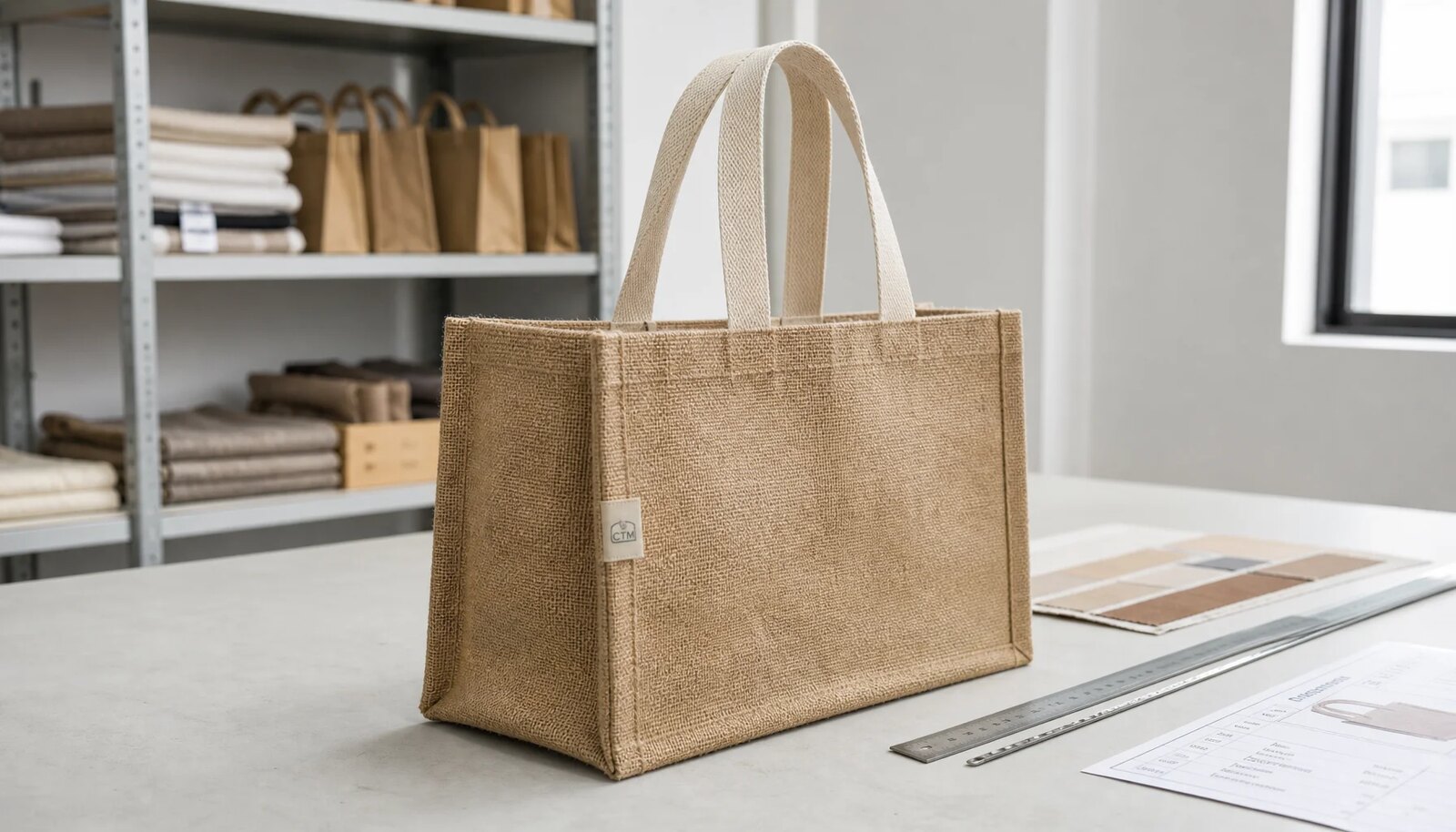
Start With the Date the Bags Must Be in Hand
For farmers market vendor programs, the purchase date is not the real deadline. The real deadline is the first day the bags must be available for sale, distribution, or campaign handoff. That date may be tied to a spring market opening, a harvest launch, a membership drive, a retail promo, or a seasonal re-order. Once the go-live date is fixed, every earlier task has to be planned backward from it. If the calendar starts at the factory, the project usually drifts. If it starts at the market date, the order stays anchored to the business need.
A jute tote order passes through several steps before a buyer can receive usable stock. Artwork has to be approved, the bag spec has to be quoted, samples have to be made, the pre-production sample has to be signed off, bulk production has to run, cartons have to be packed, freight has to be booked, and the shipment has to clear customs or the domestic transit lane. None of those steps are difficult on its own. The problem is that they sit in sequence. A delay in any one step can push the entire order past the window where the bag is still useful.
That is why the first planning document should show the last safe date for each milestone, not only the target ship date. Procurement should list the approval owner for artwork, sample review, purchase order release, freight booking, and receiving sign-off. When responsibility is not explicit, the schedule does not fail because the factory was slow. It fails because someone waited too long to answer a question. That is a different problem, and it needs to be managed differently.
Seasonal orders also need a buffer for congestion. Spring and holiday buying periods are busy for fabric, print, shipping, and customs lanes. A buffer is not a sign that the plan is weak. It is a sign that the team understands the order has to survive more than one production stage. If the sales window is fixed, the safest approach is to reduce complexity early and keep enough time in reserve to absorb the inevitable revision or transit delay.
- Work backward from the first market weekend or launch date, not from the factory's ideal completion date.
- Write the last safe date for each milestone so the team can see where the real risk sits.
- Assign one owner per approval step to avoid delay from internal handoffs.
- Keep a seasonal buffer for artwork changes, freight congestion, and customs review.
Translate the Use Case Into a Quoteable Spec
A jute tote is not just a size and a logo. It is a working carry item, and the intended use should shape the entire specification. A bag for light flyers or gift packs can be thinner and simpler. A bag for produce, bread, jars, or subscription pickup needs a stronger seam package and more thoughtful handle reinforcement. A tote sold at retail may need a firmer body, cleaner edge finishing, and more stable shelf behavior than a tote handed out for a one-day event. Buyers who define the use case early tend to get better quotes because the supplier is not guessing at the construction.
The spec sheet should read like an instruction set, not a brand story. It should include body width, body height, gusset depth, handle length, handle drop, handle width, fabric weight, color, print area, label location, and any insert board or liner requirement. If the bag needs to stand upright on a market table, say so. If the bag is expected to carry glass jars, say that too. The factory does not need a marketing narrative. It needs enough detail to choose the right pattern, seam, and reinforcement method.
Weight language should be unambiguous. Many buyers talk about ounces or GSM without confirming how the supplier measures the fabric. If the quote is for 12 oz jute, 14 oz jute, or 16 oz jute, ask the supplier to confirm the GSM conversion in writing. That matters because weight changes sewing time, freight weight, carton fill, and the feel of the bag in hand. A bag that seems inexpensive in the quote can cost more to ship or may not hold shape as expected once packed.
Spec discipline also makes quote comparisons possible. If one supplier quotes a body-only tote and another includes reinforcement, packaging, and a printed label, the lowest number is not the best number. Procurement gets better control when every supplier is quoting the same bag, not a different assumption dressed up as a like-for-like offer.
- State the carry use: produce, bread, jars, retail resale, gift pack, or giveaway.
- Define all dimensions and handle measurements before the RFQ goes out.
- Ask for the weight in both oz and GSM, then confirm the conversion in writing.
- Specify whether the bag needs a liner, insert board, lamination, or reinforced base.
Choose the Supplier Route That Matches the Calendar
There are three common paths for jute tote sourcing, and the best one depends on how much schedule control the buyer needs. A direct factory with an existing jute tote line usually gives the most stable control over dimensions, stitching, and packing because the team is already running a similar product. A stock blank plus decoration route can move faster if the buyer only needs a simple logo on a ready-made bag. A trading company can be useful when the program includes several bag categories or other merchandise, but that convenience comes with an extra communication layer.
Direct factory sourcing is often the best fit for repeat programs. It is easier to hold the same body shape, seam sequence, print location, and carton spec across seasons when the sewing line already knows the product. That matters when the tote is part of a farmer market vendor program that may need a reorder next season. The initial setup may take longer than a stock-blank purchase, but the downstream control is usually better.
Stock blanks solve a different problem. If the first shipment has to land fast and the buyer can accept fewer choices on size, color, or structure, a blank bag with local branding can be the shortest path to market. The tradeoff is that the buyer gives up control over the base bag and has to inspect the blank quality carefully. A blank that looks acceptable in a catalog may still have loose weave, uneven handles, or inconsistent sizes once it reaches the decoration stage.
A trading company can simplify vendor management, especially when a buying team wants one contact for multiple categories or freight bundles. The risk is that sample feedback may have to move through several people before it gets to the sewing line. That can turn a small correction into a schedule drag. For a fixed market date, the better route is usually the one with the fewest handoffs between the final decision maker and the production floor.
- Use a direct factory when repeatability and construction control matter most.
- Use stock blanks only when speed matters more than customization.
- Use a trading company when the communication and freight consolidation benefit outweighs the extra approval layer.
- Ask which route is actually making the bag, not just which company is selling it.
Set MOQ Around Setups, Not Wishful Volume
MOQ is rarely just a fabric question. For jute totes, the practical limit is often driven by print setup, handle variation, label application, folding method, or carton configuration. A one-color logo on one body size may run at a lower MOQ than a multi-color print with woven labels and retail inserts. Buyers need to know whether the MOQ quoted by the supplier is per style, per color, per print version, or per order total. If that is not clear, the number is not useful for procurement planning.
A low MOQ can still be expensive in schedule terms. When the factory has to split the run across versions or stop and start the sewing sequence, the order becomes harder to manage. The line spends more time changing over and less time producing. That is why a first order should usually stay simple: one body size, one handle spec, one print location, one carton configuration, and one packing method. Simplicity is not a compromise when the delivery date matters. It is often the most efficient way to hit it.
Procurement teams sometimes ask for multiple colors or sizes at the first buy because they want distribution flexibility. That can be the right commercial choice, but it has a production cost. Every added option introduces another sample review, another packing decision, and another chance for the line to pause. If the order is seasonal and the date is fixed, the team should only split variants when the business value is clearly larger than the schedule risk.
The safest approach is to use the first order as a controlled launch, not a full range test. If the tote performs well, the next buy can widen the assortment. If it does not, the company has not overcommitted inventory across too many versions. MOQ should protect the business, not push the buyer into an overcomplicated first run.
- Ask whether MOQ changes when labels, inserts, or special packing are added.
- Keep one body size and one print version if the schedule is tight.
- Confirm whether MOQ is quoted per color, per artwork version, or per total order.
- Treat the first order as a launch test, not as a final assortment plan.
Make the Artwork Work on Rough Jute, Not Just on a Screen
Jute is textured, and that texture affects how art prints. A logo that looks clean on paper or on a digital proof can gain fill-in, blur, or distortion on coarse weave. That is why the artwork should be simplified before screens are made. Screen printing is usually the most durable route for this material, but it works best with bold shapes, strong contrast, and generous spacing. Fine serif type, reversed text, and thin lines are the first things to review critically. If the design depends on delicate detail, it may be better suited to a label or insert than to the bag face itself.
For farmers market vendor bags, a one-color or two-color print is often the most dependable choice. It is easier to repeat, easier to inspect, and less likely to trigger rework. Heat transfer can work in some cases, but it adds another variable if the bag is folded tightly or packed under pressure. A woven label or sewn patch can produce a cleaner premium feel when the brand wants a more retail-ready look, especially if the tote is meant to be sold rather than given away. The point is not to avoid detail altogether. It is to place the detail where the fabric can support it.
Artwork placement matters as much as artwork shape. The logo should be readable from the distance at which the tote will be seen on a market table or in a shop display. That usually means enough letter height, sufficient contrast against the natural jute color, and a position that avoids handle attachments and side seams. The supplier should also mark what part of the print is vulnerable to misregistration, because rough weave can move small elements more than buyers expect. If the design has a slogan, a fine border, or small reverse text, the factory should call that out before proof approval.
The best approval habit is to review the design on real jute, not just in a file. A mockup can hide the way the weave softens the edge of the print. A fabric proof exposes that risk early. If the launch date is fixed, conservative artwork is usually the correct call. The bag needs to be legible, repeatable, and stable in production. The most intricate brand expression can live on the hangtag, label, or insert card instead.
- Favor bold, high-contrast artwork over thin or highly detailed graphics.
- Approve on real jute fabric so texture-related issues show up before bulk.
- Keep the logo clear from seams, handles, and other construction lines.
- Use labels or inserts for detail if the print needs to stay simple and reliable.
Treat the Pre-Production Sample as the Baseline
The pre-production sample is the production reference, not a showpiece. If the sample is approved loosely, the bulk order can drift from what the buyer intended. The sample should reflect final body dimensions, handle length, handle drop, seam allowance, reinforcement points, print placement, and packing method. If the bulk line will fold the bag differently, apply labels differently, or pack cartons differently from the sample, then the sample is not a true baseline and should be reworked before sign-off.
A useful sample review is practical and measured. Check the body width, height, and gusset. Inspect the top hem, bottom seam, and side seams. Confirm whether the handle feels stable in hand and whether the print sits where the buyer expects it to sit in normal use. If the bag is meant to carry weight, load one sample to the agreed target and look for early seam opening, handle pull-out, or body distortion. That quick function test is more useful than a polished photo.
Sample approval should also lock the small details that often become change orders later. Confirm whether the bag is flat packed or folded a certain way. Confirm whether the print is centered to the visible face or aligned to a seam. Confirm whether the handle ends are tucked, exposed, or finished in a specific way. If a label is part of the final product, the sample should use the same label method that bulk will use. Leaving those details open invites rework after the line has already started.
Once the sample is approved, the approval note should be written into the order file. That note should name the approved version, the remaining open items if any, and the exact points bulk production must match. A verbal okay is not strong enough when the order has a fixed arrival date. The sample needs to become a controlled reference that everyone can point to when questions come up mid-run.
- Measure the sample before approving it, not after bulk starts.
- Load-test at the agreed carry weight if the tote will hold heavier items.
- Lock packing, label method, and print placement in the sample approval note.
- Use the approved sample as the reference for both production and receiving QC.
Set Packing Rules Before Bulk Cutting Starts
Packing affects both the factory schedule and the receiving process, so it needs to be decided early. For jute totes, flat packing is common, but the buyer still needs to specify whether each bag needs an inner wrap, a paper band, a barcode label, a retail insert, or a moisture-protection layer. A single warehouse receiving one shipment may prefer simple bulk packing. A distributor or retailer serving multiple destinations may need clearer unit identification and more structured carton marking so the stock can be checked in quickly.
Jute is a natural fiber, so it should not be left to sit in poor conditions before or after shipping. If the shipment lane includes ocean freight or long storage, the buyer should ask for carton protection that reduces moisture and odor risk. Carton marks should be specific and match the packing list exactly: style, color, quantity, origin, and SKU information. Under-packing causes damage and messy receiving. Over-packing adds waste. The useful middle ground is the one that protects the bag and keeps the warehouse from spending time re-sorting cartons.
Packing also affects how the tote looks when it reaches the customer. If the fold distorts the print, crushes the gusset, or leaves the bag looking tired out of the carton, the retail impression weakens. If the pack is too loose, the shipment wastes cube and increases freight cost. The goal is not just to get the bags into boxes. It is to get sellable bags into boxes in a state that still looks intentional when they are unpacked at destination.
Before production starts, the buyer should know how many units go in each inner pack and how the warehouse will count them on receipt. If the carton count, carton size, and SKU mark do not match the buyer's receiving logic, the order slows down at the exact point where it should be closing cleanly. Packing is part of the product, not just a shipping detail.
- Define flat pack, inner wrap, label, and carton count before the sewing line starts.
- Use moisture protection when the lane or storage conditions justify it.
- Make carton marks match the receiving workflow and the packing list.
- Choose a fold that keeps the print and gusset looking clean when the bag is unpacked.
Build a Lead-Time Calendar With Buffers the Team Can Use
A lead-time calendar should show each stage clearly: artwork lock, sample approval, bulk production, packing, freight booking, customs, and domestic delivery. The most useful calendar is built backward from the date the bags must be on hand. Each milestone should have a safe date and an owner. If the buyer is working with a spring launch or holiday season, the calendar should include extra time for artwork revisions and shipping congestion. That buffer is what protects the launch from a single late decision.
For some programs, a two-stage shipment is the safest route. A small air shipment can protect the first market date while the main ocean or ground order moves in parallel. That does cost more on the first drop, but it may be cheaper than missing the selling window and carrying inventory that arrives too late to matter. Procurement should not treat air freight as a default answer. It is a contingency tool for cases where the business value of hitting the date outweighs freight efficiency.
The schedule should also define what happens if sample approval slips. Many teams assume they can still recover the calendar by asking the factory to work faster. That often moves the problem downstream into freight booking or customs paperwork. A better rule is to set a latest safe approval date, after which the shipping method changes or the launch is adjusted. That rule makes the tradeoff visible early instead of turning it into a surprise later.
After the first order closes, the team should capture what actually happened. Note where the delay occurred, which milestone was tight, and whether the issue came from artwork, packing, shipping, or internal decision time. That record becomes the fastest way to improve the next season's plan because it shows the actual bottleneck, not the one the team guessed at during planning.
- Map artwork, sample, bulk, freight, customs, and delivery dates backward from the sell date.
- Use air freight only when protecting the launch matters more than freight cost.
- Set a latest safe approval date so the schedule does not drift silently.
- Record the real delay source after the order closes so the next plan is better.
Compare Landed Cost, Not Just Factory Price
A low factory price does not automatically mean a better purchase. Buyers need to compare landed cost, which includes the bag, print setup, sample charge, packing, freight, duty, customs handling, and receiving. A supplier with a lower unit price can still be more expensive if the carton size is inefficient, the packing takes more cube, or the sample process is weak and forces rework. For seasonal market goods, on-time arrival is part of the value. A cheap tote that arrives after the market window is not a good buy.
The best way to compare offers is to normalize the quote. Ask each supplier for the same body dimensions, same handle spec, same print count, same packing method, and same commercial term. Then compare cost per sellable tote at destination, not just ex-factory price. If one supplier is late but cheaper, and the other arrives on time but costs a little more, the more reliable order may still be the better business choice because it protects the selling opportunity.
Procurement should watch for quote noise. A number that excludes cartons, labels, testing, or freight assumptions is not a complete number. The buyer should force each supplier to show the same cost buckets so the comparison stays honest. That does not make the quote prettier, but it keeps hidden costs from appearing after the purchase order is already released. In seasonal purchasing, the biggest mistake is often not overpaying by a small amount. It is assuming a low quote means low total spend when the operational path is actually more expensive.
When the choice is between a slightly higher landed cost and a lower-risk schedule, the schedule usually wins for a farmers market tote program. The reason is simple: inventory that arrives after the selling season has a reduced practical value, no matter how attractive the factory invoice looked on paper.
- Compare destination cost, not only ex-factory price.
- Force every supplier to quote the same spec and packing basis.
- Treat cartons, labels, freight, and rework risk as real cost items.
- Weigh the value of on-time arrival when the tote is tied to a fixed launch date.
Receive Against the Approved Sample and Write the Reorder Notes
The order is not complete when production ends. It is complete when the buyer receives bags that match the approved sample and the packing list. Receiving should verify carton count, carton marks, inner pack format, SKU labels, and visible quality before the stock is released. With jute, the inspection should happen under normal warehouse light, not only under a bright factory lamp, because rough weave can hide print issues or edge fray until the cartons are opened at destination.
The QC standard should be written before shipment, not improvised during receiving. Buyers should agree on body size tolerance, handle tolerance, print position tolerance, and the defect threshold for broken weave, loose threads, oil marks, odor, or carton damage. If the team uses AQL or another inspection framework, that should be named in the order file so there is no ambiguity about pass or fail. Clear standards prevent the receiving team from having to guess what the factory intended.
A practical receiving check should include a function test. Load a sample tote to the agreed target weight and inspect handle anchors, seams, and body shape. If the bag needs to stand upright at a market table, confirm that the base and gusset still work after transit. If it is fold-packed for retail, make sure the fold has not cracked the print or distorted the logo. The point is not to inspect every microscopic defect. It is to confirm that the shipment matches the approved baseline and is fit for the intended use.
After receiving closes, the team should capture notes for the next order. Record what changed, what arrived cleanly, whether the packing format worked, and whether the carton size was efficient for the warehouse. That record is valuable because it turns a one-time order into a repeatable program. A second-season reorder is usually faster when the buyer already knows which details mattered and which ones did not.
- Check random cartons against the packing list before moving goods to stock.
- Run a loaded-bag test at the agreed target weight before final sign-off.
- Escalate immediately if carton marks, SKU labels, or quantities do not match the PO.
- Capture reorder notes on packing, QC, and freight so the next buy is easier to execute.
Specification comparison for buyers
| Spec decision | Recommended option | When it fits | Buyer risk to check |
|---|---|---|---|
| Supplier route: direct factory with an existing jute tote line | Best for custom dimensions, stable construction, and repeat programs | When the order needs a true production sample, a controlled packing spec, and a second-season reorder path | Confirm the factory already runs the same body shape, seam sequence, and handle construction, not just a similar-looking bag |
| Supplier route: stock blank plus logo decoration | Best for the fastest launch or a small test order | When the first shipment has to land quickly and you can accept limited size and color control | Check blank quality, size tolerance, handle attachment, and carton count before you assume the decorated bag is ready for resale |
| Supplier route: trading company bundling multiple factories | Useful when procurement wants one contact for mixed bag categories or multi-item freight | When you are buying jute totes with other SKUs and need consolidated communication and logistics | Lead time can slip if sample feedback has to pass through several hands before it reaches the sewing line |
| Body weight: 12 oz jute, about 400 GSM | Lighter-duty body for low-risk carry use | When the bag is for flyers, light produce, gift packs, or short-distance market use | Thin weave can show print bleed, soften at the base, and lose shape faster than heavier cloth |
| Body weight: 14 oz jute, about 475 GSM | Balanced default for many farmers market tote programs | When the bag needs to carry produce, bread, jars, and everyday mixed items | Handle reinforcement still matters; body weight alone does not prevent seam failure |
| Body weight: 16 oz or laminated jute | Use when you need a firmer shelf feel or heavier load support | When the bag is retail-facing, display-facing, or needs more structure | Higher sewing time, more freight weight, and a stiffer hand feel can change cost and user preference |
| Print method: 1-color screen print | Best for durability and repeatability on coarse jute | When the logo is simple and the order needs a reliable setup with low rework risk | Small reversed text, fine rules, and tight registration can fill in or blur on the rough surface |
| Branding route: woven side label or sewn patch with minimal print | Good for a cleaner retail look without relying on detailed printing | When the buyer wants a premium finish and less risk from coarse weave distortion | Confirm label placement, stitch count, and trim method early so the line does not have to rework finished bags |
| Construction: plain body with reinforced handles | Usually the cleanest balance of cost, appearance, and schedule | When the bag is for market carry, light retail resale, or a seasonal giveaway | Check handle anchor strength and seam consistency rather than assuming thicker fabric will solve everything |
Buyer checklist before sampling
- Lock the final body width, height, gusset, handle drop, and expected use case before requesting quotes.
- State the jute weight in oz per square yard and GSM, and ask the supplier to confirm the conversion in writing.
- Approve the artwork in vector format and flag any thin type, reversed text, or small logo details that may fill in on jute.
- Decide whether the bag needs plain, lined, laminated, reinforced, or insert-board construction before the first quote.
- Set the packing format in writing: flat pack or folded, inner wrap, carton count, and barcode label requirement.
- Ask for sample charge, setup charge, unit price, freight term, and lead time as separate lines.
- Build a calendar buffer for artwork revision, sample approval, bulk production, vessel booking, and customs clearance.
- Require a pre-production sample sign-off before bulk cutting starts.
- Confirm carton dimensions, gross weight, and stackability before freight is booked.
- Name the owner for each milestone: artwork, sample, production release, shipment booking, and receiving approval.
Factory quote questions to send
- What is your MOQ by color, print method, and handle style for this jute tote?
- What body weight or GSM do you recommend for this size and target carry load?
- Please quote the same bag with the same body size, gusset, handle drop, and print location so we can compare suppliers on a like-for-like basis.
- Which print method is included in the quote, and how many colors are priced?
- What is the production lead time after sample approval and deposit receipt?
- What packaging is included: flat packed, folded, wrapped, labeled, and carton packed?
- Which incoterm is quoted, and what freight assumption is built into the number?
- Can you share a pre-production sample timeline and the checks you run before bulk?
- What change would trigger a re-quote: artwork, pack format, carton size, handle spec, or fabric weight?
- Are setup charges, plate fees, woven label fees, and carton fees included separately, and can you confirm whether the quoted lead time covers production only or also outbound freight booking?
Quality-control points to confirm
- Body width, height, and gusset within +/-1 cm of the approved sample.
- Handle drop and handle length within +/-1 cm of the approved spec.
- Top hem, side seams, and bottom seams straight, clean, and free of skipped stitches.
- Print placement centered within +/-5 mm of the approved position where the artwork and seam layout allow.
- No oil marks, heavy jute lint, strong odor, mold, or visible fabric contamination.
- Stitch density, thread color, and reinforcement pattern consistent with the approved pre-production sample.
- Carton count, carton label, inner pack format, and SKU marking match the packing list exactly.
- Random loaded-bag test shows no early seam opening or handle pull-out at the agreed target fill weight.
- No broken weave, frayed edge, loose thread cluster, or exposed raw edge at stress points.
- Cartons pass the agreed stack or compression check without distorting the tote body or cracking the print.