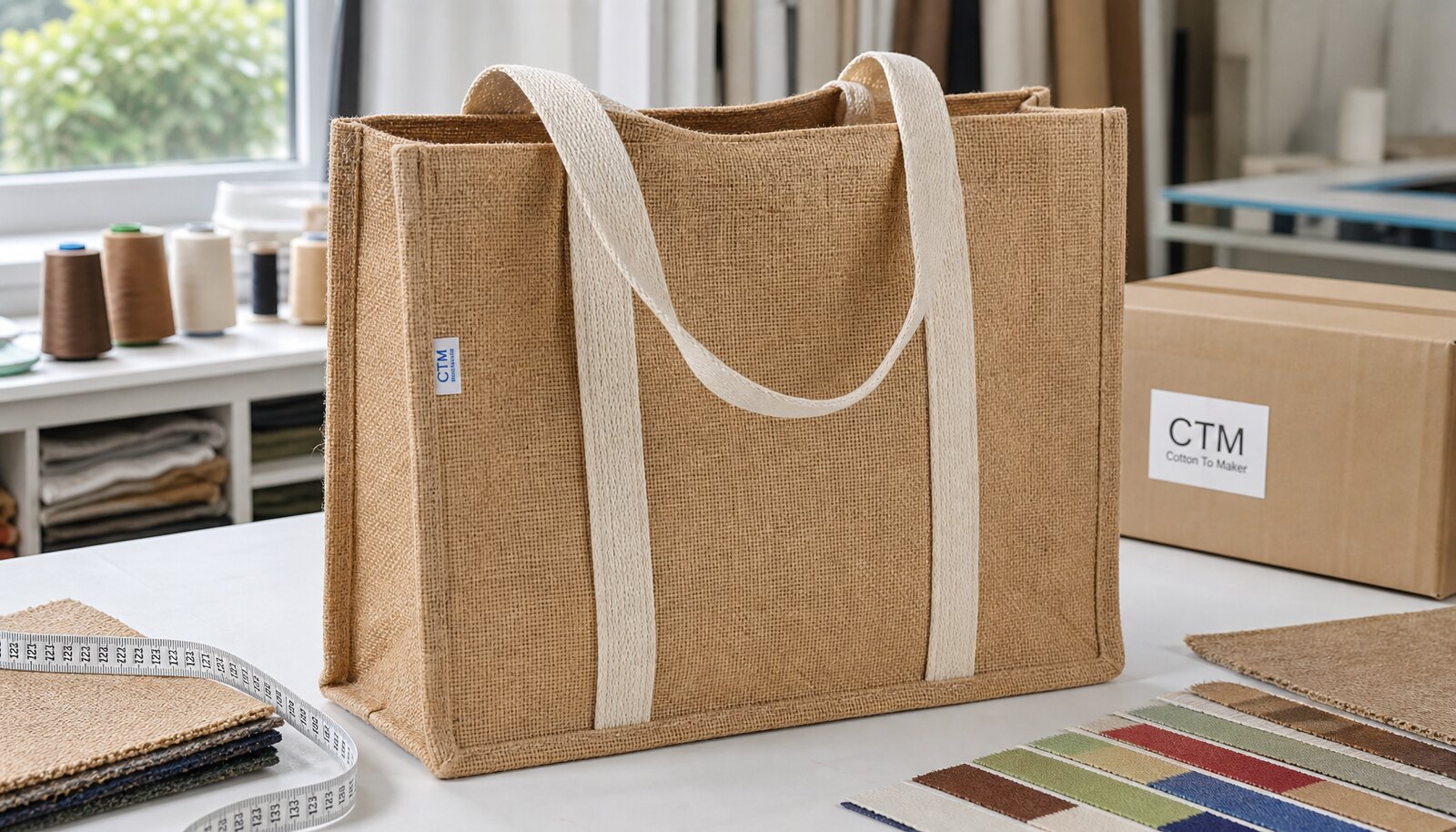
Why event buyers choose jute tote bags
Jute tote bags for events are usually chosen for three reasons: they read as more substantial than thin nonwoven bags, they support a natural or eco-positioned brand story, and they can be reused after the event instead of being discarded at the venue exit. That makes them a common fit for trade shows, conferences, product launches, sponsor kits, hospitality packs, and retail promotions where presentation matters as much as price.
The buying mistake is to treat every jute tote as the same commodity. An expo bag that only carries a brochure and a pen is a very different product from a VIP kit that must hold bottles, boxed samples, or a laptop sleeve. Once you define the actual load, the rest of the specification becomes a procurement decision rather than a design preference.
- Use jute tote bags when the event needs a reusable, natural-looking carrier with more perceived value than a thin giveaway bag.
- Use a simpler bag when distribution speed matters more than shape retention or premium presentation.
- Use the event load, not the marketing brief, as the starting point for specs.
Match the bag to the event use case
The best spec depends on how the bag will be used after it leaves the booth. A conference handout bag is optimized for low weight, simple construction, and fast distribution. A trade show carrier often needs more depth, stronger handles, and a base that can handle brochures plus sample products. A VIP or hospitality bag usually needs a more controlled finish, stronger print approval, and cleaner packing because guests will judge it more closely.
Regional sourcing context also matters. Factory clusters in India, Bangladesh, and China can all produce jute bags, but the available cloth weights, handle options, sewing styles, and transit timelines can differ. If the bags are heading to the EU, ask for the chemical and material declarations your compliance team expects. If the bags are for the U.S., confirm whether any component-level requirements apply to the intended use, packaging, or branding method. The point is not to overcomplicate the purchase; it is to avoid discovering a documentation gap after production is already underway.
- Conference handout: prioritize low cost, quick packing, and comfortable short-carry handles.
- Trade show kit: prioritize gusset depth, handle reinforcement, and a base that holds shape.
- VIP or gift pack: prioritize finish quality, cleaner print, and tighter packed presentation.
Specs that actually change cost and usability
Fabric weight is the first spec buyers should lock. For jute tote bags for events, a practical buying range is often 300-400 gsm for basic distribution and 400-500 gsm for heavier reuse or premium kits. Lower gsm reduces cost and shipping weight, but it also reduces body stability. Higher gsm gives the bag more structure, but it can also increase sewing time, material cost, and carton cube. If the bag is going to carry catalogs or boxed items, the cheapest cloth is rarely the cheapest decision.
Handle construction deserves the same discipline. Cotton webbing handles are usually the better choice when the bag needs comfort and repeated use. Self-fabric handles can lower the unit price and keep the look simple, but they are less forgiving if the bag carries weight or is expected to last beyond the event. Handle drop should be specified in finished dimensions, not just described as short or long. If guests are carrying the bag across a venue or through an airport, a handle that looks fine on a flat sample can feel wrong in use.
- Define the size using usable interior dimensions, not only outer dimensions.
- Specify gusset depth if the contents are bulky or need to stand upright.
- Add a board insert only when shape retention is worth the extra cost and setup time.
Print, artwork, and how rough jute changes the result
Jute is a textured weave, so print quality is driven as much by the material surface as by the artwork file. Screen printing is usually the default choice for bold, one- or two-color logos because it is durable, cost-effective, and readable from a distance. It is the safest route when the logo has larger shapes, strong contrast, and a repeat order. Heat transfer and DTF are better when the artwork contains gradients, multiple colors, or smaller details, but those methods need stricter sample approval because the final look can change once the print interacts with the fiber texture.
Embroidery can work for premium event bags, but it should be used intentionally. A small logo on a cleaner panel can look strong, yet dense stitching on coarse jute can distort the weave or pucker the fabric. The more detailed the artwork, the more important it is to simplify the mark before production instead of forcing a process that is a poor fit. Ask suppliers to quote the print position in millimeters, the number of colors, the number of print sides, and the exact decoration method. A quote that says only "custom print" is not production-ready.
- Screen print is usually the best value for simple event logos and larger volumes.
- DTF or heat transfer is a better fit for detailed artwork, but approval needs to be stricter.
- Avoid fine text and hairline strokes unless the supplier has already proved them on the same cloth.
How to read supplier quotes without getting misled
A serious quote should be readable as a specification sheet, not as a marketing email. For jute tote bags for events, the quote needs to show fabric gsm, bag size, handle type and length, print method, number of print colors, packing method, MOQ, sample cost, setup charges, and lead time after sample approval. If any of those are missing, the apparent unit price is not comparable to another supplier's offer because the assumptions are different.
The most useful quote structure separates base cost from add-ons. For example, one supplier may quote a base open-top bag, then add separate lines for screen setup, lining, closure, special packing, and shipping carton changes. Another supplier may roll those into one number. If the line items are not transparent, the lowest number can look attractive while hiding a thinner cloth, simpler stitching, or a smaller print area. Procurement teams should ask for the quote basis in writing so the comparison is based on the same version of the product.
- Compare only like-for-like quotes with the same fabric weight, print method, and packing format.
- Ask the supplier to separate one-time setup charges from recurring unit cost.
- Request carton size and gross weight early if airfreight or urgent replenishment is possible.
Cost tradeoffs by supplier route
Direct factory sourcing usually gives the cleanest control over spec, sample approval, and repeatability. It is often the better route when the same jute tote will be reordered across multiple events or when the buyer needs tight control over handle build, print placement, and carton packing. The tradeoff is that the buyer must manage a more complete RFQ, and the factory may expect clearer artwork and documentation before pricing.
Trader or sourcing-agent routes can be useful when the event order is only one part of a larger mixed shipment or when the buyer wants a single contact for multiple product types. The downside is traceability. If the quote looks unexpectedly low, ask who actually makes the bag, who owns the screens or artwork files, and who is responsible if the first production run deviates from the approved sample. On a procurement desk, the right question is not only "what is the price" but also "where does the price come from, and who carries the change risk."
- Direct factory: better for repeat orders, tighter change control, and clearer defect responsibility.
- Trader: useful for bundled purchases, but less transparent on factory process and margin.
- Mixed bundle: useful when bags ship with inserts, notebooks, bottles, or other event items under one schedule.
A comparison table that exposes real tradeoffs
The quickest way to compare suppliers is to identify what changes when a quote gets cheaper. In jute tote bags for events, lower price usually comes from one of four places: lighter fabric, simpler handles, reduced print coverage, or leaner packing. That is not automatically bad. It only becomes a problem when the quote hides the tradeoff and the buyer discovers it after approval.
Use the table below as a budgetary map, not as a promise. The point is to make the cost drivers visible so the procurement team can decide whether the lower number is a real saving or simply a different product.
- Ask suppliers to quote the same bag three ways if you want a useful comparison: basic, balanced, and premium.
- Use one line for base construction and separate lines for decoration, packing, and any insert or closure.
- Keep samples, quote revisions, and approval notes tied to the same version number.
MOQ, setup charges, and when a small run becomes expensive
MOQ is not just a factory policy; it is a sign of how much setup has to be spread across the order. A simple one-color open-top jute tote can usually support a lower MOQ because the sewing sequence is short and the decoration setup is simple. Once you add lining, zipper closure, board insert, or multiple print colors, the MOQ usually rises because the line speed slows and the factory has more changeovers to manage.
A low MOQ quote on a complex bag is worth extra scrutiny. If the supplier is offering a very small run with multiple upgrades at the same time, ask whether the unit price includes all setup costs, whether the artwork file is final, and whether the sample fee will be credited back. In practice, a simpler construction at a stable quantity often costs less than a heavily customized bag with a barely viable order size.
- Use lower MOQ only when the build is simple and the art is final.
- Expect higher MOQ when you add lining, closure, inserts, or complex decoration.
- Do not compare a low-MOQ quote against a high-volume quote without normalizing setup cost.
Sample approval and measurable quality checks
A sample should prove fit, appearance, and repeatability. For event bags, measure the finished dimensions on the actual sample, verify the handle drop, inspect seam reinforcement, and check the logo against the approved artwork. Then load the bag with the real event contents: brochures, bottles, sample boxes, or whatever the event will actually distribute. A bag can look acceptable when empty and still fail once it is weighted and carried across a venue.
Quality control should be defined in measurable terms wherever possible. Ask the factory what tolerance they apply to finished size, whether their fabric weight is measured on finished cloth or raw cloth, and what sampling method they use for visual inspection. For visual defects, many buyers use an AQL-based approach or an equivalent sampling plan. For function, use a simple pass/fail load test, handle pull check, and seam inspection. If the supplier cannot state the inspection method, the claim of quality is too vague to rely on.
- Check the sample both empty and loaded with the real event contents.
- Inspect one random packed unit from the carton, not only a hand-selected showpiece.
- Record the agreed inspection method in the PO or spec sheet before production starts.
Packing, cartons, and event logistics
Packing affects both damage risk and freight cost. Bulk polybag packing inside export cartons is usually the efficient choice for event distribution because it keeps labor under control and reduces carton volume. Individual polybagging is worth considering only when presentation matters enough to justify the extra labor and cube. For jute tote bags for events, overpacking can trap odor and flatten the handle folds, while underpacking can let the bags rub against each other and arrive with scuffed corners.
Carton design should be part of the quotation, not an afterthought. Ask for carton dimensions, pieces per carton, gross weight, and whether the carton load is stable enough for the route it will take through the warehouse or distribution center. If the shipment is palletized, define pallet height and stack limit before production so the final packout matches the receiving rules. Good logistics planning prevents a bag problem from becoming a warehouse problem.
- Use bulk packing for most event campaigns unless retail presentation requires more protection.
- Confirm carton dimensions against warehouse shelf or freight cube limits.
- Define pallet height and carton stackability before the order is produced.
Specification comparison for buyers
| Spec decision | Recommended option | When it fits | Typical quote impact | Buyer risk to check |
|---|---|---|---|---|
| Jute fabric weight | 300-400 gsm for basic event bags; 400-500 gsm for reusable or premium kits | Choose the lighter range for conference handouts and high-volume giveaways; choose the heavier range when the bag must hold catalogs, bottles, or boxed samples | Heavier fabric usually moves the quote up because material cost, sewing time, and freight cube all rise | A thin bag can bow at the base, show seam distortion, and look worn before the event ends |
| Handle build | Cotton webbing handles with bar-tacks for comfort; self-fabric handles for lower-cost runs | Cotton webbing fits repeated use and shoulder carry; self-fabric handles fit budget promotions and shorter carry distances | Webbing handles usually add a visible uplift versus self-fabric because of extra material and reinforcement steps | Short handle drop, weak bar-tacks, or poor hand feel can trigger complaints after the first event day |
| Lining | Unlined for basic handouts; cotton or PP lining for premium presentation | Use lining when small items, cosmetic kits, or printed brochures need a smoother interior finish | Lining adds labor and often changes the MOQ because the sewing sequence becomes more complex | Unlined jute can shed fibers, snag on fine packaging, or show print strike-through on lighter designs |
| Printing method | Screen print for bold one- or two-color logos; heat transfer or DTF for detailed art; embroidery only for small premium marks | Screen print suits large runs and simple brand marks; transfer methods suit gradients, small type, or multicolor artwork | Decoration method can be one of the biggest cost drivers, especially if the art needs extra color separations or setup | Fine detail can blur on coarse weave, so do not approve art that depends on tiny text or hairline strokes |
| Closure | Open top for mass distribution; zipper or tie closure for gift sets and higher-value contents | Open-top bags fit conference floors, exhibition halls, and quick handouts; closed bags fit VIP kits and retail-style presentation | Adding a closure increases sewing time and inspection points, so it usually raises both unit cost and lead time | Closures add failure points if zipper alignment, puller quality, or tie stitching is not specified clearly |
| Base structure | Gusseted base with a board insert when the bag must stand upright | Use this when the bag has to sit on tables, hold boxed items, or keep a more rigid profile in photos and display | A structured base generally increases price because of extra material and more precise sewing | Flat bags collapse, wrinkle more easily, and can look cheap after packing and transit |
| Supplier route | Direct factory for repeatable custom builds; trader only when you need mixed-category consolidation | Direct sourcing fits repeat orders and tighter QC control; traders fit bundle buys and multi-item event shipments | Trader quotes can look easier to buy but may include hidden margin or less transparent setup charges | If you do not know the actual factory, change control and defect accountability become harder |
| Packing method | Bulk polybag inside export cartons unless retail presentation requires individual packing | Bulk packing suits event distribution and lowers labor; individual packing fits premium gifts or resale channels | Individual packing increases labor and carton cube, so it almost always pushes landed cost higher | Overpacking can trap odor and flatten handles; underpacking can lead to scuffing and crushed gussets |
| MOQ strategy | Set MOQ by construction complexity, not by wishful thinking | Simple one-color open-top bags can run lower; lined or zipped bags need higher quantities to stay efficient | More custom features usually raise MOQ because setup cost has to be spread across more units | Very low MOQ on a complex build can hide later upcharges or quality concessions |
Buyer checklist before sampling
- Define the event use case first: conference handout, VIP gift bag, retail resale, or brochure carrier.
- Lock the usable interior size in millimeters based on the largest item set, not the outer dimensions alone.
- Specify fabric weight, handle type, handle drop, gusset depth, lining, and closure in one line item.
- Share vector artwork, Pantone references, print placement in millimeters, and the maximum printable area.
- State whether the bag must support repeated reuse, odor-sensitive packaging, or food-contact adjacent items.
- Ask the supplier to confirm the measurement method they use for finished size, gsm, and seam checks.
- Request pre-production sample photos, a packed-carton photo, and at least one random packed unit image.
- Tie the quotation to one spec version so setup charges, packing, and decoration changes are easy to compare.
Factory quote questions to send
- What is the body fabric gsm, and is that based on the exact finished cloth or the raw woven cloth?
- What handle material, width, and finished drop are included in the quoted price?
- Is the quote based on one size, one fabric weight, one print area, and one color count only?
- What are the one-time setup charges for screen, plate, or artwork preparation, and what is refundable after order confirmation?
- What changes the MOQ if we add lining, zipper closure, board insert, or a second print position?
- What stitching standard do you use for side seams and handle reinforcement, and how is it verified?
- How many pieces are packed per carton, what are the carton dimensions, and what is the gross weight?
- What is the lead time after sample approval, and what events can push that date out?
- Can you share a production photo or short video from a similar jute tote bag run?
- What print tolerance do you accept for placement, registration, and color density on rough jute?
Quality-control points to confirm
- Check finished dimensions against the approved sample and record any deviation outside the agreed tolerance.
- Confirm fabric weight using the supplier's stated measurement method and keep that method written in the PO or spec sheet.
- Inspect handle attachment, bar-tack length, stitch count, and reinforcement symmetry on sampled units from the carton.
- Verify print placement, edge sharpness, and color density against the approved artwork and sample.
- Reject units with open seams, loose threads, broken needles, oil marks, or visible weave damage on the face panel.
- Check that bag shape still holds when filled with the actual event load, not only when empty.
- Assess odor, dust, and fiber shedding if the bags will be used for retail presentation or near food-adjacent content.
- Inspect a random packed unit from a sealed carton, not only a hand-picked showpiece from the top of the stack.
- Use an agreed AQL or equivalent sampling plan for visual defects, and add a separate functional check for handles and seams.
- Record carton marks, quantity, and packaging orientation before shipment so warehouse receiving is not delayed.