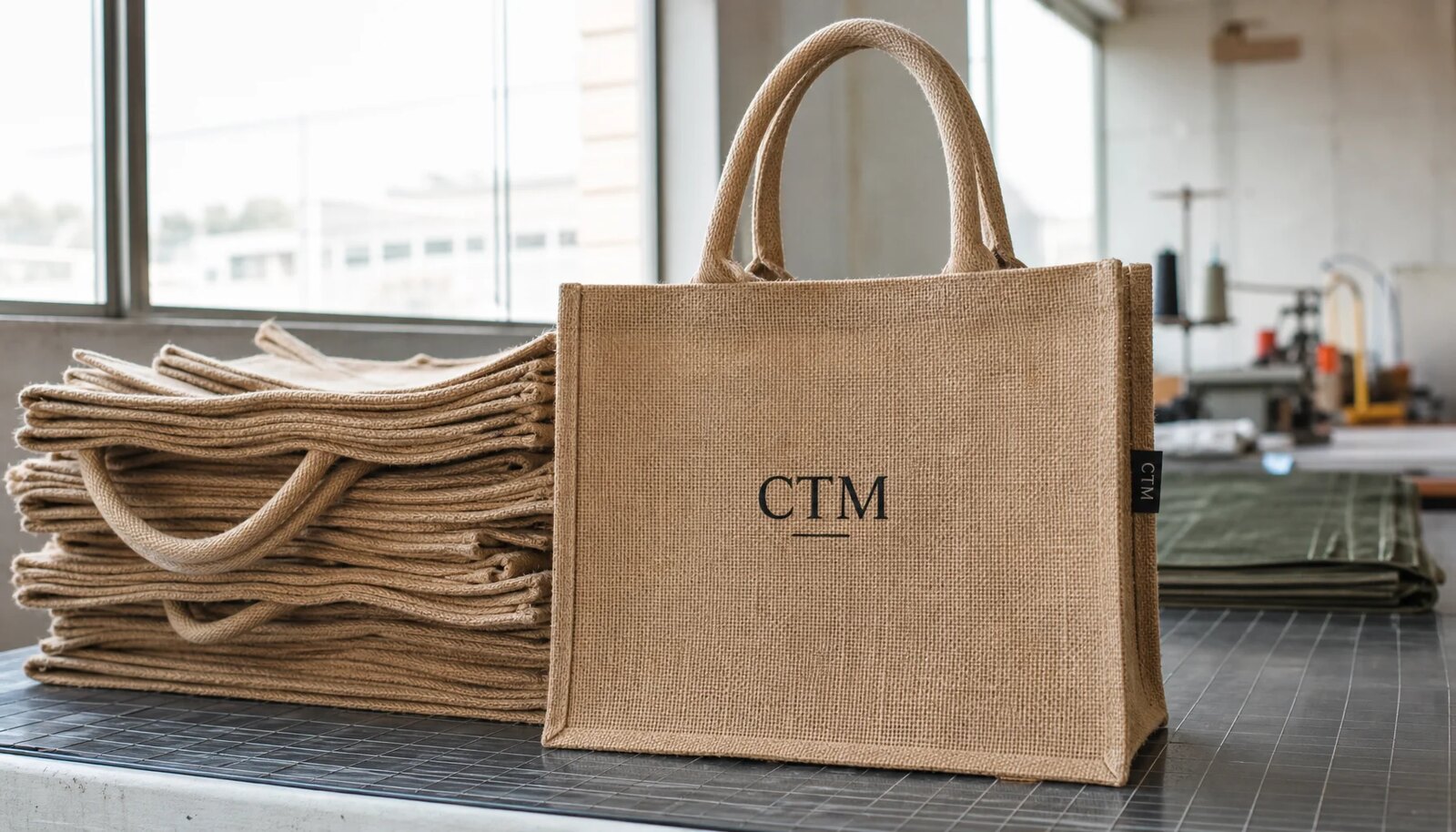
Why event buyers need tighter QC on jute tote bags
Jute tote bags look straightforward, which is exactly why they can create procurement problems. A front-facing sample photo may show a clean logo and a natural texture, but it does not prove that the handles are reinforced, the gusset is stable, the print will stay aligned across production, or the cartons will arrive dry and count-correct. For event planners, brand teams, and import buyers, the bag is not just a giveaway. It is part of the attendee experience, a carrier for sponsor materials, and often one of the few branded items that leaves the venue with the recipient.
The key difference between buying a generic promotional bag and buying jute tote bags for event use is load and timing. Event bags are filled quickly, moved through warehouses, handled by volunteers or venue staff, stacked near registration desks, and carried through crowded spaces. A defect that might seem small in a showroom can become expensive when 2,000 bags need sorting two days before a conference. That is why the quality plan should focus on practical failure points: handle pull, seam security, print clarity, odor, dust, carton strength, and the ability to match the approved sample under time pressure.
Jute is also a natural material, so buyers need a realistic inspection standard. Minor slubs, small shade variation, and texture variation may be normal. Mold odor, weak weave, broken yarns along a seam, large stains, loose handles, and visibly crooked prints are not normal. A strong jute tote bags for event planners quality inspection checklist separates acceptable natural character from defects that affect function, brand presentation, or distribution readiness.
- Treat the bag as a sewn product with load-bearing parts, not only as a printed promotional surface.
- Inspect the front, back, inside seams, gusset corners, handle attachments, and carton condition before shipment release.
- Define which natural jute variations are acceptable so the supplier cannot use natural fiber as a reason to pass avoidable defects.
- Use the actual event contents or an agreed test weight when checking whether the bag performs as intended.
Build the specification before you request pricing
The most common quote problem is not supplier dishonesty; it is an incomplete specification. If you ask for a quote for a natural jute tote bag with logo, one factory may assume 220 GSM fabric, another may quote 280 GSM, and another may use a cheaper handle construction to win the unit price. Those quotes are not comparable. A procurement-ready RFQ should define the finished bag, not simply describe the appearance.
Start with finished dimensions. Width and height should be stated as finished sewn dimensions, not fabric panel size before stitching. If the bag needs to hold folders, bottles, product samples, or boxed gifts, include a gusset measurement. The gusset is often where event usefulness is won or lost: a flat bag can be cheaper, but it may bulge awkwardly or strain the side seams when loaded. For conferences and sponsor kits, a 10-15 cm gusset is often more practical than a flat format, though the right choice depends on the exact contents and carton plan.
Next define material and construction. Body GSM, handle material, handle width, handle drop, stitch pattern, thread color, lining, lamination, closure, label, and print method all belong in the specification. Avoid relying on words like standard, premium, eco, thick, or durable without numbers. They sound useful in conversation but create confusion during purchasing and inspection. A clear spec allows the buyer to compare suppliers on the same basis and gives the inspection team a real control document.
- State dimensions as finished size: width x height x gusset, with tolerance such as plus or minus 5 mm or another agreed limit.
- Define handle drop separately from total handle length, because user comfort depends on the drop from the bag opening.
- Specify body GSM, handle material, handle width, thread color, stitch pattern, lining or lamination, and closure before price comparison.
- Attach artwork with print size, placement from edges, color count, and file format instead of asking the supplier to infer it from a mockup.
- Include intended contents and approximate load so the supplier understands the real use case.
Choose GSM, weave, and structure for the real event load
For most event orders, 250-280 GSM woven jute is a practical starting point. It usually provides a better balance of structure, cost, and handling than very light promotional fabric. Lighter 220-250 GSM fabric can work for short one-day events, simple handouts, or low-weight contents, but it should be tested with the actual contents before approval. Heavier fabric may feel more substantial, but it can increase unit cost, carton volume, and stiffness. Procurement teams should link GSM to function rather than treating higher GSM as automatically better.
GSM alone does not guarantee performance. A loose weave at higher GSM can still distort near seams, while a well-woven moderate GSM fabric may perform better in normal event use. Ask the supplier whether the jute is laminated, backed, dyed, natural, or treated, because those choices affect hand-feel, odor, print absorption, folding, and fiber shedding. If a supplier quotes GSM after lamination while another quotes raw fabric GSM, their offers are not equivalent.
Structure also includes gusset shaping, top hem, bottom seam, and side seam behavior under load. A bag that looks square when empty may lean, twist, or wrinkle badly when filled. During sample approval, place the planned event contents inside the tote and set it on a table. Check whether the base sits evenly, the handles remain balanced, and the side seams are not pulling open. That simple test often reveals construction weaknesses that a flat measurement cannot show.
- Use 220-250 GSM only for lighter loads, budget handouts, or events where reuse is not a key requirement.
- Use 250-280 GSM as the safer general-purpose range for branded event totes carrying brochures, bottles, samples, or small gifts.
- Ask whether GSM is measured before or after lamination, coating, backing, or finishing.
- Inspect weave strength near seam lines, not only in the center of the panel.
- Load the sample with representative contents and check shape, seam tension, handle comfort, and base stability.
Compare supplier quotes by total order risk, not headline unit price
A low unit price can be useful, but only if it covers the same bag, the same printing, the same inspection, and the same packing. Jute tote quotes often vary because one supplier includes screen setup, another separates it, one assumes bulk packing, another quotes individual polybags, and another may leave carton details until after order placement. For B2B buyers, the goal is not to find the lowest number on a spreadsheet; it is to find the most complete offer that can meet the event date without avoidable quality risk.
Break every quote into comparable cost drivers: body GSM, dimensions, gusset, handle type, print color count, print area, lining, closure, sample charge, setup charge, packing, carton count, inland handling, inspection requirements, and freight volume. If suppliers are quoting different assumptions, send a revised RFQ and ask them to re-quote. This extra step usually saves time later because production teams cannot build what procurement has not defined.
Also check how each supplier handles quantity breaks. Event buyers often need multiple versions: sponsor logos, city editions, VIP bags, staff bags, or different artwork for regional activations. MOQ may apply per artwork, per size, per color, or per production batch. A supplier who looks attractive at 5,000 pieces may be expensive or impractical when the order is split into five artwork versions. Ask for the pricing curve before committing the design structure.
- Request unit price at 500, 1,000, 3,000, and 5,000 pieces per artwork version, not only one order quantity.
- Separate bag cost, print setup, sample cost, packing cost, carton cost, and any special label or insert cost.
- Ask for carton dimensions, pieces per carton, gross weight, and estimated CBM before you compare landed cost.
- Confirm whether the quote includes pre-production sample, first production photos, and final inspection support.
- Reject vague quote lines such as 'standard packing' or 'normal quality' and replace them with measurable terms.
Lock artwork and printing details before production starts
Printing on jute is not the same as printing on smooth cotton, paper, or coated packaging. The woven texture affects edge sharpness, ink absorption, color brightness, and fine detail. A logo that looks crisp in a PDF may soften on natural jute, especially if it has thin lines, small type, gradients, shadows, or tight registration between colors. Procurement teams should involve brand owners early and simplify artwork when needed rather than forcing the factory to solve unsuitable artwork on the production floor.
For bold event branding, one- or two-color screen printing is often the most practical option. It keeps cost controlled, handles simple logos well, and avoids unnecessary color registration risk. Heat transfer can be useful for small runs, detailed artwork, or designs that cannot be simplified, but buyers should inspect the finished hand-feel and flex behavior. Transfer films can look less natural on rough jute, and they may show cracking or lifting if the bag is folded, compressed, or handled heavily.
A strong print approval process includes a real printed jute sample, not only a digital mockup. The approval should identify artwork version, print size, placement from top and side edges, ink color target, acceptable color variation, and registration tolerance if more than one color is used. If the event has sponsors or regulated brand marks, keep a signed artwork proof with the approved sample. This avoids disputes when a logo is slightly resized, shifted, or substituted during production.
- Use vector artwork when possible and remove tiny type, hairline strokes, gradients, or photographic detail that will not reproduce cleanly on jute.
- State print size and placement in millimeters, including distance from the top edge and side edge or centerline.
- Approve color on actual jute fabric because natural fiber changes the perceived brightness of ink.
- For multi-color prints, define acceptable registration tolerance and inspect several samples, not only one perfect piece.
- Keep the approved print proof, physical sample, and PO specification tied to the same revision number.
Inspect stitching, handles, and load-bearing points first
Handles and seams are where many jute tote bag claims begin. The printed front panel may look acceptable, but if the handles detach during registration desk use, the bag has failed. Buyers should treat handle attachment, side seams, bottom seams, gusset seams, and top hem as critical inspection points. These areas determine whether the bag can carry the intended event load and whether it will feel credible as a reusable item after the event.
Handle construction should be visible and measurable. Ask whether the handle uses self-jute, cotton webbing, rope, or another material. Confirm handle width, handle drop, attachment length, stitch pattern, and reinforcement method. A box stitch, cross stitch, or bar-tack reinforcement can improve load performance when properly sewn, but the exact method should match the sample. If reinforcement is promised verbally but not shown on the sample or written in the PO, it may disappear in mass production.
During inspection, look for skipped stitches, loose thread tails, uneven stitch density, poor backstitching, puckered seams, handle asymmetry, and attachments placed too close to the bag edge. Pull testing should be practical and repeatable. The buyer and supplier can agree on a target load based on the event contents, then test a random sample by lifting and holding the bag for a defined period. The point is not to turn a tote into industrial lifting equipment; it is to confirm that normal event use will not expose weak sewing.
- Measure handle drop and compare both handles on the same bag for symmetry.
- Check that handles are centered and attached at the same distance from side seams on both sides.
- Inspect top hem, side seam, bottom seam, and gusset corners for skipped stitches or weak backstitching.
- Test several bags with the intended load or an agreed weight, then inspect seams again for opening or distortion.
- Reject recurring handle reinforcement changes unless the supplier documents and samples the revised construction.
Set realistic inspection tolerances for natural jute
Jute has texture, shade variation, and fiber irregularity. That natural character is part of why buyers choose it, but it also makes inspection more subjective unless standards are agreed before production. A procurement-ready QC checklist should define which irregularities are acceptable and which are defects. This protects both sides: the buyer avoids receiving poor goods, and the factory avoids impossible cosmetic expectations for a natural fiber product.
Typical acceptable variation may include small slubs, minor shade differences within the same natural tone, and slight texture differences that do not weaken the bag or disrupt printing. Defects should include holes, broken yarns, large dark stains, oil marks, mold, damp odor, sharp debris, heavy dust, weak edges caught in the seam, and obvious color mismatch across panels. For dyed jute, shade consistency needs tighter control because color variation is more visible across multiple cartons or event locations.
Dimension tolerance should be stated for finished bags after sewing and finishing. Jute can shift during cutting and sewing, so demanding perfect measurements on every piece is unrealistic. However, large variation creates packing problems and makes the event look inconsistent. Set a practical tolerance for width, height, gusset, handle drop, and print placement. Then use random sampling during final inspection to check whether variation is controlled across the batch.
- Accept minor natural slubs only when they do not create holes, weak spots, print breaks, or rough handling areas.
- Reject mold, damp smell, oil marks, heavy dust, insects, sharp fibers, large stains, or foreign contamination.
- Define finished dimension tolerances before production, including bag body, gusset, handle drop, and print placement.
- Check shade consistency across cartons, not only within one carton selected by the supplier.
- Use the approved sample as the visual reference, but support it with written tolerances so inspection is not based on opinion alone.
Use sample approval to prove production, not just appearance
A sample is only useful if it represents the mass production method. A handmade prototype made with substitute jute, different thread, different handle material, or a temporary print process is a design reference, not a production approval. Before releasing a bulk order, buyers should approve a pre-production sample made with the same body fabric, GSM, handle material, lining, closure, thread color, print method, artwork size, and packing logic intended for the order.
The sample review should be practical. Fill the bag with typical event contents, carry it by hand and over the shoulder if that is the intended use, set it down, fold it if it will be packed flat, and check whether the print changes after handling. If the bag has a zipper, snap, button, or magnetic closure, open and close it repeatedly. If it has lining or lamination, check whether edges are finished neatly and whether the inside feels clean enough for the contents.
Document every approval. Take photos of the front, back, inside seam, handle attachments, gusset, print close-up, closure, label, and packed unit if applicable. Record the sample date, revision number, and any approved deviations. If the supplier changes fabric or print method after sample approval, require a new approval before mass production. This discipline is especially important for event orders because there may not be time to remake goods after arrival.
- Approve a pre-production sample made with actual materials and actual print method, not a visual substitute.
- Compare the sample against the purchase order, artwork proof, and RFQ, not only against a previous photo.
- Check physical use: load, carry, fold, open, close, and inspect after handling.
- Record sample revision number, approval date, and approved exceptions in writing.
- Keep the approved sample available for final inspection, dispute resolution, and reorder matching.
Control packing, carton marks, and moisture risk
Packing is not an afterthought for jute tote bags. Natural fiber can absorb moisture, collect dust, and compress in cartons if packing is poorly planned. Event orders also depend on fast receiving: warehouse staff, venue teams, and kit assemblers need to identify cartons quickly and count goods accurately. A strong packing specification reduces arrival surprises and prevents avoidable sorting work.
For many event programs, bulk packing is sufficient. Bags may be stacked in inner polybags and then packed into export cartons with a consistent piece count. Individual polybags can improve cleanliness for direct handout or premium gifting, but they add labor, plastic, carton volume, and sometimes unpacking time. Paper bands, inserts, hangtags, or retail labels should be used only when they support the distribution plan. Procurement teams should ask how goods will be handled after arrival before selecting the pack method.
Carton details matter for freight planning and receiving control. Before PO release, request carton size, pieces per carton, net weight, gross weight, and estimated CBM. Before shipment, verify carton marks against the PO, SKU, artwork code, destination, and carton count. For humid shipping lanes or long storage periods, discuss moisture control, dry storage, and container loading conditions. Do not add moisture-control materials blindly; match them to the route, season, and storage environment.
- Confirm unit pack, inner pack, master carton quantity, carton dimensions, gross weight, net weight, and total CBM estimate.
- Use carton marks with PO number, item code, artwork version, quantity, carton number, and destination or event name when needed.
- Inspect cartons for dryness, strength, crushed corners, poor sealing, and inconsistent piece counts.
- Choose individual polybags only when cleanliness, direct distribution, or premium presentation justifies the added cost and material.
- Ask for packed carton photos before shipment, including open carton view and external shipping marks.
Plan lead time backward from the event date
Event procurement has a fixed deadline. A product delay does not simply inconvenience the buyer; it can miss the event entirely. Jute tote bags often have manageable production timelines, but delays accumulate through artwork changes, sample revisions, fabric availability, printing corrections, holiday closures, inspection schedules, and freight booking. Buyers should build a calendar backward from the required delivery date rather than accepting a single lead-time number.
A practical schedule includes artwork freeze, RFQ deadline, sample production, sample review, sample revision if needed, purchase order release, material purchase, cutting, sewing, printing, trimming, final inspection, carton packing, shipment booking, customs, inland delivery, and receiving buffer. The supplier should identify which step is on the critical path. For example, if printing cannot start until all sponsor logos are approved, a late sponsor file can delay the entire order. If the bag uses dyed handles or custom lining, material approval may become the schedule risk.
Buyers should also decide what evidence is required before shipment. Final inspection photos, third-party inspection, carton count confirmation, or video review all take time. That time should be included in the production calendar, not squeezed in after the factory has already sealed cartons. The tighter the event date, the more important it is to freeze the spec early and avoid late changes to artwork, size, packing, or accessories.
- Use 5-10 days as a common sample planning range when materials and artwork are clear, but confirm with the actual supplier.
- Use 20-35 days after approval as a common production planning range for many orders, adjusted for quantity, complexity, and season.
- Add time for sample revision, final inspection, carton correction, freight booking, customs, and local delivery to the venue or warehouse.
- Set a latest acceptable shipment date and a latest acceptable arrival date, then share both with the supplier.
- Treat late artwork, new sponsor logos, packing changes, and split shipments as schedule changes that require written confirmation.
Specification comparison for buyers
| Spec decision | Recommended option | When it fits | Buyer risk to check |
|---|---|---|---|
| Body GSM | 250-280 GSM woven jute for most event tote bags | Conferences, trade shows, welcome kits, corporate gifting, university events, and retail promotions where the bag carries brochures, bottles, samples, or light apparel | If the GSM is too low, the bag can lose shape, distort at the side seams, or look transparent under load; if too high, freight volume and stiffness may increase |
| Bag size and gusset | Common event sizes around 35 x 40 cm or 38 x 42 cm, with 10-15 cm gusset when contents are bulky | Programs that need a practical handout bag for catalogs, drink bottles, product boxes, folders, or mixed sponsor items | A flat bag may look cheaper but can strain seams when filled; an oversized bag can raise material cost and carton CBM without improving user value |
| Handle construction | Self-jute handles with box stitch/bar-tack reinforcement, or cotton webbing handles for comfort | Orders expected to carry 3-6 kg or be reused after the event | Handle attachment is a frequent failure point; confirm attachment length, stitch pattern, thread strength, and whether reinforcement is included in the quoted price |
| Print method | 1-2 color screen print for bold logos; heat transfer only for detailed artwork, short runs, or designs that cannot be simplified | Event names, sponsor logos, brand marks, simple icons, and direct-to-bag promotional messaging | Natural jute texture softens fine detail; too many colors can create registration problems, and transfer films may crack, peel, or feel less integrated on rough weave |
| Ink and print placement | Approved Pantone or closest achievable color on natural jute, with placement tolerance stated in millimeters | Orders where brand consistency matters across multiple venues, sponsors, or event editions | Ink on jute will not look identical to ink on coated paper; reject vague promises like 'same as artwork' without a printed jute sample |
| Lamination or lining | Unlined for economical handouts; inner lamination or cotton lining for cleaner premium kits | Welcome kits, retail-style gifting, beauty or food-adjacent samples, and programs where fiber shedding must be reduced | Lining changes stiffness, odor profile, sewing steps, and cost; approve a new sample after adding lining rather than accepting an old unlined sample |
| Closure style | Open top for fast pack-out; zipper, button, snap, or magnetic closure only for premium or reusable positioning | VIP gifts, merchandise sales, travel-related event kits, or bags carrying loose small items | Closures add labor and failure points; inspect zipper tape, slider movement, color matching, and whether closure installation distorts the bag mouth |
| Supplier route | Direct factory for repeatable specs; trading company for consolidated mixed-event sourcing | Buyers who either need tight QC on one bag design or need several promotional items shipped together | Trading quotes may hide subcontracting; confirm who controls sewing, printing, inspection, carton packing, and corrective action if defects are found |
| MOQ and pricing tiers | Request 500, 1,000, 3,000, and 5,000 piece breaks per size and artwork | Event planners comparing sponsor versions, city editions, or repeat annual orders | Very low MOQs can carry high setup cost, limited color control, restricted fabric options, or reduced inspection leverage |
Buyer checklist before sampling
- Define finished bag width, height, gusset, handle drop, handle material, body GSM, lining or lamination, closure, and print size before requesting quotes.
- Ask every supplier to quote the same quantity breaks, print color count, packing method, carton count estimate, sample cost, setup cost, and production lead time after approval.
- Approve one pre-production sample made with the actual jute GSM, handle material, thread color, print method, lining, closure, and packing approach planned for mass production.
- Set measurable tolerances for dimensions, print placement, stitch density, handle strength, odor, moisture, color variation, carton labeling, and acceptable natural jute irregularities.
- Require production photos or video covering front print, inside seams, handle attachments, gusset corners, carton packing, and carton marks before final inspection or shipment release.
- Run a practical load test using the real event contents or an agreed weight, and check whether handles, side seams, gusset seams, and printed areas remain stable.
- Confirm whether weaving, cutting, sewing, printing, trimming, inspection, and packing are done in-house or through controlled subcontractors with documented QC responsibility.
- Lock the event delivery date with a backward calendar covering artwork freeze, sample approval, material purchase, first production check, final inspection, carton readiness, and freight booking.
- Keep one approved sample and one approved artwork proof as the control reference for final inspection, claim review, and any reorder.
- Do not release balance payment or shipment approval until the supplier has shared final inspection evidence that matches the purchase order and approved sample.
Factory quote questions to send
- What is the exact jute GSM, and is it measured before or after lamination, backing, coating, or finishing?
- What are the finished dimensions, gusset depth, handle drop, handle width, and acceptable measurement tolerance after sewing?
- Which print method is included, how many colors are covered, what is the maximum print area, and what setup charge applies per color or screen?
- Can you print on the approved jute fabric and share a physical printed sample before mass production, not only a digital mockup?
- What is the MOQ per size, per artwork version, and per print color count, and how does the unit price change at 500, 1,000, 3,000, and 5,000 pieces?
- Are the handles self-jute, cotton webbing, rope, or another material, and what reinforcement method is included at each stress point?
- What thread type and stitch standard will be used for side seams, bottom seams, gusset corners, handle attachments, and closures?
- Will cutting, sewing, printing, finishing, and packing be completed in-house or subcontracted, and who performs final inspection before carton sealing?
- What inspection standard do you use for size, print, stitching, odor, moisture, stains, mold, and carton damage, and can it be added to the order confirmation?
- What is the standard sample lead time, production lead time after sample approval, and latest artwork approval date needed to meet the event delivery date?
Quality-control points to confirm
- Finished bag dimensions match the approved sample and purchase order tolerance for width, height, gusset, handle drop, handle width, and opening width.
- Body GSM matches the approved spec within agreed tolerance, and the jute fabric is consistent across cartons without major shade change between production batches.
- Jute weave is reasonably even for natural fiber, with no large holes, broken yarns, weak edges, sharp fiber clumps, oil marks, mold, or contamination near seam lines.
- Handles are symmetrical, centered, equal in length, securely attached, and reinforced with the approved stitch pattern or bar-tack method at all load-bearing points.
- Side seams, bottom seams, gusset seams, and top hems have even stitch density, secure backstitching, no skipped stitches, no seam twisting, and no loose thread clusters.
- Print is sharp enough for the approved artwork, centered within tolerance, correctly oriented, and free from major smearing, bleeding, cracking, peeling, ghosting, or color mismatch.
- Artwork version, logo size, print color count, and print placement match the signed proof and approved pre-production sample.
- Lining, lamination, zipper, snap, button, label, tag, or insert is installed straight and does not distort the bag shape or create sharp edges inside the bag.
- Odor is within normal natural jute range, with no mold smell, chemical excess, dampness, smoke odor, or storage contamination.
- A practical load test confirms that the body, handles, side seams, and gusset hold the intended event load without tearing, seam opening, or handle detachment.