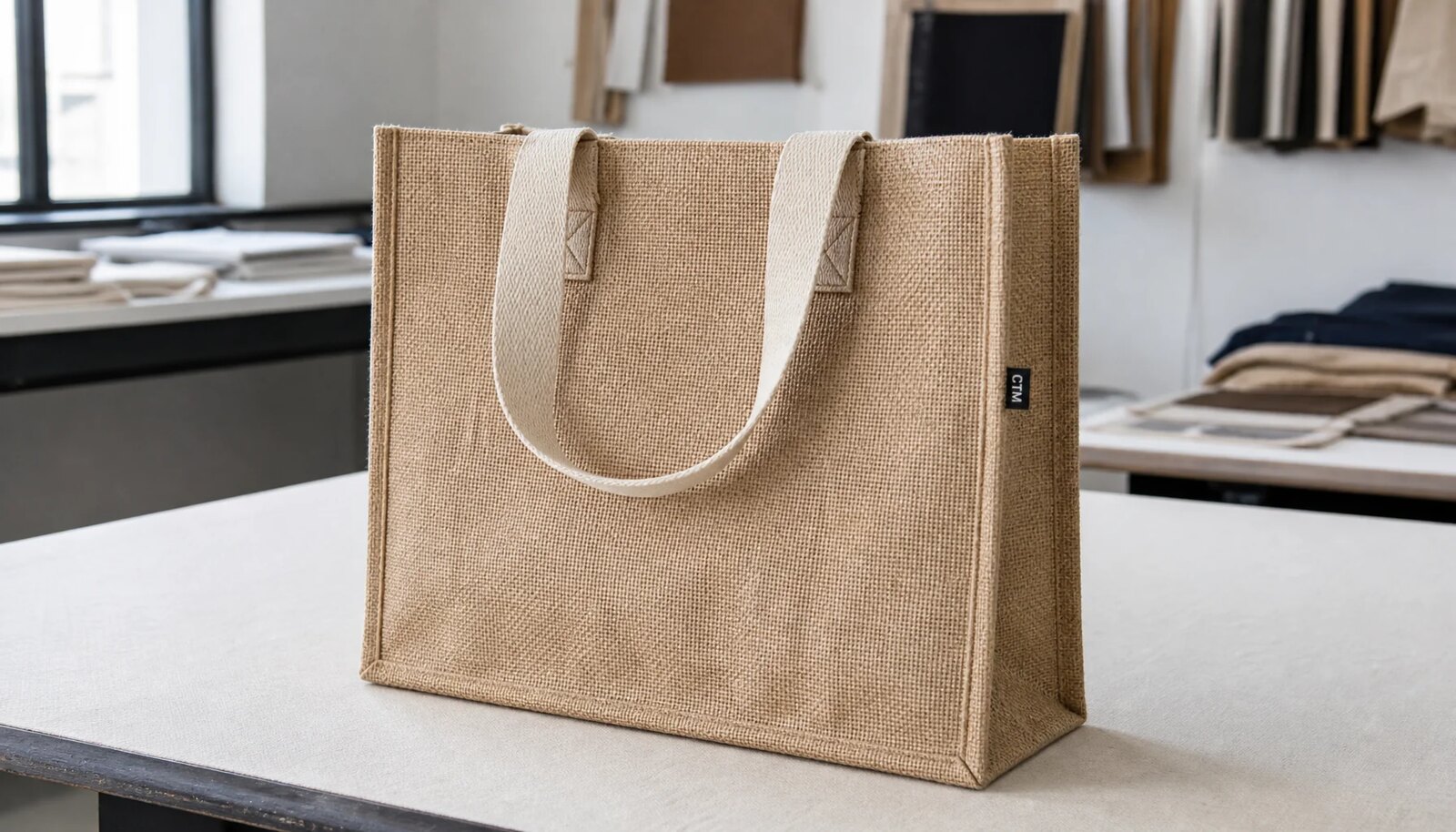
Start With the Filled Kit
The best jute tote specification begins with the carrying job, not the artwork. A bag for a T-shirt and brochure is a different product from a bag carrying a steel bottle, notebook, boxed candle, charger, and catalogue. The logo is what stakeholders notice first, but load, shape, handling route, and packing method decide whether the bag survives normal use.
Procurement should list the total packed weight, tallest item, widest item, sharpest corner, and expected carry route before asking for price. Confirm whether the bags are handed out empty, packed on-site, pre-packed in cartons, or shipped through a fulfillment center. Pre-packed bags may sit under load for days. On-site packing can create uneven stress. Fulfillment shipping adds carton pressure and moisture exposure.
State whether the tote is a one-event carrier or a reusable brand item. Reusable corporate gifts need a working load, test load, handle reinforcement, seam requirements, print-wear expectations, and packing controls. That turns a request for a strong jute bag into a measurable buyer specification.
- Record contents, packed weight, maximum dimensions, and sharp-edged items before requesting price.
- Set a working load and approval test load, usually 1.25x to 1.5x the expected packed weight.
- State whether the tote will be distributed empty, packed on-site, shipped filled, branch delivered, or stored before use.
- Decide whether the tote is a one-event carrier or reusable branded item before choosing fabric, handles, seams, and reinforcement.
Specify Jute Fabric Clearly
Body fabric is where similar-looking quotes often hide important differences. Natural jute around 300 to 350 GSM is a practical range for many standard corporate gift totes because it balances structure, cost, and packing volume. For heavier kits, boxed products, bottles, or programs where reuse matters, buyers often move toward 350 to 400 GSM.
Those ranges are starting points, not universal rules. Jute weight and stiffness vary by region, fiber lot, humidity, yarn size, weave density, finishing, and lamination. A higher GSM may look better and carry more structure, but it can increase cost, reduce immediate availability, raise freight volume, and feel too stiff for some gift programs. A lighter but tighter weave may outperform a heavier open weave in some uses.
A procurement-ready spec should include GSM, tolerance, weave appearance, finish, color range, and construction. For example, natural jute at 330 GSM +/- 5 percent, medium-tight plain weave, approved shade range, no large open holes, and no visible contamination gives the factory something it can price and the inspector something it can check.
- Use 300 to 350 GSM for many standard medium-duty gift bags where structure and cost must balance.
- Consider 350 to 400 GSM for heavier, angular, premium, or reusable corporate gift programs.
- Ask suppliers to explain regional material availability, lot variation, and cost impact before locking GSM.
- Approve both fabric swatch and finished sample because fabric weight alone does not prove bag durability.
Engineer Size and Gusset
A tote can pass fabric inspection and still disappoint if the dimensions are wrong. Corporate gift kits often include bottles, boxes, books, folders, apparel, samples, or several items packed together. If the bag is too tight, staff force contents into it, stressing bottom corners and warping the logo. If it is too large, the kit shifts, looks underfilled, and wastes carton space.
Flat measurements can mislead because a filled gusset changes usable width. A bag listed as 35 cm wide may not hold a 35 cm product once the gusset expands and seam allowance is considered. For a conference kit with a bottle and notebook, gusset depth and bottom strength may matter more than extra height. For folders and catalogues, panel height and top opening width may matter more.
Test fit the pre-production sample with real products or accurate weighted dummy contents. Evaluate the bag empty, filled, lifted, set down, and packed in the intended carton. If the tote must stand upright at a registration desk or in a welcome display, check that condition before approval.
- Set finished width, height, gusset depth, handle drop, and measurement tolerance in centimeters or inches.
- Test the sample with actual products or weighted dummy contents before approving production.
- Use a gusset deep enough for the thickest item without forcing the front and back panels outward.
- Confirm whether the bag must stand upright, pack flat, ship filled, or fit a specific carton or event layout.
Treat Handles as Load Parts
The handle zone is one of the most common failure points in jute tote bags. Handles receive concentrated force every time the bag is lifted, swung, pulled from a carton, handed to a recipient, or carried through a venue. Cotton webbing handles are often the better choice for repeated carrying because they are smoother and usually more abrasion resistant than basic folded jute handles.
A proper handle specification includes material, width, thickness, color, drop length, attachment depth, stitch pattern, thread color, and reinforcement method. For medium and heavy gift sets, box-X stitching, bartacks, or multiple rows through a reinforced top hem help spread load. A single straight stitch may be acceptable for very light handouts, but it should not be the default for reusable corporate gifting totes.
Review the handle from inside and outside. Uneven stitch tension, skipped stitches, loose threads, short attachment depth, and fabric tearing around needle holes are warning signs. After load testing, the handle should not creep upward, the top hem should not ripple excessively, and the fabric should not elongate around the stitches.
- Specify handle material, width, thickness, drop, attachment depth, and reinforcement stitch in the RFQ.
- Use reinforced top hems when the tote carries more than light brochures, apparel, or flat paper items.
- Check both sides of the handle attachment and compare post-test distortion against the approved sample.
- Reject samples where handles twist, thread breaks, needle holes expand, or the top hem deforms under test load.
Build Seams for Stress
Seams carry much of the hidden workload. Bottom seams support the packed weight. Side seams hold shape under load. Gusset corners face pressure from boxes and bottles. The top hem distributes handle force. If contents include hard corners, glass, metal drinkware, dense books, or electronics, seam stress rises quickly.
Ask suppliers to describe the top hem, side seam, bottom seam, and gusset corner construction. Are seams single stitched, double stitched, bound, overlocked, folded, or reinforced? Is there a bottom insert? Is the lining caught into the seam or sewn separately? What thread type and stitch density are used? These answers affect durability, appearance, and price.
Inspection should include visual review and post-test checks. Look for open seams, skipped stitches, fraying, loose thread ends, puckering, uneven allowances, needle damage, and seam slippage. Pay close attention to gusset corners and the transition between side and bottom seams, where point pressure often appears first.
- Define seam expectations for top hem, side seams, bottom seam, gusset corners, and lining attachment.
- Use stronger bottom construction when the kit includes bottles, books, boxes, electronics, or dense samples.
- Inspect seam intersections after load testing, not only before the bag has been stressed.
- Set repair or rejection criteria for skipped stitches, open seams, broken threads, seam slippage, and needle-hole tearing.
Match Branding to Wear
Branding on jute must work with a coarse natural surface. Screen printing is often the best balance for one- or two-color corporate logos because it can deliver good opacity at a reasonable cost when artwork is not too fine and curing is controlled. Problems appear when large solid logos cross fold lines, ink is poorly matched to the finish, or bags are compressed in cartons before the print has cured.
Heat transfer can reproduce finer detail or full-color artwork, but it needs careful durability checks. Transfers may crack, lift at the edge, or wear after folding and abrasion. For premium reusable programs, a woven label, sewn cotton label, embroidered patch, or durable sewn patch may be a better long-life branding choice than a large printed block.
Require a print strike-off or printed pre-production sample on the actual jute. Approval should cover logo size, position, color tolerance, edge sharpness, opacity, and feel. Keep artwork away from hard fold lines, handle stitch zones, gusset edges, and bottom corners whenever possible.
- Use screen print for simple corporate marks where cost, opacity, and wear resistance must balance.
- Use woven labels, cotton labels, or sewn patches when long-term brand durability matters more than maximum logo size.
- Run dry rub, fold, adhesion, and light abrasion checks on finished printed bags before bulk printing.
- Approve artwork placement on a filled and folded sample, not only on a flat digital proof.
Control Samples Before Bulk
A sample is useful only if it predicts bulk production. A handmade sample can create false confidence if bulk bags later use different fabric, handle tape, thread, printing, lining, closure, or packing. Procurement should decide which stages are needed: fabric swatch, prototype, print strike-off, pre-production sample, packed sample, and sealed golden sample.
The pre-production sample is the key approval point. It should use the same body fabric, handle material, thread, ink, lining or lamination, closure, label, stitch pattern, and packing fold intended for bulk. If any input changes after approval, the supplier should notify the buyer and submit a revised sample when the change affects appearance, strength, packing, or print result.
Once approved, seal, date, and reference the golden sample in the purchase order and QC plan. The supplier should keep a matching factory sample. The golden sample controls finished size, handle drop, seam style, reinforcement, print quality, lining, closure, packing fold, label position, and acceptable workmanship.
- Do not approve bulk production from a digital mockup or substitute-material sample.
- Require the pre-production sample to match intended bulk fabric, handle, thread, ink, lining, closure, label, and packing.
- Seal and reference the golden sample in the PO, inspection plan, and final acceptance standard.
- Ask for a revised sample if fabric lot, handle supplier, print method, closure, label, or packing fold changes.
Make RFQs Comparable
A low quote helps only when every supplier prices the same product. For jute totes, small differences in GSM, weave density, handle width, reinforcement, lining, print process, and packing can change both cost and durability. A vague RFQ invites vague pricing and makes later comparison unreliable.
Ask suppliers to quote a base version and a reinforced version when durability is uncertain. The base version may use standard jute and standard stitching. The reinforced version may include higher GSM, wider cotton webbing, box-X stitching, reinforced top hem, stronger bottom construction, or improved packing. This shows the real cost of durability and helps marketing, HR, events, and procurement make the same tradeoff consciously.
Break MOQs down by the feature that drives them. Natural jute with one-color screen print may have one MOQ, while dyed jute, custom handle color, woven labels, lining, zippers, individual packing, or multi-location artwork may have another. Separate unit price from sample fees, screen charges, label setup, PMS matching, inspection, freight, duty, and documentation.
- Request pricing at relevant quantities such as 500, 1,000, 3,000, and 5,000 pieces when volume is not final.
- Quote standard and reinforced options with the same artwork, packing, Incoterm, and delivery destination.
- Ask what changes MOQ: fabric color, handle color, print colors, labels, closures, lining, bottom inserts, or packing.
- Separate unit price, setup fees, sample cost, packing cost, inspection cost, freight basis, and excluded charges.
Use Quantified Durability Tests
A practical durability checklist for corporate jute tote bags should be written before bulk production. The goal is to reproduce normal stress from packing, distribution, carrying, set-down, storage, and reuse. Start with a static load test. Fill the bag to the agreed test load and hang it for a defined period. A common procurement method is 4 hours at 1.25x to 1.5x the expected working load, followed by inspection after unloading.
Add dynamic handling because real users do not hold bags still. A useful lift-cycle check is 50 to 100 controlled lift and set-down cycles at the working load, with the bag lifted by both handles to normal carry height. For heavier gift kits or reusable programs, increase cycles or test additional samples. Record allowable deformation, such as no handle pullout, no broken stitches, no open seam affecting function, no progressive tearing, and no permanent distortion beyond the approved limit.
Print and finish testing should happen on finished bags. For screen print, run at least 20 dry rub cycles with a clean cotton cloth under consistent pressure, then check ink transfer, cracking, flaking, and edge loss. Use a fold simulation matching the approved packing method. For laminated or lined bags, inspect corners and seam zones after loading for cracking, bubbling, odor, or delamination.
- Static load: test 5 samples at 1.25x to 1.5x working load for 4 hours, then inspect handles, hem, seams, and gusset corners.
- Lift-cycle check: run 50 to 100 controlled lift and set-down cycles at working load to reveal handle creep and seam strain.
- Set-down check: place the loaded bag down repeatedly on a flat surface to test bottom seam, corners, and inserts.
- Print check: run dry rub, fold, adhesion, and light abrasion tests after the bag has been folded for packing.
- Pass criteria: no handle detachment, no broken load-bearing seam, no progressive tearing, no severe print transfer, and no deformation that prevents normal use.
Set AQL and Shipment Rules
Final inspection should not be the first durability checkpoint. A stronger QC plan includes incoming material checks, in-line checks, and final random inspection. Incoming checks verify fabric weight, shade, weave, handle tape, thread, lining, labels, closures, and print materials before production. In-line checks catch stitch errors, print placement problems, reinforcement mistakes, and packing fold problems while correction is still practical.
Define defect severity before inspection. Critical defects may include mildew, unsafe hardware, wrong logo, severe contamination, or handle detachment under the agreed load test. Major defects may include failed load tests, wrong dimensions outside tolerance, open seams, excessive print cracking, misplaced logos, visible delamination, or wrong packing. Minor defects may include small loose thread ends, slight wrinkles, or natural fiber variation within the approved standard.
For many corporate gift orders, buyers use ANSI/ASQ Z1.4 or ISO 2859-1 single sampling with AQL 0 for critical defects, AQL 2.5 for major defects, and AQL 4.0 for minor defects. Premium, event-critical, or high-visibility orders may require tighter limits or 100 percent sorting of specific defects. The inspection rule should state whether the lot passes, requires rework and reinspection, needs sorting, or is blocked from shipment.
Packing is part of quality. Cartons packed too tightly can crease panels, flatten handles, or crack print. Cartons packed too loosely can allow scuffing and distortion. Specify fold method, pieces per inner pack, pieces per carton, carton size, gross weight, desiccant use, carton marks, and branch labels. Inspect random packed cartons, not only loose samples presented outside the packing area.
- Use incoming material checks, in-line checks, and final random inspection instead of relying only on shipment-day review.
- Classify critical, major, and minor defects before inspection so natural material variation is judged consistently.
- Use AQL 0 critical, 2.5 major, and 4.0 minor as a common starting point unless the buyer standard requires otherwise.
- Define shipment release rules: pass, rework, sort, reinspection, or reject before balance payment or dispatch.
- Approve carton quantity, carton dimensions, desiccant, fold method, carton marks, and packed sample before shipment.
Specification comparison for buyers
| Spec decision | Recommended acceptance criteria | When it fits | Buyer risk to check |
|---|---|---|---|
| Target load rating | Define working load from the filled kit. Test at 1.25x to 1.5x working load for 4 hours static hang. For a 3 kg kit, use 4.5 kg test load; for a 5 kg kit, use 7 kg to 7.5 kg test load. Test at least 5 pre-production bags and inspect all tested samples. | Onboarding kits, conference bags, drinkware sets, catalogues, cosmetics, boxed gifts, and mixed promotional packs. | Empty totes can look strong and still fail when filled. Check handle creep, top-hem distortion, seam opening, bottom sag, gusset strain, and permanent deformation after unloading. |
| Body fabric weight | Specify GSM with tolerance, such as 330 GSM +/- 5 percent or supplier-agreed local tolerance. Use 300 to 350 GSM for standard medium-duty gifts and 350 to 400 GSM for heavier or more structured programs. | Useful when the bag must look presentable on a table, carry a branded kit, and remain usable after the event. | GSM varies by region, fiber lot, humidity, and finish. Higher GSM may raise cost, reduce availability, increase carton volume, and change print feel. Confirm weave density and swatch before relying on GSM alone. |
| Weave and finish | Approve a medium-tight weave, controlled slubs, no large open holes, no contamination, and a documented shade range. Check 10 random cut panels or finished bags against the approved swatch. | Programs that need natural jute character without uncontrolled appearance variation across hundreds or thousands of bags. | Open weave can sag, distort logo edges, and expose contents. Lamination can improve structure but may hide weak sewing, so finished-bag load testing remains necessary. |
| Finished size and gusset | Set width, height, gusset, handle drop, logo position, and tolerance. For common gift totes, +/- 0.5 cm to +/- 1.0 cm may be practical depending on construction and supplier capability. Test fit with actual contents. | Boxed products, bottles, notebooks, welcome kits, folders, and gifts that must stand upright. | Flat dimensions can mislead. The expanded gusset reduces usable width, and tight packing strains corners, seams, print, and handle attachment points. |
| Handle material | Use cotton webbing handles for comfort and repeat carrying. Specify width, thickness, color, handle drop, edge finish, and attachment depth. For most corporate totes, 2.5 cm to 3.8 cm webbing is easier to carry than narrow tape. | Recipients walking through events, offices, campuses, hotels, airports, or retail spaces with a filled bag. | Thin handles can cut into the hand, twist, or fray. Folded jute handles may suit a natural look but need separate fray and stitch checks. |
| Handle reinforcement | For medium and heavy loads, require box-X stitching, bartack reinforcement, or multiple rows through a reinforced top hem. After testing, no broken stitches, tearing around needle holes, or progressive handle pullout should be visible. | 3 kg to 6 kg corporate gift sets and bags intended for reuse beyond one campaign. | Single straight stitching may be underbuilt. Inspect stitch density, skipped stitches, thread type, attachment depth, and post-test top-hem deformation. |
| Seam and bottom construction | Require closed side seams, secure bottom seam, reinforced gusset corners, and agreed seam allowance. After load and set-down testing, no open seam greater than the agreed defect limit and no seam slippage affecting function should appear. | Dense kits with books, bottles, boxes, candles, electronics, or multiple promotional items. | Bottom and gusset corners fail first when hard contents press into the fabric. A good front panel cannot compensate for weak corner construction. |
| Print method | Use one- or two-color screen print for most corporate logos. Require dry rub of at least 20 cycles with clean cotton cloth, fold check after packing simulation, and light abrasion check on the finished printed bag. | Clear corporate marks on natural jute, especially where budget and opacity need balance. | Poor ink curing can cause transfer, cracking, flaking, or blurred edges. Heat transfer and large solid prints need extra fold and adhesion checks. |
| Interior construction | Choose unlined construction for light, cost-sensitive programs. Choose laminated, lined, bound, or bottom-insert construction for shape, moisture resistance, premium presentation, or sharp-edged contents. | Cosmetics, glassware, bottles, boxed products, apparel, or gifts sensitive to lint. | Coating can make the body feel stronger while seams remain weak. Check odor, bubbling, delamination, cracking at corners, lint transfer, and sewing strength. |
Buyer checklist before sampling
- Define exact gift contents, packed weight, largest item dimensions, sharp corners, and whether the bag will be hand-carried, shoulder-carried, displayed filled, shipped filled, or stored before distribution.
- Set a normal working load and a higher approval test load in kilograms before requesting quotes. Avoid vague terms such as light, strong, premium, or heavy duty without test criteria.
- Lock finished width, height, gusset depth, handle drop, handle width, logo area, closure position if any, and measurement tolerance for each dimension.
- Specify jute GSM, GSM tolerance, weave appearance, finish, natural shade range, lamination or lining, bottom insert, and any regional material preference or restriction.
- State handle material, width, thickness, color, drop length, attachment depth, stitch pattern, stitch density target, thread type, and thread color.
- Require a reinforced top hem and reinforced handle attachment when the bag will carry bottles, books, boxes, dense samples, or more than light paper items.
- Choose print method by expected wear, folding, carton pressure, artwork detail, ink color, logo size, and destination humidity, not only by the digital mockup.
- Keep artwork away from hard fold lines, bottom corners, gusset edges, and handle stitch zones unless the supplier proves the placement through testing.
- Request a pre-production sample made with the same fabric, handle tape, thread, ink, lining, closure, label, and packing fold planned for bulk.
- Approve one sealed golden sample and require the factory to retain a matching reference sample for in-line and final inspection.
Factory quote questions to send
- What exact jute GSM, GSM tolerance, weave description, finish, natural shade range, and lamination or lining are included in this price?
- Can you provide a fabric swatch from the intended bulk material and confirm whether bulk fabric may vary by lot, shade, stiffness, humidity level, or weave openness?
- What finished width, height, gusset depth, seam allowance, handle drop, logo position, closure position, and measurement tolerance are included in the quote?
- Which handle material, width, thickness, color, edge finish, attachment depth, and reinforcement stitch are included as standard?
- Can you quote standard stitching and reinforced stitching as separate options, including the cost difference for box-X or bartack handle reinforcement?
- What thread type and approximate stitch density do you use for the handle zone, top hem, side seam, bottom seam, and gusset corners?
- What working load and test load do you recommend for this construction, and how will you test static hanging, repeated lifting, set-down impact, and bottom seam strain?
- What print method are you quoting, what artwork limits apply, and which setup, screen, label, plate, sampling, or color-matching charges are separate?
- Can you run dry rub, fold, adhesion, and light abrasion checks on the actual finished jute bag before bulk printing?
- What is the MOQ by body fabric, dyed fabric, handle color, print color count, woven label, closure, lining, bottom insert, and packing format?
Quality-control points to confirm
- Body fabric weight, weave appearance, color tone, finish, stiffness, lamination, and lining must match the approved swatch and sealed golden sample within agreed tolerance.
- Finished width, height, gusset depth, handle drop, handle width, logo placement, closure position, and carton fit must stay within the agreed measurement tolerance.
- Handles should not creep, twist, tear, loosen, or distort the top hem beyond the agreed limit after static load testing and repeated lift-cycle testing.
- Handle attachment zones must show consistent stitch density, no skipped stitches, no loose thread ends, no broken threads, and no tearing around needle holes.
- Top hem, side seams, bottom seams, gusset corners, and bottom inserts should remain aligned and closed after loading, carrying, and controlled set-down simulation.
- Print should not crack, peel, flake, blur, transfer noticeably, or lose unacceptable edge definition after dry rub, fold simulation, and light abrasion checks on finished bags.
- Closures, snaps, buttons, ties, zippers, labels, patches, and trim must be aligned, securely attached, functional, and consistent with the approved sample.
- Interior lining or lamination should not bubble, delaminate, split at corners, create strong odor, shed excessively, or interfere with sewing strength.
- Random packed bags should be free from dampness, mildew, oil stains, dye transfer, sharp fibers, heavy lint, unacceptable odor, and contamination from packing materials.
- Carton quantity, inner packing, fold method, desiccant, carton grade, barcode or label information, and outer shipping marks must match the approved packing list.