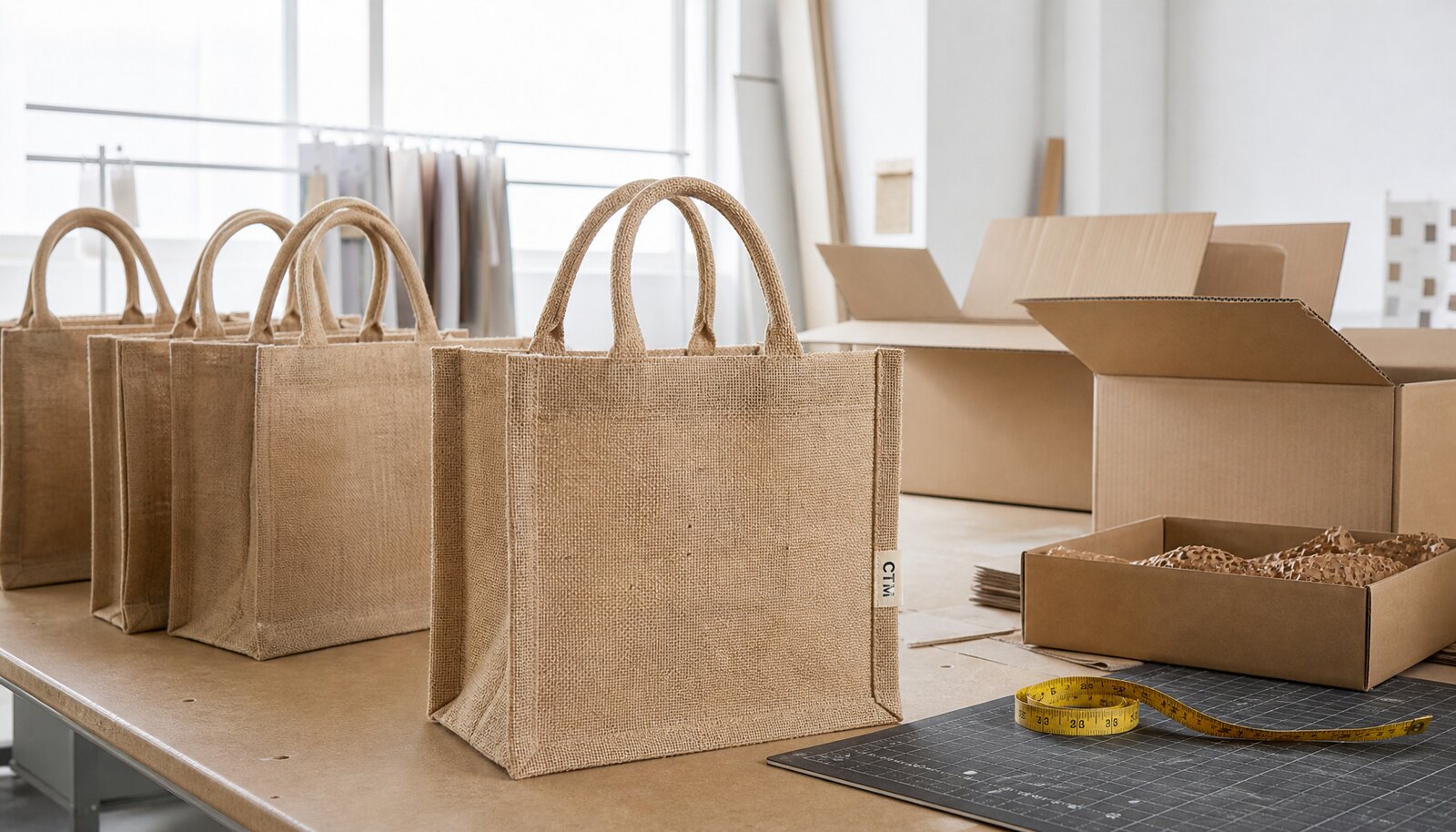
Why carton packing is the real buying issue for jute gifting totes
For jute tote bags used in corporate gifting, the bag spec is only half the job. The carton packing plan drives freight cost, print damage risk, shelf presentation, and how many units actually survive import handling without crushed corners or rubbed logos. A quote that looks cheap per bag can become expensive when the carton fills badly or needs extra labor for wrapping and relabeling.
Most procurement problems start when the buyer treats all jute totes as the same. They are not. A soft unlined tote for brochures needs a different packing method than a structured branded bag carrying bottles, notebooks, or welcome kits. If you define the carton plan early, suppliers will quote the same build and the same packing labor, which makes comparison possible.
- Carton plan affects freight cube, not just protection.
- Fold shape changes print scuff risk and carton loading efficiency.
- Packing labor should be separated from bag unit cost in the quote.
Choose the jute build before you talk about the carton
A practical starting point is a 10x10 weave jute in the 300-350 GSM range for standard corporate gifting totes. That weight is usually strong enough for documents, apparel, notebooks, and moderate insert kits without turning the bag into a bulky freight item. If the bag must stand up in retail use or carry heavier gifts, move toward 400 GSM or a reinforced structure and accept the extra cost and sewing time.
Lamination and lining deserve separate treatment. Unlaminated jute gives the most natural look and the lowest base cost, but it can shed fibers and show surface variation. A PP or cotton lining improves hand-feel and protects packed items, yet it also changes the packing thickness and can reduce the number of bags per carton. Do not let a supplier bundle these choices into one vague 'premium finish' line.
- 300-350 GSM: common for event totes and medium corporate kits.
- 400+ GSM: better for structured premium gifting and heavier contents.
- Unlined bags usually pack flatter; lined bags need a different carton count.
What changes the quote more than buyers expect
The biggest price drivers are not always the bag body. Print method, handle type, lining, and packing labor can move the quote more than a small fabric change. Screen print is usually the most cost-efficient for simple logo graphics and repeated orders, while embroidery or woven badges can be justified only when the brand wants a premium touch and can tolerate a higher MOQ or slower output.
Handle construction also matters. Self-fabric handles are economical and keep the bag visually simple, but cotton webbing handles feel better in hand and usually hold up better under load. If the tote is going into a corporate gifting box, a buyer should decide whether the handle is meant for light presentation use or for daily reuse. That decision changes reinforcement stitch pattern, sewing time, and the number of cartons the factory can safely stack.
- Screen print suits large logo areas and repeat runs.
- Cotton webbing handles improve comfort but raise cost and sewing time.
- Embroidery and badges need extra QC for alignment and stiffness.
Use supplier type as a sourcing decision, not a guess
When comparing suppliers, separate direct factories from trading routes. A direct factory is usually stronger when the order is a standard jute tote with clear print, stable size, and predictable packing. You get better control over sewing spec, carton loading, and pre-shipment photos. A trading route can help when the gift kit includes mixed products that must be consolidated into one shipment, but it can also hide the true carton build behind a single unit price.
For corporate gifting programs, the best route depends on whether your risk sits in production or consolidation. If the bag itself is the main product, work directly with the factory and request a packed sample carton. If the tote is only one piece of a larger gift set, you may need a supplier who can coordinate kitting, labeling, and mixed carton assembly. In both cases, insist on packing evidence, not just a price list.
- Direct factory: better for standard tote repeatability and stable quote comparison.
- Trading route: useful for mixed gift sets and consolidated sourcing.
- Ask for packed carton photos from the exact supplier route being quoted.
Comparison of sourcing routes for jute tote cartons
The table below is not about spec labels alone. It shows where each sourcing route tends to perform better and what can go wrong when buyers assume all quotes include the same carton work. The goal is to compare like for like before you approve samples or lock a purchase order.
Use the table to set your RFQ structure. If a supplier cannot answer these decision points clearly, their unit price is not yet comparable to the others.
- Write decisions in measurable language, not only descriptive wording.
- Ask for sample photos plus one physical approval sample for important orders.
- Keep quotation, sample approval, and inspection notes tied to the same spec version.
How to write a carton packing plan that factories can follow
A useful carton packing plan is short but exact. State the bag size, fold method, inner protection, pack count per carton, carton dimensions target, and maximum gross weight. If the bags must arrive retail-ready, specify whether the logo should face up or be folded inward. If the bags are for warehouse distribution, prioritize cube efficiency and load stability instead of presentation.
The packing plan should also define what happens when the carton fill count is reached. Some suppliers will over-pack to reduce carton count, which can crush handles and distort the panels. Others leave too much empty space, which wastes freight and lets bags shift in transit. Good buyers give the factory an acceptable range and a strict maximum, then ask for a carton photo from the pilot run.
- State folding direction and logo orientation.
- Define the exact bag count per carton and the max gross weight.
- Include whether desiccant, tissue, or polybags are required.
Sample approval should include the packed carton, not just the bag
A bag sample alone is not enough. For jute totes, the packed carton sample reveals whether the handles spring back, whether the folds create pressure marks, and whether the print rubs against adjacent bags. Ask the factory for one pre-production sample bag, one print strike-off or decorated sample, and one small packed carton using the intended loading pattern.
Inspect the sample carton in the same way you would inspect a production lot. Open random units, look at print alignment after folding, verify stitch quality at the handle anchors, and check whether the bag springs back or stays crushed. If the sample carton already looks unstable, mass production will only magnify the defect.
- Approve fabric hand, print opacity, and fold memory together.
- Open a packed carton and inspect 3-5 bags from different positions.
- Reject any sample that shows print scuffing from carton contact.
Packing details that prevent damage and freight waste
The most common damage on jute tote shipments is not catastrophic breakage. It is cosmetic damage: scuffed print, fiber dust, corner crush, and handle deformation. These defects matter because corporate gifting buyers often present the bag as part of a branded experience. A bag that looks tired at arrival reduces the perceived value of everything inside it.
A strong export carton plan normally uses 5-ply cartons with clear gross weight control and enough structure to avoid corner collapse. Tissue wrap can help if the tote is premium and fold marks are a concern. Polybags are useful when humidity or dust is an issue, but they increase labor and plastic use. Keep the packing method aligned with the route: sea freight to humid destinations often needs more protection than domestic distribution from a dry warehouse.
- Use 5-ply cartons for export unless the order is very light and local.
- Set a strict carton gross weight ceiling to prevent crush and handling risk.
- Use tissue or polybags only when the route and presentation justify them.
Lead time planning: where jute tote orders usually slip
Lead time usually slips for reasons that have nothing to do with the bag sewing itself. The biggest delays are artwork approval, print color matching, carton sample sign-off, and packing changes after the order is already in production. If the buyer approves a bag sample but changes the inner packing later, the factory may need to stop, rework, or source extra packing materials, which pushes dispatch back.
A realistic schedule should separate sample time, bulk material preparation, sewing, printing, final QC, and carton packing. For a standard order, the bag body may be quick to produce, but special handle stitching, lining, or mixed kitting can add days. Buyers who want on-time shipment should freeze the packing method before the factory starts bulk cutting.
- Lock artwork before sample approval.
- Freeze carton count before bulk sewing starts.
- Treat kitting or mixed inserts as a schedule risk, not an afterthought.
Landed-cost comparison: unit price is not the real number
When you compare quotes, ask for the bag price, decoration price, packing labor, carton cost, and whether the quote is ex-works or packed for export. A supplier with a slightly higher unit price may still be cheaper overall if they pack more efficiently, use stronger cartons, or reduce freight cube. The cheapest unit price often loses once the shipment is in the warehouse or on the water.
A simple landed-cost view should include carton count, units per carton, carton size, gross weight, and any extra packing materials. If two suppliers quote the same bag but one loads 40 units per carton and the other loads 60, the total freight and damage exposure are not the same. Buyers should compare the complete packed offer, not only the tote itself.
- Request ex-works and packed-for-export pricing in the same quote.
- Compare carton count and cube, not just bag unit cost.
- Include decoration, packing labor, and carton material in the comparison.
Specification comparison for buyers
| Spec decision | Recommended option | When it fits | Buyer risk to check |
|---|---|---|---|
| Jute fabric weight | 10x10 weave around 300-350 GSM for standard gifting totes; 400+ GSM for structured premium bags | Use 300-350 GSM for medium-value giveaways, event kits, and store bags; move up when the bag must stand upright or carry heavier inserts | Too light a fabric wrinkles, shows print distortion, and loses shape in cartons; too heavy can raise cost and slow sewing output |
| Lamination or lining | Unlaminated for natural look; PP or cotton lining only when product protection matters | Choose unlined for simple apparel, brochures, or low-risk gifting; choose lining for items with sharp edges, bottles, or premium presentation | Lining changes hand-feel, cost, and carton thickness; unlined jute can shed fibers and mark packed items if no tissue is used |
| Print method | Screen print for solid logos; heat transfer or embroidery only for small runs or premium detail | Screen print fits stable art, larger MOQs, and repeat programs; embroidery fits small logo badges or premium retail gifting | Poorly cured print cracks on folded areas; embroidery may stiffen the panel and create carton stacking pressure points |
| Handle construction | Self-fabric handles or cotton webbing handles with reinforced stitching | Self-fabric suits lower price points; cotton webbing is better for hand comfort and heavier inserts | Short handles can deform in packing; weak stitch reinforcement causes handle pull-out after compression in transit |
| Carton load strategy | Use master cartons with controlled layer count and bag orientation; add inner polybag only when needed | Best for export buyers who need a balance of cube efficiency and presentation consistency | Overstuffed cartons crush corners and print; loose loading wastes freight and shifts during transit |
| Inner protection | Tissue wrap or individual polybag only for premium gifting or dusty routes | Use tissue for shelf-ready presentation; use polybag when humidity, dust, or visible scuffing is a concern | Excessive plastic adds labor and can trap moisture in humid lanes; no protection can cause fiber dust and surface rub |
| MOQ route | Standard print and standard size to reach factory-efficient MOQ; custom sizes or trims require higher MOQ | Use this route when the buyer needs competitive pricing and a repeatable carton plan | MOQ confusion often comes from mixing bag spec MOQ with print-color MOQ and carton packing MOQ |
| Supplier route | Direct factory with packing photos and pre-shipment carton sample, or trading route if the order needs mixed-item consolidation | Direct factory suits standard tote programs; trading route can suit mixed-product gift kits | Intermediary quotes may hide carton details, sewing spec, or print method changes that affect landed cost |
| Carton format | 5-ply export cartons with clear net/gross weight limits and carton mark labels | Use for international shipments and stacking in warehouse or retail DCs | If carton strength is too low, corners crush and bag handles press into panels; if too large, freight density worsens |
Buyer checklist before sampling
- Bag size in centimeters, tolerated size variance, and whether gusset depth is measured flat or fully opened
- Jute fabric weight or weave density, plus whether the bag is laminated, lined, or unlined
- Logo art in vector format, print area, color count, and whether the artwork sits on a flat panel or near seams
- Handle length, handle material, reinforcement stitch pattern, and target load rating
- Carton pack count, carton dimensions, maximum gross weight, and whether individual wrapping is required
- Destination climate, storage time, and whether humidity protection or deodorizing is needed
- Target MOQ, sample approval route, and acceptable production variance for color, stitching, and print position
Factory quote questions to send
- What jute fabric weight and weave density are you quoting, and do you have a reference sample or spec sheet?
- Is the logo quote based on screen print, heat transfer, embroidery, or woven label, and how many print colors are included?
- What is the exact carton pack count, carton size, gross weight limit, and carton material grade?
- What are the MOQ thresholds for the bag body, print color, and any special packing inserts?
- Can you share sample photos of sewing, handle reinforcement, print placement, and a packed carton before mass production?
- What is your standard lead time after sample approval, and what factors usually add delay to export packing?
- How do you control moisture, fiber dust, and carton compression for sea freight shipments?
- Can you quote both ex-works and packed-for-export pricing so I can compare landed cost properly?
Quality-control points to confirm
- Fabric weight tolerance should be clearly stated; buyers should not accept a vague 'thick jute' description without a GSM range.
- Stitching on handle anchors and side seams should be uniform, with no skipped stitches, loose threads, or seam puckering at load points.
- Logo placement must stay within an agreed tolerance from top edge and centerline so cartons open to a consistent retail presentation.
- Print should pass rub handling after curing; smearing, tackiness, or cracking on fold lines should fail pre-shipment inspection.
- Cartons should match agreed dimensions and loading plan; overfilled cartons or crushed corners indicate packing process drift.
- If tissue, polybags, or inserts are specified, the factory must use the exact packing sequence approved in the sample carton.
- Random carton opening during inspection should confirm the same bag count, same folding direction, and same accessory inclusion across the lot.