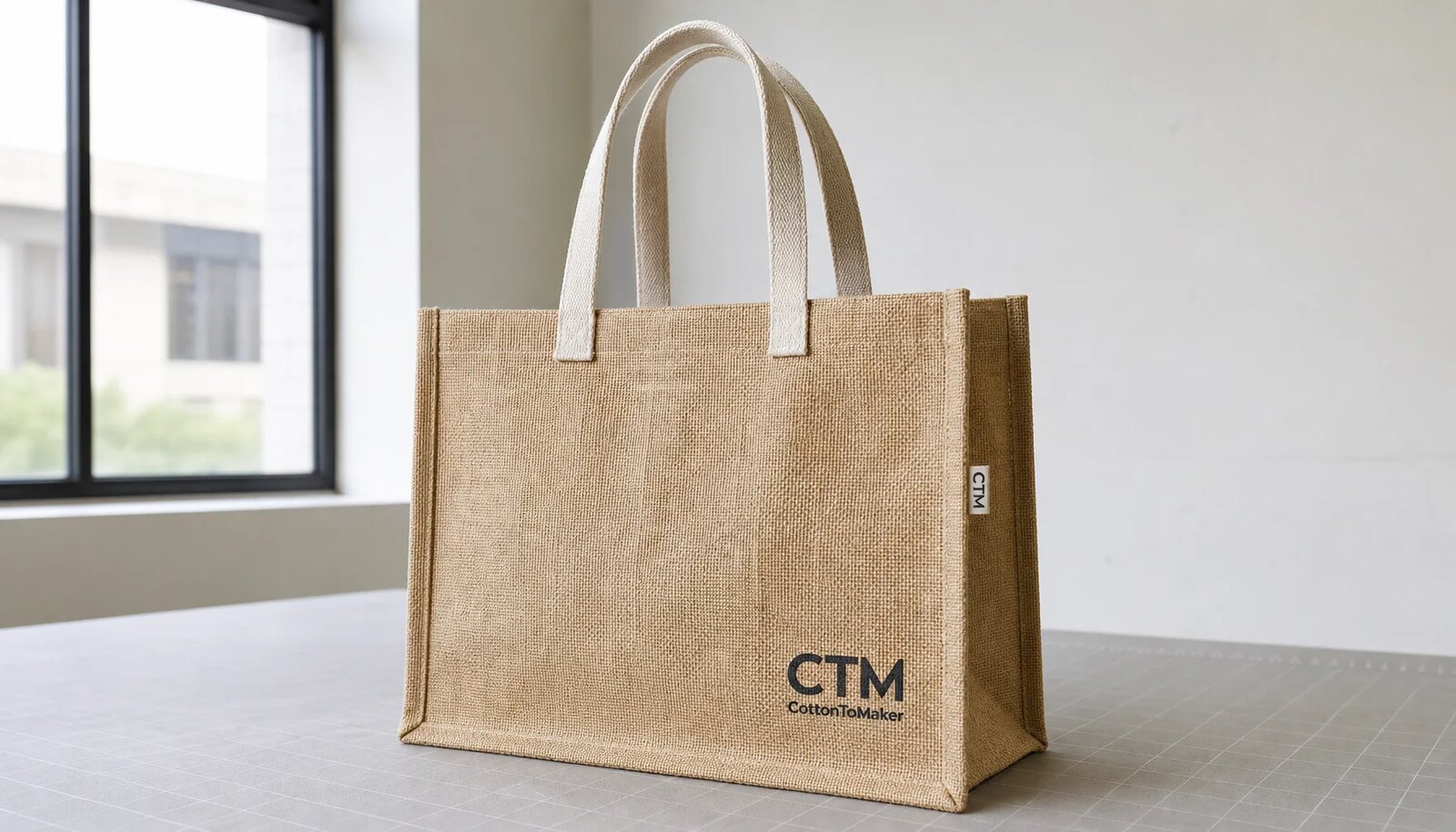
Start With the Tote’s Job
MOQ discussions improve when procurement first defines what the bag must do. A paid merchandise tote sold beside whole-bean coffee needs a better handfeel, clean stitching, and shelf-ready presentation. A gift-with-purchase may prioritize recognizable branding and controlled unit cost. A subscription insert may need a flatter fold and lower carton cube. A wholesale account giveaway can require co-branding, SKU labels, and cartons that match a distributor’s receiving process.
Ask for the minimum for the exact program, not a general minimum for jute bags. The commercial use affects body size, fabric weight, handles, decoration, label type, packing, and QC standard. A second print color, woven label, hang tag, barcode sticker, or retail unit pack can change both MOQ and price after internal approval if it was not included in the first RFQ.
Many roasters can use one tote across retail, events, subscriptions, and wholesale support. The negotiation gets stronger when the base construction stays the same and only the print, hang tag, or carton label changes.
- Classify the tote as retail merchandise, GWP, subscription insert, event handout, wholesale support, retail packaging, or gifting before quoting.
- Separate launch quantity from the expected 6- or 12-month reorder volume.
- Identify the true non-negotiables: carry strength, barcode readability, shelf appearance, low freight cube, co-branding accuracy, or event delivery date.
- Ask for MOQ for the body construction and MOQ per artwork so a catalog minimum does not anchor the discussion.
Write a Priceable Spec
A factory-ready RFQ should include finished body width, height, gusset depth, handle drop, handle width, top finishing, fabric GSM, backing or lining status, print dimensions, label details, fold method, carton quantity, and shipment term. Use centimeters and inches, and state that dimensions are finished sewn dimensions. Small confusion between flat artwork size and finished bag size can affect cutting yield, print placement, and carton fit.
Avoid vague language such as standard jute. Lighter promotional totes may be quoted around 280-340 gsm, while more structured retail totes often sit near 350-450 gsm. Treat those ranges as buyer reference points, not universal grades. Ask the supplier to confirm the proposed GSM, weave density, finish, and tolerance for the actual production lot.
Natural jute has shade movement, slubs, and visible fiber texture. That can work well for coffee branding, but natural does not mean uncontrolled. Separate acceptable variation from rejectable defects such as oil stains, water marks, damp odor, mold signs, large weave gaps, contamination, weak yarns near seams, and dirty print zones.
Tolerances need written agreement. For many sewn natural-fiber totes, buyers may start discussions around ±1 cm for main dimensions and handle drop, and about ±5 mm to ±10 mm for print or label placement. Confirm these tolerances with the supplier, especially for laminated, lined, or deep-gusset constructions.
- Specify finished size, gusset, handle drop, handle width, fabric GSM, lining or lamination, top finish, print area, label type, and packing format in one RFQ file.
- Define usable print area, not only logo size, because seams, gussets, handles, and open weave affect decoration.
- State whether shade must match a previous program or only stay within an approved natural range.
- Put tolerances for dimensions, GSM, print position, label position, appearance, and packing into the purchase spec.
Compare Supplier Routes
A direct cut-and-sew jute bag factory is usually the best fit for repeat orders where custom construction, consistent approvals, and landed-cost control matter. The buyer must provide a clear spec because direct factories normally calculate minimums by body, fabric, artwork, component, sewing setup, and packing labor.
A trading company or export agent may be useful when the buyer wants one commercial contact, help qualifying factories, or consolidation with other branded merchandise. The approval discipline still belongs to the buyer. Ask who makes the sample, who retains the golden sample, who approves material changes, and who is responsible for inspection and rework.
Stock blank programs can suit low-volume launches, short event deadlines, or market tests. They may reduce initial MOQ and sampling time, but control is limited. Available blanks may not match the preferred GSM, handle drop, gusset, shade, print area, or future reorder requirement.
Compare all routes on the same assumptions: size, GSM, decoration, packing, carton quantity, shipment term, inspection standard, and reorder forecast. A stock route may win on speed; a direct factory may win on repeatability; an agent may win on coordination.
- Use a direct factory when repeatability, custom control, and program landed cost matter most.
- Use an agent when supplier access, mixed sourcing, or export coordination is valuable, while keeping approvals centralized.
- Use stock blanks when speed and lower launch quantity matter more than complete construction control.
- Compare unit price only after carton data, shipment term, packing, and inspection expectations are aligned.
Separate MOQ Drivers
Factory MOQ is usually a setup and efficiency calculation. For jute tote bags, the common drivers are fabric roll usage, cutting marker efficiency, size changes, handle material, screen setup, label minimums, sewing-line setup, packing labor, and carton labeling. A one-size, one-color, unlined tote bulk packed in master cartons is simpler than a multi-SKU retail program with separate labels, unit wraps, two-sided prints, and version-specific carton marks.
Ask for MOQ in layers: body size, artwork, print color count, woven label design, handle color, packing format, carton mark, and total program volume. This shows where flexibility exists. A factory may need a certain body quantity for efficient cutting but accept a lower quantity per artwork when the shared body volume is high. Another supplier may be flexible on print changes but constrained by the label mill.
The best negotiation reduces setup burden while giving the supplier credible future volume. Use one base bag across channels. Keep handles, thread, and carton format consistent. Print one spot color where possible. Use one woven side label for the brand and hang tags for blend, event, or seasonal changes.
Separate MOQ from price breaks. A smaller launch quantity may be possible at a higher unit price because setup cost is spread over fewer pieces. That can be better than overbuying merchandise that may not sell. Request price tiers for launch quantity, first reorder, and annual forecast.
- Ask for MOQ by body, artwork, print colors, label design, handle color, packing format, carton mark, and full program volume.
- Standardize body size first because cutting and sewing setup often drive the minimum more than small artwork changes.
- Use hang tags or inserts for limited variations when unique woven labels create a new component MOQ.
- Request price tiers that match actual demand instead of chasing only the lowest possible minimum.
Choose Decoration Carefully
Decoration affects brand presentation, MOQ, defect risk, and price. Screen printing is common for bold coffee roaster logos, spot colors, and repeat merchandise programs. The limitation is the surface: jute has open weave, slubs, texture, and shade movement. Fine lines, tiny type, gradients, halftones, and reversed-out marks may break up even when the digital file looks clean.
Artwork should be adjusted for the fabric. As a starting reference, avoid very thin strokes below roughly 0.5 mm unless the printer confirms they can hold them on the actual material. Keep small text large enough to remain readable after ink settles into the weave; many buyers test around 8-10 pt equivalent or higher depending on font and fabric openness. Supplier confirmation and strike-off approval matter more than the number itself.
Woven labels can give more controlled brand detail, especially for repeat programs or strict identity systems. They can also become a shared component across several tote designs. The tradeoff is separate setup, thread color limits, folding choices, stitching labor, and label MOQ.
Do not approve decoration from a mockup alone. A mockup confirms layout, not ink spread, edge clarity, color shift, rub performance, or how the print crosses slubs. Require a strike-off or pre-production sample on the actual jute surface. If a fast sample uses substitute fabric, mark it as concept-only.
- Use screen print for bold logos, spot colors, and artwork that can tolerate natural texture.
- Use woven labels for small brand marks, repeat programs, or a more controlled retail detail.
- Avoid tiny type, thin rules, gradients, halftones, and small compliance marks unless tested on production fabric.
- Approve ink color, coverage, rub performance, and placement from a physical strike-off or production sample.
Build Landed-Cost Quotes
A useful quote separates the bag unit price from every cost that affects landed cost. Ask for sample fee, screen fee, setup fee, label setup, label unit cost, hang tag cost, barcode sticker and application cost, inner packing cost, carton printing, master carton dimensions, carton quantity, gross weight, estimated CBM, lead time, inspection support, and shipment term.
Request price breaks at meaningful quantities: launch order, realistic reorder, and annualized program volume if there is a forecast. Then ask which variables move price most. The answer may show that reducing print colors matters more than shortening handles, or that a tighter fold reduces freight cube more than a small unit-price concession.
Shipment terms must match. EXW, FOB, CIF, DDP, and domestic delivered quotes are not comparable without adjustment. At minimum, collect shipment term, port or delivery point, carton dimensions, pack count, gross weight, and estimated CBM. If the receiving warehouse requires labels, pallet rules, barcodes, or ASN data, include those before final pricing.
A clear quote also helps internal teams make one decision. Marketing can review logo execution, operations can review carton count and receiving labels, and finance can assess payment terms and inventory exposure.
- Request itemized costs for screens, labels, tags, samples, packing, barcode work, carton marks, and special documentation.
- Compare suppliers using the same shipment term, destination, carton requirement, inspection standard, and payment assumption.
- Ask for carton dimensions, pack count, gross weight, and estimated CBM so freight cube is visible.
- Have suppliers show price impact for one-color print, shared base bag, hang tag instead of woven label, and bulk pack versus retail pack.
Approve Samples Properly
Sampling should prove how bulk production will be made. A quick prototype can confirm the general look, but a pre-production sample should use the same jute GSM, weave, handle material, thread, ink, label, hang tag, fold method, and packing materials as the bulk order. If substitute material is used for speed, document that limitation and do not treat it as the golden sample.
Review the sample like a buyer and an inspector. Fill it with realistic contents: several retail coffee bags, accessories, event materials, or a typical kit weight. Some roaster totes may target a practical carry range around 4-8 kg, but the correct requirement depends on use. Lift, hold, and flex the bag, then inspect handle stitching, seam strain, bottom gusset distortion, and print cracking.
Presentation matters too. Handles should not twist badly, pull unevenly, or feel uncomfortable for the intended load. The bag should not smell damp, smoky, chemical, or moldy. Loose threads and rough finishing should be controlled, especially for paid merchandise.
After approval, retain a golden sample or reference set. Mark it with approval date, spec version, artwork revision, fabric GSM, label version, print color reference, handle specification, and packing notes. This gives buyer and supplier a physical standard for the first order, reorders, and dispute resolution.
- Separate concept sample, swatch, print strike-off, pre-production sample, and golden sample in the approval plan.
- Do not approve mass production from substitute fabric, substitute handles, or unfinished packing unless the limitation is documented.
- Load, lift, flex, measure, and inspect the sample instead of approving only a photo.
- Keep signed golden samples with spec version and artwork revision for reorder control.
Set QC Before Cutting
Quality control for jute totes should balance natural material character with measurable commercial acceptability. Minor shade variation, texture, and slubs may be acceptable if agreed. Oil stains, water marks, damp odor, mold signs, insect contamination, weak yarns, open seams, major weave gaps, and dirty print zones should be rejectable.
Dimensional inspection should cover finished body width, height, gusset depth, handle drop, handle width, print placement, and label placement. Use written tolerances instead of visual judgment. For larger orders, use an AQL-style final random inspection or another written lot check with defined critical, major, and minor defects.
Stitching inspection should cover skipped stitches, loose threads, seam alignment, top edge finishing, bottom gusset strength, and handle reinforcement. Ask what stitch type and reinforcement method will be used: box stitch, cross stitch, bar tack, multiple rows, or another construction. The load check should use the agreed weight and inspect the bag after lifting and holding.
Print inspection must happen on actual bags. Check registration, edge clarity, ink coverage, pinholes, bleeding, rubbing, cracking, color appearance, and cure quality. Packing inspection should verify inner count, fold method, carton quantity, carton dimensions, gross weight, SKU labels, carton marks, and barcode readability.
- Define acceptable jute variation separately from stains, odor, mold, contamination, weak seams, and poor print cure.
- Measure dimensions and decoration placement against written tolerances.
- Inspect handles and bottom gussets with a realistic load test based on intended contents.
- Document defect categories, acceptance limits, rework process, and reinspection responsibility before production begins.
Control Packing and Cartons
Packing is a cost, quality, and warehouse-control decision. Bulk packing may work for event distribution, wholesale repacking, or internal kitting. Retail programs may need paper wraps, polybags where permitted, hang tags, insert cards, barcode stickers, or a fold that displays the logo. Changing from bulk pack to unit pack after sampling can change labor, material cost, carton cube, and lead time.
Carton planning matters because freight follows volume as well as weight. Ask for master carton dimensions, pack count, gross weight, and estimated CBM. Confirm whether cartons are single-wall or double-wall, whether inner bundles are tied or bagged, and whether the bag is folded logo-in or logo-out.
Barcode control is easy to miss in merchandise programs. If the tote is sold as a retail SKU, confirm barcode type, size, placement, and scan readability. If cartons require receiving labels, specify label content and position. For multiple artwork versions, carton marks and inner packs must identify the version clearly.
Jute also needs moisture awareness. It can absorb odor or dampness if stored poorly or shipped through humid conditions. Specify clean, dry cartons and clean storage. For sea freight, humid destinations, monsoon-season risk, or long warehouse dwell time, ask whether liner bags, desiccant, pallet wrap, or other moisture controls are recommended and priced.
- Choose bulk pack, inner bundle, or retail-ready unit pack based on receiving channel requirements.
- Specify fold method, inner quantity, master carton quantity, carton dimensions, carton marks, SKU labels, and barcode placement.
- Request carton cube and gross weight before awarding the order.
- Add moisture-control requirements for sea freight, humid storage, long transit, or retail channels where odor and carton condition matter.
Plan Lead Time and Reorders
Lead time should be broken into approval, production, inspection, and shipping. A supplier may quote production after sample approval, but procurement must allow for artwork proofing, swatch review, print strike-off, sample transit, internal approval, bulk production, final inspection, documents, and freight. The order truly starts only when materials, artwork, payment terms, and written approval are complete.
Material availability changes the schedule. If suitable jute, handle tape, thread, and cartons are in stock, sampling can move faster. A specific GSM, custom handle color, woven label, printed carton, or retail-ready pack may extend timing. Ask what the quoted lead time assumes and whether inspection time is included.
Leave time for correction. Decoration on jute can require adjustment after the first strike-off because ink coverage, edge clarity, or color appearance may not match expectations on textured material. A revised strike-off can protect a fixed launch, event, or retailer delivery window from avoidable defects.
Reorders still need discipline. Consistency can shift if the factory uses a new fabric lot, replaces screens, changes label thread, alters handle tape, or folds cartons differently. Keep a current spec file and reorder calendar. Share expected reorder windows so fabric and labels can be planned, and compare each reorder against the retained golden sample.
- Build the calendar around artwork approval, swatch review, strike-off, sample approval, production, inspection, document release, and shipping.
- Ask whether lead time assumes stock materials or fresh purchase for jute, handles, labels, and cartons.
- Leave time for a failed strike-off or corrected sample, especially for new artwork.
- For reorders, reconfirm GSM, handle construction, print position, label version, packing spec, and carton marks before PO release.
Specification comparison for buyers
| Procurement decision | Best-fit option | What to specify in the RFQ | Buyer risk to control |
|---|---|---|---|
| Sourcing route | Direct cut-and-sew jute bag factory | Finished size, jute GSM, lining or lamination status, handle construction, artwork, label, packing, carton data, shipment term, inspection standard, and reorder forecast | A catalog MOQ may not apply once size, fabric, decoration, packing, and QC requirements are fixed |
| Supplier model | Trading company or export agent | Factory role, sample ownership, substitution approval, inspection responsibility, and whether production may be subcontracted | Spec drift can occur if the agent, factory, and buyer do not work from one approved revision |
| Low-volume launch | Stock blank jute tote plus decoration | Available blank dimensions, actual GSM range, handle drop, print area, stock reservation period, decoration limits, lead time, and reorder availability | Lower launch MOQ can come with limited control over shade, construction, lot consistency, and future supply |
| Multi-SKU coffee program | One shared base bag with artwork or tag variations | Shared body size, fabric, handles, thread, carton format, artwork count, label count, SKU labels, and MOQ per artwork | Savings disappear if each SKU needs separate cutting, screens, labels, folds, or carton marks |
| Fabric selection | Natural jute in a confirmed GSM range | Target GSM, GSM tolerance, shade range, weave defects, backing or lining status, and swatch approval process | The term standard jute is too vague; suppliers may quote different weights, stiffness, weave density, or finishes |
| Brand presentation | Screen print with optional woven side label or hang tag | Pantone or spot color reference, print dimensions, minimum line weight, label size, label fold, placement tolerance, hang tag details, and barcode needs | Fine detail, small type, gradients, and legally sensitive marks may not reproduce cleanly on open jute weave |
| Packing route | Bulk pack, inner bundle, or retail-ready unit pack | Fold pattern, inner count, unit wrap, barcode placement, master carton quantity, carton dimensions, gross weight, carton marks, and mixed-SKU rules | A low unit price can be offset by oversized cartons, repacking labor, warehouse relabeling, or high dimensional freight |
| Sample approval | Pre-production sample plus retained golden sample | Spec version, production fabric swatch, final artwork, strike-off, handle material, label, fold method, carton format, and signed approval date | A visual sample made with substitute fabric or handles can create disputes when bulk goods differ |
| QC standard | AQL-style final inspection or written lot check | Inspection level, critical/major/minor defects, measurement tolerances, load test, rub test, odor check, barcode scan, and rework process | Natural variation is normal, but stains, damp odor, mold, weak seams, poor print cure, and wrong labels should be rejectable |
Buyer checklist before sampling
- Define the tote’s commercial role: paid retail merchandise, gift-with-purchase, subscription insert, wholesale account giveaway, trade show handout, event kit, corporate gifting, loyalty item, or retail packaging support.
- Separate launch quantity from expected 6- or 12-month reorder volume so suppliers can price first-run risk and program potential differently.
- Lock finished dimensions in centimeters and inches: body width, body height, gusset depth, handle drop, handle width, and usable print area.
- Specify target jute GSM, such as 280-340 gsm for lighter promotional use or 350-450 gsm for more structured retail totes, plus the accepted tolerance, subject to supplier confirmation.
- State whether the bag is unlined, laminated, cotton-lined, reinforced, or backed; do not accept standard construction language without detail.
- Define top finishing, stitch color, visible stitch density, handle material, handle width, reinforcement method, and expected carry load.
- Provide vector artwork, print dimensions, color references, minimum text height, placement tolerance, and any marks that must remain readable on jute texture.
- Choose branding components: screen print, woven side label, center label, hang tag, paper insert, barcode sticker, carton SKU label, or a controlled combination.
- Ask for MOQ by bag body, artwork, print color count, label design, handle color, packing format, carton mark, and total program volume.
- Confirm sample type, sample fee, strike-off process, golden sample retention, inspection standard, carton dimensions, barcode requirement, and shipment term before purchase order release.
Factory quote questions to send
- What is the MOQ for this exact finished size, jute GSM, lining or lamination status, handle construction, decoration method, and packing spec?
- Can you quote MOQ separately by bag body, artwork, print color count, woven label design, handle color, hang tag, carton mark, and total program volume?
- Which jute GSM, weave density, and finish will you use, and what GSM tolerance do you hold in bulk production?
- Can you provide a swatch or sample photo from the proposed fabric lot before we approve the production sample?
- What finished-dimension tolerances do you hold for body width, height, gusset depth, handle drop, handle width, print placement, and label placement?
- Which costs are outside the unit price: screens, label setup, sampling, artwork adjustment, strike-off, inner packing, carton printing, barcode application, inspection support, document fees, or bank charges?
- Will the pre-production sample use the same jute fabric, handle tape or cord, thread, ink, label, hang tag, fold method, and packing materials as mass production?
- What print method do you recommend for this artwork on jute, and what minimum line weight, text height, or reversed-out detail should we avoid?
- Can you provide a print strike-off on the actual jute surface before bulk production, and is it included in the sample fee?
- What color tolerance should we expect for screen print on natural jute, and will you match the color visually on fabric rather than coated paper only?
Quality-control points to confirm
- Retain a signed and dated golden sample with spec version, artwork revision, fabric swatch, approved label, handle material, and packing reference.
- Confirm production fabric GSM by the agreed method and compare handfeel, stiffness, shade, and weave against the approved swatch or golden sample.
- Measure finished body width, height, gusset depth, handle drop, handle width, print placement, and label position against written tolerances.
- Check jute fabric for uneven weave beyond the agreed limit, oil marks, water stains, mold signs, damp odor, broken yarns, contamination, insect debris, and weak areas near seams.
- Inspect top edge finishing, side seams, bottom gusset stitching, stitch density, loose threads, skipped stitches, and reinforcement at handle attachment points.
- Perform a practical load check using the expected carry weight for coffee bags, retail goods, event kits, or samples; inspect handle stitches and seam strain after lifting and holding.
- Review screen print on actual jute for registration, ink coverage, edge clarity, color match, pinholes, bleeding, cracking, rubbing, and cure quality after flexing the fabric.
- Verify woven label or tag details: size, fold, orientation, thread colors, stitch position, straightness, readability, and position after the bag is filled.
- Check barcode readability with a scanner where required, plus barcode placement, SKU labels, hang tags, carton marks, and warehouse compliance before cartons are sealed.
- Confirm inner pack count, fold method, master carton quantity, carton dimensions, gross weight, carton strength, and whether cartons are packed tightly enough to avoid shifting and deep creasing.