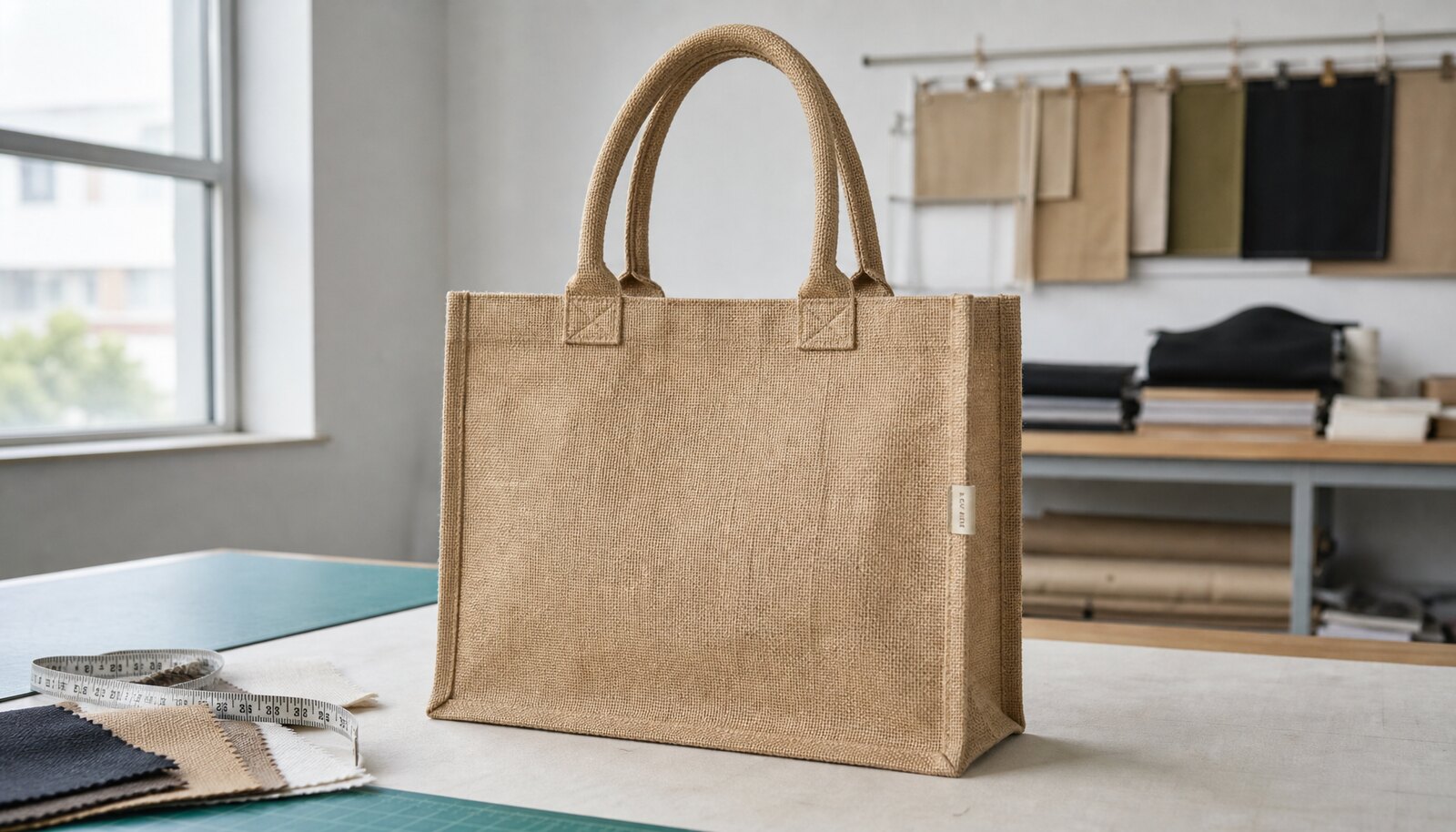
Why jute tote bags fit a brand launch
Jute tote bags make sense when the launch needs a natural look, stronger shelf presence, and a bag that feels more substantial than a giveaway tote. They work well for retail openings, press kits, premium event packs, and product launches where the bag itself is part of the brand experience. The buyer mistake is treating jute as a generic promo item. It is not. A launch bag has to look deliberate, survive handling, and stack cleanly in receiving, backroom storage, and customer fulfillment.
Before you request quotes, define the bag's job. If it is a short-life handout, you can accept a simpler body and lighter structure. If it is supposed to carry paid retail goods or be reused by consumers, the spec needs better seams, cleaner print, and more controlled packing. Natural fiber variation is normal, but that does not excuse sloppy construction. The right question is not whether the jute looks uniform like plastic. It is whether the bag is consistent enough to support the launch story and hold up in real use.
- Treat the bag as launch packaging, customer merchandise, or retail stock, then spec it accordingly.
- Accept natural fiber variation, but set a clear limit on odor, shedding, and print placement.
- Build the RFQ around use case first, not just size and logo.
Choose the right jute construction and GSM
For most launch totes, body weight is the first commercial decision. A light build around 280 to 320 GSM can work for simple handouts and low-fill kits, but it can feel soft and less structured. A midweight build around 350 to 400 GSM usually gives a better retail impression, better standing shape, and less distortion at the side seams. Once you move into heavier inserts, bottles, boxed sets, or repeated customer use, the factory should show you a stronger build and possibly a lined or laminated option. Weight is not just about feel. It affects sewing behavior, edge cleanup, print registration, and carton load stability.
Handle choice matters as much as body weight. Self-fabric jute handles can look cohesive, but they may feel rough on the hand unless the edge finish is managed well. Cotton webbing handles usually feel cleaner and are easier to grab, especially on a bag with a premium launch position. Jute rope or thick rope-style handles can support a more rustic look, but they need a serious top reinforcement plan. Ask for the handle width, attachment stitch pattern, and whether the factory uses bar-tack or a reinforced box-X. That detail often separates a good sample from a bag that fails after a few customer uses.
- 280 to 320 GSM: lighter promotional use, lower structure, lower cost.
- 350 to 400 GSM: stronger retail feel, better shape, safer default for launches.
- Lamination or lining: useful when the interior must feel cleaner or carry heavier inserts.
- Cotton webbing handle: usually more comfortable and more consumer-friendly than raw jute handle edges.
Print methods that survive the launch cycle
Jute texture changes how artwork behaves. A clean one- or two-color screen print is usually the most dependable choice for a brand launch because it holds shape, stays readable at a distance, and does not overcomplicate the quote. For fine detail, small text, or multi-color artwork, the supplier may suggest heat transfer or another applied decoration method, but that decision needs a real sample, not a promise. Jute is uneven by nature, so fine lines can break up, and dense coverage can look patchy if the ink is not matched to the fabric surface.
Do not let the factory quote print method in isolation from the artwork. Ask how much flat area they can actually hold after seam allowances and gusset fold lines are removed from the usable print space. A large logo on a mockup can shrink once the bag is sewn. Also ask for rub resistance, fold resistance, and alignment control at production speed. For launch orders, a logo that looks crisp in a photo but cracks after a few retail handlings is a problem, not a decoration choice.
- Screen print is usually the safest default for bold logos and limited colors.
- Heat transfer can help with detail, but it should be tested for cracking and edge lift.
- Woven labels or sewn side labels are useful when the brand mark must stay clean and consistent.
- Avoid assuming full-bleed or photographic art will look good on raw jute without proof samples.
Compare supplier routes before you price the order
A launch buyer should compare sourcing routes, not just unit prices. A direct jute bag factory usually gives the best control over cut, stitch, and packing, but only if the factory actually owns the production steps that matter. A trading company can be useful when the program includes several SKUs or you need one contact for a mixed shipment, yet the extra layer can hide the real source of defects. A local promo supplier may be convenient for communication, but the order can still move offshore, which means the sales sample and the production bag may come from different hands.
The strongest quote is the one that shows production ownership. Request factory photos of the cutting, sewing, printing, and packing areas; a clear process flow; and a sample approval path that matches the order route. If the supplier outsources print or sewing, that is not automatically bad, but the risk should be visible in the quote. Hidden subcontracting is where lead time slips, color drift, and inconsistent stitch quality usually start.
- Prefer a supplier that can show where each production step happens.
- Use trading routes when consolidation matters, but price the added margin and schedule risk.
- Treat outsourced sewing or printing as a risk factor that needs written controls.
Build the RFQ around MOQ logic, not just a target price
The fastest way to get unusable quotes is to ask for a jute tote without the commercial variables that drive cost. A proper RFQ should state the body size, target GSM, handle material and length, print method, number of print colors, any lining or lamination, label type, and packing format. Each of those items can move MOQ and lead time. A small logo change can require a new screen. A woven label can change the sewing sequence. A lined bag may need a different carton count. If the buyer does not define the build, the factory will make assumptions, and those assumptions rarely match the launch plan.
MOQ logic should be negotiated by cost driver. Ask the supplier to separate the bag body MOQ, the print setup MOQ, and the packaging MOQ if packaging is custom. Then request the same spec quoted at a few order levels so you can see where the price break actually happens. For launch programs, it often makes sense to price a modest first run, then lock the same spec for replenishment so the second order does not force a new sample cycle. That is how you keep the launch item stable instead of rebuilding it every time demand increases.
- Quote the same design at multiple quantities to expose the real price break.
- Separate bag cost from decoration, packaging, and setup charges.
- Do not let a low unit price hide a high setup fee on a small launch run.
Approve samples with acceptance criteria, not opinions
A launch sample has to do more than look close. It needs to prove the bag can be reproduced in bulk. Start with a pre-production sample or sealed golden sample and record the exact size, print placement, handle length, seam type, and carton pack. If the buyer team gives feedback verbally and nobody records the change, the factory can only guess which version is final. That is how artwork moves, gusset depth changes, or handle spacing drifts between sample and mass production.
The sample review should include a simple use test. Load the bag with the intended product weight, carry it by the handle, fold it, and inspect the print edge and seam stress points. Check odor after unpacking, because lamination, ink, and storage conditions can all affect how the bag smells in a retail environment. Keep the approved sample with the PO file. When a dispute appears later, that sample is the only practical reference for deciding whether the factory matched the agreed build.
- Record size, artwork placement, and packaging from the approved sample.
- Run a basic load and carry test with the actual launch contents.
- Treat the sample as a production reference, not a display piece.
Set QC thresholds that catch jute-specific defects
Jute has its own defect profile, so the QC plan should reflect that reality. Common issues include uneven handle stitching, print drift across the textured surface, loose fibers around the cut edge, and visible odor from storage or lamination. A launch buyer does not need perfection in every fiber, but the order does need a practical threshold for what is acceptable. That means defining how much variation is allowed in size, how many visible needle skips are allowed per bag, what level of print misregistration is rejectable, and when fiber shedding becomes a retail problem rather than a normal natural-material trait.
The best QC approach is a short, written checklist that the factory and inspector can use on the same day. Focus first on appearance at arm's length, then on functional failure points. Look at handle anchoring, top edge reinforcement, stitch consistency, and the integrity of any label or patch. Then inspect the bag under real use conditions: opening, folding, loading, and stacking. If the bag is for a launch event or store program, the out-of-box presentation matters almost as much as the mechanical strength.
- Measure the bag against the approved sample, not against an idealized drawing.
- Reject obvious print drift, weak handle attachment, or strong chemical smell.
- Set a clear visual standard for fiber shedding so the supplier knows the limit.
Plan packing, carton loading, and retail readiness
Packing decisions affect both damage risk and the launch experience. Jute breathes, which is helpful, but it also picks up moisture and abrasion if the packing is sloppy. For retail-ready orders, the buyer may want individual polybags, belly bands, barcode labels, or hang tags. For bulk replenishment, a nested pack inside a strong master carton may be enough. The right answer depends on where the bag lands next. A store display bag needs a cleaner presentation. A warehouse-to-store transfer bag needs better compression control and stronger carton marks.
Ask the factory to state the inner pack quantity, carton dimensions, carton gross weight, and whether any desiccant or moisture protection is included. If the bag has a printed surface, verify that bags are stacked in a way that does not scuff the artwork during transit. If the launch uses multiple sizes or print variants, ask for carton labeling that keeps the allocation clear. Mixed cartons can save freight space, but they can also create receiving errors if the SKU marking is weak.
- Use individual packing only when the channel needs retail presentation or extra surface protection.
- Confirm carton size early so the freight quote is based on real volume, not a guess.
- Keep SKU labels and carton marks simple enough for warehouse teams to receive quickly.
Compare landed cost and schedule risk before release
For a brand launch, the cheapest quote on paper is not always the lowest landed cost. Compare the bag price, print setup, sample fees, packing upgrades, carton costs, inland freight, inspection, and the international freight mode. A supplier that looks expensive may actually be cheaper if the print is more stable, the carton pack is tighter, and the production cycle is shorter. A low quote that needs rework, extra samples, or emergency air freight can burn the launch budget fast. The buyer should be reading the quote like a cost engineer, not a merchandiser chasing a low sticker price.
Schedule risk is just as important. Jute orders can slip when artwork changes late, when the supplier has to source a specific label or handle tape, or when humidity slows finishing and packing. Build time for sample approval, production, inspection, and booking, then keep a buffer if the launch date is fixed. The safest launch program is often the one that splits the order: one small approved run for the first release and a second, unchanged spec for replenishment. That gives the buyer control without forcing a redesign in the middle of the campaign.
- Compare quotes on total landed cost, not only ex-factory price.
- Add setup, packing, inspection, and freight before choosing the supplier.
- Use a first-run and replenishment plan when launch timing is unforgiving.
Specification comparison for buyers
| Spec decision | Recommended option | When it fits | Buyer risk to check |
|---|---|---|---|
| Direct jute bag factory | Best for custom sizes, handle upgrades, and controlled sewing | You need a repeatable launch item, 3,000 pcs or more, and clear factory accountability | Confirm they cut, sew, print, and pack in-house instead of routing the order through unnamed subcontractors |
| Trading company or sourcing agent | Use when you need multiple product categories in one shipment | Your launch program includes bags plus other merch and you need one commercial contact | Check whether the agent is adding margin, hiding the true factory, or weak on QC ownership |
| Local promo supplier with offshore production | Good for simple artwork and small internal approval cycles | You need fast communication and are willing to pay for convenience | Ask for the actual production site, because office samples can differ from factory output |
| Print house with outsourced sewing | Only for very simple tote builds and short-run branding | The print is the priority and the bag is a basic carrier, not a retail hero item | Sewing quality, handle attachment, and seam reinforcement often vary because the printer does not control the full process |
| Factory with in-house printing | Best for tighter color control and repeat orders | Your logo placement matters and the same spec will be reordered | Verify print method compatibility with jute texture and check whether ink cracking appears after folding |
| Factory with lamination and lining in-house | Use for cleaner interiors and better structure | You want a more premium launch bag or a bag that must carry heavier retail inserts | Lamination can add smell, stiffness, and lead time if the factory does not cure and air the bags properly |
| Regional nearshore supplier | Useful when freight time and communication speed matter more than lowest unit cost | You are launching on a fixed calendar and need shorter transit time | Unit cost is often higher, so compare landed cost rather than quote price only |
| Dual-source launch plus replenishment | Place the first run with a flexible factory and the re-order with a scale factory | You expect artwork changes, store feedback, or uncertain demand | Keep size, print, and packing identical or you will create two products that look similar but do not stack or ship the same way |
Buyer checklist before sampling
- Final bag size with a measurement tolerance stated in writing
- Body GSM and whether the jute is laminated, lined, or left natural
- Handle material, handle length, and reinforcement method at the top seam
- Artwork file, print colors, print size, and approved placement drawing
- MOQ by color, print version, and packaging configuration
- Signed pre-production sample or golden sample reference
- Packing spec, carton size, carton quantity, and barcode or retail label needs
- Target ship date, inspection date, and the approval deadline for samples and artwork
- Testing requirement for seam strength, odor, and print rub resistance
- Incoterm and quote breakdown for bag, print, packing, and freight
Factory quote questions to send
- What body GSM do you recommend for this size and use case, and is the fabric laminated or uncoated?
- What is the MOQ for the bag body, the print setup, and any extra label or patch?
- Which print method will you use, and what is the maximum number of colors you will quote cleanly?
- Can you quote the same spec with and without lining, so we can compare landed cost?
- What size tolerance will you hold on length, width, and gusset depth?
- What reinforcement do you use on the handles and top edge, and is bar-tack included?
- What are the sample steps, sample fee policy, and how many revisions are included before production?
- How will the bags be packed inside the carton, and what is the master carton quantity and weight limit?
- What is the normal production lead time after sample approval, and what delays typically extend it?
- Please separate unit price from screen charges, artwork setup, packing, inspection, and freight-related charges
Quality-control points to confirm
- Bag dimensions match the approved sample within the agreed tolerance, usually tighter on width and handle length than on natural-fiber texture
- Handles are even, firmly stitched, and reinforced at stress points with no loose thread tails or skipped stitches
- Print placement stays inside the approved safe area and does not drift into seams, folds, or gussets
- Ink or transfer does not crack badly after folding or light rub testing, especially around high-friction corners
- Natural jute smell is acceptable but not sharp, moldy, or chemical-heavy after unpacking
- Fiber shedding is within a normal range for jute and does not create a dirty retail appearance
- Cartons are dry, clean, and strong enough to protect the bags from compression and moisture in transit
- Packing count, barcode labels, and carton marks match the shipping documents and the buyer's retail allocation plan