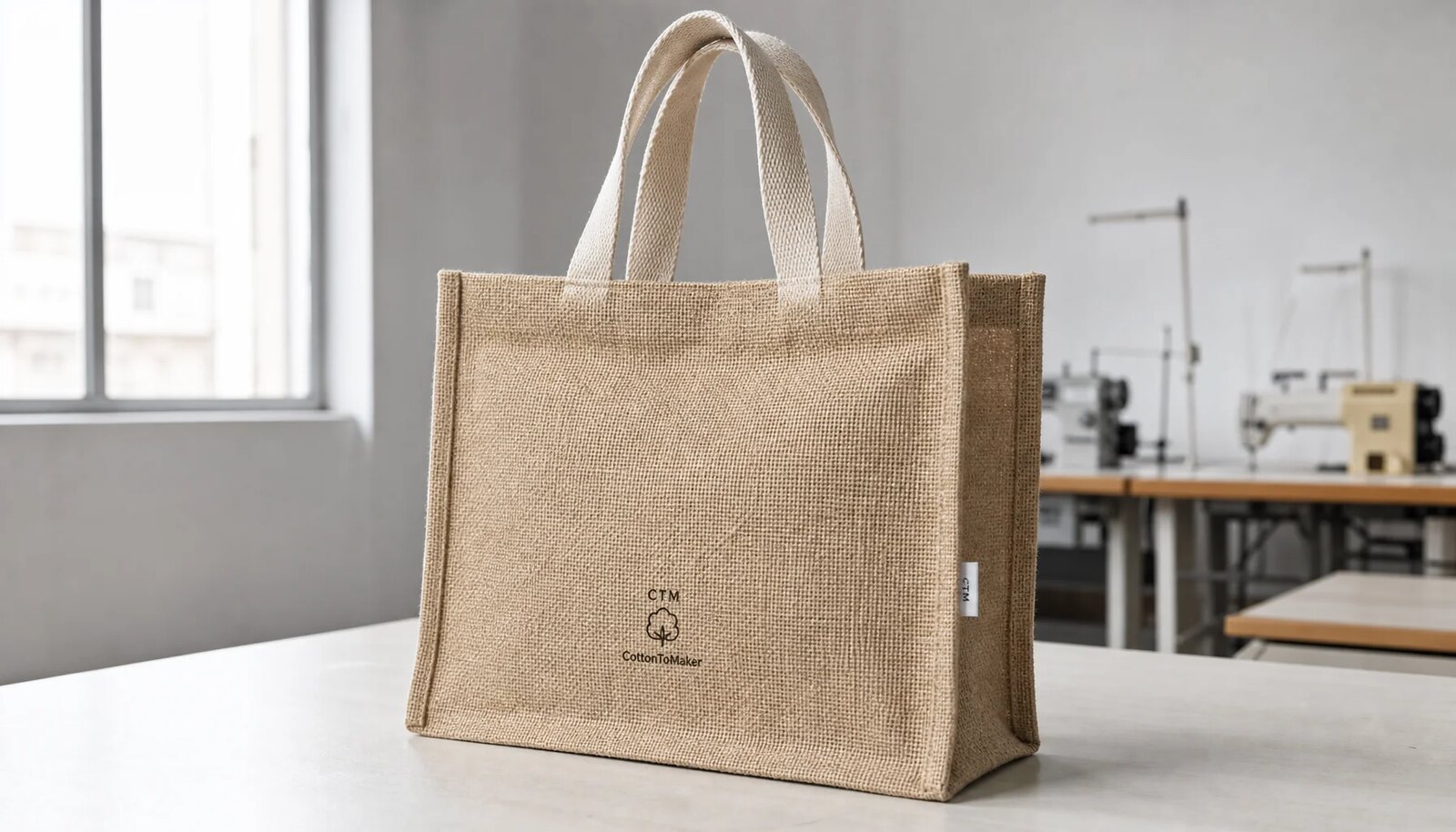
Start with the event load, not the GSM number
A useful jute tote specification starts with the contents the bag must carry. For event planners and procurement buyers, that means writing the load in plain operational terms before asking factories for price: paper inserts only, notebook and brochure stack, bottle plus boxed sample, folded apparel, retail merchandise, or a mixed sponsor kit assembled by a third-party kitting team. GSM matters, but it is not a strength guarantee by itself. A moderate-weight jute tote with sound handle attachment can perform better than a heavier-looking bag with weak stitching or a narrow seam allowance.
The bag also moves through more hands than the final attendee sees. It may be received by a warehouse, counted by an event agency, opened by a kitting team, filled at speed, stacked behind registration, moved to a hotel ballroom, and then carried through a full day. The specification needs to survive that chain, not just look attractive in a supplier photo. A bag that looks acceptable empty can sag badly when loaded with a notebook, bottle, sponsor samples, and a catalog set.
As a practical starting point, 300-350 GSM is best reserved for light handouts, especially flat paper packs and short-use registration bags. The 360-420 GSM range is a common working band for standard conference totes and welcome kits. The 430-500 GSM range is better for premium gift, retail-style, or display-ready programs where structure and presentation are part of the value. These bands are guidance, not universal rules, because weave density, lamination, gusset, handle reinforcement, and base design all affect performance.
Procurement should define the target load before the fabric band is chosen. If the filled bag is expected to stay under roughly 1 kg, the lighter band may be enough. For 1-2.5 kg welcome kits, buyers should usually move into the middle band and pay close attention to handles. For heavier or awkward loads, such as bottles or boxed products, specify the construction around the load rather than asking only for more GSM.
- List the exact packed contents before requesting fabric recommendations.
- Estimate the filled load range and whether the tote will be hand-carried or shoulder-carried.
- Use heavier fabric only when it improves structure, print clarity, or presentation.
- Treat handles, gusset, base, and stitch quality as part of the fabric weight decision.
What GSM means in jute buying terms
GSM means grams per square meter, but it is only useful when the measurement basis is clear. In jute tote sourcing, one supplier may quote raw woven cloth before any finish. Another may quote laminated cloth. A third may refer to the finished construction after lining, handles, seams, and base board are added. Those are not interchangeable. Two quotes that both say 400 GSM may produce bags with different hand feel, stiffness, print surface, carton volume, and landed cost.
Raw jute cloth GSM describes the textile before lamination or lining. Laminated jute GSM may include a backing film that adds weight and structure. Lined construction may add cotton, nonwoven, polyester, or other backing depending on the supplier's standard. Finished bag weight includes trims and reinforcement, so it should not be used as a substitute for body fabric weight unless the supplier states exactly how it is calculated. For quote comparison, ask suppliers to state the body cloth GSM and any added material separately.
Normal tolerance should also be discussed. Jute is a natural fiber, and bulk fabric can vary by lot and finishing condition. Many B2B buyers use a negotiated fabric GSM tolerance such as plus or minus 5 percent, while looser commodity programs may accept a wider range if the approved sample and strength are still met. Finished dimensions often need their own tolerance, commonly around plus or minus 1 cm for width and height on simple totes, with tighter or looser limits depending on pattern, sewing method, and order risk. These are commercial starting points, not automatic factory promises.
Fabric feel depends on more than weight. Yarn count, weave openness, finishing, moisture level, lamination film, calendering, and cutting direction all influence stiffness. A dense 380 GSM cloth can feel more controlled than a loose 430 GSM cloth. A laminated bag may stand better and print cleaner, but it may also crease more visibly during flat packing. That is why the approved physical sample must sit beside the written spec.
- Ask whether GSM is measured on raw cloth, laminated cloth, lined cloth, or finished construction.
- Break out lamination, lining, board, and handles separately from body cloth GSM.
- Define fabric weight and finished-size tolerances before bulk production.
- Compare supplier quotes against a physical sample, not only against a number.
Choose the right weight band for the event use case
The most practical jute tote bags fabric weight guide for event planners is a use-case guide. A 300-350 GSM unlaminated tote can be suitable for badges, maps, programs, brochures, flat samples, and budget handouts. It is usually not the right choice for bottles, thick catalogs, boxed gifts, or anything that pushes hard against the base and side seams. Buyers should expect a softer body, more visible weave variation, and less crisp print edges in this band.
The 360-420 GSM band is the safer standard for many event orders. It has enough body for welcome kits, notebooks, catalogs, sponsor inserts, and mixed promotional items while remaining reasonably packable. Light lamination can help the front panel hold shape and create a more controlled print surface, but the buyer should decide whether that added structure is worth the change in hand feel. This band is often the best balance when the tote needs to feel reusable without becoming bulky or expensive to ship.
The 430-500 GSM range belongs to programs where the bag itself is part of the presentation. It can make sense for executive gifts, paid merchandise, bottle packs, premium sponsor packages, and table displays. The tradeoff is cost, carton volume, fold behavior, and sometimes longer sample development. A stiffer tote can look better when filled, but it may be less convenient for attendees who need to pack it into luggage after the event.
The venue workflow should influence the decision. Bags that are shipped empty and filled on-site need to open easily, count quickly, and stack cleanly. Bags that are pre-kitted and shipped full need stronger seams, base control, and cartons that protect both the bag and the contents. Buyers can often avoid overspending by using a midweight jute body with better handles, a suitable gusset, and a defined base instead of moving automatically to the heaviest cloth.
- 300-350 GSM: light handouts, paper inserts, short-use registration bags, and budget programs.
- 360-420 GSM: standard event totes, notebooks, catalogs, welcome kits, and mixed sponsor packs.
- 430-500 GSM: premium gift bags, retail-style merchandise, bottle sets, and display-ready programs.
- For upright display, specify base construction and board insert instead of relying only on GSM.
Compare same-GSM quotes without losing discipline
When procurement receives two quotes for a 400 GSM jute tote, the unit prices may appear comparable while the constructions are not. One factory may include lamination, cotton webbing handles, reinforced stitching, and export cartons. Another may quote unlaminated jute, self-fabric handles, basic lockstitching, and a loose carton plan. Both can honestly use the same headline GSM, but they are not quoting the same finished product.
The cost differences often sit in details that are omitted from short email quotes. A 60 cm shoulder handle uses more tape than a 35 cm hand-carry handle. A wider 3 cm handle usually costs more than a narrow 2 cm handle but can improve comfort and load distribution. A board insert adds material, cutting, placement, and sometimes extra stitching. A two-color print adds screen setup, registration control, drying time, and inspection risk. A laminated front panel changes both material cost and printing behavior.
MOQ differences can also be legitimate. A stock size made from available cloth may have a lower minimum than a custom pattern requiring special cutting. A custom handle color, woven label, patch, special lining, or nonstandard carton count can push MOQ higher because setup must be spread across enough units. The buyer should ask why the MOQ exists and whether any small specification change would reduce it without weakening the bag.
The cleanest way to compare quotes is to force each supplier into the same bill of materials. Ask for body fabric GSM and basis, lamination, lining, finished size, gusset, handle details, base structure, print method, label, packing count, carton dimensions, lead time, incoterm, and sample policy. Once those items are visible, the lowest unit price may no longer be the lowest-risk offer.
- Separate fabric, lamination, handles, board, print, label, packing, and freight assumptions.
- Ask whether MOQ is driven by cloth, trim, artwork setup, cutting pattern, or carton method.
- Compare landed cost and event readiness, not only ex-factory unit price.
- Treat vague quote language as a risk until the construction is defined.
Specify handles, gusset, and base as load-bearing parts
A jute tote's carrying performance is decided around the fabric as much as by the fabric. Handles are the first stress point. Cotton webbing handles usually give better comfort, cleaner appearance, and more predictable sewing than self-jute handles. Self-jute handles can support a natural aesthetic, but they may feel rougher and should be reinforced carefully. For event kits, the RFQ should state handle material, width, length, color, fold-back length, and stitch pattern.
Handle length needs practical definition. A short hand-carry handle may be around 30-35 cm, while a shoulder handle may be around 55-65 cm depending on bag size and target user. Buyers should not rely on terms like short handle or long handle without numbers. Handle width also matters: narrow tape can dig into the hand when the kit is heavy, while wider tape can improve comfort and perceived quality. The attachment should include a clear stitch box, cross-stitch, bar tack, or other agreed reinforcement.
Gusset width determines whether the planned contents fit without stressing the seams. A narrow gusset may be acceptable for papers but frustrating for bottles, boxed gifts, folded apparel, or multiple sponsor items. A wider gusset improves capacity and table presentation but increases fabric use and can reduce carton density. The gusset should be selected from the packed kit dimensions, not copied from a generic catalog tote.
Base construction matters when the buyer wants the bag to stand upright or hold shape. A simple folded base can work for light loads. A reinforced base or board insert helps heavier kits and display bags. The RFQ should state whether the board is loose, stitched in, removable, covered by lining, or fixed by seam construction. It should also request board thickness and material in writing. Otherwise, a supplier may use a thinner insert to protect cost.
- Specify handle length, width, material, fold-back, and reinforcement method.
- Choose gusset width from the actual packed kit dimensions.
- Name base construction and board insert method when shape retention matters.
- Load the sample with real contents before approving handle and base performance.
Match print method to jute texture and artwork
Jute is a textured natural fiber, so artwork that looks sharp on a digital proof may not behave the same on the bag. One-color screen print is often the most dependable method for natural jute because it tolerates the open weave, keeps setup manageable, and works well for simple logos. It is a strong choice when buyers need clear branding, predictable production, and a controlled budget. The artwork should avoid very fine lines, tiny reversed text, and small registration marks unless the supplier proves them on the final fabric.
For detailed branding, a laminated panel, sewn patch, woven label, cotton label, or smoother print panel can improve legibility. These options are useful when sponsor marks are small, brand colors are sensitive, or the artwork cannot be simplified. They also add decisions: patch material, edge finish, stitch color, label size, placement tolerance, and whether the added panel changes the natural look of the tote. Price and sample these as part of the complete construction, not as an afterthought.
Multi-color printing requires more control than many buyers expect. Each color may require its own screen or setup, and registration is harder on a textured, flexible surface. If the panel shifts during printing, outlines may not align. If the bag is stiff and then flat packed, fold lines may stress the ink. Heat transfer may be suitable for some artwork, but buyers should ask how it performs on fibrous jute and whether it lifts, cracks, or changes hand feel after packing.
The safest approval path is a strike-off on the exact bulk fabric weight and finish. A print approved on substitute cloth does not prove the final production surface. The strike-off should show ink density, edge clarity, color, alignment, and behavior after folding. For many event orders, a clean logo in the right place creates a stronger result than complex artwork that exceeds the fabric's capability.
- Use one-color screen print for simple logos, natural jute, and tight production windows.
- Use a patch, label, or smoother panel when artwork needs more detail.
- Set print placement tolerance, such as a negotiated plus or minus 5 mm or 10 mm depending on artwork and bag size.
- Approve print on the final fabric, finish, and panel construction.
Write the RFQ so factories quote the same bag
A strong RFQ removes interpretation. Instead of asking for pricing on jute tote bags for an event, give the supplier the commercial and operational conditions: event date, delivery location, quantity, packed contents, estimated load, size requirement, branding method, packing preference, and inspection expectation. Then define the bag construction in measurable terms. This reduces the chance that one supplier wins by omitting a detail another supplier included.
The RFQ should include finished width, height, gusset, handle length, handle width, handle material, body fabric weight and basis, lamination or lining, base construction, board insert, print method, print colors, print area, label requirement, and carton plan. If some decisions are open, ask the supplier to recommend options and price them separately. For example, request one line for 360-420 GSM lightly laminated jute and one line for 430-500 GSM structured jute, both with the same handles, print, and packing.
Artwork instructions should be precise. Provide vector artwork when available, specify Pantone or target color if color control matters, state whether color variation on natural jute is acceptable, and name the maximum print area. If sponsor logos are included, tell the supplier whether every mark must remain readable or whether small marks may be simplified. If a patch is acceptable, list it as an alternate line item instead of letting the factory decide during production.
The RFQ should protect the schedule. Ask for lead time after artwork approval, sample lead time, sample transit time, bulk material booking time, production lead time after sample approval, final inspection date, cargo handover date, and shipping route. Event buyers often have fixed deadlines, so a quote should show the full calendar, not only a vague statement that production takes three weeks.
- Include intended load, event date, delivery location, and kitting workflow.
- Specify dimensions, fabric basis, handles, gusset, base, print, packing, and inspection terms.
- Ask for alternate pricing only when the alternates are clearly defined.
- Require lead time by milestone: artwork, strike-off, sample, approval, bulk, inspection, and shipment.
Approve samples as production references, not souvenirs
A pre-production sample should not be treated as a visual courtesy. For jute totes, the sample must prove the fabric, construction, print, and packing choices together. A blank swatch helps early material selection, but it does not prove handle strength, seam quality, logo behavior, gusset shape, board placement, or carton fold marks. Before bulk production, the buyer should approve a sample made with the final body fabric, finish, handles, print method, label, base, and packing method.
During review, measure the sample and load it with realistic contents. If the event kit includes a bottle, notebook, brochures, and boxed product, place those items in the bag and carry it as an attendee would. Check whether the handles twist, side seams pull, bottom sags, board shifts, and front logo wrinkles. Set the loaded bag on a table and see whether it stands, leans, or collapses. If it will be stacked behind a registration desk, test a small stack and watch for crushed handles or marked prints.
The approved sample should become the physical master. The factory and buyer should both treat it as the reference for bulk production, while still allowing normal natural fiber variation within agreed limits. Any later change to handle tape, lamination, lining, board, print ink, thread, label, or carton method should require written approval. If the supplier says a material is out of stock and offers a substitute, procurement should treat that as a new decision.
Packing should be included in sample approval when presentation matters. Flat packing can create fold lines through the print if the fold direction is poorly planned. Bundles can save time but may compress handles. Individual sleeves may protect bags but add material and labor. If the bags will be handed out directly, the sample packing should show how cleanly the logo face arrives. If they will be kitted later, the packing should support fast counting and easy allocation.
- Approve a full pre-production sample, not only a swatch or digital mockup.
- Measure the sample and test it with the real event kit.
- Keep the approved sample as the bulk production master.
- Review fold direction, bundle count, carton count, and logo-face protection before release.
Set QC thresholds before the shipment is ready
Quality control for event jute totes should focus on defects that affect use, presentation, and distribution. The most visible failures are weak handles, crooked logos, uneven print, strong odor, stains, dampness, excessive loose fibers, inconsistent size, and wrong packing. Procurement should define thresholds before production is finished. A supplier cannot manage to expectations that were never written, and a buyer cannot fairly reject normal natural fiber variation without stating what level is unacceptable.
Finished-size checks should include width, height, gusset, handle length, and print placement from bags pulled across different cartons. Buyers commonly negotiate tolerances such as plus or minus 1 cm for simple finished dimensions and tighter print placement limits for logo-sensitive programs, but the correct tolerance depends on size, construction, and artwork. Stitching should be inspected at stress points: handle attachments, side seams, bottom corners, gusset turns, labels, lining seams, and board retention points.
Handle strength should be checked against the intended use case. A simple factory pull check is not the same as a certified lab test, but the supplier should still state its method, test load, duration, and pass/fail rule. For example, procurement can request an internal load check using the estimated packed load plus a margin, held for a defined time, with no seam tearing or handle detachment. Higher-risk programs may require third-party testing, especially when bags are sold as merchandise or carry heavy contents.
Print inspection should compare bulk bags to the approved physical sample. Slight jute texture variation is expected, but logo position, size, readability, and ink adhesion should stay within the agreed standard. Inspectors should look for ink bleeding, missing strokes, heavy deposits in the weave, misregistration, cracking at fold lines, and color shifts that make the brand mark unacceptable. If the order includes multiple sponsor logos, check the smallest mark first because it reveals print limits fastest.
Moisture and odor deserve attention. Jute can absorb humidity during storage, production, or transit. Bags packed too tightly before drying or stored in damp conditions may arrive with an odor that is hard to solve before an event. QC should include odor checks, damp feel checks, visible mold risk, stain review, and carton condition. Open cartons from different stack positions because lower cartons may show compression or moisture even when the top carton looks fine.
- Measure dimensions, handle length, and print placement across random cartons.
- Inspect stitching at stress points, not only front-panel appearance.
- Define handle load check method, test load, duration, and pass/fail rule.
- Check odor, moisture, stains, oil marks, broken yarns, and excessive loose fibers.
Control packing, cartons, and landed cost
Packing is a procurement decision, not an afterthought. Jute bags can be flat packed, folded, nested, bundled, sleeved, or partially formed. Flat packing is usually the most freight-efficient method, but it can create fold marks if the bag is stiff, laminated, or printed across the fold line. Semi-formed packing may protect presentation but increases carton volume. Individual sleeving can reduce rubbing and keep bags cleaner, but it adds material, labor, and waste.
Carton details should be requested before award. Pieces per carton, carton dimensions, net weight, gross weight, carton wall strength, and pallet plan all affect landed cost and event handling. A cheaper unit price can become expensive if cartons are bulky or unsuitable for stacking. Air freight magnifies this issue because dimensional weight can exceed actual weight. Ocean freight, warehouse storage, and venue handling also care about volume, carton integrity, and moisture exposure.
The downstream workflow should guide the carton plan. If a central team will kit bags with sponsor products, cartons should be packed in counts that match the kitting plan and are easy to open, count, and stage. If bags ship directly to multiple venues, carton labels should be clear and allocation counts should be accurate. If bags are handed out from a backroom, the logo face should arrive clean enough that staff do not need to rework every piece.
Moisture protection should be discussed for long routes, humid seasons, or storage before the event. Depending on route and budget, buyers may consider poly liners, desiccants, stronger cartons, better ventilation before packing, or tighter warehouse timing. The goal is not to add unnecessary packaging, but to prevent damp, crushed, stained, or hard-to-distribute bags from reaching the venue. Packing specifications should be part of the quote, the sample approval, and the pre-shipment inspection.
- Request pieces per carton, carton dimensions, gross weight, net weight, and carton strength.
- Choose flat packing, sleeves, bundles, or formed packing based on kitting and venue workflow.
- Confirm fold direction so carton compression does not damage the logo.
- Compare freight using carton dimensions and gross weight, not only unit price.
Specification comparison for buyers
| Spec decision | Recommended option | When it fits | Buyer risk to check |
|---|---|---|---|
| 300-350 GSM unlaminated jute | Use for light handouts where price, low bulk, and quick production matter most | Brochures, event maps, badges, programs, slim flat inserts, and lightweight registration packs under roughly 1 kg | Bag can sag, seams may show more stress, and open weave can reduce print sharpness if attendees add bottles or heavy catalogs |
| 360-420 GSM jute with optional light lamination | Use as the standard event tote range for balanced structure, cost, and packability | Welcome kits, notebooks, catalog sets, sponsor inserts, reusable conference bags, and mixed promo packs around 1-2.5 kg | Ask whether GSM is raw cloth, laminated cloth, or finished composite; two 400 GSM quotes may not be equivalent |
| 430-500 GSM laminated or structured jute | Use for premium gift, merchandise, resale, or table-display bags | Executive kits, bottle packs, boxed gifts, venue merchandise, and programs where the bag must stand upright and feel substantial | Higher stiffness can increase unit price, carton volume, fold marks, sample lead time, and dimensional freight cost |
| Lamination film or lining | Specify only when structure, print surface, or moisture resistance justifies it | Bags needing a smoother print panel, cleaner interior, better body, or more controlled shape | Film thickness, coating side, lining material, and whether GSM includes the film must be stated to prevent downgraded quotes |
| Reinforced base or board insert | Add when the packed kit needs a flat bottom or display stability | Bottles, boxed products, folded apparel, retail stock, premium gift kits, and pre-kitted shipments | Board thickness, board material, loose versus stitched-in placement, and moisture behavior must be confirmed |
| Cotton webbing handles | Choose for comfort, better load distribution, and a cleaner B2B finish | Long event days, shoulder carry, repeat use, heavier kits, and higher-perceived-value attendee bags | Check handle width, length, fold-back, stitch box size, bar tack or cross-stitch position, and colorfastness |
| Self-jute handles | Use when a fully natural look matters more than soft hand feel | Rustic programs, lower-load promotional bags, lower-cost natural branding, and light handouts | Can feel rough, vary more by lot, and fail at attachment points unless reinforcement is clearly specified |
| One-color screen print | Use for the most predictable branding on textured natural jute | Simple logos, short schedules, budget-controlled runs, and natural fabric panels | Fine text below practical readability limits, thin strokes, and reversed marks may fill in or break on open weave |
| Patch, label, or smoother print panel | Use when the artwork needs more detail or brand consistency than direct print allows | Sponsor grids, color-sensitive marks, retail-facing bags, and detailed campaign graphics | Adds setup, sewing, placement, color, and edge-finish decisions that must be sampled before bulk |
Buyer checklist before sampling
- Define the practical packed load: paper only, notebook and brochures, bottle and boxed sample, laptop accessories, apparel, retail merchandise, or mixed sponsor kit.
- Estimate the load range in kilograms per bag and state whether the bag will be carried by hand, over shoulder, pre-kitted, or displayed on tables.
- State whether quoted GSM must refer to raw jute cloth, laminated jute cloth, lined cloth, or total finished construction.
- Fix finished width, height, gusset, base shape, handle length, handle width, handle material, handle reinforcement, seam allowance, and board insert before comparing price.
- Specify whether the bag must stand upright when filled, lie flat for kitting, fold into luggage, or arrive without heavy crease marks through the logo.
- Name the print method, color count, artwork size, print position, placement tolerance, target color reference, and whether a patch, label, or smoother print panel is acceptable.
- Request a pre-production sample with the exact fabric weight, lamination or lining, stitching, handles, print, label, board, and packing method.
- Agree practical inspection tolerances before production, such as size tolerance, handle length tolerance, print placement tolerance, GSM variance, stitch density, odor, moisture, stains, and loose fiber limits.
- Ask for carton data before award: pieces per carton, carton dimensions, gross weight, net weight, carton grade, pallet plan, flat-pack or formed packing, and export label format.
- Confirm lead time separately for artwork proof, material booking, strike-off, sample production, sample transit, sample approval, bulk cutting, sewing, printing, final inspection, and cargo handover.
Factory quote questions to send
- Is the quoted GSM measured before lamination, after lamination, after lining, or as a finished bag construction including trims?
- What is the expected GSM tolerance for the fabric lot, and how will it be checked during incoming material inspection?
- What finished size, gusset width, base construction, handle length, handle width, handle material, handle color, seam allowance, and reinforcement are included in the price?
- What lamination or lining is included, which side is laminated, what film thickness or lining material is used, and does it change print method or folding behavior?
- What stitch type and stitch density are used on side seams, bottom seams, handle attachments, labels, and board-retaining seams?
- Which print method is included, how many colors are covered, what is the maximum print area, what registration tolerance applies, and what setup charge applies per screen or color?
- Can you provide a print strike-off and a pre-production sample using the exact bulk fabric weight, lamination, handles, board, and packing method?
- What is the MOQ for this exact combination of size, GSM, lamination, handle, board, print method, label, and packing plan?
- What are the expected tolerances for finished width, height, gusset, handle length, print placement, print size, GSM, and carton count?
- What internal handle pull check or load check do you use, what test load and duration are applied, and can it be matched to our packed kit weight?
Quality-control points to confirm
- Measure finished width, height, gusset, handle length, and print placement on random pieces from multiple cartons and compare them to the agreed tolerance, not to a catalog photo.
- Check whether fabric weight and hand feel match the approved master sample, and confirm lamination or lining has not been omitted or changed.
- Inspect stitch density and seam security at handle attachments, side seams, base corners, gusset turns, label seams, lining seams, and board-retaining stitches.
- Pull-test handles and seam anchors against the intended load, especially when the kit includes bottles, boxed products, hard catalogs, or multiple inserts.
- Check handle symmetry, handle twist, handle fold-back length, stitch box size, bar tack or cross-stitch placement, and whether stress points are reinforced consistently.
- Compare logo placement, print size, ink density, edge clarity, and color to the approved physical master sample, not only to a digital proof.
- Verify that small logo details remain readable on the actual jute texture and that ink does not crack, flake, bleed, skip, or collect heavily in the weave.
- Confirm that fold lines, bundle pressure, or carton compression do not run through critical artwork or damage the logo face.
- Check for strong odor, damp feel, mold risk, oil marks, rust marks, excessive loose fibers, broken yarns, stains, foreign matter, and visible contamination.
- Open random cartons from top, middle, and lower stack positions to confirm count, bundle quantity, fold direction, carton labeling, packing list accuracy, and presentation.