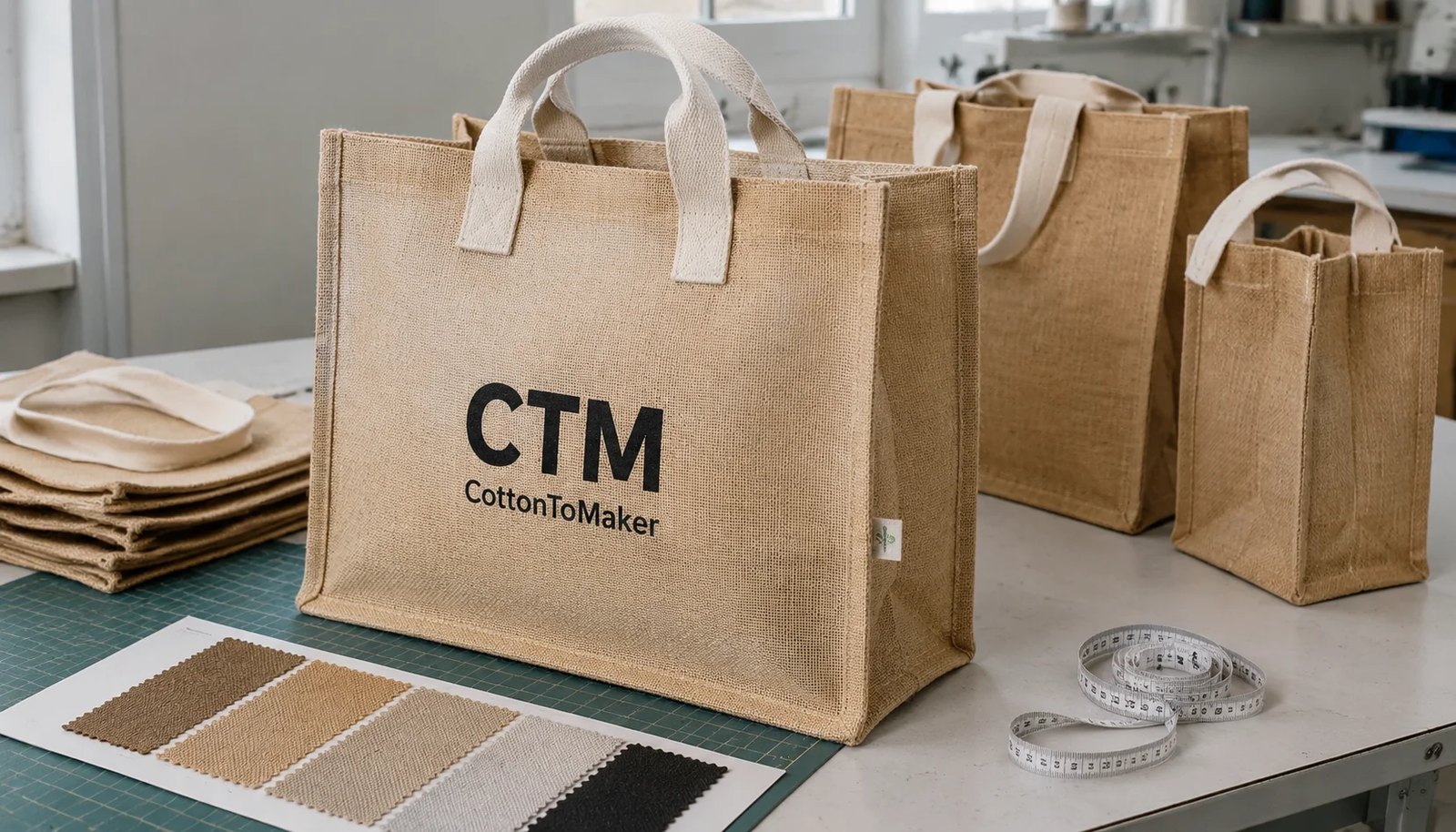
Why durability testing matters more for natural grocer jute totes
Jute tote bags are popular with natural grocers because the material looks low-plastic, tactile, and suitable for produce, refill goods, and farmers-market style merchandising. The buying risk is that jute looks strong even when the bag construction is not ready for real grocery handling. A shopper does not load the bag like a lab technician. They put jars, milk cartons, apples, leafy vegetables, and boxed goods into one tote, lift it from the checkout counter, drop it into a car trunk, and reuse it while the fabric is exposed to moisture and friction.
For procurement teams, the durability question should not be limited to whether the fabric is thick. Failures usually happen at the handle stitch, side seam, bottom gusset, print surface, or packing stage. A good RFQ for jute grocery totes sets the expected load, test method, sample approval steps, and packing standard before suppliers quote. Without that, one supplier may quote a promotional jute bag and another may quote a retail reusable grocery tote, even if both descriptions say natural jute tote bag.
- Use a defined working load, such as 8 kg, 10 kg, or 12 kg, instead of saying heavy duty.
- Treat handle attachment as a load-bearing component, not a decorative detail.
- Test samples after printing and packing, because ink, folding, and compression can change performance.
Start the RFQ with load, size, and shopper use
A durability checklist starts with the job the bag must do. For natural grocers, common sizes range from small lunch and produce totes to larger checkout totes with a boxy bottom gusset. If the bag is intended to replace a paper grocery bag, a flat tote without enough gusset will disappoint store teams because it cannot stand open and it loads poorly. If the program is a paid reusable bag at checkout, the bag must feel strong enough for the shopper to trust immediately.
State the target filled load and the intended product mix in the RFQ. For example, a tote for dry packaged snacks may not need the same bottom reinforcement as a tote expected to carry glass jars, bottled beverages, and root vegetables. The more exact the use case, the more comparable the supplier quotes become. A factory can then recommend the right fabric weight, seam method, handle width, and packing method instead of guessing from a photo.
- Common grocery tote size range: about 35-45 cm wide, 30-40 cm high, with 12-18 cm gusset.
- Short handles fit hand carry at checkout; longer handles support shoulder carry but increase stress on attachment points.
- Boxy bottom gussets improve loading speed and shelf presentation but require accurate sewing to avoid twisting.
Select jute GSM and lamination for the real environment
For reusable grocery totes, many buyers land in the 13 oz to 15 oz natural jute range, roughly 370-425 GSM depending on yarn and weave. Lighter jute can work for promotional events or light packaged goods, but it is less forgiving when the tote is used for dense grocery loads. Heavier jute feels more substantial and holds shape better, but it raises material cost, carton weight, and ocean freight volume. The best choice is not always the thickest fabric; it is the fabric that passes the agreed load test while meeting price and shelf feel targets.
Lamination is another tradeoff. Interior PP lamination improves structure, reduces fiber shedding inside the bag, and helps the tote resist damp produce or condensation. It also changes hand feel, smell risk, recyclability messaging, and sometimes import compliance claims. If your brand position is strongly plastic-free, do not allow a supplier to quote laminated jute without labeling that clearly. If your priority is store durability and clean interior finish, lamination may be justified, but it should be tested for peeling, odor, and cracking after folding.
- Unlaminated jute: more natural hand feel, more breathable, but more fiber shedding and less moisture resistance.
- Laminated jute: better structure and cleaner interior, but requires odor and delamination checks.
- GSM tolerance should be written into the purchase order, commonly within about plus or minus 5 percent.
Handle construction is usually the first failure point
When a jute tote fails in use, the fabric body is often still intact. The weak point is the handle area where a narrow webbing strip, poor thread tension, or small stitch box concentrates load. Natural grocers should be especially careful because grocery loads include hard, dense items that create sudden stress when the shopper lifts the bag quickly. A handle that feels acceptable on an empty sample may tear after repeated lift cycles.
Cotton webbing is common for natural grocer jute totes because it feels better in the hand and matches the natural look. Jute handles can also be used, but rough edges and inconsistent thickness should be controlled. For heavier bags, specify handle width, handle drop, reinforcement patch if used, stitch pattern, and thread type. The stitch should be neat, dense enough to hold, and positioned far enough from raw fabric edges to avoid pull-out.
- For hand carry, a handle drop around 12-18 cm is common; for shoulder carry, buyers often need about 25-30 cm depending on bag height.
- A box-and-cross stitch generally distributes force better than a few straight lines.
- Review the reverse side of handle stitching, not only the front face; skipped stitches and loose loops matter.
Print method choices on coarse jute
Screen printing is normally the safest and most economical method for jute tote bags with bold grocery branding. It works well for solid logos, simple produce illustrations, co-op names, and store slogans. The limitation is the coarse jute surface. Very fine lines, tiny registered marks, small ingredient-style text, and delicate gradients do not reproduce like they would on cotton canvas or nonwoven material. Artwork should be reviewed at actual size on the selected jute weight.
Heat transfer, woven labels, cotton patches, and leather-look patches can be used when the design requires sharper detail, but each adds cost and different durability risks. A transfer may not bond evenly to rough jute. A sewn patch adds labor and may distort the panel if not positioned well. A woven side label is useful for subtle brand ID, but it does not replace a clear front logo if the bag is used as retail merchandise.
- Keep minimum text height realistic; small letters can fill in because of jute texture.
- Avoid large ink coverage over heavy folds or near bottom gusset stress points.
- Include print rub and tape tests in approval because poor curing can mark adjacent bags in cartons.
Durability testing checklist with practical acceptance criteria
A jute tote durability test should simulate the worst normal use, not an extreme stunt that no reusable bag can pass. The test weight should connect to the declared working load. If the bag is marketed for 10 kg, many buyers require static testing at 1.5 to 2 times that load for a set duration, then dynamic lifting at the working load. The goal is to identify handle pull-out, seam slippage, bottom distortion, and lamination cracking before the shipment reaches stores.
Testing should be done on pre-production samples and repeated during inspection on random finished goods. One golden sample is not enough because jute is a natural fiber with variation. Durability depends on fabric batch, cutting direction, thread tension, sewing operator skill, and packing pressure. The inspection plan should record the test method, weight used, duration, number of cycles, sample quantity, and failure definition.
- Static hang test: hang the filled bag using both handles for the agreed time and record handle movement, seam opening, and fabric tearing.
- Dynamic lift test: lift and lower the loaded bag repeatedly to simulate checkout, car, and home use.
- Seam slippage review: measure opening or yarn movement at side seams, bottom gusset, and handle attachment points.
- Print rub test: rub dry and, if relevant, lightly damp cloth across the logo to detect ink transfer.
- Odor and moisture check: reject mildew, strong chemical odor, visible dampness, or carton humidity that threatens storage.
Sample approval should use production-equivalent materials
Many problems begin when the sample is made from available stock jute and the order is later produced from a different fabric batch. For natural grocer programs, sample approval should be tied to bulk-equivalent material as early as possible. If the first sample is only a shape and artwork trial, label it that way. The final pre-production sample should match the bulk specification for jute weight, lamination, handle webbing, thread, logo ink, stitch density, and packing fold.
Do not approve a jute tote only from front photos. The buyer should review physical samples or at least a full measurement and construction video before bulk cutting. Dimensions can look correct when the bag is empty but change when the gusset is opened. Handle drop can also vary if the webbing stretches or if sewing alignment is inconsistent. A signed sample standard, plus a written tolerance table, gives the factory and inspection team the same reference.
- Measure width, height, gusset, handle drop, handle width, logo size, and logo position from defined reference points.
- Load the sample with real grocery-like items, not only soft filling, to reveal bottom and side seam stress.
- Photograph approved details: top edge, inner seam, bottom corner, handle stitch, logo print, label, and carton packing.
Cost drivers behind jute tote durability
A cheaper jute tote quote is often cheaper for a reason. The common cost drivers are jute weight, lamination, bag size, gusset depth, handle material, handle width, sewing time, print colors, print positions, inner finishing, carton packing, and order quantity. A buyer comparing only unit price may miss that one quote includes a 15 oz laminated body with cotton webbing and reinforced stitching, while another includes lighter unlaminated jute with basic handles.
MOQ logic also matters. Jute fabric, lamination setup, cutting efficiency, and print setup all affect the minimum quantity. A factory may accept a lower MOQ for a standard size and natural body with one-color print, while custom dyed jute, special handle color, private woven labels, or multiple store versions raise the practical MOQ. If you need regional logo versions, discuss whether the same base bag can be produced in bulk and printed in separate batches.
- Lower cost route: standard natural jute, stock handle color, one-color screen print, flat export packing.
- Mid-range route: 13-15 oz jute, interior lamination, cotton webbing handles, reinforced stitching, two-color print.
- Higher cost route: custom color panels, multiple print positions, sewn patches, retail hangtags, individual packing, and stricter testing.
Packing and storage affect durability before the bag is sold
Jute is a natural fiber, so export packing is not just a logistics detail. Moisture, compression, and poor carton strength can create mildew, odor, crushed gussets, and ink transfer. For natural grocers, this is a brand risk because shoppers notice smell and staining immediately. Cartons should protect the bag shape without wasting too much volume. Very tight compression may improve freight cost but can create permanent creases across the logo or cause laminated panels to crack.
The packing specification should include pieces per carton, folded or flat method, carton dimensions, carton grade, liner use, desiccant use, barcode placement, and whether bags need retail hangtags or inner bundles. If the goods will move through a distributor warehouse before store allocation, carton labels should support receiving and picking. A durable bag still becomes a rejected shipment if cartons collapse or the front print is scuffed during transport.
- Use a moisture barrier liner when shipping through humid routes or storing for long periods.
- Place printed panels face-to-face only if ink curing and rub resistance have been verified.
- Record cubic meters per 1,000 pieces so the landed cost comparison includes freight, not only FOB price.
Lead time and schedule risks for seasonal grocery programs
Jute tote lead time depends on material availability, print complexity, sample rounds, and inspection requirements. A basic natural jute tote with one-color print can move faster than a custom dyed, laminated, multi-logo program, but buyers should still build in time for sample approval and corrections. For seasonal natural grocer campaigns, the most common schedule mistake is placing artwork late and expecting the factory to hold capacity without approved specs.
A practical timeline separates design confirmation, prototype sampling, pre-production sample approval, material booking, bulk cutting, printing, sewing, inspection, packing, and shipment. If your brand requires internal approval from merchandising, sustainability, legal, and store operations, include that in the calendar. Factory lead time usually starts after sample approval, deposit, and final artwork, not after the first email inquiry.
- Lock the durability test method before the pre-production sample, otherwise failures cause late redesign.
- Approve carton marks and barcodes early because retail distribution errors can delay release even when bags are finished.
- For tight launch dates, reduce risk by using standard natural jute and standard handle colors instead of custom materials.
Specification comparison for buyers
| Spec decision | Recommended option | When it fits | Buyer risk to check |
|---|---|---|---|
| Jute fabric weight | 13 oz to 15 oz natural jute, usually around 370-425 GSM | Mainstream grocery tote programs carrying produce, jars, boxed foods, and daily retail items | Too-light jute may stretch at seams; too-heavy jute raises freight cost and can feel rough for shoppers |
| Lamination choice | Interior PP lamination for structure and moisture resistance | Natural grocers selling chilled produce, bottled drinks, or items that may sweat in transit | Low-grade lamination can crack, smell, delaminate, or make the bag difficult to recycle depending on market claims |
| Handle material | Cotton webbing or padded jute-cotton webbing stitched with cross reinforcement | Retail-ready reusable bags where hand comfort matters more than lowest price | Thin rope or poorly anchored webbing can fail before the jute body fails |
| Bottom construction | Full bottom gusset with reinforced seam and optional insert board | Bags expected to stand open at checkout and carry bulky grocery items | Insert boards add cost and packing volume; unreinforced gussets may distort under point loads |
| Logo method | Screen print for bold 1-3 color grocery branding | Most natural grocer logos, co-op marks, and seasonal produce graphics | Fine text can bleed on coarse jute; insufficient curing causes rub-off during carton transit |
| Edge finishing | Overlocked inner seams plus bound top edge | Standard for wholesale jute totes that need cleaner interiors and better seam durability | Raw or loose inside seams shed fibers and may fail snag testing |
| Load test target | Static hang test at 1.5-2 times declared working load plus dynamic lift cycles | Buyers who want evidence beyond visual inspection before approval | A sample may pass one static test but fail repeated checkout handling if handle stitching is weak |
| Packing method | Flat packed with moisture barrier carton liner and desiccant where humidity risk is high | Ocean freight, long inland transit, or storage in humid distribution centers | Compressed bales reduce volume but can crease print, deform gussets, and trap moisture |
Buyer checklist before sampling
- Define the intended grocery load in kilograms, not only the bag size. A 12 kg target needs different handle stitching than a giveaway tote.
- Specify jute fabric weight by oz or GSM and require a tolerance, for example plus or minus 5 percent.
- State whether the bag is laminated, unlaminated, or laminated only on selected panels.
- Confirm handle length, width, material, stitch pattern, and minimum pull strength before artwork approval.
- Use artwork scaled to actual jute texture; avoid very small type, thin lines, and heavy ink blocks near seam folds.
- Approve a pre-production sample made with bulk-equivalent jute, handle webbing, thread, lamination, and printing ink.
- Require static load, dynamic lift, seam slippage, rub, odor, and carton drop checks in the inspection plan.
- Set acceptable dimensional tolerance after pressing and packing, not only on a freshly sewn sample.
- Define packing: pieces per carton, flat or folded, carton liner, desiccant, carton strength, and barcode position.
- Collect quote data in one table: size, GSM, lamination, print colors, handle type, MOQ, sample fee, lead time, packing volume, and incoterm.
Factory quote questions to send
- What jute weight are you quoting in oz and approximate GSM, and what tolerance will be used during production?
- Is the quoted jute laminated or unlaminated? If laminated, what film type and approximate thickness are included?
- What handle material, width, length, and reinforcement stitch pattern are included in the price?
- What working load do you recommend for this size, and what factory test method can you perform before shipment?
- Is the logo price based on screen print, heat transfer, woven label, or another method? How many print colors and positions are included?
- Will the pre-production sample use the same jute batch, handle webbing, thread, lamination, and ink as bulk production?
- What is the MOQ by size and color, and how does the unit price change at the next two quantity breaks?
- What are the estimated carton dimensions, gross weight, net weight, and cubic meters per 1,000 pieces?
- What packing method is quoted: flat, folded, pressed, with carton liner, with desiccant, or retail polybag?
- What production lead time starts after sample approval and deposit, and what risks could extend that schedule?
Quality-control points to confirm
- Fabric weight check against approved GSM or oz tolerance before cutting.
- Visual grading for heavy slubs, holes, stains, oil marks, loose fibers, and color variation beyond approved range.
- Panel dimension and gusset measurement after sewing and after packing recovery.
- Handle pull strength and stitch integrity at each attachment point.
- Static load hang test using the agreed test weight and duration.
- Dynamic lift test simulating repeated shopper use rather than one gentle lift.
- Seam slippage and seam burst review at side seams, bottom gusset, and handle reinforcement.
- Print rub test, tape test, registration check, and logo placement measurement.
- Odor, moisture, mildew, and carton humidity check before final packing.
- Carton drop and compression review for export packing suitability.