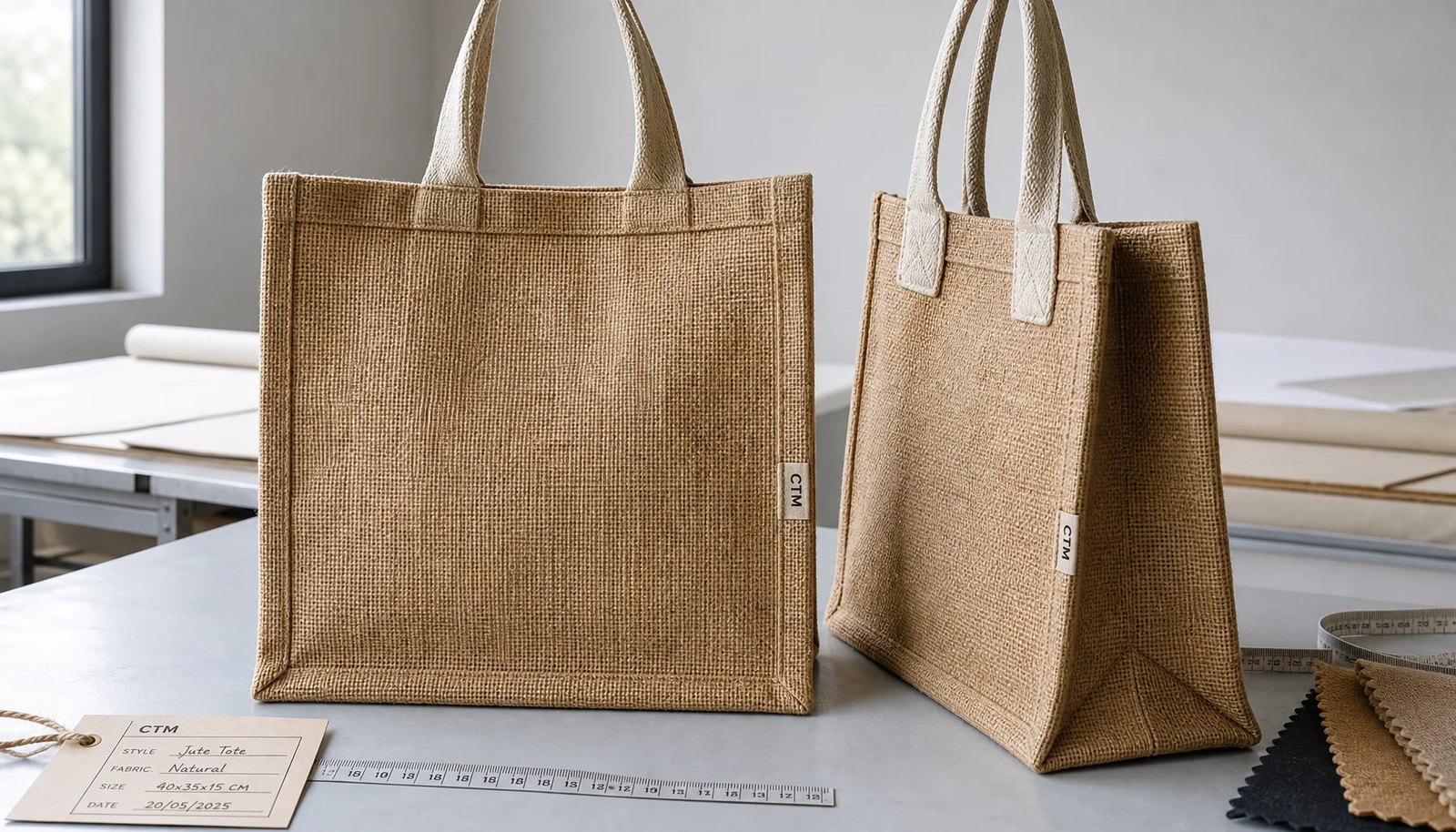
Start With the Event Load Profile
A trade show jute tote is not the same product as a retail shopper bag or a generic giveaway sack. At a booth, the bag is loaded quickly, often by people who did not choose it, then carried across a hall, stacked in a car trunk, and sometimes folded into freight cartons after the event. The predictable failure points are handle anchors, top hems, bottom corners, print wear, and moisture pickup. If you only approve the fabric color and logo placement, you are buying a sample that has not been stress-tested against real show behavior.
The first procurement decision is not GSM. It is the load profile. Define what goes inside the tote and how many times you expect it to be carried. A literature-only bag may only need to survive 2 to 3 kg without obvious distortion. A tote meant for catalogs, a bottle, sample packs, and a notebook needs stronger handle reinforcement and a more stable body. If the bag will be distributed on day one and reused for several days, fatigue risk rises and the acceptance criteria need to be stricter.
- Light use: brochures, postcards, a pen, and a small handout pack.
- Medium use: brochures plus one bottle, one sample item, or a small gift kit.
- Heavy use: mixed event collateral, product samples, and repeated carry after the show.
- If the tote is part of a VIP kit, treat it as packaging that protects presentation, not as a throwaway item.
Turn the Tote Into a Measurable Spec
Do not buy jute by appearance alone. Ask for the fabric weight in GSM, the weave description, the handle material, the handle width, the finished dimensions, the gusset depth, and the reinforcement method. For a basic trade show tote, many buyers start around 300 to 350 GSM. If the bag needs to feel more substantial or carry heavier contents, 400 to 450 GSM is a more realistic range. Once you move into that range, the tote begins to behave more like a reusable retail bag than a low-cost handout, so cost, carton bulk, and sewing time all move with it.
GSM does not tell the whole story. A 350 GSM bag with weak side seams can fail sooner than a 320 GSM bag with a better top hem and bar-tack reinforcement. The spec should state the measurement basis, because suppliers can quote before or after finishing, and the finished weight can shift once printing, lining, or lamination is added. For most procurement programs, a practical starting tolerance is plus or minus 10 mm on body dimensions and gusset, plus or minus 5 mm on handle drop and print placement, and zero tolerance for wrong artwork or missing reinforcement.
- Write the finished size, print area, handle drop, and carton count into the RFQ instead of assuming the supplier will infer them.
- Ask whether the quoted GSM is for base fabric or finished fabric after print, lining, or coating.
- Do not accept a quote that leaves handle width, top hem width, or reinforcement out of the spec.
- If the product will be packed flat, state whether the compressed shape matters after unpacking.
Choose Construction That Actually Carries Weight
The bag construction is where most field failures are decided. Start with the handle. Cotton webbing usually feels better in hand and distributes load more evenly than narrow jute strips, while jute handles preserve a fully natural look. What matters is not the material in isolation but the attachment. For trade show programs, a practical handle width is 25 to 40 mm, with at least 40 mm of sewn-down length at each end and a box-x or bar-tack reinforcement pattern at the anchor.
Then look at the body and bottom. A gusset gives the bag better stance and more usable volume, but it also creates extra seams that must be sewn consistently. If the contents are sharp-edged or heavy, ask whether the bottom corners have an extra reinforcement layer or wider seam allowance. A tote can look identical in a mockup and still behave very differently once it is packed, stacked, and carried for a full show day. If the order is for a reusable tote, the top hem should be folded or bound in a way that resists fraying after repeated use.
Lamination and lining are not automatic upgrades. They can improve moisture resistance, stiffness, and wipe-clean performance, but they can also add odor, crease at fold lines, and complicate recyclability claims in some markets. If the bag will be handed out at a conference where attendees will reuse it after the event, test how it folds, reopens, and recovers after compression. A structure that looks premium in a photo but cracks, whitens, or warps under normal handling is the wrong build.
- Ask the supplier to state the stitch density on load-bearing seams and the reinforcement pattern at the handle anchor.
- Check the top hem for even folding and clean stitching, not just visual neatness.
- If the bag is laminated, inspect fold points after compression so whitening or cracking is caught before bulk approval.
- Do not let decorative seams carry structural load unless the supplier proves they can.
Use a Durability Test Sequence Buyers Can Repeat
The durability test should mirror the load the bag will actually carry. If the tote is meant for literature and a bottle, a static hold around 5 to 7 kg is more useful than a vague promise that the bag is strong. Load a sample with the same mix of contents you expect at the event and hold it by the handles for 60 seconds, then repeat that cycle three times. Reject the sample if any seam opens, the handle stitches pull, the bag shows permanent distortion that changes the carry shape, or the handle stretch becomes visible enough to affect usability.
Add a simple lift-and-set cycle test. A tote that survives being held up may still fail when it is repeatedly lifted, set down, and picked up again during a show. Run 25 lift cycles with the loaded bag and inspect the handle anchors, top hem, and bottom corners at cycle 10, 20, and 25. If the bag is likely to be tossed into a car trunk or booth storage bin, add five drops from 75 to 90 cm, including one corner drop. Reject on seam split, bottom corner damage, or print damage that makes the logo hard to read.
Finish with a print, moisture, and compression check. Rub the printed area with a dry cloth 20 times, and with a damp cloth 10 times if the tote may see condensation, hand sanitizer, or light rain. Pack a small sample carton at real density and hold it under normal shipping stack pressure for 24 hours. If the bags are likely to travel through humid warehouses, look for musty smell, spotting, or fabric warping after brief humidity exposure. The test is not a lab qualification program. It is a practical stress check that exposes weak sewing or weak finishing before the bulk run is locked.
- Static hold: load to expected payload, hold for 60 seconds, and repeat three times.
- Lift cycles: run 25 lift-and-set cycles and inspect at 10, 20, and 25.
- Drop test: use 5 drops from 75 to 90 cm, including one corner drop.
- Rub test: use 20 dry rubs and 10 damp rubs when exposure risk exists.
- Compression check: stack filled sample cartons for 24 hours to look for crush, whitening, or handle deformation.
- Reject on open seam, handle failure, unreadable logo, or mildew smell.
Treat Decoration as Part of the Structure
On jute, decoration is part of the durability problem. A clean logo on a flat mockup can still fail on a coarse weave if the ink is not cured well or the print area sits on a high-friction fold. Screen print is often the best balance for simple logos because it gives solid coverage and is economical at volume. It works best when the artwork is bold, the color count is low, and the buyer wants consistent branding across a larger run. For procurement, the question is not whether the logo looks good on screen. It is whether the logo still reads clearly after handling, stacking, and abrasion.
If the design is more premium or needs longer wear resistance, consider a woven label, sewn patch, or side tag. Those options can outlast ink on rough burlap texture, but they also add sewing steps, cost, and lead time. They are not automatically better; they are a different tradeoff. The right test is the one that matches the use case. Ask for a strike-off on the actual bag, not only a digital proof, and inspect how the decoration behaves when the tote is filled and carried. Fine details matter here: thin rules, small reversed type, and tight registration usually look acceptable in artwork but disappear in the weave.
Placement matters as much as process. Keep critical artwork away from the main fold line, the gusset edge, and the handle anchor where the bag flexes most. If the logo includes both text and a mark, make sure the most important identifier remains readable if a corner is folded or if the tote is packed flat. A trade show tote is a high-touch item, so the branding has to survive contact, not just approval on a screen.
- Ask for a strike-off on the actual bag material, not just a digital proof.
- Keep key text away from the fold line and gusset edge.
- For large solid prints, confirm cure control and rub resistance on the approved sample.
- If using a sewn label, confirm edge finish, stitch count, and placement tolerance.
- Do not approve artwork that depends on fine detail surviving coarse jute texture unless the supplier has already proven it.
Approve Samples With Traceability
A sample only matters if it predicts bulk production. Ask for a pre-production sample made from the same fabric lot or the closest approved lot, using the same handle material, the same decoration process, and the same finishing method you expect in the order. A nice-looking showroom sample can hide the real production risk if it was built with a different weave, a different lining, or more careful hand finishing than the bulk line can sustain. For trade show sourcing, the sample should represent the line you are actually buying, not the best bag the supplier can assemble by hand.
Make the approval step traceable. Tag the sample with the style code, revision number, fabric lot if available, decoration method, date, and who approved it. Keep one golden sample with the buyer and one at the factory. If the bulk run drifts, those two samples become the reference point for corrective action. If the order includes multiple sizes or artwork versions, approve each SKU separately. One sample does not protect you from a mix-up across the line.
Document the sample in a way that can be audited later. Keep photos of the front, back, seam, handle anchor, inside finish, and carton label. Record the measurements you checked and the exceptions that were accepted intentionally. If the supplier proposes changes after approval, require a fresh sign-off. On a seasonal trade show order, vague sample approval is one of the fastest ways to turn a late shipment into an argument.
- Label the sample with style code, revision number, fabric lot, and decoration method.
- Keep a buyer-held golden sample and a factory-held reference sample.
- Approve each SKU separately if there are size or artwork variations.
- Record front, back, seam, handle, and carton label photos in the approval file.
- Treat any post-approval change as a new revision, not a verbal update.
Verify the Factory Before You Compare Price
A supplier who cannot show the actual production site is a risk no matter how attractive the unit price looks. Ask for the legal entity name, production address, and a current view of the sewing and printing areas. Confirm whether the quoted team owns the sewing and decoration lines or outsources any part of the job. If they outsource, ask how they control sample-to-bulk consistency, how they track lot codes, and what happens when a subcontracted step misses the spec. That matters because a sample can be built in one place and the bulk run somewhere else.
Do not stop at a certificate. Ask for proof that the factory can make this specific build: a recent photo set, a short line video, and a sample of a similar bag or a similar handle construction. If they claim high capacity, ask for a daily output range and whether the quoted lead time assumes off-season capacity. If they claim the sample came from the same line as bulk production, ask them to name the line or at least explain how that line is traced. The goal is not to collect marketing material. It is to identify process drift before money is committed.
If you are buying through a trading company, ask them to name the factory in writing before the order is placed. Hidden factory changes create lead time risk, spec drift, and shipping surprises. A broker can still be the right commercial route, but the buyer should know exactly where the bag is being sewn, printed, packed, and inspected.
- Request the factory legal name, address, and a current view of the production floor.
- Ask whether sewing, printing, and packing happen in-house or through subcontractors.
- Ask for a recent photo set or short video of a similar bag being made.
- Confirm whether the sample and bulk order use the same line or the same approved process.
- If you buy through a trading company, require the factory name in writing before PO release.
Quote the RFQ So Suppliers Cannot Hide Cost
A quote is only useful when it is built on the same assumptions. Break the price into the base bag, decoration, packaging, tooling or setup, sampling, and any inland freight or export service. Compare quotes only when the same artwork version, same pack count, same carton size, and same Incoterm are being used. If those pieces differ, the unit price is a distraction. A bag can look cheap until the missing print setup, carton work, or sample fee is added back in.
Ask for carton dimensions and total cubic meters before you compare freight. Jute is bulky, so landed cost is often driven by volume rather than weight. A supplier that quotes a low bag price but uses oversized cartons can wipe out the difference in freight. If the shipment is going by air or express, that cube matters even more. Also ask what is excluded. Polybags, tissue, desiccant, palletization, carton testing, and local delivery are all common places for a quote to look complete while still leaving gaps.
The same discipline applies to lead time. Ask the supplier to separate sample time, bulk production time, and transit time. A rush order often costs more not only because the line is busy, but because artwork, packing, and pre-shipment work get squeezed into a tighter window. If the supplier cannot explain where the extra time or money sits, they are not quoting the same build you are trying to buy.
- Request separate line items for bag, decoration, packing, tooling, sampling, and freight-related service.
- Compare only quotes that use the same artwork, same carton count, same Incoterm, and same lead time.
- Ask for carton dimensions and cubic meters before comparing shipping options.
- Clarify whether the unit price includes inner wrap, desiccant, palletization, or export documentation.
- Ask what changes if artwork, MOQ, or delivery date moves.
Set AQL and Pre-Shipment Release Rules
Quality control should be written before production starts, not improvised when the cartons are ready to ship. If your team uses ANSI/ASQ Z1.4, a common starting point is general inspection level II with AQL 2.5 for major defects and 4.0 for minor defects, while critical defects stay at zero tolerance. That only works if everyone agrees on what counts as critical, major, and minor. The factory cannot inspect to a rule that does not exist.
Define the defect classes in plain language. Critical defects include wrong product, wrong artwork, mildew, contamination, or a handle that fails the load test. Major defects include seams that open, missing reinforcement, dimensions outside tolerance, legible logo loss after rub testing, wrong carton count, or cartons that arrive damaged enough to affect product condition. Minor defects include loose thread beyond the trim allowance, slight shade variation within the approved range, or small scuffs on the carton that do not affect the bag.
Use staged release points. Inspect the first output before the full lot is packed, then pull cartons from the middle of the run, and finally inspect sealed cartons before shipment. Keep the golden sample on hand, and tie the sign-off to the style code, revision number, carton code, and inspection date. Photos and measurements matter because a jute tote can look acceptable in a glance and still be wrong in the details that affect reuse.
- Set critical, major, and minor defect definitions before the first production run.
- Use staged inspection: first output, mid-run sample, and final packed cartons.
- Record style code, revision number, carton code, and inspection date on the sign-off.
- Keep the golden sample visible during inspection so the factory and buyer are checking against the same reference.
- Do not confuse a visual check with a durability check; use both.
Protect the Bags in Packing, Transit, and Storage
Packing can change the bag you think you bought. Jute is bulky, and over-compression can leave permanent creases, especially on laminated styles. If the tote will be displayed after the show or handed to attendees as a premium item, ask for packing that preserves shape rather than the smallest possible carton count. If it is a true giveaway item, denser packing may be acceptable, but the buyer should still confirm that handles do not kink, print does not rub, and the cartons survive normal freight handling. For trade show programs, a few extra cubic meters are often cheaper than replacing damaged inventory at the last minute.
Moisture control matters because jute absorbs odor and dampness more readily than synthetic bags. The packing spec should address carton quality, inner wrap, and desiccant if the route crosses humid warehouses or long transit legs. Agree on carton marks, carton count, and orientation before shipment. If leftovers will be held for future events, ask for master cartons that can be resealed without damaging the bags and that support easy recounting on receipt. The receiving team should not have to guess which carton carries which style or which batch.
Landed cost is where small mistakes become expensive. Freight should be estimated from the real cubic meter figure, not from the bag price alone. A lower ex-factory quote that uses larger cartons, more air, or a different packing method can cost more once shipping and handling are added. If the supplier offers DDP, check the assumptions carefully. Duties, local delivery, storage charges, and exception handling can be hidden if the quote is not explicit. The right price is the one tied to the actual packed shipment, not the one printed on the first line of the quote.
- Ask for pcs per carton, carton dimensions, and total carton count before freight booking.
- Confirm whether the factory uses polybags, tissue, bulk pack, or a mix of formats.
- If shape matters, request a carton compression check before mass packing begins.
- Check whether carton labels and inner pack counts match your warehouse receiving process.
- If the tote is being stored after the event, ask for a packing format that supports resealing and recounting.
Specification comparison for buyers
| Spec decision | Recommended option | When it fits | Buyer risk to check |
|---|---|---|---|
| Direct factory with sewing and printing under one roof | Use when you need control over fabric, seams, decoration, and carton pack | Best for repeat trade show programs and annual orders that need the same build every season | Confirm the quoted supplier is the actual production site, not a broker relaying specs |
| Trading company with a disclosed partner factory | Use when you need one contact point and sourcing support across several bag styles | Fits mixed-volume programs or buyers who want help coordinating decoration and packing | Verify the real factory name, sample origin, and whether bulk production can switch plants |
| Domestic decorator using imported blanks | Use when lead time matters more than the lowest unit cost | Works for urgent events, late artwork changes, or smaller runs with simple branding | Check the blank origin, actual fabric weight, and whether the final print area matches the blank |
| Small-MOQ workshop | Use for pilot launches, regional events, or first-time product tests | Good when you only need a few hundred to a thousand units and can tolerate more hand-made variation | Set tighter size and stitch tolerances because manual finishing can drift from sample to bulk |
| 300 to 350 GSM unlined jute with cotton webbing handles | Use for literature kits and lighter giveaway loads | Best when the tote needs to feel natural and stay cost-controlled | Check handle anchor stitching and seam quality, not GSM alone |
| 400 to 450 GSM jute with reinforced seams and handle anchors | Use for brochures plus samples, bottles, or repeated carry after the show | Best when the bag needs to survive longer reuse and heavier contents | Watch freight weight, carton bulk, and higher sewing cost |
| Screen print | Use when the logo is simple and the order volume spreads setup cost | Good for bold branding on coarse jute with limited artwork complexity | Test rub resistance because poor cure shows up fast on textured weave |
| Woven label or sewn patch | Use when the bag is positioned as a premium reusable item | Best for buyers who want branding that survives abrasion better than ink | Confirm attachment method, edge finish, and the extra sewing time it adds |
| FOB direct import | Use when your team can manage freight, customs, and landed-cost comparison | Best for buyers who want to separate bag price from shipping cost and compare suppliers fairly | Make sure carton counts, cubic meters, and damage responsibility are written clearly before release |
Buyer checklist before sampling
- Define the actual carry load before comparing quotes: literature only, literature plus bottle, or mixed sample kit.
- Lock the finished size, gusset depth, handle length, handle width, and decoration area before artwork approval.
- Ask for the exact fabric weight in GSM and the weave build, not just a generic jute description.
- Choose one primary decoration method and one backup method so suppliers do not price different builds as if they were equal.
- Request a pre-production sample made from the same fabric lot or the closest approved lot.
- Write the load test, drop test, rub test, and acceptance criteria into the purchase order or spec sheet.
- Confirm packing units, carton strength, moisture protection, and whether inner wrap or desiccant is included.
- Compare quoted price against landed cost, not just ex-factory price, before placing the order.
Factory quote questions to send
- What is the exact GSM of the jute fabric, and do you have a current spec sheet or swatch card?
- Is this price from your own sewing line, or are you outsourcing any part of the work?
- What handle material, width, and stitch pattern are included in the quote?
- Which print method is quoted, how many colors are included, and what setup charge applies if artwork changes?
- What is the MOQ by size, color, and decoration method?
- What sample fees apply, and are they credited back after bulk order placement?
- What packing spec is included in the unit price, and how many pieces go in each carton or inner pack?
- What is the realistic production lead time after sample approval, and how does it change in peak season?
- Can you confirm the bag's tested or estimated carry load, and what failure mode have you seen in past production?
- If a seam, print, or packing issue appears during inspection, what is your rework or replacement process before shipment?
Quality-control points to confirm
- Fabric GSM should match the approved range, with a practical tolerance of about plus or minus 5 percent unless your spec is tighter.
- Finished body size and gusset depth should stay within plus or minus 10 mm, and handle drop and print placement within plus or minus 5 mm.
- Load-bearing seams should use consistent stitch density, with no skipped stitch longer than 3 mm on the approved sample.
- Handle anchors should use box-x or bar-tack reinforcement on both ends, with no stitch pull after the load test.
- A static hold test on the approved build should show no seam opening, handle tear, or permanent distortion that breaks usability.
- A loaded lift-and-set cycle check should survive 25 cycles without visible loosening at the handle anchor or top hem.
- Print should stay legible after 20 dry rubs, and if moisture exposure is possible, after 10 wet rubs as well.
- Color and logo position should match the golden sample, with no wrong artwork, reversed panel, or unreadable type.
- Cartons should match the approved count and dimensions, stay dry, and arrive without crushed corners, mildew, or odor.
- If your company uses ANSI/ASQ Z1.4, a common starting point is general inspection level II with AQL 2.5 for major defects and 4.0 for minor defects, while critical defects remain zero tolerance.