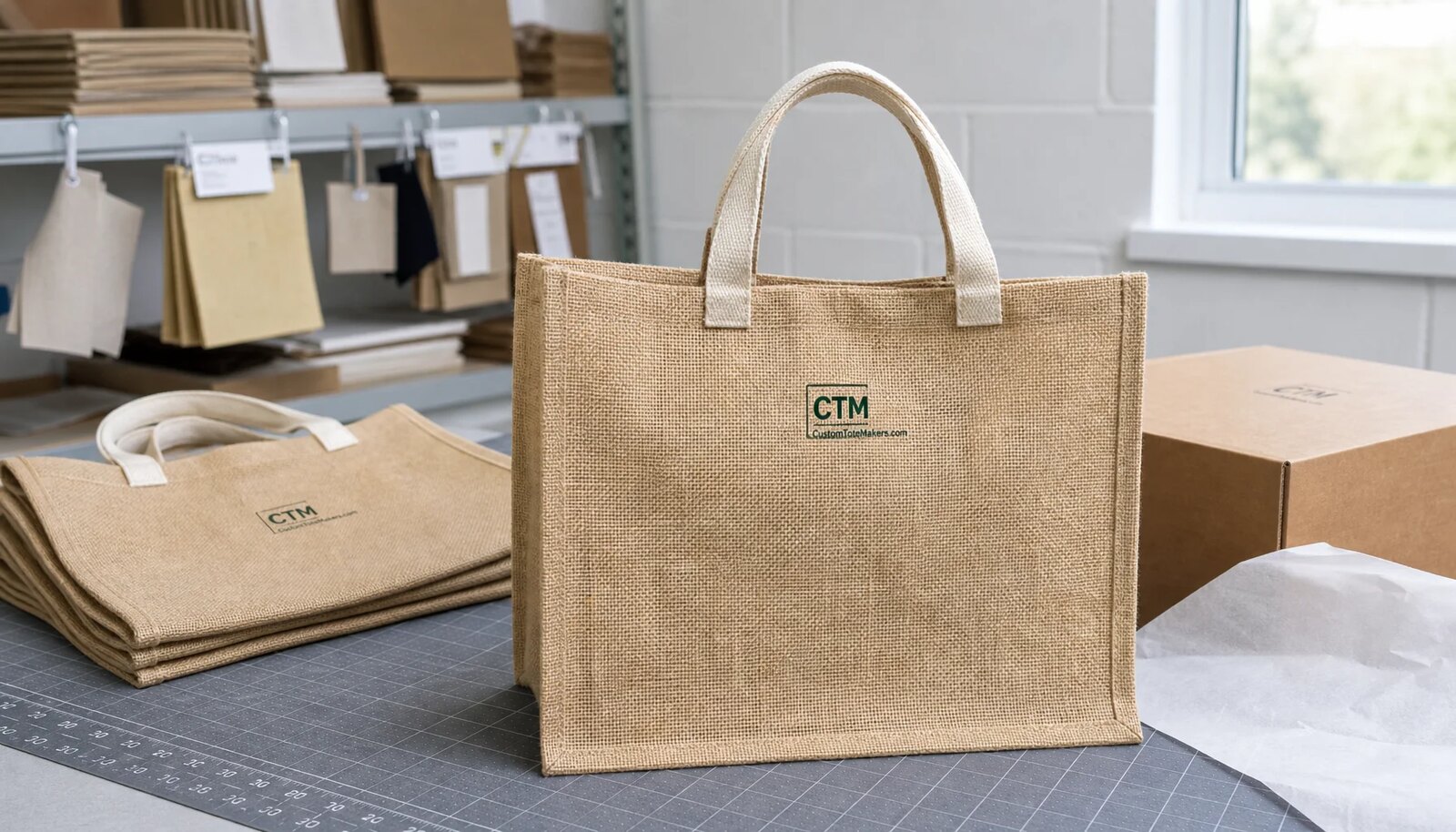
Start with the carton plan
For jute tote bags for craft fairs, packing is part of the product specification. It affects freight volume, warehouse receiving, event handling, and how the bag looks when vendors unpack it at a booth. A loose sample can look fine, while bulk goods arrive with creased logo panels, crushed gussets, bent handles, or mixed artwork because carton details were left until the end.
Define the bag and carton together. A 35 x 40 cm unlined tote with a 10 cm gusset will not pack like the same-size tote with cotton lining, padded handles, hangtags, and individual polybags. Two suppliers may quote the same FOB unit price, but the landed cost changes if one packs 40 pieces per carton and another packs 60 pieces in larger or heavier cartons.
Put carton requirements into the PO or technical pack: pieces per carton, length, width, height, gross weight, net weight, closure method, carton marks, SKU segregation, and estimated CBM. Without these details, procurement teams compare incomplete offers and inspectors lack a clear packing standard.
- Request carton data during quotation, not after sewing starts.
- Compare CBM per 1,000 pieces alongside FOB unit price.
- Approve the folding method before mass packing.
- Set a carton gross-weight target that matches warehouse, courier, or event handling.
- Use the same packing method for sample review, production inspection, and shipment release.
Match the tote to the booth use
Craft fair totes carry different product mixes. Some hold brochures and light apparel. Others carry candles, jars, books, soaps, small ceramics, packaged food, or several purchases from different booths. A giveaway bag can use simpler construction than a retail carry bag expected to hold dense goods for several hours.
Set the gusset early. A flat jute tote folds thinner and usually packs more efficiently, but it is less useful for boxed goods or jars. A 10 to 15 cm bottom gusset helps the bag stand and improves retail usability, while adding folded bulk and reducing carton quantity. That tradeoff belongs in the quote.
The acceptance standard should follow the selling context. Cost-controlled event bags, customer-facing retail bags, and premium reusable totes do not need the same finish level. Premium programs need cleaner print placement, stronger handle attachment, and tighter compression control because defects are visible on booth tables.
- Light giveaway: unlined jute, simple screen print, bulk packing, and standard carton marks.
- Retail carry bag: 13 oz to 15 oz jute planning range, reinforced handles, 10 to 15 cm gusset, and controlled folding.
- Premium reusable tote: cotton lining, woven label or cleaner print method, stronger reinforcement, and lower carton compression.
- Heavy product use: request bottom reinforcement or stronger stitching and test with intended sample goods.
- Multi-event program: standardize one base bag and vary artwork only where SKU control supports the plan.
Specify jute weight in numbers
Jute quotations often use vague terms such as heavyweight, premium, laminated, or natural. Replace them with numbers: target body weight in oz or GSM, tolerance, lining type, handle material, finished size, and finished bag weight in grams. The finished sample weight gives buyers a fast cross-check when bulk production arrives.
For many craft fair shopping bags, 13 oz to 15 oz jute, about 380 to 450 GSM, is a practical planning range. Lighter jute can reduce cost and carton weight, but may collapse or crease more easily. Heavier jute can improve structure and perceived value, while increasing folded thickness, carton weight, and CBM.
Natural jute has shade variation, slubs, and uneven fiber. These are normal material traits, not reasons to accept mildew odor, water marks, oil stains, holes, broken weave, or heavy shedding. For repeat seasonal programs, keep an approved swatch and define an acceptable shade range.
- State jute weight as oz and approximate GSM where possible.
- Record the approved sample's finished weight in grams.
- Define unlined, cotton-lined, or PE-laminated construction clearly.
- Keep retained swatches for buyer, factory, and third-party inspection reference.
- Write separate tolerances for body size, handle length, print position, and carton quantity.
- Avoid broad sustainability claims unless material, lining, and packaging support them.
Choose artwork methods for rough jute
Screen printing is usually practical for jute tote bags when artwork uses one to three solid colors. The coarse surface means ink edges and opacity will not look like print on cotton canvas, paper, or smooth synthetic fabric. A digital mockup helps with layout, but it does not prove print quality.
Fine artwork needs extra review. Thin lines, small reversed text, gradients, distressed textures, and tight multi-color registration can lose definition on natural jute. If the design includes sponsor marks, legal copy, or detailed illustration, a woven label, printed cotton patch, or sewn panel may be safer than direct print. Heat transfer can hold more detail, but changes the hand feel.
Artwork approval also needs a packing review. A logo crossing a fold line may unpack with a permanent crease. Large solid ink areas can scuff or transfer under pressure. Approve a strike-off on the same jute quality planned for production, then review it after folding in the proposed carton method.
- Set print position tolerance, commonly around +/-5 mm for standard tote panels unless tighter control is agreed.
- Use thicker lines and larger text for direct print on jute.
- Approve Pantone targets while allowing realistic variation from jute shade and ink absorption.
- Review strike-offs on production jute, not only paper proofs or digital images.
- Use paper interleaving if printed panels show abrasion, ink transfer, or pressure marks.
- Quote screen charges by color and artwork version.
Build carton count around compression
For medium gusseted jute totes, 40 to 60 pieces per export carton is often workable. The right count depends on bag size, jute weight, lining, handle bulk, hangtags, polybags, and carton strength. Too much empty space allows movement and distortion. Too much compression creates deep creases, crushed corners, and handle pressure marks.
Carton gross weight also needs a handling target. Where cartons move through warehouse staff, courier networks, or event teams, many buyers plan around 15 to 18 kg gross weight. Heavier cartons may suit palletized warehouse delivery, but can be awkward for direct-to-event shipments.
Ask for packed-carton photos, a short video, or a fold diagram before mass packing. It should show handle placement, whether printed panels touch, how hangtags or barcodes are protected, and how layers are arranged. Multiple artwork versions should be packed and labeled by SKU unless assortment packing is approved in writing.
- Record carton length, width, height, pieces per carton, net weight, gross weight, and CBM in the PO.
- Use CBM per 1,000 pieces to compare suppliers.
- Reject carton plans that require force to close flaps.
- Open trial cartons after compression or stacking to check logo creasing and gusset distortion.
- Use reinforced export cartons for stacking, LCL shipping, or long warehouse storage.
- Approve carton marks before packing starts, especially for split destinations.
Control MOQ and SKU splits
MOQ is not only total order quantity. Factories plan fabric purchasing, cutting, print setup, sewing flow, trimming, QC, and packing segregation by version. A 3,000-piece order with one size and one artwork is much easier than 3,000 pieces split across ten logos, five destinations, and different barcode rules.
Keep the base specification stable where possible: same bag size, jute weight, handle material, lining, and carton pack count. If the program needs several craft fair logos, quote artwork versions separately with screen charges and per-version MOQ. This makes setup cost visible and helps buyers decide which versions justify production.
Carton labeling must match the receiving workflow. Distributor inventory usually needs single-SKU cartons. Direct-to-event shipments may need destination-packed cartons numbered 1 of 12, 2 of 12, and so on. Mixed cartons create avoidable risk unless the packing list identifies the contents clearly.
- Clarify MOQ by size, jute color, handle color, lining, print color, print position, and artwork version.
- Request SKU-level quote lines when versions have different quantities.
- Require carton marks with SKU, artwork name, PO number, quantity, carton number, destination, gross weight, and net weight.
- Avoid mixed-SKU cartons unless assortment packing is formally approved.
- Ask how overruns and shortages will be allocated across artwork versions.
- Reconcile carton numbers against the packing list before shipment release.
Approve samples in production order
A loose sample approval leaves too much risk. The approval flow should mirror production: material swatch, print strike-off, finished sample, and packed-bag review. The swatch confirms jute weight, color, texture, and lining. The strike-off confirms print behavior. The finished sample confirms dimensions, stitching, handle comfort, and placement. The packed review confirms whether the tote survives the proposed fold and carton count.
Measure and weigh the finished sample. Record body dimensions, gusset depth, handle length, handle width, print position, and finished bag weight in grams. If the supplier changes fabric lot, handle material, lining, or fold method later, the approval record makes the change easier to catch.
For craft fair orders, packed presentation matters. Photograph the approved fold, handle placement, hangtag position, interleaving, carton layer arrangement, carton label, and closure method. If packing approval changes carton quantity, gross weight, or CBM, update the quotation and PO before bulk packing.
- Approve material, print, finished bag, and packing method as separate checkpoints.
- Measure the approved sample and record tolerances in the technical file.
- Keep sealed reference samples for factory QC and buyer inspection.
- Reject samples with mildew smell, dampness, weak handles, crooked print, unstable gusset, or heavy shedding.
- Request packed-carton photos for small orders when a formal carton trial is not practical.
- Update the PO if packing approval changes carton count or freight volume.
Compare landed cost, not unit price
Jute bags are bulky relative to unit value, so freight volume and packing efficiency can change landed cost quickly. A lower FOB price may become more expensive if the carton plan uses fewer pieces per carton, larger cartons, or unnecessary individual polybags. A higher unit price may be the better buy if the packing plan reduces logo creasing, re-sorting labor, and event complaints.
Ask suppliers to separate cost components procurement can manage: base bag, printing, screens, woven labels, hangtags, barcodes, polybags, paper interleaving, reinforced cartons, carton labels, samples, inland freight, and remake fees. Separate lines make it easier to simplify the specification without restarting negotiation.
Freight mode changes priorities. For air, dimensional weight may matter more than actual weight. For sea LCL, carton dimensions and total CBM affect freight, destination charges, and warehouse handling. For courier delivery to events, gross weight, carton strength, and clear labels may matter more than maximum density.
- Compare FOB price, CBM per 1,000 pieces, carton count, and gross weight together.
- Check whether polybags, hangtags, barcodes, and special carton labels are included.
- Estimate re-sorting labor if cartons are mixed by artwork or destination.
- Confirm whether stronger cartons increase unit cost but reduce compression damage risk.
- Include inspection, inland freight, customs handling, and receiving labor in landed cost.
- Do not approve a cheaper quote if carton data is missing or unrealistic.
Protect the event calendar
Craft fair schedules do not move easily. A late tote shipment may have little value if it arrives after event season or after kit assembly starts. Break lead time into artwork confirmation, material sourcing, sample making, strike-off approval, bulk cutting, printing, sewing, trimming, QC, carton packing, and export handover.
The production clock starts after the last blocking approval, not the first inquiry. Blocking items may include deposit, material confirmation, artwork approval, strike-off approval, finished sample approval, and final packing instruction. Artwork changes after screens are made or destination changes after packing starts can reset part of the schedule.
When deadlines are tight, simplify the order instead of forcing complexity into a short timeline. Use one base size, fewer artwork versions, fewer print colors, standard handles, bulk packing, and a clear carton mark format. Keep time for inspection after cartons are packed, because label errors and compression defects cannot be fully checked earlier.
- Set required arrival date and work backward through shipping, customs, receiving, and event distribution.
- Define whether lead time starts from deposit, artwork approval, sample approval, or material arrival.
- Freeze artwork before bulk printing and carton marks before mass packing.
- Confirm whether partial shipment is allowed if one artwork version is delayed.
- Build inspection time into destination-packed or barcode-labeled orders.
- Simplify size, print, labels, and packing for urgent programs.
Inspect tote quality and carton execution
Final inspection should cover both the bag and the packing plan. Inspectors need to open cartons from different parts of the packed lot, including top, middle, and bottom stack positions. Lower cartons often reveal compression damage first. For jute, allow normal fiber irregularity and shade variation while rejecting defects that affect function, cleanliness, or presentation.
Product checks should measure body dimensions, gusset depth, handle length, handle width, print position, and finished bag weight against the approved sample. Inspection should also cover seams, bartacks, thread trimming, handle security, odor, moisture, stains, broken weave, holes, heavy shedding, and print legibility. Handle load checks are especially useful for bags intended for dense goods.
Carton inspection is equally important. Good bags can still fail procurement requirements if cartons are mislabeled, mixed by artwork, missing barcodes, overfilled, undercounted, or assigned to the wrong destination. The inspector should reconcile carton quantity, carton numbering, SKU allocation, gross weight, and packing list details before shipment release.
- Measure body size, gusset, handle length, print position, and finished weight from random cartons.
- Check handle stitching, seam security, odor, moisture, stains, holes, shedding, and loose jute ends.
- Open cartons from top, middle, and bottom stack positions to detect compression damage.
- Verify carton count, pieces per carton, SKU separation, barcode readability, and carton marks.
- Tie defect photos to carton number, SKU, artwork version, and inspection sample size.
- Release shipment only after the packing list matches finished quantity, carton count, and destination allocation.
Specification comparison for buyers
| Spec decision | Planning target for procurement | Best fit | Buyer risk to check |
|---|---|---|---|
| Jute body weight | 13 oz to 15 oz jute, about 380 to 450 GSM, with agreed GSM tolerance and finished sample weight in grams | Retail craft fair bags for candles, jars, soaps, books, apparel, packaged food, and small ceramics | Treat this as a planning range, not a universal standard. Verify fabric swatch, receiving record, and finished bag weight before bulk approval. |
| Finished size and gusset | Medium tote around 35 x 40 cm with 10 to 15 cm bottom gusset; state whether dimensions are measured flat, opened, or formed | Booth retail bags that need to hold boxed or jarred goods without becoming oversized for freight | Oversized gussets reduce pieces per carton and increase CBM. Compare carton volume per 1,000 pieces before approving size. |
| Handle construction | 25 to 38 mm cotton webbing, padded jute, or reinforced jute handle with box stitch, cross stitch, or bartack at stress points | Reusable customer-facing bags where comfort and load perception matter | Weak handles create functional failures. Ask for handle width, length, stitch pattern, thread type, reinforcement, and sample pull-check method. |
| Print method | Screen print for one to three solid colors; woven label or printed cotton patch for fine detail; heat transfer only when detail outweighs natural hand feel | Natural craft fair branding where logo readability matters more than photographic detail | Small reversed text, gradients, and tight registration can fail on coarse jute. Approve a strike-off on production jute. |
| Lining or lamination | Unlined for cost-controlled natural bags; cotton-lined for cleaner interior; PE-laminated only when structure or wipe-clean use is required | Wholesale markets, boutique retail, gifting, event kits, and display programs | Lining changes folded thickness, carton count, cost, and sustainability language. Specify exact material and thickness. |
| Carton pack count | For medium gusseted jute totes, often 40 to 60 pcs/export carton; keep gross weight around 15 to 18 kg where manual handling is expected | Warehouse receiving, courier routes, and direct-to-event distribution | These are planning targets. Overpacking can crease logos, distort gussets, deform handles, and exceed staff handling limits. |
| Inner packing | Bulk pack with consistent folding; paper interleaving for printed-panel protection; individual polybag only for barcode, dust control, or kit assembly | Distributor stock, direct-to-event shipments, branded booth kits, and retail programs | Unneeded polybags add cost, labor, volume, and compliance checks. Define thickness, warning text, barcode location, and carton-count impact. |
| MOQ and SKU split | Use one base size, material, handle color, and carton plan; split artwork only where needed and quote setup charges separately | Craft fair chains, maker-market organizers, museums, gift distributors, and regional event programs | Too many splits increase screen charges, packing-list errors, and mixed-carton risk. Confirm MOQ per SKU and artwork version. |
| Carton labeling | SKU, artwork name, PO number, quantity, carton number, destination, gross weight, net weight, and required origin mark on at least two sides | Warehouse receiving, event-kit packing, marketplace fulfillment, and distributor inventory | Generic marks cause re-sorting, wrong-destination shipments, and missed event deadlines. Approve label layout before mass packing. |
Buyer checklist before sampling
- Define finished size, measurement method, gusset depth, handle length, intended load range, and whether the bag needs to stand upright at a booth counter.
- Specify jute body weight in oz or GSM, tolerance, lining or lamination, approved natural shade range, and any sustainability wording the material must support.
- Record the approved sample's finished weight in grams and use it to cross-check production samples from different cartons.
- Send vector artwork with Pantone references, print size, placement from edges, minimum line thickness concerns, text-size warnings, and fold-line restrictions.
- Request carton dimensions, pieces per carton, gross weight, net weight, carton board strength, closure method, palletization plan, and estimated CBM with the first quotation.
- Compare suppliers by FOB unit price plus CBM per 1,000 pieces, carton count, gross weight, setup charges, and special packing cost.
- Approve a pre-production sample in the proposed fold, including handle placement, printed-panel direction, hangtag position, interleaving, polybag use, and layer arrangement.
- Set acceptance criteria for size, gusset shape, handle pull, stitching, odor, moisture, stains, shedding, print position, print legibility, carton crush, barcode scan, and carton marks.
- Separate quote lines for bag cost, printing, screens, woven labels, hangtags, barcodes, individual polybags, interleaving, reinforced cartons, inland freight, samples, and remake fees.
- Confirm lead time from the last required approval: material, artwork, strike-off, deposit, finished sample, and final packing instruction.
Factory quote questions to send
- What exact jute body weight will be used, what tolerance applies, and what is the finished sample bag weight in grams?
- Is the bag unlined, cotton-lined, PE-laminated, or otherwise reinforced, and how does that choice change folded thickness, carton quantity, gross weight, and CBM?
- What handle material, width, length, color, stitch pattern, reinforcement, and thread type will be used? What sample pull or load check can you perform?
- Which print method do you recommend for our artwork on coarse jute, and what limits apply for line thickness, text size, ink coverage, and registration?
- Can you provide a print strike-off on the same jute quality planned for production and review it after folding and carton compression?
- What carton pack count do you recommend for this size, and what are the carton dimensions, gross weight, net weight, and CBM per 1,000 pieces?
- What carton board strength or export carton grade will you use, how will cartons be closed, and how will the carton tolerate stacking during export or storage?
- Can you provide packed-carton photos, a fold diagram, layer arrangement, handle placement, printed-panel direction, and warning if the logo crosses a fold line?
- Are print setup charges, screens, labels, hangtags, barcodes, polybags, export cartons, sample remake charges, and inland freight included or listed separately?
- What MOQ applies per bag size, jute color, handle color, lining type, print color, print position, destination, and artwork version?
Quality-control points to confirm
- Finished body dimensions should commonly stay within +/-1 cm and handle length within +/-1.5 cm unless the buyer approves wider tolerance for large or hand-finished designs.
- Gusset depth must be measured consistently, with the report stating whether the bag was measured flat, opened, or formed.
- Jute weight should be checked against fabric receiving records, retained swatches, or cutting-room samples; the approved swatch should remain available during inspection.
- Finished bag weight in grams should be compared with the approved sample to catch changes in fabric weight, lining, handle thickness, or reinforcement.
- Handle attachment should show secure reinforcement with no skipped stitches, broken stitches, loose bartacks, exposed knots, weak tension, or uneven stress-point placement.
- Random handle load or pull checks should use samples from different production bundles when bags are intended for jars, candles, books, ceramics, or other dense goods.
- Print registration, color, opacity, edge sharpness, and position should be checked against the approved strike-off on jute, allowing natural texture but rejecting major bleeding, smearing, misalignment, or unreadable text.
- Bags should be dry and free from strong odor, mildew, oil stains, water marks, holes, broken weave, heavy shedding, sharp loose jute ends, and packing-floor contamination.
- Packed bags should not show crushed corners, transferred ink, deep fold marks across the logo, permanent gusset distortion, or handle deformation at the agreed carton count.
- Cartons should match the agreed pieces per carton, dimensions, gross weight, carton mark format, barcode placement, closure method, SKU separation, and destination allocation before shipment release.