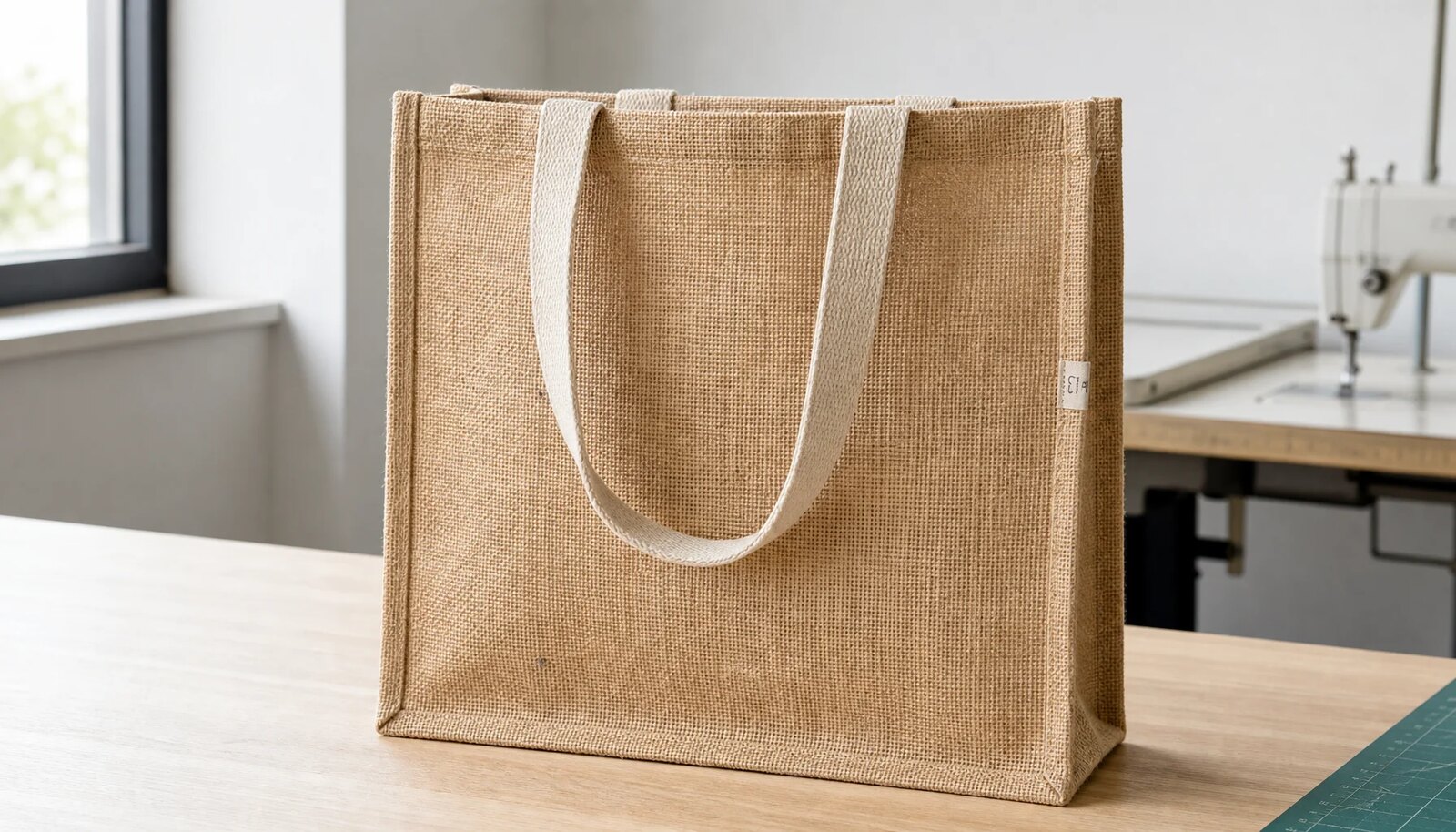
Start With Use Case and Loaded Weight
For B2B buyers, a jute tote bag is not only a branded surface. It is part packaging, part presentation, and often part of the gift itself. The right fabric weight depends first on what the recipient will carry, how the bag will be handed over, and whether the buyer expects the bag to be reused after the event. A conference tote carrying a notebook and leaflets does not need the same build as a holiday client gift holding a rigid box, drinkware, apparel, and printed inserts.
Begin the RFQ with loaded use instead of artwork. List the contents, approximate total weight, largest item dimensions, and any hard corners that may stress the base. A bag that looks acceptable when empty may bow outward, collapse at the side panels, or pull at the handle seams once loaded. If the gift will sit upright on a reception table, the base and gusset matter as much as the front print. If the bag is handed out flat at a trade show, carton efficiency may matter more than structure.
Procurement teams should also separate one-time event needs from repeat programs. For a single low-cost giveaway, buyers may accept more natural variation and a simpler construction. For annual employee onboarding kits or client gifting across several markets, repeatability becomes a commercial requirement. In those cases, the body GSM, handle spec, construction, print method, and packing standard should be documented so the same bag can be reordered without restarting the entire approval process.
- State the intended contents and loaded weight before requesting logo options.
- Define whether the bag must stand upright, carry comfortably, fit a box, or pack flat for freight efficiency.
- Use a real or equivalent load during sample approval instead of approving the empty bag only.
- For repeat programs, keep the approved sample, artwork file, measurements, and packing standard as reorder references.
Read Jute GSM Without Overbuying
GSM means grams per square meter of fabric, but it is not a complete quality grade by itself. In jute tote sourcing, the number should be read together with weave density, yarn thickness, lamination, lining, bag size, handle reinforcement, and packing method. Two bags quoted at 320 GSM can feel different if one is open-weave raw jute and the other is laminated or tightly woven. A smaller gift bag can feel firm at a lower GSM because the panels are short, while a large shopper can look soft even at the same fabric weight.
As a practical starting point, 250-280 GSM works for light giveaways and budget-sensitive events where the bag carries flat or low-weight items. Buyers should expect less standing structure and more visible creasing. The 300-350 GSM range is often the useful middle zone for corporate gifting because it gives better body while keeping carton volume and unit cost reasonable. For premium sets, heavier contents, or bags expected to be reused, 350-420 GSM or a supported construction may be appropriate. Very heavy fabric is not automatically better; it can increase cost, bulk, and lead time without solving print or seam issues.
The quote should say exactly what is being measured. Some suppliers refer to raw jute fabric GSM before lamination. Others may quote a laminated fabric weight or loosely describe the finished bag as a weight class. This creates false comparisons. Ask for the measured fabric basis and tolerance, and make sure samples are made from the same material that will be used for production. If the supplier cannot define the measurement point, treat the GSM claim as a description rather than a controlled specification.
- 250-280 GSM: light event use, brochures, small flat gifts, lower-cost campaigns.
- 300-350 GSM: common starting range for welcome kits, apparel packs, notebooks, and general corporate gifts.
- 350-420 GSM: stronger presentation for premium gift sets, heavier loads, or reusable customer-facing bags.
- Always confirm whether GSM refers to raw jute, laminated fabric, backed fabric, or a general supplier description.
Specify Construction, Backing, and Tolerances
Fabric weight is only one line in the specification. The buyer also needs to define how the bag is built. Raw single-layer jute gives a natural texture and a lower-material construction, but it can shed fibers, crease, and absorb ink unevenly. Laminated jute can improve shape and reduce loose fibers on the inside, but it changes the feel, odor profile, recyclability discussion, and heat behavior. A cotton or non-woven lining improves presentation and protects contents, but it adds sewing steps and another material that must be inspected.
Procurement should write the bag construction in plain, testable language. Include finished width, height, gusset depth, handle drop, handle width, interior type, seam finish, base support, closure, pocket, and label placement. For many corporate programs, workable tolerances are around +/-5 mm to +/-10 mm for finished dimensions, +/-5 mm for handle drop, and +/-3 mm to +/-5 mm for logo placement, depending on bag size and production method. Tighter tolerances may be possible, but they must be agreed before pricing and sampling because they affect inspection and rejection risk.
The handle specification deserves special attention. A low quote may hide narrow webbing, short handles, weak stitching, or no reinforcement at the stress points. For hand carry, a shorter handle drop may be fine; for shoulder carry, buyers often need roughly 35-45 cm handle drop, depending on bag size and market preference. Specify cotton webbing, jute webbing, rope, padded handles, or another material, then define reinforcement such as box stitch, cross stitch, bartack, or extra tape. Handle failure is more damaging to the recipient experience than a small cosmetic variation in the jute weave.
- Write a complete construction spec, not a request for a generic jute tote.
- Agree tolerances before the pre-production sample is approved.
- Ask whether structure comes from heavy fabric, lamination, lining, base board, or seam design.
- Treat handle material and reinforcement as load-bearing specifications, not decoration details.
Match Logo Method to Coarse Fiber
Jute is a rough, uneven surface, so logo quality must be engineered rather than assumed. Direct screen printing can work well for bold one-color or two-color marks, especially with enough line thickness and open spacing. It is less reliable for tiny text, thin rules, gradients, tight registration, and complex brand marks. Ink can bridge over high yarns, break over low points, spread into the weave, or look uneven across natural slubs. A digital mockup cannot show those effects.
For fine detail, consider a separate branding component. A cotton patch, canvas patch, woven label, embroidery, printed fabric panel, or leather-look patch can produce a cleaner brand impression than forcing a complex logo directly onto jute. These options also change perceived value. A small woven side label feels subtle and retail-like. A large front print works better for visibility at an event. A patch can support multi-color artwork while keeping the natural bag surface intact.
The RFQ should include print size, exact position from seams or bag edges, color references, and artwork limits. Ask the supplier what minimum line width and text height they recommend for the selected jute. Require a strike-off on actual approved fabric for any logo that includes small type, more than one color, or strict brand standards. During approval, check not only visual appearance but also curing, odor, rub resistance, and whether printed faces transfer ink or scuff during packing.
- Use direct screen print for bold marks with simple shapes and adequate spacing.
- Use patches, woven labels, embroidery, or sewn panels for small text and premium brand control.
- Approve a physical strike-off before bulk production when logo quality is commercially important.
- Define print placement tolerance and inspect from fixed reference points such as side seam, top edge, or gusset line.
Build an RFQ Suppliers Can Price Accurately
A strong RFQ reduces guesswork. Instead of asking for a price for branded jute tote bags, provide one document that includes finished dimensions, target GSM, construction, handle, logo method, logo size, packing, quantity by SKU, delivery term, sample requirements, and inspection expectations. The more complete the RFQ, the easier it is to compare suppliers fairly. Otherwise, one supplier may quote a stock 280 GSM raw bag while another quotes a custom 350 GSM laminated bag with reinforced handles and individual packing.
Ask each supplier to identify assumptions and exclusions. Are screens, setup charges, labels, carton marks, export cartons, documentation, and sample shipping included? Is the price based on one print color or multiple colors? Does the quoted lead time start after deposit, artwork approval, fabric approval, or sealed sample approval? Does the carton count assume flat packing, folding, or nested packing? Small differences here can erase the apparent savings in the headline unit price.
For repeat programs, request a simple bill of materials. It does not need to expose factory margin, but it should describe body fabric, backing or lining, handle material, thread, label, print, trims, packing materials, and carton. This helps procurement value-engineer intelligently. Reducing print colors, using a standard handle color, or changing individual packing may save more than dropping below an acceptable GSM. The best quote is not always the lowest unit price; it is the clearest commercial basis for the bag you actually need.
- Send one RFQ package to all suppliers so responses are comparable.
- Require suppliers to state whether the quote is for stock goods, modified stock, or full custom production.
- Separate one-time setup charges from repeat unit pricing.
- Compare carton dimensions, CBM, gross weight, and packing method along with unit price.
Understand MOQ, Lead Time, and Supplier Route
MOQ is not random. It usually reflects material booking, cutting efficiency, printing setup, sewing-line changeover, and packing labor. A stock natural jute tote with standard cotton handles and one front print can often be supplied at a lower MOQ because blanks or fabric may already be available. Custom GSM, custom size, dyed handles, lining, lamination, zipper closure, special labels, or branch-level packing can raise MOQ because the supplier must buy or make dedicated components.
Lead time should be broken into stages. Material preparation, lamination or backing, cutting, printing, drying or curing, sewing, trim attachment, finished inspection, packing, carton marking, pre-shipment inspection, and export booking all take time. Sample shipping and buyer approval can add more time than production itself if artwork changes repeatedly. For event-based corporate gifting, build the schedule backward from the required delivery date and include at least one correction cycle for sample or print adjustments.
Supplier route also changes risk. A direct factory may provide stronger control over cutting, sewing, and packing, especially for repeat programs. A trader or sourcing partner may be valuable when the bag is part of a multi-item gift kit and one party needs to coordinate several categories. A stockist can be the right route for urgent low-MOQ decoration, but the buyer accepts existing size, GSM, handle, and color choices. The key is to know which route you are buying so price, speed, and quality expectations match reality.
- Ask which specification changes increase MOQ and which standard options keep MOQ lower.
- Confirm whether lead time includes samples, material booking, printing setup, packing materials, inspection, and export booking.
- Choose stock decoration for speed, custom factory production for control, and managed sourcing for multi-category programs.
- Do not compare a decorated stock bag and a custom production bag as if they are the same offer.
Approve Samples With Measurable Controls
Sampling should move from material to finished product. A fabric swatch confirms weave, shade, GSM, odor, and backing. A blank construction sample confirms size, gusset, handle drop, seam finish, base shape, and loaded behavior. A logo strike-off confirms how artwork performs on the selected jute. A pre-production sample combines the approved material, construction, print, trims, and packing. For higher-value or repeat orders, the final approved piece should become the sealed golden sample.
Avoid approvals based only on comments such as premium feel or good quality. The approval record should capture measurements, tolerance limits, acceptable fabric variation, handle construction, print size, placement, color, stitch expectations, label position, and packing method. The sample should be loaded with intended contents or an equivalent weight. Check whether the bag balances, whether the handles twist or pull, whether the base sags, and whether the logo distorts when the bag is filled.
The sealed golden sample protects both buyer and supplier. Natural jute will always have some shade and texture variation, but the golden sample defines the center point of acceptance. If bulk goods are too loose in weave, too soft, too dark, poorly printed, or packed differently, the conversation can refer to a physical reference instead of opinion. Keep one sealed sample with the supplier and one with the buyer, inspection agency, or local receiving team when the order value justifies it.
- Approve fabric, construction, logo, and packing as separate sample decisions when risk is high.
- Record actual measurements and tolerances on the sample approval sheet.
- Test the sample with real or equivalent contents before signing off.
- Use the sealed golden sample as the inspection reference for fabric, construction, branding, and packing.
Inspect Fabric, Sewing, and Load Performance
Quality control for jute tote bags must allow normal natural-fiber character while rejecting defects that affect appearance, function, or brand presentation. Slubs, minor shade movement, and texture variation can be acceptable if they match the approved range. Oil stains, mildew marks, strong odor, broken yarns, severe gaps, loose handles, skipped stitches, wrong size, print bleed, and carton compression damage should not be treated as normal jute variation.
A practical QC plan covers incoming material, in-line production, and finished goods. Incoming checks confirm fabric GSM, shade, weave, dryness, lamination or backing, and surface defects before cutting. In-line checks catch wrong panel size, uneven gussets, handle placement errors, seam alignment issues, and print registration before the entire order is completed. Finished-goods inspection verifies measurements, handle strength, seam finish, logo quality, trims, odor, and packing. For larger orders, request production photos or inspection reports at each stage rather than waiting until cartons are closed.
Buyers do not need complex lab testing for every promotional tote, but they should require simple performance checks that match the intended use. Load the bag with the planned gift weight or a defined equivalent, carry it for a short handling test, and inspect handle seams and base seams afterward. Rub the print with dry white cloth and, where appropriate, a lightly damp cloth to check visible transfer. Open packed cartons and inspect whether fold lines, pressure marks, or rubbing have damaged the printed face. These checks are simple, but they catch many issues recipients actually notice.
- Define acceptable jute texture using sample references or photos.
- Inspect handle attachment and base seams as critical functional points.
- Use loaded carry checks for gift sets with dense or rigid contents.
- Check print rub and packing pressure before shipment approval, not after the goods arrive.
Control Packing, Moisture, and Distribution
For corporate gifting, packing is part of the delivered product. A bag can pass sewing inspection and still fail commercially if it arrives creased across the logo, flattened beyond recovery, dusty, musty, or mixed across branches. Flat packing saves carton space and freight cost, but it can create visible fold lines. Nested packing can preserve shape better, but it increases carton volume. Individual polybags reduce dust and rubbing, but some buyers prefer lower-plastic or paper-based presentation. The packing decision should be approved with a real sample inside a real or representative carton.
Jute needs moisture awareness because it is a natural fiber. Damp storage, humid loading conditions, weak cartons, or long ocean transits can create odor, staining, or mildew risk. Buyers should ask suppliers how fabric is stored, whether cartons are kept dry before loading, and whether the route requires extra moisture precautions. Desiccant, carton liners, or stronger export cartons may be appropriate in some lanes, but they should be discussed as route-specific controls rather than assumed accessories.
Distribution accuracy matters when the program has several offices, markets, departments, or gift tiers. Specify SKU separation, pieces per inner pack, pieces per export carton, carton numbering, branch names, carton marks, and packing-list format. Ask for packed-carton photos showing the open carton, inner arrangement, label, and sealed carton. Repacking at destination is expensive, creates handling damage, and can destroy a gift-ready presentation, so allocation rules belong in the original RFQ.
- Approve folding or nesting with the printed bag and carton before bulk packing starts.
- Confirm carton dimensions, pieces per carton, gross weight, net weight, and total CBM.
- Discuss moisture control for humid storage, long ocean freight, or seasonal shipping.
- Use SKU-level carton marks and packing lists for multi-location corporate programs.
Compare Landed Cost Before Awarding
A jute tote bags for corporate gifting fabric weight guide becomes useful only when it leads to better commercial comparison. The final sourcing decision should compare the whole landed result, not only the unit price. Align finished size, GSM, construction, handle, logo method, color count, print positions, trims, packing, carton dimensions, incoterm, documentation, inspection scope, and delivery schedule before selecting a supplier. If those points are not aligned, the quotes are answering different briefs.
Landed cost includes more than the bag. Heavier fabric, base boards, nested packing, or individual presentation wrapping can increase CBM and freight. Weak cartons may cause repacking. Poor print approval may cause rework. Loose distribution rules may require sorting at destination. A quote that looks cheaper by a few cents can become more expensive if it creates missed event dates, damaged presentation, or receiving-lane labor. For procurement, the best price is the price attached to a controlled specification and a reliable delivery plan.
Before award, ask suppliers to restate the specification in their own proforma or quotation. Confirm sample stages, approval gates, tolerances, production lead time, inspection point, packing details, and shipment term. Require written confirmation of any buyer-critical item: exact GSM basis, handle drop, load expectation, logo method, packed carton quantity, and delivery date. This creates a clean handoff from sourcing to production and gives the quality team a clear standard to inspect against.
- Compare unit price together with CBM, gross weight, carton count, sample cost, setup cost, and inspection cost.
- Require suppliers to list exclusions and assumptions in writing.
- Award against the approved specification, not against a vague product name.
- Keep the golden sample and final quotation together as the working production standard.
Specification comparison for buyers
| Buying scenario | Practical specification starting point | Why it fits | Quote or QC risk to lock down |
|---|---|---|---|
| Budget event giveaway | 250-280 GSM unlaminated jute, stock size, cotton webbing handles, one-color screen print | Works for brochures, small flat gifts, short campaigns, and quantity-driven events | Confirm actual fabric GSM tolerance, finished size tolerance, handle drop, print rub, and whether stock fabric shade may vary by lot |
| General corporate gifting | 300-350 GSM jute, reinforced side/base seams, 35-45 cm handle drop, tested logo method | Balances cost, structure, reuse value, and presentation for notebooks, apparel, light boxes, and welcome kits | Check loaded shape, handle attachment strength, print clarity on actual fabric, and carton compression after packing |
| Premium client gift set | 350-420 GSM jute or 300-350 GSM with lamination/lining/base board, reinforced handles, controlled packing | Better for rigid boxes, bottles, heavier contents, and gift-table presentation | Ask what creates structure: heavier jute, lamination, lining, board insert, seam construction, or a combination |
| Fine-detail branding | Cotton patch, woven label, embroidery, transfer on patch, or simplified screen print after strike-off | Protects small type, thin strokes, registration, and brand color consistency better than direct print on coarse weave | Require strike-off on production fabric; define minimum line width, minimum text height, placement tolerance, and acceptable ink bleed |
| Repeat annual program | Custom factory spec with retained golden sample, BOM, artwork file, fabric lot records, packing standard | Improves reorder consistency across seasons, branches, or regional programs | Record body GSM, weave appearance, handle width, stitch type, print formula, carton pack, and approved tolerances |
| Fast pilot or low MOQ | Stock blank bag decorated by stockist or mixed-stock supplier | Useful for internal events, market tests, and urgent small-volume campaigns | Low MOQ may restrict size, GSM, gusset, handle color, lining, and logo position; inspect stock before decoration |
| Multi-SKU branch distribution | Direct exporter or managed supplier with SKU-level packing lists and carton mark control | Reduces sorting errors when several offices, markets, logos, or recipient tiers are involved | Approve carton label format, SKU separation, inner pack count, gross weight, and photo evidence before shipment |
| Strict landed-cost comparison | RFQ with same GSM, construction, print count, packing, carton size, incoterm, and inspection scope | Prevents a cheaper quote from hiding lighter fabric, shorter handles, weak packing, or excluded documentation | Compare CBM, gross weight, pieces per carton, setup charges, sample charges, export documents, and freight assumptions |
| Moisture-sensitive shipment route | Dry fabric, clean storage, suitable cartons, moisture-control discussion, no over-compressed packing | Important for natural fiber goods shipped through humid production, storage, or ocean freight conditions | Check odor, mildew marks, moisture staining, carton integrity, and whether desiccant or liner bags are appropriate for the route |
Buyer checklist before sampling
- Define the use case: trade show handout, employee welcome kit, client gift, holiday pack, retail resale, internal recognition, or repeat corporate program.
- List intended contents with approximate loaded weight, dimensions, and risk points such as bottles, rigid boxes, electronics accessories, catalog edges, or apparel bulk.
- Specify finished bag width, height, gusset depth, handle drop, handle width, and whether measurements are taken empty, flat, or loaded.
- State target body fabric GSM and clarify whether it refers to unlaminated jute fabric, laminated fabric, lined construction, or a supplier's finished-bag estimate.
- Define construction: raw single-layer jute, laminated backing, cotton lining, non-woven lining, base board, zipper, snap, pocket, piping, binding, or custom shape.
- Set practical tolerances before sampling, such as finished size +/-5 mm to +/-10 mm, handle drop +/-5 mm, print placement +/-3 mm to +/-5 mm, and GSM tolerance agreed by fabric lot.
- Choose handle material, handle color, handle width, handle drop, attachment seam, and reinforcement method such as box stitch, cross stitch, bartack, or extra webbing tape.
- Provide vector artwork with Pantone/brand references, print size, print position, minimum text size, line thickness, and acceptable artwork simplification for jute texture.
- Confirm decoration method assumptions: screen print, heat transfer, cotton patch, woven label, embroidery, leather-look patch, hangtag, or mixed branding.
- Break quantity down by SKU, print version, size, color, delivery point, and acceptable over/under shipment if the supplier requires one.
Factory quote questions to send
- What exact body fabric GSM are you quoting, and is it measured before lamination, after lamination, after coating, or inferred from the finished bag?
- What GSM tolerance do you allow by fabric lot, and can you provide a fabric swatch or test report showing the measured basis used for the quote?
- What are the finished bag size tolerances for width, height, gusset, handle drop, handle width, and print placement?
- Is the quoted construction raw single-layer jute, laminated jute, lined jute, backed jute, base-board supported, zippered, pocketed, or another build?
- What handle material, width, thickness, length, color, and reinforcement stitch are included in the price?
- What loaded weight do you consider suitable for this construction, and what simple in-factory handle or seam test can you perform before shipment?
- How many print colors, print positions, screens, patches, labels, or embroidery areas are included, and what is the cost impact of adding one color or position?
- Can you produce a strike-off on the actual approved jute fabric, not only on similar stock fabric or paper proof?
- What minimum line width and minimum text height do you recommend for direct print on this weave?
- What is your MOQ for this exact GSM, size, handle, logo method, lining, packing, and carton format, and which changes would alter MOQ?
Quality-control points to confirm
- Measure finished width, height, gusset depth, handle drop, handle width, pocket size, print size, and print placement against the approved sample and written tolerances.
- Verify actual body fabric weight from the approved lot and confirm whether the measured material is raw jute, laminated jute, or lined construction.
- Check fabric appearance against the golden sample for acceptable shade range, weave openness, slubs, broken yarns, stains, odor, moisture marks, and mildew risk.
- Inspect laminated or backed fabric for even bonding, bubbling, delamination, cracking, sharp edges, interior cleanliness, and odor after packing.
- Review stitching density, seam straightness, skipped stitches, loose threads, edge fraying, seam allowance, side-gusset symmetry, and base-corner alignment.
- Check handle attachment at every stress point, including box stitch, cross stitch, bartack, webbing alignment, thread quality, and whether both handles are equal length.
- Run a practical loaded carry check using intended contents or a comparable weight, then inspect handle seams, base seams, side seams, and bag distortion.
- Confirm print registration, logo size, placement, color, ink coverage, curing, edge bleed, pinholes, crocking/rub, and no transfer onto adjacent packed bags.
- Inspect patches, woven labels, embroidery, hangtags, snaps, zippers, lining, pockets, and base boards for position, spelling, orientation, attachment strength, and finish.
- Check folding, nesting, individual packing, tissue, polybag, carton compression, carton strength, carton marks, SKU separation, and packing list accuracy.