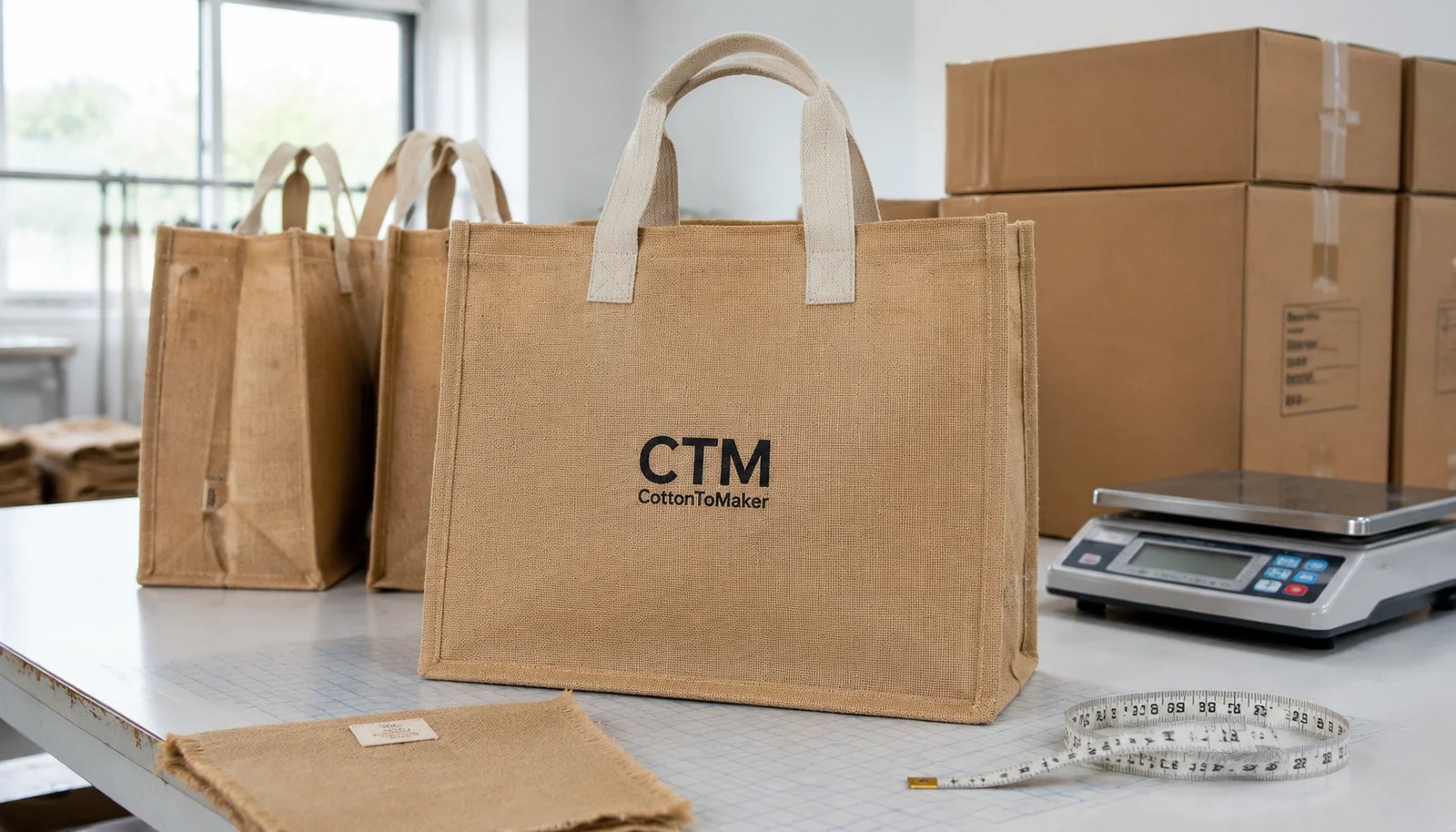
Why carton planning changes the real cost of jute grocery totes
For jute tote bags used by natural grocers, carton packing is not a back-office detail. It affects unit cost, receiving speed, warehouse labor, freight cube, and the condition of the bag when it reaches the store. A tote that looks strong in a sample room can arrive with crushed handles, distorted panels, dusty surfaces, or mixed carton counts if the packing plan is decided after production.
Jute is bulkier and less compressible than lightweight cotton. It also has a coarse surface that can rub against neighboring bags during transport. That means a carton plan for cotton drawstring pouches or thin canvas totes should not be copied directly to jute grocery totes. The better approach is to build the carton plan at the same time as the bag spec, then approve the sample and packing together.
- Carton quantity affects freight CBM more than many buyers expect.
- Tight packing can flatten the gusset and crease the print area.
- Loose packing can cause panel rubbing and carton deformation.
- A warehouse-friendly carton count reduces receiving errors during store allocation.
Start with the grocery use case before locking bag dimensions
Natural grocers usually need a tote that can carry jars, boxed dry goods, produce, supplements, or promotional items. The bag should stand reasonably well at checkout, open easily, and feel durable without becoming too stiff. A common grocery tote range is around 14 to 16 inches wide, 12 to 15 inches high, with a 5 to 7 inch gusset. The exact dimension depends on whether the tote is sold as merchandise, given away in a campaign, or used as a reusable checkout bag.
The carton plan depends directly on the finished volume of the bag. A deeper gusset improves shopping utility but increases folded thickness. Longer handles may improve shoulder carry but add bulk at one side of the folded bag. If the buyer approves dimensions first and discusses cartons later, the supplier may only be able to reduce carton quantity per box, increasing CBM and landed cost.
- For checkout use, prioritize a stable gusset and reinforced handles.
- For promotional giveaways, a slightly smaller gusset may improve carton efficiency.
- For retail resale, keep the bag shape neat after folding because shelf presentation matters.
- For distributor programs, align carton quantity with store pack requirements.
Choose jute GSM and structure with packing in mind
Most custom jute tote bags for grocery retail fall in the 270 to 320 GSM range. A lighter fabric can reduce cost and carton weight, but it may not hold shape well under grocery loads. A heavier jute can look premium and stand better, but it adds thickness, affects sewing speed, and reduces the number of pieces per carton. If the quote does not state GSM, the price comparison is incomplete.
Lamination is another packing-related decision. Laminated jute gives more structure and can reduce fiber shedding, but it makes the bag stiffer and less breathable. Unlaminated jute has a more natural feel, yet it can absorb humidity and transfer more fiber dust. For natural grocers, the choice should balance brand expectations, reuse durability, print result, odor control, and carton compression performance.
- 270 GSM: useful for lighter promotional totes where freight cube matters.
- 300 GSM: common middle option for reusable grocery bags.
- 320 GSM and above: better structure, but higher freight and carton pressure.
- Laminated jute: cleaner structure, but validate cracking and fold marks.
- Unlaminated jute: natural hand feel, but needs stronger humidity control.
Print method choices that survive coarse jute and carton friction
Jute is not a smooth print surface. Fine text, thin lines, gradients, and small QR codes can break because the fiber texture interrupts ink coverage. For most natural grocer branding, single-color or two-color screen printing is the safest method. It works best with bold artwork, sufficient stroke width, and realistic color expectations. A Pantone reference helps, but the printed result on natural jute will not look identical to coated paper.
Heat transfer can produce sharper graphics, but it must be tested on the selected jute. The rough surface may show transfer edge lines, incomplete bonding, or film lift after rubbing. Embroidery on jute is possible for smaller logos but can pucker the panel and increase cost. Whatever method is selected, carton packing should protect the printed panel from abrasion, especially if the bags are packed face-to-face.
- Keep small text large enough to remain readable on coarse fiber.
- Avoid large heavy ink blocks unless the hand feel and drying time are tested.
- Approve print position on an actual sewn bag, not only a flat panel.
- Use interleaving or face-in folding if dark prints are prone to scuffing.
- Include print rub testing before mass shipment.
Build the carton quantity from handling weight, not only cube
A carton that maximizes pieces per box may look efficient in a spreadsheet but fail in a warehouse. Jute totes are heavy compared with lightweight cotton bags. If a carton is packed too densely, gross weight can exceed the buyer's manual handling limit, cartons may bulge, and the bottom seam of the carton can weaken during transit. Many retail receiving teams prefer cartons that stay manageable, often below about 15 to 18 kg where hand lifting is used.
The right carton quantity usually comes from three inputs: folded bag thickness, target gross weight, and store allocation unit. For example, a distributor may prefer 20 pieces per carton if stores receive small replenishment quantities. A national promotion may prefer 40 pieces per carton if warehouse picking is centralized and cartons remain within weight limits. The supplier should provide estimated carton dimensions, gross weight, net weight, and CBM before the purchase order is finalized.
- Do not accept a quote that lists only pieces per carton without carton size.
- Check whether the quoted carton quantity matches your store pack plan.
- Keep carton weight suitable for the destination warehouse handling rules.
- Avoid extremely flat cartons that crush gussets and handle folds.
- Request carton CBM so landed cost can be calculated correctly.
Inner packing options for clean receiving and lower waste
Jute tote inner packing should be practical, not decorative. Individual polybags add cost, labor, plastic waste, and unpacking time. For many natural grocers, bundles of 10 or 20 pieces with a paper band are enough if the export carton is clean and the bags are dry. Recycled polybags may be justified for light-colored printed bags, premium resale totes, or long warehouse storage.
The buyer should define whether bags are folded with the logo facing in or out, whether handles are tucked inside, and how many pieces form a bundle. These details influence presentation and counting speed. If the first time the warehouse sees the packing layout is after arrival, receiving staff may cut bands, recount mixed stacks, or reject cartons that appear short because the bundle count is unclear.
- Paper bands reduce plastic and make counting fast.
- Bundle labels help when multiple SKUs share similar natural jute color.
- Logo-facing-in folding can reduce scuffing during ocean freight.
- Individual packing is better reserved for resale or premium retail display.
- Moisture absorber use should be discussed for humid routes and storage.
MOQ logic: why carton plans can change supplier pricing
MOQ for jute tote bags is not only a sales rule. It is tied to fabric roll consumption, handle material availability, print setup, sewing line efficiency, and carton ordering. A buyer requesting four small colorways, custom handle colors, and separate carton marks may face higher cost than one consolidated SKU with standard handle tape and shared carton specification. This is especially true when the total quantity is modest.
Carton packing can also create MOQ friction. If each store destination needs different carton marks or different carton quantities, the factory must separate finished goods during packing. That adds labor and increases the chance of mixed cartons. For a first order, a simpler carton plan usually gives better cost control and fewer shipping errors. Complex distribution packing is possible, but it should be priced openly rather than hidden inside a vague unit price.
- Consolidate artwork sizes where possible to reduce print setup waste.
- Use standard handle colors unless brand control requires custom dyeing.
- Avoid too many carton configurations for a small order.
- Separate destination carton marks should be listed in the PO and packing list.
- MOQ discussion should include fabric, print, handle, and packing requirements.
Sample approval must include the proposed packing method
A single loose sample bag is useful for checking size, sewing, handle comfort, and print appearance. It is not enough for a grocery tote packing approval. The buyer also needs to know how the bag behaves when folded, stacked, bundled, and placed in the carton. Jute panels can crease, laminated surfaces can show fold marks, and prints can scuff if bags are packed too tightly.
For higher-volume orders, request a pre-production sample using production fabric, production handles, actual print method, and the proposed folding direction. If a full sample carton is not practical before order confirmation, the factory should at least provide a packing simulation with photos, carton dimensions, quantity per carton, and gross weight estimate. Final mass packing should not begin until these details are accepted.
- Measure the sample after sewing, not only the cut panel.
- Load the sample with realistic grocery weight and inspect handle stress.
- Fold the sample for 24 hours and review crease recovery.
- Rub printed panels together to see whether ink transfers.
- Compare packed sample thickness with the quoted carton quantity.
Quality thresholds that prevent shipment disputes
Jute is a natural material, so some fiber variation, slub, and shade difference are normal. The purchase order should still define acceptable limits. Without practical thresholds, the buyer may expect a clean uniform textile while the factory ships natural jute with visible variation. The correct standard is not perfection; it is consistency appropriate for retail sale and safe grocery reuse.
Key QC points include size tolerance, handle strength, seam security, print readability, odor, moisture, carton condition, and piece count. For natural grocery buyers, odor and mildew are especially important because products may be stored near food or wellness merchandise. Cartons should be inspected for dampness, bulging, wrong marks, and incorrect SKU mix before loading.
- Set size tolerance before production so inspection is objective.
- Use repeated lift testing instead of only one static pull.
- Reject sharp broken jute fibers or loose threads that affect customer use.
- Control moisture during storage and before container loading.
- Match carton count and carton marks against the final packing list.
Lead time and schedule risks hidden in the packing plan
A realistic lead time for custom jute tote bags depends on fabric availability, artwork approval, print drying, sewing capacity, carton production, final inspection, and booking. Buyers often focus on the sewing date but lose time during artwork revisions or carton mark changes. If the carton size changes after the first packing trial, the factory may need to reorder cartons, which can delay packing even when bags are finished.
The cleanest schedule is to freeze the bag spec, print file, carton quantity, carton marks, and inner packing before bulk material ordering. When retailers add destination codes or change store allocation late, the factory must re-sort goods or relabel cartons. That is possible, but it should be treated as a schedule risk. A carton packing plan is part of production data, not a final warehouse afterthought.
- Approve artwork before fabric cutting when print position affects panel layout.
- Approve carton dimensions before the carton supplier starts production.
- Allow extra time for laminated jute because folding and print drying may need validation.
- Freeze carton marks before mass packing begins.
- Schedule inspection after packing, not only after sewing.
Specification comparison for buyers
| Spec decision | Recommended option | When it fits | Buyer risk to check |
|---|---|---|---|
| Jute fabric weight | 270-320 GSM laminated or unlaminated jute depending on structure | Most natural grocery retail totes, produce promotions, and reusable checkout bags | Low GSM may collapse after loading; high GSM increases carton weight and freight cost |
| Bag size and gusset | Common grocery format around 14-16 inch width with 5-7 inch gusset | Fits boxed goods, jars, produce, and folded apparel without looking oversized | Oversized gussets reduce carton efficiency and can deform during compression |
| Handle construction | Cotton webbing or padded jute handles with box stitch reinforcement | Retail customers carry 5-8 kg groceries and expect comfort | Rope or thin webbing can cut into hands and fail pull testing |
| Logo method | Single or two-color screen print for jute; heat transfer only after sample validation | Bold natural grocer branding, simple messages, store opening campaigns | Fine artwork breaks on coarse jute; transfer films may show edge lift on rough fiber |
| Inner packing | Flat folded bags in bundles of 10 or 20 with paper band or recycled polybag only if needed | Store distribution teams need quick counting and clean handling | Over-packing adds labor and plastic; under-packing risks dust and fiber transfer |
| Export carton style | 5-ply corrugated carton sized to avoid over-compression, usually 20-40 pcs per carton | Ocean freight, warehouse stacking, and mixed-store allocation | Weak cartons bulge; cartons packed too tight crush handles and distort panels |
| Carton marking | SKU, PO, color, size, quantity, carton number, gross/net weight, and destination code | Multi-store natural grocery programs and distributor receiving | Generic markings cause receiving delays and carton splitting at warehouse |
| Sample approval | Pre-production sample packed in proposed carton with actual bundle count | Before mass cutting and before carton order is finalized | Approving only the bag sample misses packing thickness, carton fit, and logo scuffing |
| MOQ logic | MOQ driven by fabric roll, print setup, handle color, and carton configuration | Private label programs from several hundred to several thousand pieces | Forcing many colorways below MOQ raises unit cost and increases shade variation |
Buyer checklist before sampling
- Define the finished bag size, gusset depth, handle length, and target load before requesting carton dimensions.
- Specify jute GSM and whether lamination is required; do not compare quotes only by bag size.
- Send vector artwork with Pantone references and minimum line thickness suitable for coarse jute.
- Require one packed pre-production sample carton or at least a carton packing simulation before mass packing.
- Set carton quantity per SKU based on store allocation, warehouse handling weight, and freight cube.
- Require carton marks that match the PO, SKU, and distribution plan, not only the factory item number.
- Confirm whether inner packing uses paper bands, recycled polybags, or no individual packing.
- State acceptable carton gross weight limits for your receiving warehouse, commonly below 15-18 kg where manual handling is expected.
- Include loading tests, seam inspection, print rub testing, and carton drop/compression checks in the QC plan.
- Request quote data broken into bag cost, print cost, packing cost, carton cost, and freight-ready carton dimensions.
Factory quote questions to send
- What exact jute GSM, construction, and lamination are included in this quote?
- What finished bag size tolerance and gusset tolerance will be applied after sewing and pressing?
- What handle material, handle width, handle length, and reinforcement stitch pattern are quoted?
- Which print method is recommended for our artwork on jute, and what artwork limitations should we adjust before sampling?
- What is the MOQ for this jute fabric, handle color, print color count, and carton packing plan?
- How many pieces are packed per inner bundle and per export carton, and what are the estimated carton dimensions, gross weight, and CBM?
- Will the pre-production sample include the actual proposed folding, bundle method, and carton packing layout?
- What carton board strength, ply count, and sealing method are included for export packing?
- What sample lead time, production lead time, and carton ordering lead time should be allowed after artwork approval?
- Which QC tests will be performed before shipment, and what inspection report data can be shared?
Quality-control points to confirm
- Finished size tolerance should normally be controlled within about +/-1 cm for width and height and +/-0.5-1 cm for gusset, unless the design is intentionally loose.
- Handle pull test should reflect the intended grocery load; for reusable grocery totes, test above the claimed carrying load with repeated lifting, not only one static pull.
- Seam strength must be checked at side seams, gusset corners, handle attachment points, and top hem because jute frays more easily than dense cotton canvas.
- Print inspection should include color placement, registration, broken lines on coarse fiber, rub resistance after drying, and ink penetration through uneven jute texture.
- Odor, moisture, and mildew checks are important for jute because natural fiber can absorb humidity during storage and sea transit.
- Carton inspection should verify piece count, folding direction, handle position, carton bulging, tape seal strength, and carton mark accuracy.
- Packed carton drop or compression simulation should be used when bags are shipped long distance or stacked in mixed cargo.
- Metal detection or needle control records should be available when the retail buyer requires general sewn-goods safety controls.