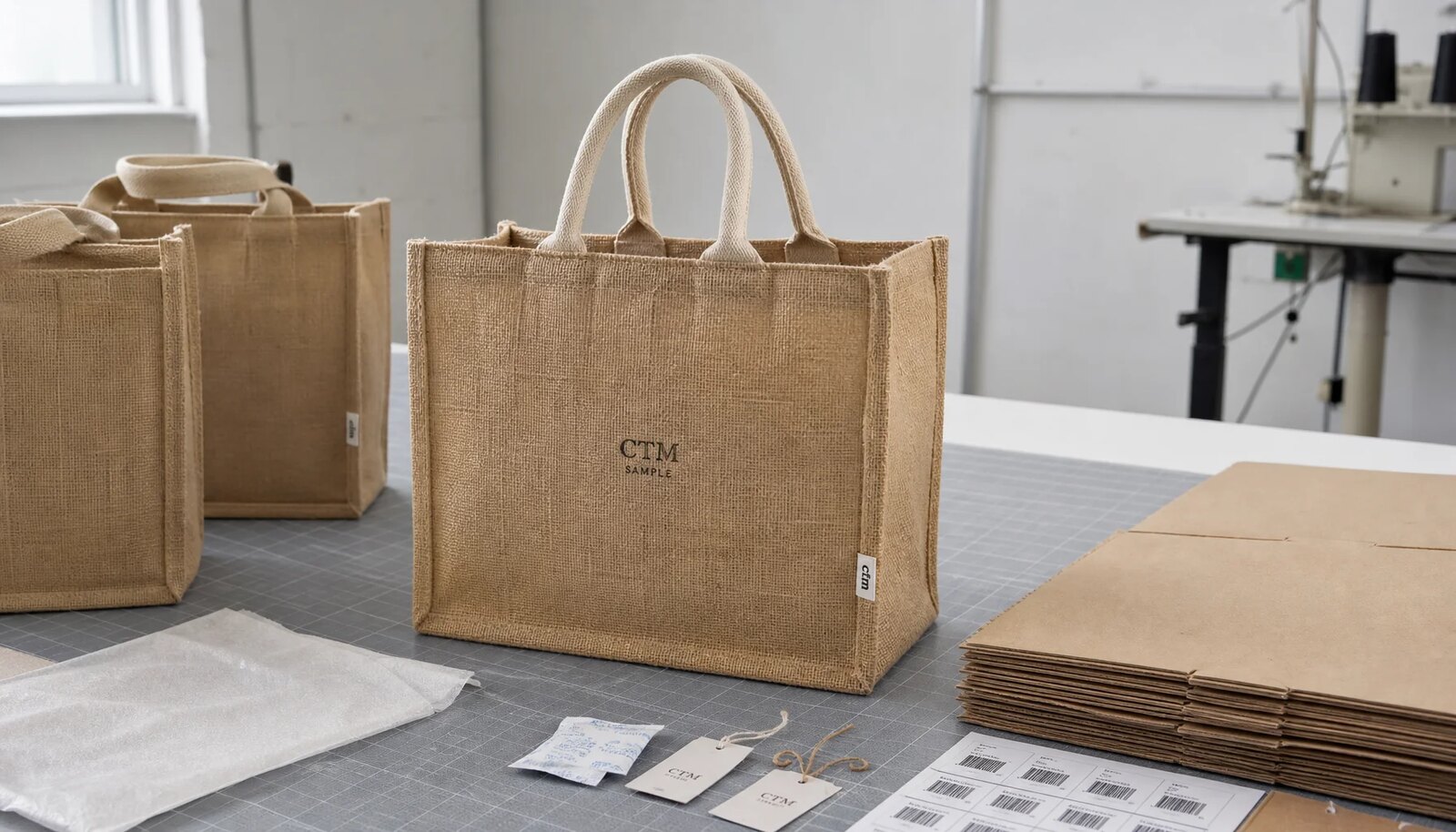
Start With the Hotel Retail Channel
A jute tote bags carton packing plan for hotel retail should begin with the way the buyer will sell, store, and replenish the item. A resort boutique that displays a small number of premium totes near the spa has different packing needs from a hotel group that allocates cartons across twenty properties. A conference hotel may treat the bag as a practical retail add-on near the front desk, while a beach resort may sell it as a destination souvenir. The same tote can pass artwork approval and still fail operationally if cartons arrive crushed, dusty, hard to count, or poorly marked.
Procurement normally needs three outcomes to work together. The tote must look sellable after unpacking, the carton must avoid unnecessary freight volume, and receiving staff must identify stock quickly. Jute is stiffer than cotton canvas and less forgiving after hard compression, especially when laminated, lined, or printed with a large solid logo. Fold direction, carton density, handle placement, carton strength, moisture protection, and carton labeling should be specified before the purchase order is released.
The channel also changes the acceptable trade-off between presentation and cost. Premium resort stores may accept fewer pieces per carton if bags arrive with fewer creases and can be placed directly on shelf. Backroom replenishment programs may prefer efficient flat packing if the approved carton test proves the bag recovers shape after 24 hours. Multi-property hotel groups often need inner packs of 5 or 10 pieces so a central warehouse can split inventory without opening and recounting every unit.
- For premium boutique retail, allow more carton space and use careful flat stacking, light shaping, or tissue only where the presentation value justifies the cost.
- For backroom replenishment, bulk flat packing can work if carton recovery, odor, print rub, and gusset shape are approved from a packed sample.
- For multi-property distribution, inner packs of 5 or 10 pieces reduce counting errors and simplify allocation by hotel, shop, or stockroom location.
- For gift-with-purchase or amenity retail, carton efficiency may matter more than shelf shape, but print rub, odor, stains, and unit count still need inspection.
- For central warehouse receiving, prioritize carton sequence, SKU visibility, barcode readability, consistent carton quantity, and destination information.
- For direct-to-property delivery, print destination marks clearly enough for non-specialist receiving staff to identify cartons when stacked.
Lock the Bag Spec Before Carton Math
Carton planning is unreliable when the bag specification is still moving. A natural 13 oz jute tote with cotton webbing handles and bound unlined seams packs differently from a 15 oz laminated jute tote with cotton lining, rope handles, hangtag, and barcode sticker. A small change in gusset width, handle bulk, lining thickness, or fold method can change carton count and carton weight. Procurement should treat carton quantity as the result of an approved construction, not as a generic factory number copied from a previous order.
A useful RFQ defines finished width, finished height, gusset, handle total length, handle drop, handle width, body fabric weight, lamination, lining, seam finish, label position, hangtag method, print position, and unit barcode requirement. For hotel retail, common jute body weights are around 13 oz to 15 oz, roughly 440 to 510 GSM depending on weave and supplier conversion. Heavier jute can improve standing structure, but it increases carton weight and may reduce pieces per carton. A tight, even weave may matter more than a high GSM number when the buyer wants a cleaner print surface and better shape recovery.
Measurement language should be precise. Finished bag size after stitching is more useful than cut-panel size. Handle drop should be measured from the top edge of the bag to the highest point of the relaxed handle. Gusset should be measured after the bag is opened and squared, not estimated from a folded side panel. If the hotel has shelf depth, fixture height, stockroom rack, or carton handling restrictions, those limits should be shared before the supplier proposes carton dimensions.
- Finished dimensions: specify width, height, and gusset after stitching, with tolerances for each measurement.
- Fabric: state natural jute, dyed jute, laminated jute, washed jute, or jute-cotton blend when appearance and hand feel are controlled.
- Interior: specify cotton lining, laminated inner surface, or bound seams for unlined bags, including acceptable seam tape color and trimming quality.
- Handles: define material, width, total length, handle drop, reinforcement stitch type, thread color, and whether handles may be folded inside the bag.
- Branding: include print size, print location, side label size, hangtag style, unit barcode placement, and country-of-origin marking if required.
- Packing dependency: require carton count to be recalculated after any change to body size, gusset, lining, handle, hangtag, or fold method.
Choose a Carton Count That Protects Shape
The cheapest carton plan is not always the lowest landed-cost plan. Overpacking jute totes can reduce the number of cartons on a quote sheet, but it can create compressed corners, cracked lamination, bent handles, print rub, and extra labor at the hotel store. If staff must reshape, wipe, separate, or reject bags before merchandising them, the carton plan has failed even if the freight cube looked efficient.
For many hotel retail jute tote orders, 40 to 80 pieces per export carton is a practical planning range. Small flat totes may fit more, while large gusseted totes with thick handles, lining, hangtags, or tissue support may need fewer pieces. The carton should be tight enough to prevent shifting during transit but not so tight that flaps must be forced closed. Forced closure is a warning sign because the pressure usually transfers to the top layer of bags.
The carton should be confirmed through an actual packed carton whenever possible. The supplier should record piece count, layer count, stack direction, handle orientation, gross weight, net weight, carton dimensions, and whether the carton bulges after sealing. Procurement can then calculate CBM per 1,000 pieces, compare freight impact, and check manual handling limits. If the carton exceeds the buyer's receiving policy, reducing pieces per carton may be less costly than causing warehouse handling issues.
Carton strength should match route and handling. A five-ply export carton is often safer for heavier jute totes, laminated constructions, sea freight, loose loading, or multi-touch distribution. If the buyer has a packaging standard, confirm bursting strength, edge crush test requirement, pallet height, and stack loading assumptions instead of relying on the phrase export carton alone.
- Keep carton gross weight within the buyer's receiving limit, often below 18 to 20 kg for manual handling unless palletized.
- Use five-ply cartons for heavier jute totes, lined constructions, long transit, humid routes, or loose container loading.
- Avoid placing rope handles or thick webbing so they create pressure ridges across printed panels.
- Record carton dimensions from an actual packed sample before final freight booking and landed-cost comparison.
- Do a 24-hour recovery review after unpacking to check creases, gusset shape, handle deformation, and print rub.
- Reject carton plans that require force to close the flaps or create visible carton bulging after sealing.
Match Folding to Retail Presentation
Jute bags can be packed flat, half-folded, nested, or lightly shaped. Flat packing is often better for printed front panels because it avoids a hard center crease, but it requires a carton footprint large enough to prevent corner curling. Half-folding improves carton cube and can reduce freight cost, yet it can leave a visible center line, especially on laminated jute or bags with large front artwork. Shaped packing with tissue or insert support creates a more polished first impression, but it increases labor, packing material, carton volume, and usually landed cost.
The buyer should approve the actual fold method, not just a loose sample. A strong approval includes a packed carton or smaller carton simulation using the final fold, stack direction, handle orientation, inner pack, liner, desiccant, hangtag, and carton label position. This is important for hotel stores because the tote is merchandise and brand presentation at the same time. Guests are less forgiving of crushed retail goods than they are of purely promotional packaging.
Fold direction should be documented with photos and simple packing instructions. If printed panels face each other, ink rub risk must be checked. If all handles stack in the same direction, one side of the carton may become bulky and bend the bag bodies. Alternating handle direction between layers can improve carton balance. For lined bags, the fold should not twist the lining or trap a lump at the gusset. For laminated bags, avoid sharp folds that whiten the laminate or create a permanent ridge.
- Flat pack is best for front-panel artwork, structured totes, and buyers who want fewer visible fold lines.
- Half-fold pack is acceptable only when the buyer approves the center crease after 24-hour unpacked recovery.
- Lightly shaped packing is useful for higher-priced retail bags displayed upright or sold as premium resort merchandise.
- Alternate handle direction between layers when handle bulk creates uneven pressure or carton bulging.
- Keep printed panels from rubbing against rough seams, hangtag strings, barcode stickers, or other printed panels during transit.
- Photograph the approved fold, layer count, handle direction, inner pack, and carton closure so bulk packers follow the same method.
Control Print and Branding Risk
A carton packing plan cannot rescue a weak print specification. Jute has an uneven surface, visible fiber, and natural shade variation. Fine lines, small letters, distressed artwork, and large solid ink blocks need careful sampling before bulk approval. For most hotel logos, destination graphics, and resort shop marks, screen printing is the practical method because it suits solid artwork and repeat production. Heat transfer can work for detailed multi-color graphics, but it must be tested for adhesion, edge lift, hand feel, and rub performance on the exact jute used in bulk.
Color approval must be realistic. Pantone colors printed on natural jute will not match the same colors printed on white paper or white cotton canvas. Navy, coral, red, green, and metallic tones may look muted because the fiber color shows through. The buyer should state whether a natural-fiber effect is acceptable or whether a white underbase is required. An underbase can improve color strength but adds cost, changes hand feel, and creates another production variable to control.
Print and packing decisions should be approved together. If the logo sits on a hard fold line, ink may crack, become glossy, or transfer under compression. If a large solid print faces the rough back of another bag, rub marks may appear in transit. If a hangtag or barcode label presses against the print, it can leave a pressure mark. The pre-production sample should include final artwork, final print method, final fold, final inner packing, and a rub review after the sample has been packed and reopened.
Private labels and hangtags need the same discipline as the main print. A woven side label should have agreed dimensions, fold type, seam position, and stitch alignment. Hangtags should specify paper weight, string or pin method, barcode format, retail price field if any, and placement. Unit barcodes should be tested for scan readability after packing, because curved tags, jute fiber dust, or low-contrast printing can create receiving and store scanning issues.
- Set a minimum line thickness before sampling; very thin strokes and small serif text often break on jute texture.
- Approve print from a physical sample under normal store lighting, not only from a digital mockup or flat artwork proof.
- Run dry rub and light wet rub checks before bulk production, especially for dark inks, heat transfers, and white underbases.
- Keep the print away from hard fold lines if the bag will be half-folded, tightly stacked, or compressed in cartons.
- Review large solid logos for pinholes, uneven absorption, fiber show-through, edge sharpness, and surface tack.
- Confirm whether extra screens, underbase printing, artwork cleanup, barcode labels, and hangtag application are included in the quote.
Build MOQ Around Material Reality
MOQ for jute tote bags is not one simple number. The practical minimum depends on available jute fabric, dyeing requirement, handle material, lining, print colors, woven labels, hangtags, barcode labels, carton marks, and packing versions. A supplier may accept a lower quantity for stock natural jute with one-color print, while the MOQ changes quickly when the buyer adds custom dyed fabric, custom webbing, printed lining, special labels, separated property cartons, or several retail SKUs.
Hotel retail programs often include related items: a large shopping tote, a smaller spa tote, a market tote, or two logo versions for different properties. MOQ should be discussed by shared material platform. If the same jute roll, handle webbing, lining, thread, label, hangtag, and carton label format can be used across sizes, the supplier may have more flexibility. Shared materials also reduce leftover stock and lower the risk of shade mismatch between repeat orders.
The quote should state whether MOQ is per design, per size, per color, per print, per label, per destination, or per shipment. A quotation that says 500 pieces may mean 500 pieces of a stock body, but not 500 pieces with custom handle color and five property-specific carton labels. Buyers should separate sampling minimums from bulk minimums and ask how extra production pieces are handled. For a trial launch, stock natural jute and standard handle colors may be the most practical route before moving to custom dyed materials.
- Separate MOQ for bag body, fabric color, handle webbing, lining, woven label, hangtag, barcode sticker, print, and carton mark.
- Clarify whether MOQ is per design, size, color, destination, or shipment because each interpretation changes the buy plan.
- Use common handle, lining, thread, label, and hangtag materials across SKUs to reduce leftover material and improve repeat consistency.
- Confirm whether carton marks can be separated by hotel property without increasing MOQ or creating mixed-SKU packing risk.
- For trial orders, consider stock natural jute and standard handle colors before custom dyed fabric or complex private label programs.
- Ask how overproduction, QC replacement pieces, and shortage allowances are allocated when the order is split across several properties.
Specify Inner Packing and Carton Labels
Inner packing affects cost, plastic use, receiving speed, cleanliness, and hotel sustainability rules. Bulk packing inside a carton liner is common for jute totes and keeps material use relatively low. Inner packs of 5 or 10 pieces make counting easier and help a hotel group allocate stock to several properties. Individual polybags are usually unnecessary for standard jute totes unless each unit requires scanning, dust protection for premium presentation, or direct distribution to stores without further handling.
Carton labels should be treated as part of the product specification. A hotel group warehouse may need PO number, SKU, item description, color, size, destination property, carton sequence, pieces per carton, gross weight, net weight, carton dimensions, country of origin, and barcode. A distributor may also need a customer item code, seasonal program name, department number, or mixed-carton warning. The supplier should send carton mark artwork for approval before printing or applying labels.
Buyers should decide whether mixed cartons are allowed. Mixed cartons may reduce leftover quantities at the end of production, but they create receiving complexity unless the label clearly lists all contents. For hotel retail, one SKU per carton is usually cleaner unless the buyer's warehouse has a defined mixed-carton process. If cartons ship to multiple hotels, destination should appear on at least two carton sides so cartons remain identifiable when stacked, palletized, or cross-docked.
Barcode handling should be separated into unit retail barcodes and logistics carton labels. A retail barcode belongs on the hangtag or unit label if stores scan the bag at point of sale. A logistics carton barcode belongs on the outer carton for warehouse receiving. Using the wrong barcode in the wrong place can create scanning errors, especially when cartons are received at a DC and later moved to a property store.
- Use one carton label layout for standard cartons and a separate layout for approved mixed cartons if mixed packing is allowed.
- Include carton sequence such as 1 of 25 so receiving teams can identify missing cartons quickly.
- State whether carton marks should be printed directly, applied by adhesive label, or both for high-volume receiving.
- Keep retail barcodes on hangtags or unit labels separate from logistics carton labels to avoid scanning errors.
- If cartons go to different properties, print destination clearly on at least two carton sides and avoid unexplained abbreviations.
- Confirm inner pack count, carton liner type, desiccant placement, plastic reduction rules, and carton label data in the purchase order.
Plan Moisture, Odor, and Storage Control
Jute is a natural fiber, so moisture control is a commercial requirement, not a nice extra. The risk is not only visible mold. Buyers may also receive complaints about musty odor, damp cartons, softened print, stained panels, rusty metal accessories if used, or bags that feel unpleasant when unpacked. A carton packing plan for jute tote bags should include warehouse storage, cured-print timing, clean carton use, liner type, desiccant method, and loading conditions.
Procurement should avoid vague wording such as dry packing. More useful wording requires bags to be packed in clean dry cartons, stored off the floor, kept away from wet walls and loading doors, protected from rain during loading, and shipped with suitable desiccant based on route and season. If bags are printed, ink and adhesive should cure before packing so odor is not trapped inside the carton liner. If laminated jute is used, odor should be checked after the bag has remained sealed in normal packing, not only when a loose sample is aired out in a showroom.
Odor review should be practical and repeatable. A sealed sample pack can be opened after 24 hours to check for musty, chemical, ink, adhesive, or damp fiber smell. This does not replace laboratory testing when a buyer requires it, but it catches common retail issues before shipment. Hotel retail should use a stricter threshold than industrial promotional packing because guests may handle the bag indoors, pack clothing inside it, or keep it in a hotel room.
Moisture controls should also cover final staging and container loading. Cartons should not sit directly on a damp floor while waiting for inspection or pickup. Loading should be protected during rain. Container condition should be checked for holes, heavy rust, wet floor, strong odor, and previous cargo contamination where the forwarder or factory controls loading. For long sea freight, carton desiccant and container desiccant may both be considered depending on route, season, and buyer standard.
- Use a carton liner when shipping natural jute during humid months, by sea freight, or to tropical hotel destinations.
- Do not pack freshly printed bags before ink, adhesive, or heat-transfer application has fully cured.
- Keep cartons off wet factory floors and away from exterior walls, open loading doors, and rain exposure.
- Record moisture readings when the order is sensitive, production is during humid season, or destination QC is strict.
- Reject strong musty, chemical, damp, adhesive, or ink odor during sample approval and pre-shipment inspection.
- Confirm whether desiccant is placed in cartons, in the container, or both, and who is responsible for each step.
Use Sample Approval as a Packing Test
A sample approval for hotel retail jute totes should cover more than size and logo placement. It should prove that the final packing method works. The best approach is to approve a pre-production sample set that includes the body fabric, handle, print, lining or seam binding, woven side label, hangtag, unit barcode if any, inner pack, fold method, carton label, liner, desiccant method, and at least one packed carton or carton simulation.
The sample should be reviewed against measurable criteria. Measure finished width, height, gusset, handle drop, print placement, label placement, stitch quality, lining behavior, odor, and recovery after packing. If the bag has cotton lining, check whether the lining twists, pulls, or bunches after folding. If the bag is laminated, check whether fold lines whiten, crack, or create a stiff ridge. If rope or thick webbing handles are used, check whether they leave pressure marks on adjacent panels.
Both buyer and supplier should keep reference samples. One loose approved sample helps verify construction and print. One sealed approved sample pack helps verify fold method, odor, label placement, inner packing, and recovery. Photos of layer direction, handle orientation, carton label position, and sealed carton condition should be included in the production file. Final inspection can then compare bulk cartons against the approved method instead of relying on verbal packing instructions.
For larger or repeat programs, a pilot carton is worth the time. The supplier can pack the proposed carton quantity, seal it, weigh it, photograph it, and reopen it after 24 hours. The buyer can review whether the top layer is crushed, whether the printed panels rubbed, whether the gussets recover, and whether the carton weight is practical. Any change made after this test should trigger a revised carton confirmation.
- Approve a shade band for natural jute instead of expecting every bag to match one perfect sample exactly.
- Measure three to five samples from the same trial run rather than only the best sample selected by the factory.
- Photograph the approved fold, layer direction, handle orientation, inner pack, liner, desiccant, and carton mark.
- Keep one sealed sample pack at the factory and one with the buyer for comparison during final inspection and first receipt.
- Do not release bulk production until artwork, material, construction, label, hangtag, barcode, and packing are signed off.
- Include a 24-hour packed recovery review so the buyer can judge creases, odor, print rub, and shelf readiness.
Inspect Cartons, Not Only Bags
Final inspection should include both product quality and packed-carton quality. A jute tote can pass loose-piece inspection but fail after cartons are opened at the hotel warehouse. Inspectors should check random finished bags for dimensions, handle strength, stitching, print, stains, loose fibers, odor, label placement, and barcode readability. They should also open packed cartons to verify piece count, inner pack count, liner use, desiccant placement, carton label accuracy, carton weight, and whether the packing method matches the approved reference.
Tolerance should be agreed before production. For standard tote sizes, width and height are commonly controlled within plus or minus 5 mm, while handle drop may use plus or minus 10 mm unless the buyer's fixture requires tighter control. Print placement tolerance should be stated from fixed seams, such as top edge and side seam. Jute is a natural, textured fabric, so small shade and fiber variations are normal, but stains, oil marks, mold, strong odor, broken stitches, loose handles, and unreadable barcodes should be treated as defects.
Carton sampling should cover the beginning, middle, and end of packing, especially when several SKUs or destinations are involved. Inspectors should compare actual contents to the carton label and packing list. If carton labels are printed before final quantity reconciliation, shortages or QC replacements can make the label wrong unless the supplier updates it. This detail matters for hotel retail because receiving teams often rely on carton labels to allocate inventory quickly.
The inspection plan should also address carton condition. Crushed corners, bulging sides, weak tape, wet marks, wrong carton sequence, missing origin mark, or inconsistent gross weights can signal larger problems. If cartons will be palletized, pallet pattern, corner protection, stretch wrap, and pallet height should be confirmed. If cartons will be loose loaded, carton strength and stack condition become more important.
- Check actual packed quantity against carton label, packing list, and PO quantity before cartons are sealed for shipment.
- Measure finished bag width, height, gusset, handle drop, print placement, and label placement from agreed reference points.
- Open packed cartons to inspect fold method, layer count, handle direction, liner use, desiccant placement, and top-layer compression.
- Scan unit barcodes and carton barcodes where required rather than only checking that a barcode is visually present.
- Review carton sequence, destination mark, SKU, color, size, gross weight, net weight, and country-of-origin information.
- Record carton gross weight and dimensions so freight booking, receiving limits, and landed-cost calculations match reality.
Specification comparison for buyers
| Spec decision | Recommended option | When it fits | Buyer risk to check |
|---|---|---|---|
| Jute body fabric | 13 oz to 15 oz natural jute, usually about 440 to 510 GSM depending on weave, yarn, and supplier conversion | Hotel gift shops, resort boutiques, spa retail, and destination stores where the tote must look structured after unpacking | GSM alone is not enough; confirm actual fabric weight, weave tightness, lamination status, shade range, panel squareness, and cut-panel weight checks |
| Construction | Laminated jute with cotton lining for premium retail, or unlined jute with bound inner seams for simpler programs | Lining suits higher ticket retail and cleaner interiors; bound unlined construction suits promotional retail, market totes, and lower price points | Lamination can whiten or crack on hard folds; unlined seams can shed fiber if seam tape, trimming, and stitch quality are weak |
| Handle specification | Cotton webbing handles, 38 to 45 mm wide, with reinforced box stitch or cross stitch at each attachment point | Daily-use hotel retail totes carrying robes, towels, books, spa products, bottled goods, snacks, or beach merchandise | Rope handles add bulk and can create carton pressure ridges; narrow webbing may twist or feel weak under retail loads |
| Print method | Screen print for solid logos and simple destination artwork; heat transfer only after adhesion, edge-lift, and rub testing | Most hotel marks, resort shop logos, property graphics, and one to three color retail artwork | Jute texture breaks fine detail; minimum line thickness, underbase needs, color shift on natural jute, and rub resistance must be approved physically |
| Carton count | 40 to 80 pieces per export carton as a planning range, adjusted after packed-carton testing | Most hotel retail replenishment orders where carton handling weight and unpacked appearance both matter | Overpacked cartons can crush handles, distort gussets, rub prints, and create unsellable creases even if freight cube looks efficient |
| Carton strength | Five-ply export carton for heavier, lined, laminated, or sea-freight orders; confirm bursting or edge-crush requirement if the buyer has a standard | Long transit, loose loading, humid routes, multi-touch distribution, or cartons over about 15 kg gross weight | Weak cartons may collapse in stacks; forced carton closure transfers pressure to the top layer of bags |
| Inner packing | Bulk pack inside a carton liner, or inner packs of 5 to 10 pieces when allocation and counting matter | Bulk pack reduces material and cost; inner packs help hotel groups split cartons by property, shop, or floor stock location | Too much individual plastic may conflict with sustainability policy; no liner increases dust, odor, and moisture exposure |
| Carton labeling | Outer mark with PO, SKU, item description, color, size, destination, carton number, quantity, gross weight, net weight, carton dimensions, origin, and barcode if required | Hotel group warehouses, retail DCs, distributors, mixed-SKU consolidation, and property-level allocations | Missing carton sequence, destination, size code, or scannable barcode can delay receiving and trigger manual recounts or chargebacks |
| MOQ logic | Confirm MOQ by body fabric, color, handle, lining, label, hangtag, print, carton mark, and destination split | Programs with one hotel brand but several sizes, colorways, properties, or retail barcode versions | A low bag MOQ may not include custom dyed jute, custom webbing, woven labels, separate carton marks, or efficient split packing |
Buyer checklist before sampling
- Define the retail format before quoting: flat stock for backroom refill, lightly folded bags for fixture replenishment, or shaped presentation for premium boutique display.
- State finished width, height, gusset, handle drop, handle width, fabric ounce weight or GSM, weave requirement, lamination, lining, seam finish, label position, and hangtag method.
- Provide vector artwork with Pantone references, maximum print area, placement from top and side seams, minimum line thickness, underbase requirement, and accepted color variation on natural jute.
- Set measurable tolerances: finished width and height, gusset, handle drop, print placement, label placement, carton quantity, carton weight, and carton dimensions.
- Specify carton plan requirements: pieces per carton, carton strength, maximum gross weight, inner pack count, carton liner, desiccant, carton label data, and palletization if needed.
- Require a pre-production sample that shows the exact fabric, handle, print, lining or seam binding, woven label, hangtag, barcode sticker, fold method, inner pack, and carton mark layout.
- Approve a packed carton or carton simulation by piece count, layer count, handle direction, fold method, carton weight, carton dimensions, closure condition, and 24-hour unpacked recovery.
- Include moisture requirements: cured print before packing, clean dry cartons, off-floor storage, carton liner, desiccant placement, rain-protected loading, and acceptable odor after sealed storage.
- Confirm whether cartons ship to one DC, several hotel properties, a distributor, or individual stores because this changes inner packs, destination marks, mixed-carton rules, and barcode needs.
- Set inspection thresholds for size, handle strength, seam finish, print adhesion, print placement, stains, loose fiber, odor, moisture, carton compression, carton labeling, and quantity accuracy.
Factory quote questions to send
- What jute ounce weight, GSM range, weave density, yarn quality, fabric finish, lamination status, and shade tolerance are included in the quoted price?
- Can you provide a cut-panel weight check, finished bag measurement report, and fabric photos before bulk stitching begins?
- Is the quoted construction laminated, cotton lined, unlined with bound seams, or unlined with overlocked seams, and how will that affect folding, fiber shedding, odor, and carton recovery?
- What handle material, width, length, drop, stitch pattern, thread, and reinforcement size are included, and what load test method can you perform on the approved sample?
- How many pieces fit per carton for our selected size, gusset, handle type, lining, fold method, hangtag, and liner, and what are the estimated carton dimensions, gross weight, net weight, and CBM?
- Will the bags be packed flat, half-folded, alternated by handle direction, nested, or shaped with tissue, and will the approved method be locked for bulk packing?
- Which print method is quoted, what is the maximum print area, what minimum line thickness do you recommend on this jute, and will you perform dry rub and light wet rub checks before bulk approval?
- What is the MOQ for the bag body, custom jute color, custom handle webbing, lining, woven side label, hangtag, barcode sticker, and printed carton mark if these are ordered together?
- Can you split carton marks by hotel property, SKU, or destination without mixing goods inside cartons or changing the production MOQ?
- How many extra pieces are normally produced for QC replacement, how are shortages handled before carton sealing, and will replacement pieces use the same labels, hangtags, and packing method?
Quality-control points to confirm
- Finished width and height should normally be controlled within plus or minus 5 mm for standard tote sizes, with gusset, handle drop, and panel squareness tolerances agreed before production.
- Handle drop should be measured from the top edge of the bag to the top of the relaxed handle; a typical tolerance is plus or minus 10 mm unless the retail fixture requires tighter control.
- Handle attachment should use reinforced stitching, preferably box stitch or cross stitch, with no skipped stitches, loose threads, weak backtacks, broken yarns, or misaligned reinforcement at load points.
- A practical handle pull check should be agreed before production, such as a static load test using a buyer-approved weight and hold time, because decorative approval alone does not prove retail use strength.
- Print placement should be measured from agreed seams with a ruler or jig, not judged by eye, because jute panels can shift during stitching and folding.
- Print adhesion should pass dry rub and light wet rub checks suited to jute texture before mass production, especially on large solid logos, dark inks, heat-transfer edges, and white underbases.
- Natural jute shade variation should be approved with a shade band or acceptable range; do not judge bulk against one unusually clean or light sample only.
- Odor should be reviewed after the bag stays sealed in its normal inner packing for at least 24 hours, because fresh ink, lamination, damp fiber, or carton materials may smell different after sealing.
- Carton compression should not create permanent corner creases, broken lamination, crushed handles, distorted gussets, rub marks on print, or deformed top-layer bags.
- Carton gross weight should stay within the buyer's manual handling limit, commonly below 18 to 20 kg unless cartons are palletized or handled by equipment.