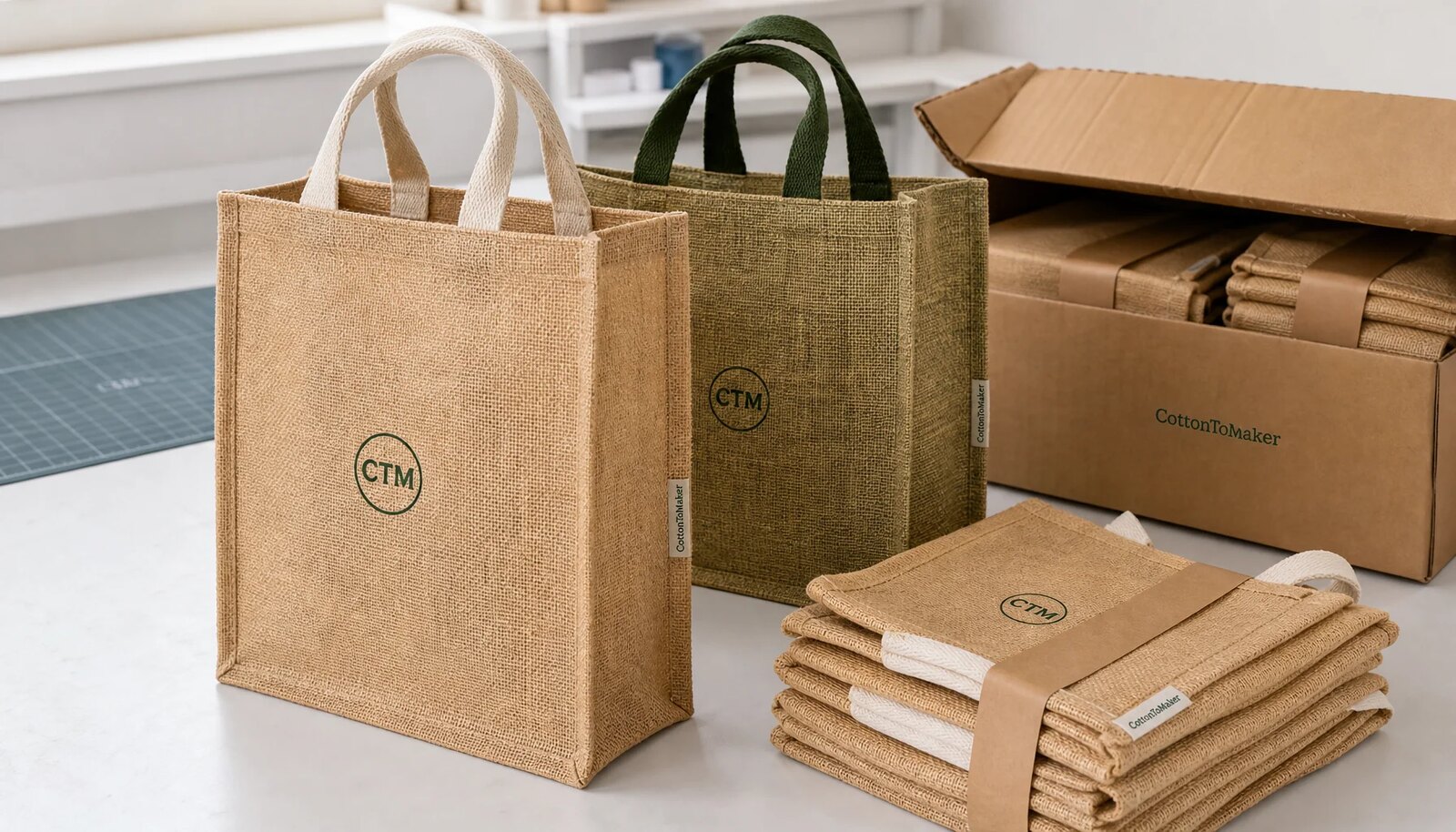
Make packing part of the product spec
For B2B craft fair orders, a jute tote bags carton packing plan is not a warehouse detail to solve at the end. It affects how the bags look when they reach a booth table, how fast staff can count inventory, how cartons are split between makers or event sites, and how much freight cube the buyer pays for. A sturdy, well-sewn jute tote can still arrive looking poor if the carton is overfilled, the handles press into the printed logo, or the carton softens after damp storage.
Craft fair programs often carry more moving parts than a simple promotional tote order. One PO may include sponsor logos, regional event marks, seasonal designs, booth allocations, and mixed delivery points. If the packing instruction only says standard export carton, the factory will usually choose the fastest workable method at origin. The buyer then absorbs the sorting time, dented print panels, mixed cartons, or carton quantities that do not match event distribution.
Treat packing data as formal PO data. The specification should state pieces per carton, pieces per inner bundle, folding method, handle direction, carton dimensions, gross weight limit, carton mark content, and moisture protection. These are not cosmetic preferences. They give the supplier a measurable target and give the final inspector a practical reference.
The best time to discuss carton packing is before sample approval. Once a bag is printed, laminated, folded, and stacked, its real bulk becomes clear. A packing plan approved only from a loose sample is still a guess.
- Put carton quantity, carton size, inner bundle count, and carton marks on the purchase order.
- Approve a packed sample or realistic carton simulation before mass packing.
- Control handle direction because handles are a common pressure point inside jute tote cartons.
- Separate print versions clearly by carton mark, inner label, or SKU code when several designs ship together.
- Plan carton weight around receiving and event handling, not only container loading efficiency.
Start with measurable bag construction
Carton quantity should be calculated from the finished bag, not from a category name. A 38 x 40 x 15 cm laminated jute tote with cotton webbing handles packs very differently from a flat unlaminated shopper or a lined tote with a zipper. Gusset depth, lamination stiffness, handle thickness, seam bulk, and print position all change stack height and compression risk.
For craft fair use, buyers often want a natural-looking tote that still stands neatly and carries retail goods such as candles, ceramics, soaps, packaged foods, books, or small textiles. A practical structured starting point is natural jute around 380-430 GSM before lamination, often described as 14 oz to 16 oz. This is not a universal rule, but it is a useful RFQ range when the bag needs more presence than a lightweight giveaway tote.
Lock the construction before asking the supplier to optimize the carton. If a supplier quotes 100 pcs/carton from an unprinted stock sample, the final printed laminated version may not fit without heavy compression. The safer sequence is construction sample, print strike-off, fold-and-stack test, packed-carton review, and then final carton approval.
Small changes can have a large packing effect. A wider cotton handle may make the tote more comfortable, but it can also create a ridge through every layer of the stack. A deeper gusset may help the bag stand at a booth, but it usually reduces the number of pieces that can be packed safely in one carton. Procurement should ask for the operational trade-off before approving the change.
- State finished width, height, gusset depth, handle drop, handle width, and size tolerance.
- Use the same jute, lamination, handle, thread, and print method for the pre-production sample whenever possible.
- Record finished sample weight so future production can be compared without relying only on stated GSM.
- Confirm whether the bag is designed to stand upright, fold flat, or prioritize lowest freight cube.
- Do not approve carton quantity until handle bulk and print placement are included in the packing test.
Balance GSM, lamination, and carton volume
Jute is bulkier and less uniform than cotton canvas or non-woven fabric. Two quotes can show the same finished size and the same pieces per carton yet produce very different packed cartons. One factory may use looser weave, heavier lamination, thicker handles, or wider seam allowances. The result appears later as carton bulging, higher CBM, crushed gussets, or visible pressure marks on the print.
Ask for jute weight in GSM or ounces and clarify whether the figure is before or after lamination. Some suppliers quote fabric weight before lamination because that is how raw jute is purchased. Others may describe the laminated composite. Without that detail, price comparisons can be misleading. Also ask for tolerance. Natural jute variation is normal, but bulk production should remain close enough to the approved sample to protect appearance and carton fit.
Lamination changes both presentation and packing. Inside PP lamination helps the bag stand, reduces loose fiber transfer, and gives a more wipeable interior. It also stiffens the bag and can increase carton cube. Outside lamination may support a smoother print surface, but it can reduce the natural look and should be checked for scratching. Unlaminated jute folds more softly and may pack flatter, but it offers less structure and can absorb moisture more quickly.
Moisture control starts before the carton is closed. A laminated tote can still smell musty if the jute was damp before lamination or if finished bags were packed too soon after sewing and printing. Ask how jute rolls are stored, how finished bags are aired, and whether cartons are kept off wet floors before loading. If the order will sit in storage before the fair season, carton liners or desiccant may be worth pricing as separate options.
- Inside lamination improves structure but may reduce pieces per carton.
- Unlaminated jute can lower stiffness and cube but may shed fibers and absorb moisture faster.
- Higher GSM improves body but raises gross weight and may require fewer pieces per carton.
- Ask for approved swatches and finished sample weight, not only material names.
- Include odor, dampness, and lamination adhesion checks in final inspection.
Protect print before carton packing
Most craft fair jute tote bags use simple branding: event names, maker-market logos, sponsor marks, or one to two color graphics. Screen printing is usually suitable for bold artwork, but natural jute has an uneven woven surface. Fine lines, small reversed type, tight registration, and large solid ink areas should be tested on actual production material, not on a smoother substitute fabric.
Print placement is tied directly to packing. If the logo crosses a hard bottom fold or sits under a handle lump, the print may arrive with dull areas, cracking, or pressure dents. A full-size artwork layout should show clearance from the bottom fold, gusset fold, side seam, upper seam, and handle attachment area. This matters even more on laminated jute because the surface is stiffer and fold memory can be more visible.
Curing and airing need a place in the production schedule. Bags packed too soon after printing may show ink transfer, blocking, tacky surfaces, odor, or flaking. The factory should confirm curing time for the chosen ink and print method, then run a rub check after curing. For larger solid prints, ask the factory to stack several printed samples in the approved fold direction overnight and inspect them the next day.
A printed strike-off should use the same jute and lamination planned for bulk. A print approved on substitute fabric does not prove that the final natural jute will hold the same edge detail, color appearance, or rub resistance. It also does not show how the print behaves when the actual bag is folded and packed.
- Use screen print for bold logos and limited colors; test heat transfer when artwork is detailed.
- Avoid placing logos across gusset folds, bottom folds, or handle pressure zones.
- Approve print color on natural jute because the base fabric changes the perceived shade.
- Run dry rub, light scratch, and stacked-sample checks after curing.
- Do not seal cartons while print surfaces are tacky or bags retain strong production odor.
Set carton quantity by use, not maximum fill
The highest possible pieces per carton is rarely the best procurement answer. Craft fair inventory may be handled by warehouse teams, event contractors, shop owners, temporary staff, or booth volunteers. A heavier carton can reduce carton count, but it can also create lifting problems, carton splitting, crushed lower layers, and repacking labor.
For many laminated jute tote projects, 50-100 pcs per export carton is a practical working range. A small flat tote may sit near the higher end. A larger gusseted tote with thick cotton handles may need fewer pieces to avoid bulging and pressure marks. The final number should be validated by stack height, carton closure, gross weight, and unpacked appearance.
Gross weight deserves a firm limit. Many receiving teams prefer cartons below 15-18 kg, although the right number depends on the buyer's warehouse rules and local handling practices. If the carton exceeds that range, ask whether the freight saving is worth the ergonomic and damage risk. Also check that the carton closes naturally. If workers must force down the flaps, the carton quantity is too aggressive even if the carton can be sealed.
Allocation can matter as much as cube. If each craft fair booth receives 50 bags, then 50-piece cartons may be simplest. If a central warehouse replenishes booths in tens, 10-piece bundles inside 100-piece cartons may be more efficient. If each maker receives 25 bags, the bundle plan should support that. A carton count that looks efficient in the factory can waste time at destination if every carton must be split and relabeled.
- Ask for pieces per carton, carton dimensions, net weight, gross weight, CBM, and board grade with the quote.
- Keep carton gross weight within the buyer's handling limit, commonly under 15-18 kg unless approved.
- Match carton and bundle quantities to booth, seller, or event allocation plans.
- Reject carton plans that require excessive compression to close flaps.
- Check unpacked bags for handle dents, print pressure marks, and distorted gussets.
Specify inner packing for fast receiving
Inner packing should match the way the bags will be counted, stored, and distributed. Individual polybags can support retail resale, item-level barcode scanning, and cleaner shelf presentation. They also add cost, packing time, plastic waste, and booth unpacking labor. For many craft fair programs, bundle packing is faster and more practical.
Ten pieces per bundle is a useful default because it is easy to count and easy to replenish during an event. Kraft bands work when the buyer wants less plastic and the moisture risk is controlled. Master poly bundles or a carton liner may be better for sea freight, humid storage, dusty event warehouses, or long pre-season inventory holding.
The packing instruction should be visual and specific. State whether the print faces up or down, whether all front panels face the same direction, whether handles are tucked inside the bag mouth or laid in one direction, whether gussets are flattened, and how many bundles sit in each layer. These details prevent random handle lumps that deform cartons and protect printed panels from concentrated pressure.
Label placement should also be defined. Some buyers need a barcode on each bag. Others only need bundle labels or carton labels. Adhesive labels may not stick cleanly to natural jute and can leave residue, so label method and position should be tested before bulk packing. If several designs share similar artwork, the label system should prevent mixing without requiring warehouse staff to open every carton.
- Use 10 pcs per bundle when fast counting and partial replenishment matter.
- Use individual polybags only when retail resale, barcode scanning, or cleanliness justifies the added work and cost.
- Choose kraft bands for lower-plastic bundle control when moisture risk is low.
- Use a master liner or poly bundle when dust, humidity, or long storage is expected.
- Include folded-bag, inner-bundle, open-carton, sealed-carton, and carton-mark photos in the approved reference set.
Build the RFQ around carton-efficient quantities
MOQ for jute tote bags is driven by more than sewing labor. It may depend on raw jute purchasing, lamination setup, cutting loss, handle sourcing, print screens, ink setup, thread color, label work, packing labor, and carton marks. A supplier may accept a low order quantity, but the unit price often rises when those setup costs are spread across fewer bags.
For craft fair orders, ask for MOQ per size, per artwork, per handle color, per lamination option, and per carton mark version. A factory may be comfortable producing 2,000 totes in one design but less efficient if the same quantity is split across eight sponsor logos. Each version can require strike-off approval, print setup, drying space, line separation, separate carton labels, and extra inspection attention.
Carton efficiency should be calculated before the PO is issued. If the approved carton holds 80 pcs and the buyer orders 1,000 pcs, the shipment becomes 12 full cartons and one 40-piece short carton. That may be acceptable, but it may complicate allocation. Ordering 960, 1,200, or another carton-friendly quantity can sometimes make warehouse distribution cleaner.
Price comparison should include packing surcharges. One quote may include kraft bands, carton liners, desiccant, stronger cartons, and pallet labels. Another quote may include only loose bulk packing in standard cartons. Separate the base unit price from setup, printing, packing, and export carton costs so the buyer can compare like for like.
When the event calendar is fixed, ask the supplier to show lead time by stage. Jute sourcing, lamination, cutting, printing, curing, sewing, trimming, airing, packing, inspection, and export handover all need time. A short quoted lead time is not helpful if it leaves no room for print curing or pre-shipment inspection.
- Request price breaks at carton-friendly quantities such as 500, 800, 960, 1,000, 1,200, and 2,000 pcs where relevant.
- Clarify MOQ by size, artwork, handle color, lamination, and carton mark version.
- Calculate full cartons and short cartons before releasing the PO.
- Avoid too many small print versions unless setup cost and mixing risk are acceptable.
- Ask whether sample charges, screen charges, packing upgrades, and palletization are included or separate.
Use samples and photos as QC references
A loose approval sample does not prove that the order will survive packing. The buyer needs to know how the jute tote behaves after folding, stacking, bundling, carton closure, and reopening. The sample process should cover construction, print, handle strength, lamination, odor, and packed presentation.
The pre-production sample should represent actual bulk materials. If substitute jute is used for sampling, the buyer should treat carton quantity as provisional. The same applies to handles. A change from narrow jute handles to thicker cotton webbing may improve comfort but reduce carton capacity and create new pressure points.
Ask the supplier for a packing photo set before the full order is sealed. The set should include one unfolded bag, one folded bag, one inner bundle, one loaded open carton, one closed carton, and one carton mark. These photos become practical inspection references and help the buyer's receiving team understand how goods should arrive.
Keep one sealed golden sample and one working inspection sample. The golden sample should represent approved size, print, handle, lamination, thread, label, and finishing. If the supplier later proposes a material or packing change because of availability, the change should be documented and approved before bulk production continues.
For remote approvals, ask for short videos as well as photos when needed. Opening a packed carton, removing bundles, and shaping a bag can reveal fold memory, handle dents, odor, and carton compression in a way still photos may not show.
- Measure width, height, gusset depth, handle drop, handle width, seam placement, and print placement on the sample.
- Load the sample with expected merchandise weight and check handle comfort and stitch security.
- Open and flatten the gusset several times to check lamination cracking or sharp edges.
- Stack printed samples overnight in the planned fold direction before approving bulk print.
- Use approved packing photos during final inspection to verify fold, handle direction, bundle count, and carton marks.
Write QC tolerances and defect rules clearly
Jute is a natural material, so some shade variation, slub texture, and weave irregularity are expected. That does not mean the buyer must accept stains, mildew, open seams, weak handles, or heavy print defects. The purchase order should separate normal material character from unacceptable defects.
Useful size tolerances are often around +/-5 mm for smaller flat totes and +/-8 mm for larger gusseted totes, unless the bag design requires another range. Handle drop should be controlled because even a small change can affect shoulder carry and carton stacking. Print placement should be measured from consistent reference points such as top seam, side seam, or panel centerline.
Classify defects before inspection. Critical defects may include mildew, unsafe sharp edges, strong chemical odor, wrong artwork, wrong carton mark, or severely weak handles. Major defects may include open seams, broken stitches, obvious print transfer, wrong bundle quantity, lamination peeling, large stains, or cartons too damaged for export. Minor defects may include small loose threads, slight shade variation within the approved range, or small natural slubs outside the print area.
Final inspection should open cartons, not only count sealed boxes. Inspectors should check bundle count, print condition after packing, odor inside the carton, handle position, carton liner use, carton mark accuracy, and gross weight. A carton that looks fine from the outside can still contain mixed designs or over-compressed bags.
If the order uses multiple designs, inspection should include version control. Check that artwork, inner labels, carton marks, and packing lists match. Mixed cartons create costly problems for craft fair distribution because the error may not be discovered until goods reach the event site.
- Define AQL level or sampling method before production is complete.
- Measure finished size, handle drop, print placement, and carton gross weight during inspection.
- Check dry rub, light scratch, lamination adhesion, seam strength, and handle attachment.
- Open cartons to verify bundle quantity, facing direction, fold method, and carton marks.
- Record photos of any stains, odor issues, wet cartons, print transfer, open seams, or carton deformation.
Compare landed cost, not only unit price
A low unit price can hide expensive packing decisions. If the quote does not include carton dimensions, CBM, gross weight, packing method, carton board grade, and mark requirements, procurement cannot estimate landed cost accurately. Freight, warehouse labor, pallet storage, relabeling, and event allocation can change the real cost per usable bag.
One supplier may quote lower by packing 120 pcs per carton with heavy compression and standard cartons. Another may quote slightly higher with 80 pcs per carton, cleaner 10-piece bundles, stronger board, and carton liners. The first option can look cheaper until cartons arrive overweight, prints show pressure marks, or staff must split mixed designs before the event.
Ask every supplier to quote the same RFQ specification. Include finished size, GSM, lamination, handle, print method, print area, inner packing, carton gross-weight target, carton marks, pallet requirements, and inspection expectations. If packing upgrades are optional, show them as separate lines so the buyer can decide with full cost visibility.
For larger craft fair programs, ask for pallet data as well: cartons per pallet, pallet height, pallet gross weight, pallet labels, stretch wrap, and corner protection. If the order ships to several event sites, carton marks should support allocation without opening cartons.
The strongest packing plan is easy to verify. A procurement file should contain the approved sample record, carton quantity, bundle count, carton size, gross weight, CBM, carton mark artwork, packing photos, and inspection checklist. With those items in place, the buyer can compare suppliers on real operating cost rather than only the first unit price on the quote sheet.
- Require FOB unit price, sample charge, screen charge, packing surcharge, carton data, estimated CBM, and lead time.
- Compare net weight and gross weight to spot hidden differences in fabric, handles, or carton board.
- Ask whether palletization, pallet labels, stretch wrap, and corner protection are included.
- Confirm whether carton liners, desiccants, barcodes, inserts, and bundle labels are included or extra.
- Use carton count and CBM to estimate freight cost before selecting the final supplier.
Specification comparison for buyers
| Packing decision | B2B recommendation | Useful target or tolerance | Buyer risk to verify |
|---|---|---|---|
| Finished bag size | Lock width x height x gusset before approving carton quantity | Typical craft fair tote range: 35-40 cm W x 35-42 cm H x 10-18 cm gusset; size tolerance often +/-5 mm to +/-8 mm depending on construction | A carton count based on a stock bag may fail after final gusset, lamination, handles, and print are added |
| Jute body weight | Quote by GSM or ounce weight and state whether the value is before or after lamination | Common structured range: about 380-430 GSM before lamination, often described as 14 oz to 16 oz jute | Low GSM may collapse after compression; high GSM may push CBM or gross weight beyond the buyer's receiving limit |
| Lamination | Use inside PP lamination when shape, wipeable interior, and reduced fiber transfer matter | Request lamination side, handfeel, thickness if available, and approved swatch reference | Heavy or poorly bonded lamination can crack at gussets, trap odor, increase carton cube, or create sharp interior edges |
| Handles | Specify cotton webbing or jute handles, handle width, handle drop, and stitch reinforcement | Common handle drop: 20-25 cm; common cotton webbing width: 2.5-4.0 cm; pull test should be agreed by buyer and supplier | Handle bulk is a frequent cause of carton bulging and print pressure marks; weak anchoring can fail before the bag body |
| Print method | Use screen print for bold 1-2 color artwork; test heat transfer for detailed artwork | Require strike-off on actual production jute and rub check after curing and stacking | Fine lines, small reversed text, large solids, and tight registration are risky on uneven jute texture |
| Print position | Keep artwork clear of bottom folds, gusset folds, upper seams, and handle pressure zones | Use a full-size artwork placement template and approve on a made-up sample | Print may crack, dull, block, or show handle dents if placed where the bag is folded or compressed |
| Inner bundle | Use countable bundles aligned to event allocation | 10 pcs per bundle is common; 25 pcs or 50 pcs may fit distribution plans if not too compressed | Random handle direction or mixed facing direction slows receiving and can deform cartons |
| Master carton quantity | Confirm by packed sample or carton simulation, not by guesswork | Many laminated jute totes land around 50-100 pcs/carton; gross weight is often best kept under 15-18 kg unless approved | Overfilled cartons can crush prints, retain fold memory, arrive overweight, or fail during stacking |
| Carton specification | Quote carton dimensions, board grade, net weight, gross weight, CBM, marks, and pallet suggestion | Use export-grade corrugated cartons matched to route, stacking, and gross weight; confirm closure without force | A low unit price can hide weak cartons, high freight cube, mixed marks, or manual repacking at destination |
Buyer checklist before sampling
- State finished size as width, height, gusset depth, handle drop, handle width, and acceptable tolerance before requesting carton optimization.
- Define jute GSM or ounce weight, whether it is measured before or after lamination, allowed material tolerance, lamination side, and approved swatch reference.
- Specify handle material, handle color, webbing width, handle drop, thread color, stitch pattern, reinforcement method, and agreed handle pull-test requirement.
- Approve a printed pre-production sample made with the same jute, lamination, handle, thread, and printing method intended for bulk production.
- Check print placement against bottom folds, side gussets, upper seam, and handle pressure points before mass printing begins.
- Confirm curing and airing time after printing so bags are not packed with wet ink, tacky print surfaces, or trapped production odor.
- Set exact inner packing rules: pieces per bundle, fold method, print facing direction, handle position, kraft band or poly bundle, bundle label, carton liner, and barcode placement if required.
- Keep carton gross weight within the warehouse handling range, commonly under 15-18 kg unless the buyer's receiving team approves a heavier carton.
- Require every quote to include pieces per carton, carton dimensions, net weight, gross weight, CBM, carton board grade, carton mark layout, and pallet suggestion if applicable.
- Match carton quantity and bundle quantity to the craft fair allocation plan so receiving teams do not need to split every carton manually.
Factory quote questions to send
- What jute weight are you quoting in GSM or ounces, is that before or after lamination, and what tolerance will you control in bulk production?
- What finished bag size, gusset depth, handle drop, handle width, thread color, and reinforcement stitch are included in the quoted price?
- Is the bag laminated inside, laminated outside, or unlaminated, and can you provide the lamination handfeel, thickness if available, and approved material swatch?
- Which print method is included, how many colors are included, what maximum print area is safe on this jute, and what limitations apply to fine lines, reversed text, or large solids?
- Will you provide a printed strike-off on actual production jute before mass printing, and how long will curing and airing take before packing?
- What MOQ applies per size, per artwork, per handle color, per lamination option, and per carton mark version?
- How many pieces fit in one export carton for this exact approved bag, and what are the carton dimensions, net weight, gross weight, CBM, board grade, and closure method?
- How will handles be folded or positioned inside each bundle and carton to prevent print pressure marks, carton bulging, and uneven stack height?
- What inner packing is included by default, and what is the extra cost for individual polybags, kraft bands, bundle labels, barcode labels, carton liners, desiccant, stronger cartons, or palletization?
- What lead time applies after sample approval and deposit, including jute sourcing, lamination, cutting, printing, curing, sewing, trimming, airing, packing, inspection, and export handover?
Quality-control points to confirm
- Finished size should normally be controlled within +/-5 mm for smaller flat totes and +/-8 mm for larger gusseted totes unless the approved sample or PO states another tolerance.
- Jute panels should be checked against the approved swatch for shade, GSM, weave openness, large slubs, holes, oil marks, mildew spots, and strong damp or chemical odor.
- If cutting swatches is not practical at final inspection, compare finished bag weight against the approved sample and investigate large weight differences before accepting bulk goods.
- Screen print should pass dry rub and light scratch checks after curing, with no major ink transfer, blocking, flaking, or cracking along normal fold lines.
- Artwork placement should match the approved layout for centering, print size, color, and clearance from seams, gusset folds, bottom folds, and handle pressure points.
- Handle attachment should use the agreed stitch pattern, stitch length, back-tacking, thread color, reinforcement location, and pull-test load agreed for the order.
- Lamination should not bubble, peel, delaminate, crack at gusset folds, create sharp interior edges, or separate when the bag is opened and flattened repeatedly.
- Sewing should be checked for skipped stitches, open seams, uneven gussets, loose threads, raw edges, needle damage, and weak corners where load stress concentrates.
- Finished bags should be opened and shaped after unpacking to confirm that carton compression has not left unacceptable fold memory, handle dents, or distorted gussets.
- Inner bundles should contain the exact agreed quantity, facing direction, fold style, handle position, bundle material, label placement, and barcode placement shown in the approved reference photos.