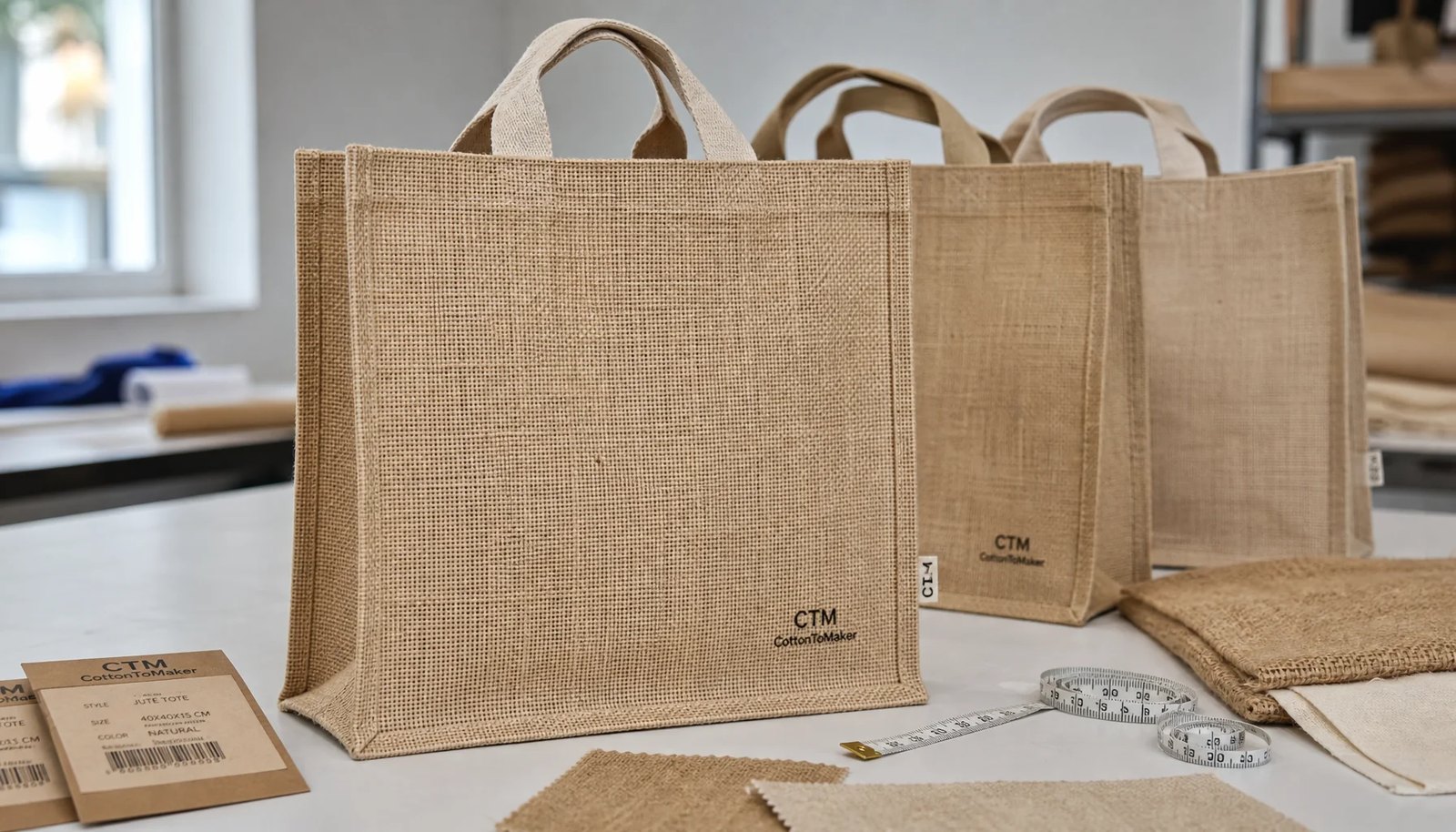
Begin With the Bookstore Job, Not the Lowest Bag Price
A university bookstore should not buy jute tote bags as if every tote does the same job. One order may be a low-cost checkout upgrade. Another may be a textbook carrier, an apparel gift bag, a premium alumni item, or an orientation tote packed with folders, coupons, and department materials. The outside description can sound identical, yet the right specification changes quickly: size, gusset, fabric weight, handle drop, reinforcement, print method, carton plan, sample timing, and price target all move with the use case.
Start by writing the promise made to the student, parent, alumni buyer, or campus department. If the tote is sold as reusable campus gear, it should carry dense items such as textbooks, notebooks, a water bottle, and apparel without handle tearing or bottom seam distortion. If it is a gift-with-purchase bag, presentation, print sharpness, and carton recovery may matter more than maximum load. If it supports orientation, the bag has to survive pre-packing, pallet moves, stacking, event distribution, and a long day outdoors or in crowded campus buildings.
Procurement also needs to separate the internal customer. Admissions, athletics, alumni relations, sustainability offices, and academic departments may all buy through the bookstore, but they do not value the same details. Admissions usually cares about a fixed event date. Alumni teams may need licensed marks and a cleaner retail finish. The bookstore needs landed cost, margin, storage, and replenishment discipline. A practical jute tote bags bulk pricing plan for university bookstores often uses one standard tote, one premium tote, and clear rules for approved artwork variations before suppliers quote.
- For checkout programs, prioritize replenishment speed, simple artwork, carton handling, and predictable landed cost.
- For bookstore resale, prioritize clean seams, shelf appearance, UPC labeling, logo placement, and retail margin after freight and handling.
- For orientation kits, prioritize load performance, event-date delivery, pre-packing efficiency, and carton marks by destination.
- For alumni merchandise, prioritize brand approval, gift-ready presentation, stronger handles, and a price point that supports the upgraded spec.
- For multi-department buying, limit SKU variation until each department commits quantities and artwork versions in writing.
Turn Jute Fabric Into a Measurable Specification
Most quote gaps begin with the fabric line. Suppliers may call jute standard, heavy, premium, natural, burlap, laminated, or export grade. Those words are useful for conversation, but not enough for purchasing. Ask for GSM, ounce range, weave description, and a physical swatch. For many bookstore totes, a medium to medium-heavy jute construction is a sensible starting point; commercial tote fabrics are often discussed around 270-340 GSM or roughly 10-12 oz, while heavier retail styles may go higher depending on weave and lamination. The final choice should be approved by swatch and sample, not by a label in a quote sheet.
Unlaminated jute gives the raw texture many buyers want. It feels natural, looks simple, and can support eco-oriented messaging when the wording is accurate. It also sheds more fiber, absorbs moisture more readily, and may wrinkle or lose shape in cartons. Internally laminated jute, commonly with a light PP film on the inside face, gives the tote more stiffness, better wipeability, and a stronger display shape. That same film changes hand feel, crease recovery, edge trimming, and sustainability language. If the quote does not state lamination, the price is not comparable.
Natural jute is not visually uniform. Shade, yarn thickness, slubs, darker fibers, and surface texture will vary. That variation is normal, but the buyer has to define the acceptable range. A campus brand team may approve a navy logo on one natural jute sample and later dislike bulk production because the background looks greener, darker, or more uneven. The safest control is simple: sign the approved sample, attach the approved swatch, and require a new swatch if the factory changes jute source, season, lamination, or dye lot.
- Specify jute by GSM, ounce range, weave, finish, or signed swatch; do not let premium or thick stand alone in the RFQ.
- State the finish exactly: unlaminated, internally laminated, externally laminated, both-side laminated, cotton-panel combined, or structured with a base insert.
- Approve acceptable slubs, shade variation, fiber shedding, stiffness, wrinkles, and odor before fabric is cut.
- Ask whether heavier fabric changes MOQ, cutting yield, sewing speed, carton quantity, gross weight, or lead time.
- Keep a signed swatch with the approved sample so reorders can be checked against the same standard.
Size the Tote Around Real Campus Contents
Finished size should be written as width x height x gusset, with centimeters or inches clearly stated. Also state when and how the bag is measured. For sewn totes, measurement is usually taken flat, empty, and before packing. A common bookstore tote may sit near 38 x 42 x 10 cm, but there is no universal campus standard. A folder-oriented admissions tote may need a wide opening and stable gusset. A premium retail tote may need more structure and a base that looks good on a shelf. A checkout tote may need a size that fits common purchases while still packing efficiently in cartons.
Gusset depth deserves real attention. A flat bag can look generous in a mockup and still handle textbooks, drinkware, or apparel poorly. An 8-12 cm gusset is often useful for bookstore programs, although the right number depends on the contents and price target. Larger gussets improve capacity but increase fabric consumption, carton cube, shelf footprint, and sometimes freight cost. Review the bottom construction on a physical sample. Dense books stress gusset corners and bottom seams more than lightweight giveaways.
Tolerances keep inspection fair. For jute totes, a finished-size tolerance around +/-1 cm is often practical for width, height, and gusset unless the buyer needs tighter control and the factory agrees. Print placement should usually be tighter, often around +/-5 mm to +/-10 mm depending on panel consistency and artwork size. These tolerances are not decorative paperwork. They tell the supplier, buyer, and inspector where normal sewing variation ends and a defect begins.
- State finished width, height, and gusset, and identify whether the measurement is taken flat, empty, and before packing.
- Use enough gusset for the intended load; flat totes are often weak choices for textbooks, bottles, and apparel bundles.
- Set a default sewn tolerance such as +/-1 cm for finished dimensions unless the factory agrees to tighter control.
- Measure print position from top edge, side seam, and centerline so inspection does not rely on visual opinion.
- Confirm that the chosen size works for bookstore shelving, checkout counters, storage space, and carton handling.
Specify Handles Before They Become the Failure Point
Handles are not a minor trim item for university bookstores. Books are compact and heavy, so a tote can look fine empty and still fail once it carries two textbooks, a hoodie, and a bottle. Cotton webbing handles are often preferred for bookstore merchandise because they feel cleaner, carry more comfortably, and can coordinate with school colors. Practical widths commonly fall around 2.5-3.8 cm, with wider handles used for premium or larger totes.
The RFQ should separate total handle length from usable handle drop. Total length is the strap length before sewing. Drop is the distance from the top edge of the bag to the top of the handle loop. A short hand-carry drop may work for a small gift bag, but a reusable campus tote usually needs shoulder-carry comfort. Approve the drop on a filled sample, not a flat sample alone. A loaded bag sits lower, pulls differently, and exposes weak handle placement faster.
Reinforcement belongs in the written spec. Box stitching, cross stitching, or bar-tack reinforcement at each attachment point is more dependable for dense contents than a simple straight stitch. State thread color, stitch type, handle placement from side seams, and whether the handle extends down the front and back panels for extra strength. Add a load test to the purchase order. For textbook-oriented totes, 8-10 kg held for 30 minutes or a defined carry-cycle test is a useful starting point, adjusted to the claim and product size.
- Specify handle material, width, total length, usable drop, color, placement, thread, and reinforcement stitch type.
- Approve shoulder-carry comfort on a filled sample instead of relying only on flat handle measurements.
- Require reinforced stitching at each handle attachment point and inspect skipped stitches, loose threads, and fraying.
- Ask the supplier for a recommended safe carrying weight and write the agreed load test into the purchase order.
- Avoid reducing handle width or reinforcement to save a few cents when the tote is sold as reusable campus merchandise.
Match Decoration to University Artwork Reality
Spot-color screen printing is usually the most economical decoration method for bulk jute tote bags. It works well for bold campus names, simple mascots, slogans, large block lettering, and one- to three-color designs. The challenge is the surface. Jute is coarse, uneven, and absorbent compared with paper or smooth cotton canvas. Fine serif text, thin rules, small seals, gradients, and tight multi-color registration can lose detail. A digital mockup helps with scale and placement, but it cannot prove ink absorption, edge sharpness, color shift, or rub resistance.
Official university marks need a careful approval path. Send vector artwork, Pantone or brand references, print dimensions, clear-space rules, logo file name, and licensing notes with the RFQ. If the artwork includes crests, seals, fine lines, small text, or multiple colors, require a strike-off on the same jute intended for production. If the brand office must approve the product, build that review into the calendar before bulk fabric is cut or screens are finalized.
When the artwork is too detailed for direct print, move the discussion early to a sewn cotton canvas patch, woven label, heat transfer patch, embroidery patch, hangtag, or simplified approved mark. These choices carry different costs. A sewn patch adds fabric, cutting, decoration, sewing labor, placement tolerance, and sometimes a separate MOQ. A woven label can preserve detail but may be too small for a large front-panel statement. A heat transfer can improve detail but must be tested for adhesion and hand feel on the chosen surface. Choose the method before comparing prices.
- Use direct screen print for bold one- to three-color logos, large text, and simple bookstore graphics.
- Require strike-offs for official crests, fine text, detailed mascot art, multi-color registration, or strict brand approval.
- Separate screen charges, setup fees, artwork revisions, extra-color charges, and larger print-area charges from unit price.
- Set print placement tolerance, commonly +/-5 mm to +/-10 mm depending on tote construction and artwork size.
- Use patches or labels when brand detail matters more than the lowest decoration cost.
Build Quantity Breaks Around Demand and MOQ Drivers
MOQ is not just a supplier preference. It is shaped by jute purchasing, handle color availability, cutting yield, lamination, sewing setup, screen printing setup, label production, carton packing, and export handling. A standard natural jute tote with stock handles and a one-color print may have more flexible minimums. A custom-dyed handle, unusual gusset, heavier laminated body, sewn patch, or several artwork versions can raise the minimum because the factory is running multiple small jobs inside one order.
University bookstores should ask for quantity breaks that match real buying decisions. Useful breaks include a pilot quantity, semester quantity, back-to-school quantity, annual quantity, and reorder quantity. A new design may justify a smaller first run even when the unit price is higher, because unsold totes consume cash, shelf space, and backroom storage. A proven core tote may justify a larger order if sell-through history supports it and the bookstore has safe storage.
The best quote explains which pieces drive MOQ. The bag body may carry one minimum, custom handles another, woven labels another, and department-specific carton marks another. This gives procurement better negotiating options. Instead of pushing every supplier to cut price, the buyer can standardize handle color, combine department quantities, reduce artwork versions, or postpone premium packing until demand is proven.
- Request pilot, semester, back-to-school, annual, and reorder quantity breaks instead of one vague bulk number.
- Ask which MOQ applies to fabric, handle color, lamination, print screens, patches, labels, hangtags, and packing rules.
- Limit first-run SKU variation until departments commit quantities and artwork versions before production.
- Confirm whether unchanged reorders reduce setup charges or whether screens and color matching expire after a period.
- Use sell-through data before adding new colors, sizes, premium finishes, or department-specific versions.
Compare Landed Cost, Not Just FOB Unit Price
A jute tote quote is comparable only when the cost drivers are visible. Product variables include fabric weight, lamination, finished size, gusset depth, handle material, handle width, handle drop, reinforcement, print method, number of colors, print area, patch or label requirements, hangtags, packing method, carton density, and quantity. A cheaper line item may simply mean lighter jute, narrower handles, less stitching, smaller artwork, fewer labels, or aggressive compression.
Ask suppliers to separate base unit price, sample cost, strike-off cost, screen or setup charges, label charges, hangtags, retail packaging, export cartons, inspection allowance, Incoterms, payment terms, lead time, and quote validity. Carton data is especially important. Jute totes are bulky relative to unit value, so pieces per carton, carton dimensions, net weight, and gross weight can change landed cost meaningfully. A tote that looks cheaper FOB may cost more delivered if the carton plan wastes space.
Bookstore margin should be calculated at landed cost. Include freight, insurance if used, customs duty, brokerage, port or terminal charges, inland trucking, warehouse handling, receiving labor, relabeling, damage allowance, storage, and campus redistribution. If buying through an importer or distributor, ask what is included in delivered pricing and what assumptions apply. The goal is not to force every supplier into the lowest number. The goal is to understand why prices differ and which specification supports the retail plan.
- Compare quotes only after matching fabric, size, gusset, handle, reinforcement, lamination, artwork, labels, packing, and tolerance.
- Require pieces per carton, carton dimensions, net weight, gross weight, and packing method with every serious quote.
- Separate one-time costs such as samples, screens, strike-offs, and labels from repeat-order unit price.
- Confirm Incoterms, payment terms, quote validity, lead time trigger, and charges excluded from the quoted price.
- Record the final agreed specification in the purchase order to prevent quiet substitutions after price negotiation.
Approve Samples With Written Acceptance Criteria
The sample stage should prove the construction, decoration, and packing plan. It is not only a photo opportunity. A pre-production sample should confirm jute swatch, lamination, finished size, gusset, handle comfort, reinforcement, seam quality, print clarity, odor level, labeling, and carton recovery. The approved sample should be signed, dated, photographed, and retained by both buyer and factory. If the sample is not made with production-intended materials, it should not be treated as final approval.
For branded university merchandise, sample approval should include artwork file name, Pantone or brand reference, print dimensions, print position, clear space, and licensing approval if required. A physical strike-off matters because jute changes how ink looks. Navy, black, maroon, and forest green can shift on natural jute compared with coated paper, cotton, or a screen proof. If the brand office changes art after sample approval, the supplier should requote screens, setup, patch work, and added lead time.
Functional checks should happen before bulk cutting. Fill the tote with realistic contents and carry it by hand and shoulder. Afterward, inspect handle attachments, bottom seam, gusset corners, and side seams. Rub the cured print with a dry white cloth and a slightly damp white cloth. Open a packed sample after compression if the factory plans tight cartons. These are simple checks, but they catch expensive problems while the specification can still be corrected.
- Approve a physical pre-production sample made with production-intended jute, lamination, handles, decoration, labels, and packing.
- Measure finished size, gusset, handle drop, handle spacing, and print position against written tolerances.
- Run the agreed load test and inspect seams, gusset corners, and handle attachments after the test.
- Keep one signed sample with the bookstore or procurement office and one matching sample at the factory.
- Document approved natural variation in jute shade, slubs, odor, print texture, and minor fiber irregularities.
Use Inspection Standards Fit for Retail Merchandise
Final inspection should be based on agreed standards, not subjective comments after cartons arrive. Many B2B buyers use AQL sampling for sewn products; a common starting point is general inspection level II with AQL 2.5 for major defects and 4.0 for minor defects, adjusted for order value and risk. Critical defects should have zero tolerance. For bookstore totes, critical issues may include mildew, wrong university logo, unsafe sharp lamination edges, severe chemical odor, or handle failure during the agreed load test.
Major defects affect saleability or use. Examples include wrong size outside tolerance, weak handles, open seams, severe stains, badly misaligned print, heavy ink transfer, wrong label, incorrect carton quantity, or unacceptable lamination peeling. Minor defects may include small loose threads, minor shade variation within the approved range, small slubs, or slight print texture that is normal for jute. Attach the defect definitions to the purchase order or inspection booking so everyone uses the same standard.
QC should cover the bag and the packing. Inspectors should measure bags flat, compare fabric to the approved swatch, confirm handle drop, run load testing on sampled pieces, rub test the print, check labels and hangtags, and open cartons to assess odor and compression. Cartons should show correct count, SKU, purchase order number, destination, gross weight, and carton sequence. If several campus departments share the order, mixed or poorly marked cartons can become a receiving problem even when the totes pass inspection.
- Define critical, major, and minor defects before inspection so pass-fail decisions are objective.
- Use AQL sampling appropriate to the risk; general level II with AQL 2.5 major and 4.0 minor is a common starting point.
- Treat mildew, wrong logo, failed load test, unsafe edges, and severe odor as critical or shipment-hold issues.
- Inspect product measurements, fabric, lamination, handles, seams, print, labels, odor, carton count, and carton marks.
- Reserve time for corrective action before shipment instead of discovering defects after import or campus delivery.
Control Packing, Carton Marks, and Receiving Labor
Packing affects freight cost, retail appearance, and the workload at receiving. Jute totes may be packed flat, folded once, nested, or lightly compressed. Too much compression can crease laminated jute, distort gussets, bend handles, and make the bags look tired on the sales floor. Too little compression increases carton count and freight cost. Ask the supplier for proposed pieces per carton, carton dimensions, net weight, gross weight, and packing photos before shipment.
University bookstore receiving often happens during seasonal pressure, especially before orientation, back-to-school, graduation, and alumni weekends. Cartons that are too heavy, poorly labeled, or mixed by SKU slow down receiving and increase errors. A useful carton label includes purchase order number, SKU, artwork version, quantity per carton, carton number, total carton count, destination code, country of origin marking if required, and barcode if the bookstore uses one. For multi-campus or department orders, destination carton marks should be finalized before packing starts.
Retail presentation should be included in the RFQ, not added after price approval. Some jute totes can ship bulk packed with no individual packaging. Others need a hangtag, UPC sticker, price label, belly band, insert card, or individual polybag. Each choice affects labor, cost, sustainability messaging, and carton density. If the bookstore wants to avoid individual plastic, specify the alternative protection and labeling method. If the tote will be sold online or shipped individually, it may need stronger presentation and protection than in-store shelf stock.
- Approve packing method: flat, folded, nested, compressed, individually packed, or bulk packed by SKU.
- Set carton weights that receiving staff can lift repeatedly; bulky totes should not be packed only for maximum factory efficiency.
- Define hangtags, UPC labels, retail price stickers, inserts, belly bands, and polybag rules before suppliers quote.
- Use destination-specific carton marks for split shipments, multi-campus programs, departments, or distributor deliveries.
- Request packing photos and carton label photos before shipment, then match them against the purchase order.
Specification comparison for buyers
| Procurement decision | Typical B2B specification | Best fit for university bookstores | Quote and QC risk to control |
|---|---|---|---|
| Core retail tote | Finished size about 38 x 42 x 10 cm, natural jute body, 2.5-3.8 cm cotton webbing handles, one- or two-color screen print | Bookstore resale, checkout upgrade bags, student merchandise, alumni weekend tables, and repeat semester stock | Low quotes may use lighter fabric, short hand-carry handles, weak reinforcement, smaller print area, or tight packing that creases the tote |
| Premium bookstore tote | Heavier jute or structured laminated body, wider handles, sewn cotton patch or cleaner label, hangtag or UPC, controlled retail packing | Graduation, alumni gifts, donor merchandise, higher retail price points, and bundled apparel programs | Higher fabric weight, patch sewing, labeling, and lower carton density increase MOQ, lead time, landed cost, and retail price pressure |
| Orientation or admissions tote | Durable gusseted tote sized for folders, apparel, water bottle, and printed materials; cartons marked by event or distribution point | Orientation kits, admitted-student days, departmental welcome packs, campus tours, and sponsor-supported giveaways | Fixed event dates require earlier sample approval, destination carton marks, load testing, and allowance for packing and campus redistribution |
| Factory-direct custom order | Custom size, gusset, handle color, logo placement, carton labels, inspection criteria, and repeat-order file maintained by factory | Planned back-to-school or annual bookstore buys with known artwork and enough time for sampling and import | Requires complete RFQ data, written tolerances, signed sample approval, and clear Incoterms; vague specs make supplier prices impossible to compare |
| Importer-managed custom order | Overseas production with local invoicing, duty handling, warehousing, compliance assistance, or consolidated deliveries | Bookstores, buying groups, or distributors that want custom production without managing import operations directly | Importer margin is included; buyer should still request factory-level spec, carton quantity, carton dimensions, gross weight, inspection plan, and what charges are included |
| Distributor-held blank stock | Stock natural jute tote decorated locally by screen print, transfer, patch, or tag | Rush top-ups, small department quantities, uncertain first-year demand, and events too close for custom production | Higher unit cost, limited size and handle choices, batch-to-batch stock variation, and possible decoration limits on coarse or laminated jute |
| Unlaminated natural jute | Raw jute look, no PP film, softer structure, visible fiber texture, more natural hand feel | Eco-oriented retail messaging, simple gift packaging, and designs that accept natural slubs and color variation | More shedding, moisture sensitivity, odor variation, wrinkle risk, and lower shape retention; define acceptable odor, fiber, stain, and color range |
| Internally laminated jute | Light PP film on inside face, improved stiffness and wipeability, stronger display shape | Checkout totes, damp-weather campus markets, gift totes, and retail display where bags should stand upright | Lamination affects sustainability wording, hand feel, crease recovery, edge safety, and print curing; confirm film side, finish, and inspection rules |
| Direct screen print | Spot-color ink, usually best for bold one- to three-color marks, large text, slogans, and simple mascot art | Most cost-effective decoration for repeat bookstore programs and official campus merchandise with stable artwork | Fine crests, serif text, gradients, and tight registration may break on jute; require production-material strike-off and rub testing |
Buyer checklist before sampling
- Define the commercial use first: resale tote, checkout bag, textbook carrier, gift-with-purchase, orientation kit, admissions giveaway, alumni merchandise, or premium retail item.
- State finished size as width x height x gusset, in centimeters or inches, and specify whether measurement is taken flat and empty; use a default sewn tolerance such as +/-1 cm unless tighter control is agreed.
- Specify jute fabric by GSM, ounce range, construction, or signed swatch; avoid vague terms such as natural, thick, heavy, export quality, or premium without a measurable reference.
- Define fabric finish precisely: unlaminated, internally PP laminated, externally laminated, both-side laminated, laminated with cotton canvas panels, or structured with a base insert.
- Record acceptable natural variation: jute shade range, visible slubs, fiber shedding, odor level, wrinkles, yarn thickness, dark fibers, and minor surface irregularities.
- Specify handle material, width, total length, usable drop, color, placement from side seams, reinforcement stitch type, thread color, and expected carrying use.
- Set a practical load test, such as 8-10 kg for a textbook-oriented reusable tote or a lower agreed value for small gift bags, and state hold time or cycle method.
- Send vector artwork with Pantone or brand references, print dimensions, print location, clear space, licensing notes, approved logo version, and acceptable color variation on natural jute.
- Request a strike-off for official marks, crests, fine text, multi-color prints, or any design where a digital mockup cannot prove ink behavior on jute.
- Ask suppliers to quote quantity breaks, MOQ drivers, sample cost, screen or setup charges, unit price, packing method, carton quantity, carton dimensions, gross weight, Incoterms, and lead time.
Factory quote questions to send
- What jute fabric weight, GSM or ounce range, yarn quality, weave density, and swatch reference are included in the quoted unit price?
- Is the quoted tote unlaminated, internally laminated, externally laminated, or laminated on both sides, and what film type, approximate thickness, and finish are included?
- What finished width, height, gusset depth, seam allowance, and size tolerance are included, and will tolerance be measured flat before packing?
- What handle material, handle width, total handle length, usable handle drop, handle color, and reinforcement stitch pattern are included?
- What safe carrying weight do you recommend for this construction, and what load test method can be performed before shipment?
- Which decoration method is quoted: spot-color screen print, heat transfer, cotton patch, woven label, embroidery patch, hangtag, or another process?
- How many print colors, print locations, screens, and setup charges are included, and what is the charge for each extra color or larger print area?
- What artwork details are not suitable for direct printing on this jute, such as thin lines, gradients, small serif text, or tight registration?
- What is the MOQ for the base bag, and does MOQ change by bag size, handle color, fabric weight, lamination, patch, label, print method, or packing requirement?
- What quantity breaks can you quote for pilot, semester, back-to-school, annual, and reorder volumes, and how long is the price valid?
Quality-control points to confirm
- Measure finished width, height, and gusset depth against the signed sample; for sewn jute totes, +/-1 cm is a practical default tolerance unless the buyer approves tighter or looser control.
- Check handle drop, handle width, handle placement, and handle spacing; inconsistent drops of more than about 1 cm can affect shoulder comfort and retail appearance.
- Verify fabric weight, weave, stiffness, jute shade, slubs, fiber shedding, and hand feel against the approved swatch rather than relying only on invoice descriptions.
- Inspect lamination side, adhesion, bubbling, peeling, cracks, sharp inner edges, corner trimming, and crease recovery after cartons are opened.
- Inspect handle attachment points for box stitch, cross stitch, bar tack if specified, skipped stitches, loose threads, weak thread tension, and fraying around punched or sewn areas.
- Run the agreed load test with realistic contents; for textbook totes, buyers often specify 8-10 kg held for 30 minutes or a defined carry-cycle test, then inspect seams and handles.
- Check side seams, bottom seams, gusset corners, seam allowance, thread color, broken yarns, uneven trimming, and loose fibers that could affect resale quality.
- Measure print placement from top edge, side seam, and centerline; use a tolerance such as +/-5 mm to +/-10 mm depending on artwork size and natural panel variation.
- Inspect print coverage, edge sharpness, registration, color consistency, pinholes, ink bleed, and legibility of small crest or seal details at normal viewing distance.
- Rub the cured print with a dry white cloth and a slightly damp white cloth; visible pigment transfer should be treated as a major defect for retail merchandise.